Final report for FNC23-1379
Project Information
North Sky Farm is a regenerative farm originally from central Virginia where we milked 20, 100% grassfed Dutch Belted cows seasonally, and operated a large egg layer flock on leased land. In the Spring of 2022 we purchased and moved our business to a 60 acre dairy farm in northern Illinois. Current farm infrastructure includes a 60 cow stanchion barn and attached milk house. We are in the process of building a cheese making facility on site and converting the row cropland to Certified Organic perennial forage for cattle.
-Travis Hurt, Project Coordinator:
Travis has been working in agriculture and livestock for 8 years and has an undergraduate degree in Appropriate Technology and Sustainable Development. He has raised and managed his own livestock since 2016. He has apprenticed and worked with multiple livestock farms during that time in Virginia, New Jersey, Wyoming and South Dakota and is a graduate of the Vermont Institute of Artisan Cheese. He is a skilled carpenter, mechanic and fence builder and able to safely and efficiently operate a wide range of tools and heavy machinery. He designed and built a state inspected dairy facility on a leased farm that milked 20 heritage cows daily in addition to managing a large layer flock. For the past 5 years he has also run his own agricultural fencing company and is currently transitioning the dairy to farmstead cheese making.
-Mariah Hurt, Project Bookkeeper and Analyst, Social Media Coordinator:
Mariah has an undergraduate degree in Biology as well as a Master’s degree in Data Science and has extensive scientific, analytics, and accounting experience. She is a certified Quickbooks Pro Advisor, and holds certificates in budgeting, modeling, and financial forecasting from the Corporate Finance Institute. She has co-managed a diversified livestock operation with Travis since 2016 including large animal livestock handling and management, poultry and egg management and sales, equipment operation and rotational grazing implementation management.
-Steven Weaver, Technical Advisor:
Mr. Weaver is a dairy farmer and milking parlor construction contractor specializing in low cost swing type parlors. He is a technical advisor on the project through phone conversations.
-Jay Soloman, Technical Advisor:
Mr. Soloman is an agricultural engineer and Illinois Extension agent who has extensive experience with grazing dairies and animal systems. He is a technical advisor on the project through phone conversations and email.
The combination of high costs of milking infrastructure, low availability of land with existing infrastructure, and prevalence of tenant farming create an insurmountable barrier to entry for small grass-based dairy farms. This project has three main objectives that as far as we can find are not fulfilled by any existing guides available: complete portability, low cost, and excellent cow comfort and safety for farmers.
- Complete portability: While pastureland may be available for rent, farmers need milking equipment that can be transported as their business and lease arrangements change.
- Low cost: While some plans exist for low cost milking systems, they're generally still very expensive. An example from Kansas State Extension lists a cost of $90,000. Our guide is aimed at farmers with a budget of $10,000 or less.
- Excellent cow comfort and safety for farmers: Many older dairy farms have stanchion milking systems. Stanchion milking systems pose a real risk to farmer safety. The physical strain required to work with these contraptions limit their use to farmers who are young, physically strong, and those willing to suffer tirelessly. Our system will be a parlor system which is superior both in terms of farmer safety and cow comfort.
Objectives of This Guide
This project created a do-it-yourself construction guide to build a portable, low cost, safe and efficient milking parlor. Research entailed a meta-analysis of existing parlor designs and construction methods, conducting interviews with experts, and drew on personal experience constructing the parlor. The construction guide uses step-by-step photos of the actual construction of the low-cost parlor, and provides farmers with the process to build the parlor for themselves. The guide includes detailed layouts, part lists, and high-resolution photos of the process. Accompanying the photos are specific instructions written with a novice builder in mind and explain the process in a way that someone with basic skill and hand tools can construct it in a reasonable amount of time. The guide also includes a 5 year Pro Forma using this parlor.
We have built this parlor on our farm, and sharing out the guide will hopefully help other dairy farmers facing similar hurdles construct their own.
This project will focus on research to create a do-it-yourself construction guide to build a portable, low cost, safe and efficient milking parlor. Research will entail a meta-analysis of existing parlor designs and construction methods, conducting interviews with experts, and will draw on personal experience constructing the parlor. The project will conclude with education and outreach in collaboration with several agricultural organizations.
Research (Spring 2023 - Spring 2024):
The construction guide will be created using photos of the actual construction of the low-cost parlor, and will provide farmers with the step-by-step process to build the parlor for themselves. The guide will include detailed layouts, part lists, and high-resolution photos of the process. Accompanying the photos will be specific instructions written with a novice builder in mind and explain the process in a way that someone with basic skill and hand tools can construct it in a reasonable amount of time.
Complete portability: In constructing the parlor we will document the time and cost required for each step, and these measurements will be documented in easy to understand tables in the guide. The result will be that the guide will allow the parlor to be assembled in a short time frame with a design that is completely portable. This allows the farmer to utilize rented land if needed.
Low cost: From preliminary interviews with experts, and analysis of existing portable parlor designs we have already identified several keys to keeping costs low. Continued research for this project will refine these findings. An example of our findings so far is that metal pipe and fittings should be utilized so that the parlor is strong enough to be used daily and contain cattle but will not require welding or special tools since these specialized tools would greatly increase the cost of the project.
Excellent cow comfort and safety for farmers: We will include an analysis based on our research of the pros and cons of different common milking systems. This will allow beginning farmers to not just understand the ‘how’ but also the ‘why’ behind decisions made in the guide. For example, since the design is a parlor rather than a stanchion milking system it is much safer for the farmer greatly reducing the chances of being kicked or stepped on. It is more ergonomic and reduces the chances of occupational injury due to repeated bending, stooping, and reaching.
Education and outreach (Spring - Fall 2024): The parlor will stand as an educational resource and case study on how to milk cows safely and effectively on a budget. Through field days, articles, and webinars the design and construction process will be distributed to several agricultural organizations.
Working in collaboration with McHenry College Center for Agrarian learning and the Illinois Agricultural Extension office, parlor construction outreach will include students and beginning farmers receiving hands-on building experience.
The creation of the parlor and of the construction guide will demonstrate that grass-based sustainable dairy farming can be done profitably on a budget and on rented land.
- Adapt an existing swing type milking parlor design to be low cost and attainable for a novice builder to assemble and in a reasonable amount of time.
- Assemble the adapted design as proof of concept.
- Document the assembly with high-quality, detailed pictures and thorough notes on assembly techniques and tools used.
- Create a step-by-step instruction guide on how to build the parlor by compiling the photos, detailed instructions, tool recommendations and lessons learned from the build.
- Host field days and webinars for organizations to promote and disseminate the design of the parlor and accompanying instructional guide.
Construction Guide Cover Design
Fall 2024 Project Update:
We were able to conduct interviews with experts in early 2024 and were able to do a farm visit to Roger Dahlburg in Wisconsin to see his low cost milking parlor in person and talk to him about design and assembly. We were also able to meet with two other farmers who constructed their own low cost milking parlors. This Winter during our off-season will be an optimal time for us to sit down at the computer and make a high quality guide with the pictures, diagrams, and parts lists that we would like to include. The photos and videos we’re taking still need to be organized, and edited so that they can be effectively dispersed as education material.
Research
We started with conducting preliminary interviews and research on low cost milking parlors including their design and construction. We then created a budget and parts list keeping in mind in particular
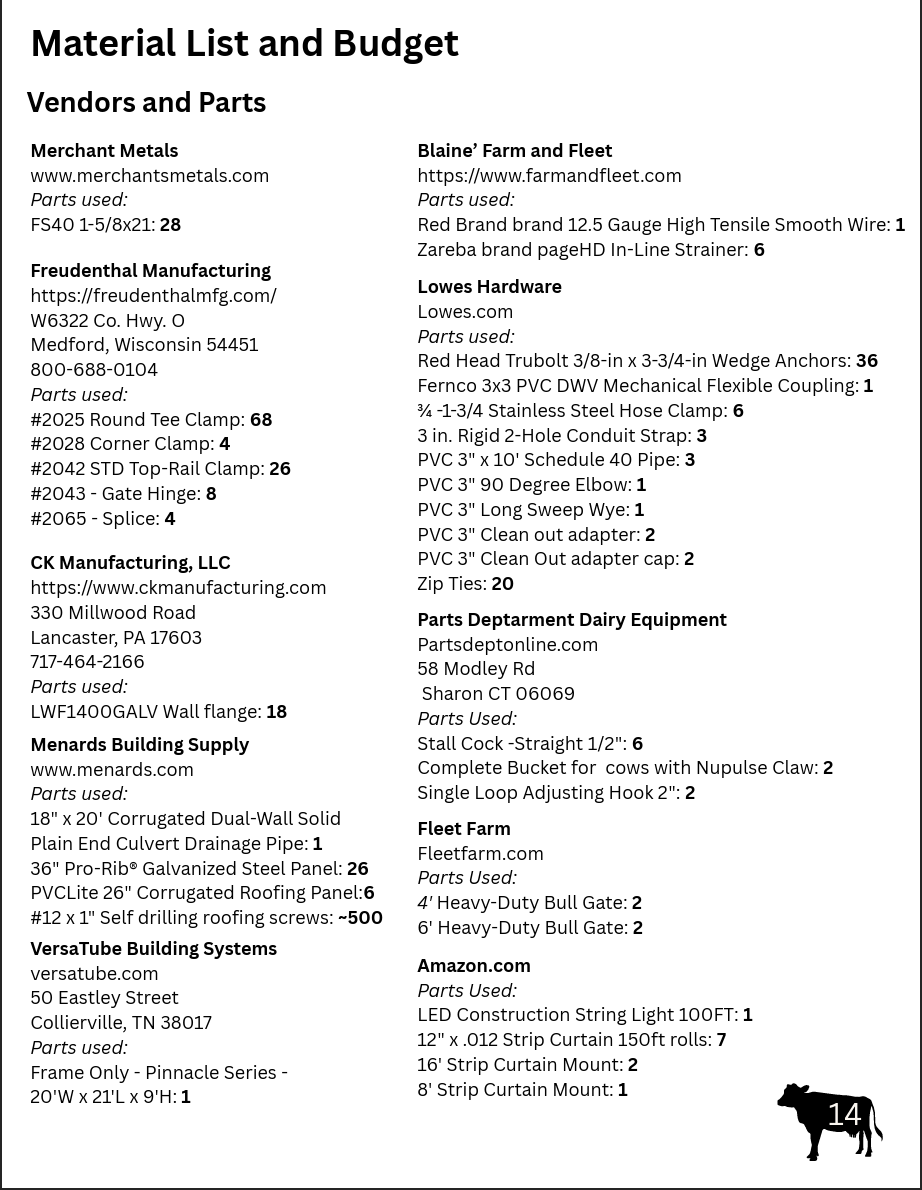
- Selecting vendors for parts that are accessible to all farmers (rather than custom made or welded parts)
- Using tools that many farmers may already have or can easily and inexpensively get
- Documenting specifically with photos, a webinar and written descriptions parts of the build that can be confusing.
We constructed the design using that materials and documented the process. We compiled this research and the documented build into a guide and webinar that is now posted and available for free online so farmers can access it.
We used published information from three main sources for this project:
- "The TRANS Iowa Low-Cost Milking Parlor Design: Transitioning Your Iowa Dairy for Future Profit and Quality of Life" The TRANS Iowa Low Cost Milking Parlor developed by Larry Tranel of the Iowa State Extension is a swing style parlor that is meant to be installed as a complete system. The design allows for milking 10 cows per side to accommodate large cow numbers, and covers critical details to increase cow flow through the parlor.
- “You, too, can have a parlor” written in the April 2001 issue of “Graze” magazine. Vance Haugen, Wisconsin Agricultural Extension Agent in Crawford County (Retired), has produced multiple articles and videos on low cost milking facilities. He has personally designed and helped construct low cost swing parlors for 60 farms. He is a champion of keeping costs low and the parlor ergonomic.
- “Remodeled Parlors” David W. Kammel David W. Kammel, Professor Biological Systems Engineering Department of the University of Wisconsin at Madison, has conducted research and produced design publications utilized by both the Trans Iowa design and the work of Vance Haugen. In his work titled “Remodeled Parlors” he describes in detail different types of milking facilities.
These experts in the dairy field have produced facility designs that have been thoroughly tested for efficiency and safety.
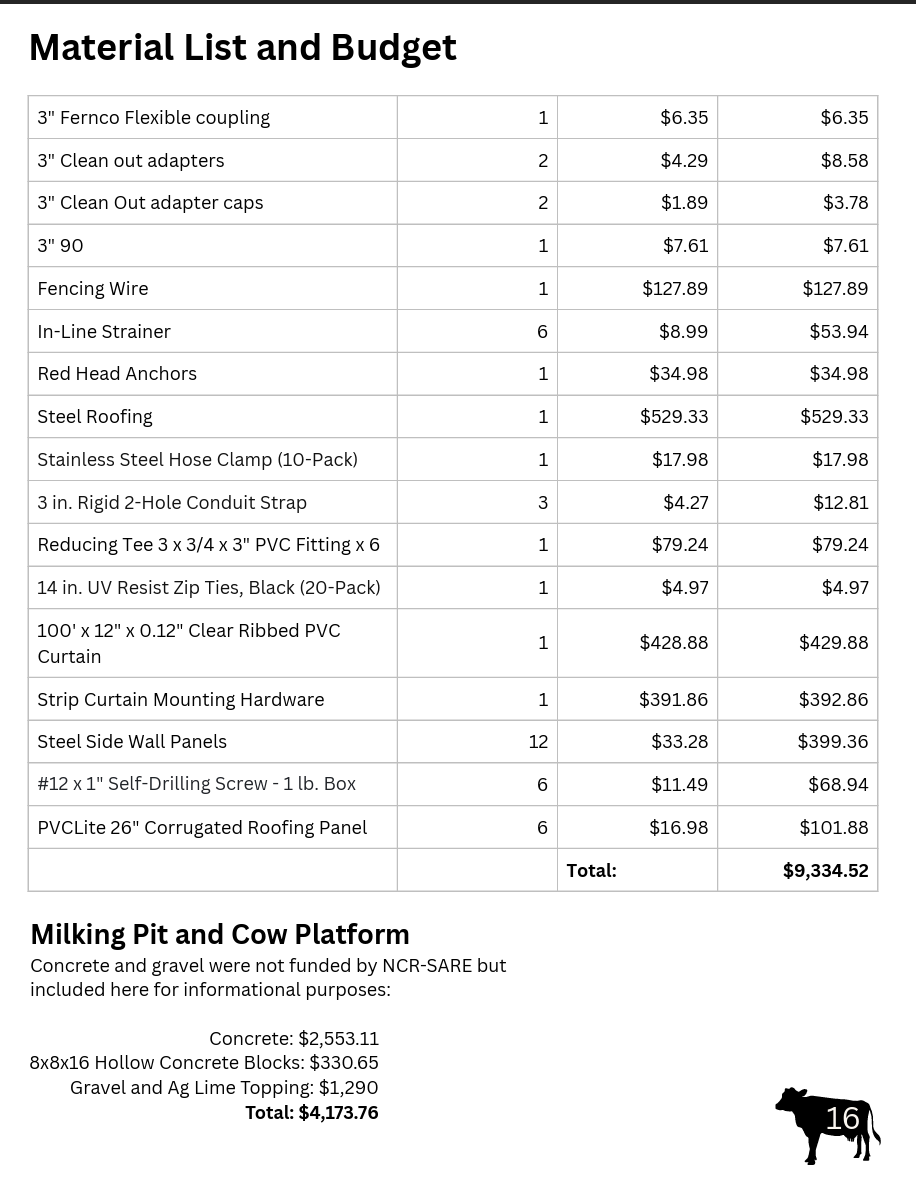
Our objective was to create a guide that is easy to follow for farmers on a budget with limited construction experience. Included in the guide is the total materials budget which we aimed to keep under $10,000, the total ended up $9,334.52 so we were successful in that goal. The guide is published online and accessible for free for farmers along with a detailed explanatory webinar where we go in depth on how decisions were made and describe some of the more difficult aspects of the project.
This guide is has been created for aspiring grass-based sustainable dairy farmers in need of a concrete plan to get started. Farmers can build the parlor at a low cost on rented land, easing the land access barrier - widely known to be the biggest concern facing beginning farmers. Please research the design of your own parlor accordingly as we take no responsibility for your actions or guarantee the parlor in the guide will work for your particular situation. The swing style parlor is a well-researched and popular milking facility design particularly in New Zealand on grazing-based dairy systems. It has been slowly rising in popularity in the US due to the contribution of University funded research.
The 72-page guide includes sections on:
- Background Research and visits to farms with systems that informed our parlor
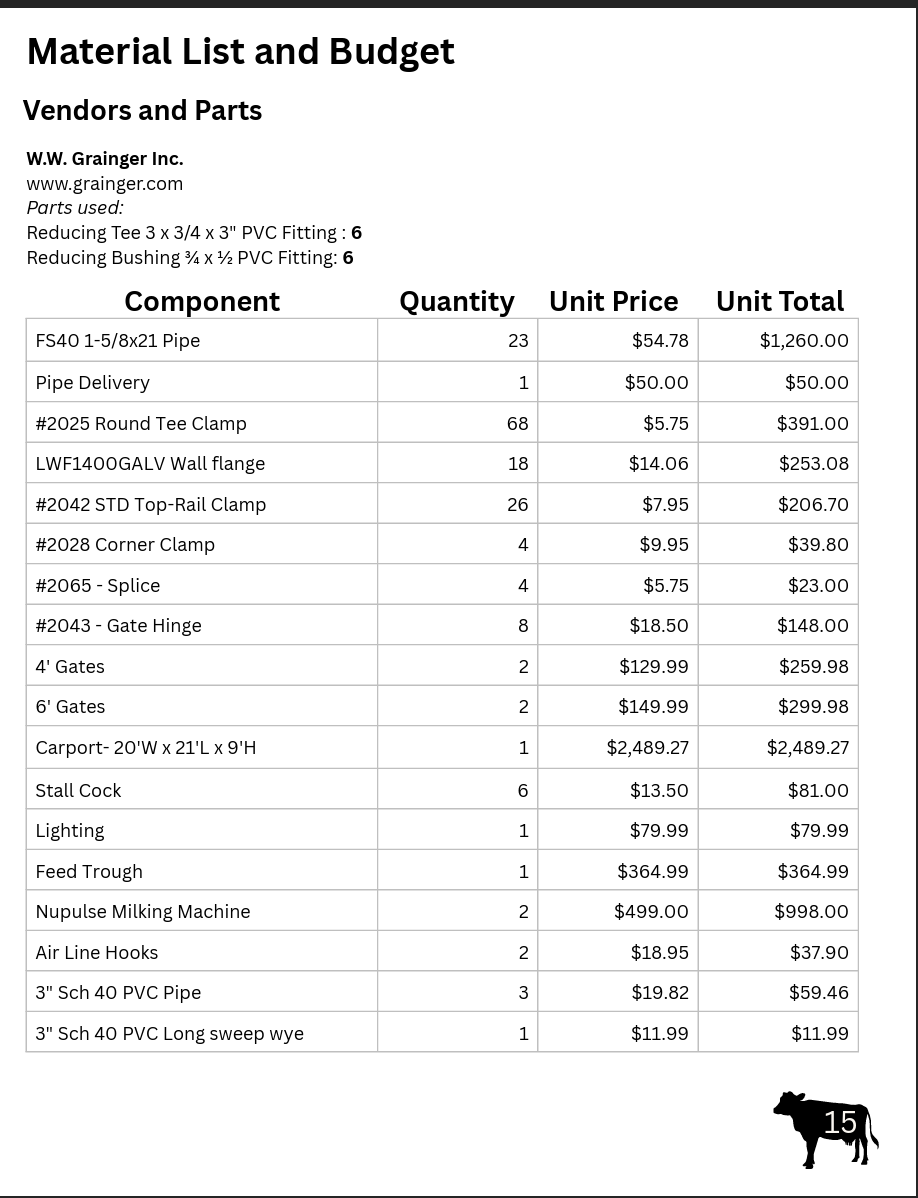
- Material List and Budget
- Cut List
- Material and Layout
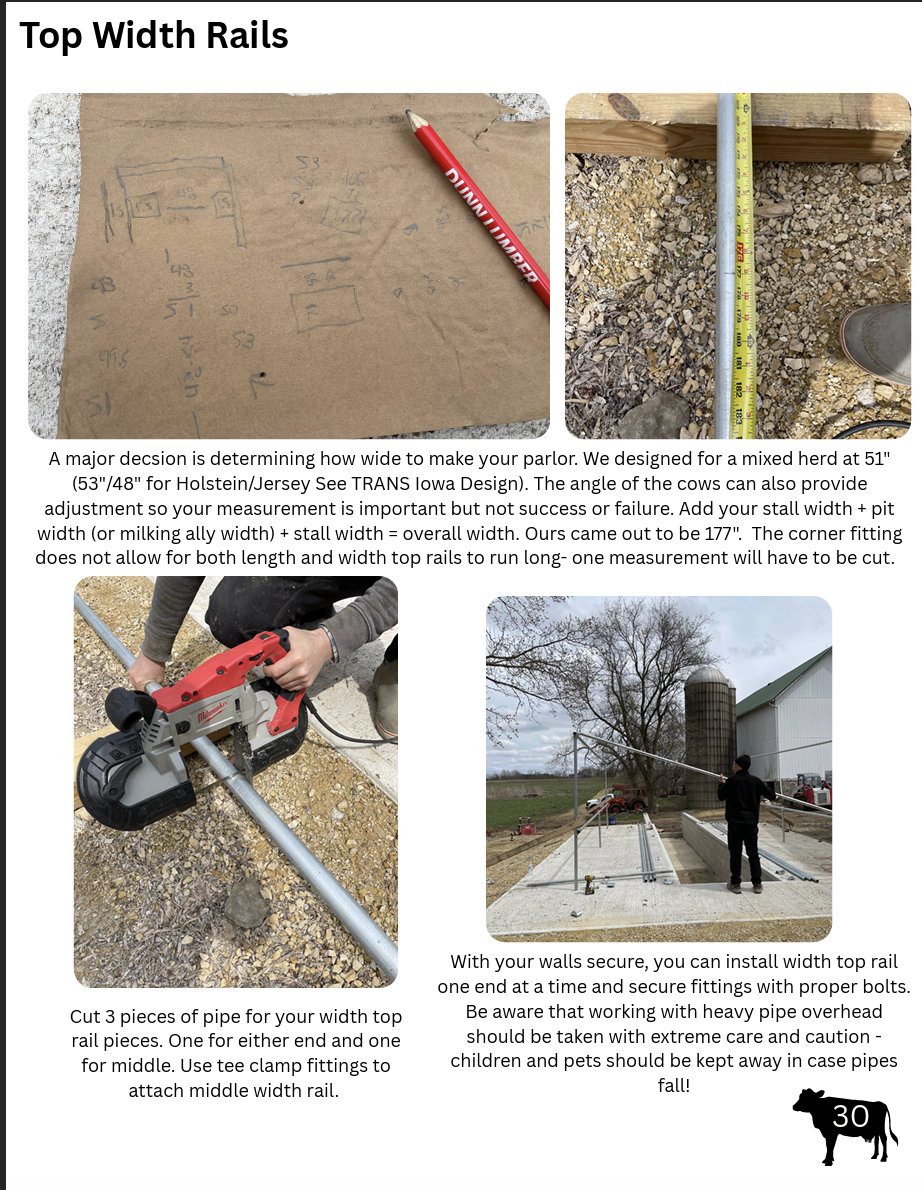
- Step-by-step directions, with photos (example below), for Cutting Pipe, Building Parlor Walls, Standing Walls Up, Making Rump and Kick Rails, Feed Trough and Support Frame, Anchoring to Foundation, Entry and Exit, Shelter, PVC Vacuum Line and Milking System, Lighting, and more
- Additionally downloadable spreadsheets that can be used for financial projections are also available to download with the guide.
The guide includes a 5 year Pro Forma using this parlor. The purpose of these sheets is to aid in projecting 5 year farm finances. The sheets allow for you to input custom values for things such as numbner of cattle, estimated costs, and initial investment in infrustructure. The sheets will help you to estimate projected revenue as well as cost and to see what the next five years might look like for your farm.
As far as we can find a guide of this type detailing the construction did not previously exist.
Educational & Outreach Activities
Participation summary:
We created a resources page on our website to host the three items we created 1. The PDF guidebook, 2. The downloadable financial spreadsheets, and 3. The webinar. We have shared the resources page with farmers who helped on the project. We are planning to share this page as a resource to the Illinois FarmLink.
Learning Outcomes
What we learned from this grant was how to build a low cost milking parlor using basic tools and without advanced building techniques. There are plans, videos, and webinars online showcasing low cost parlors but very little information on how to actually build one. This has affected our farm operation because now we have an actual low cost DIY milking parlor that can be used and can demonstrate that building a parlor on a budget is attainable for farmers - even on rented land. This is a particularly meaningful milestone as we farmed on rented land for a long time and know it is the case for many beginning farmers and ranchers. It is a functional research site that farmers can potentially visit and can see that it works and may potentially help their farms and businesses. I think the biggest advantage of implementing a project like ours is that our guide can be used to build a parlor. It is not theoretical or purely academic, it's a step by step guide book a novice builder can follow to build a low cost, efficient, safe milking facility. I would tell other farmers to follow the steps taken in our guidebook and they will be successful in building their parlor.
Project Outcomes
Within our guide and webinar we address many future recommendations.