Final report for FNC24-1429
Project Information
The farm is a small family farm in central Iowa used to grow corn, soybeans, and hay. The soil of the area involved in SARE research is loamy with moderate drainage, neutral slope, high fertility, and has been used in standard chemical intensive corn and soybean rotation for decades.
In April 2024 chestnuts and other perennials were planted in 8 acres of a former corn and soybean field which had been planted with cereal rye as a cover crop. The chestnuts were provided by Canopy Farm Management as bare root saplings. They were planted by hand, protected against pests and weather with a 5' tree tube and stake from Plantra, mulched with woodchips, and regularly irrigated by drip irrigation once per rainless week .
Before receiving this grant, several non commercial sustainable practices were done by Tom Peterson. Native trees such as oaks, cottonwoods, and willows, and fruit trees such as cherries, peaches, and apples were grown in many non field areas of the farm. Invasive plants such as thistle, parsnip, and honeysuckle were regularly and thoroughly removed. Working with DNR forester Joe Herring, a forest stewardship plan was developed for the adjacent woodlot, and several invasive plants and honey locust trees were removed to make way for native trees.
Steady slow irrigation is generally the most optimal for plant growth, plant health, soil health, erosion control, and other agricultural aspects. Unfortunately the weather rarely rains in a steady slow stream; instead, plants are frequently stressed or killed by too much or too little water. Too much water can be somewhat controlled by cover crops and buffer strips, but these techniques are not widespread and can take time and money to develop. Too little water can be somewhat remedied by irrigation, but current irrigation methods can be expensive, complicated, and require large amounts of water.
Our specific application required providing regular moderate amounts of water to newly planted young chestnut trees. Current irrigation techniques are generally designed for high density gardens or annual crop fields, but commercial tree planting is done at large scale and low density (tens of trees per acre). These tree plantings are better modeled as discrete points that require water, rather than an entire field that requires uniform irrigation. Thus most trees are watered by hand using water from hoses and buckets with small holes to slowly drip water into the ground, or with custom irrigation setups grafted onto existing irrigation systems.
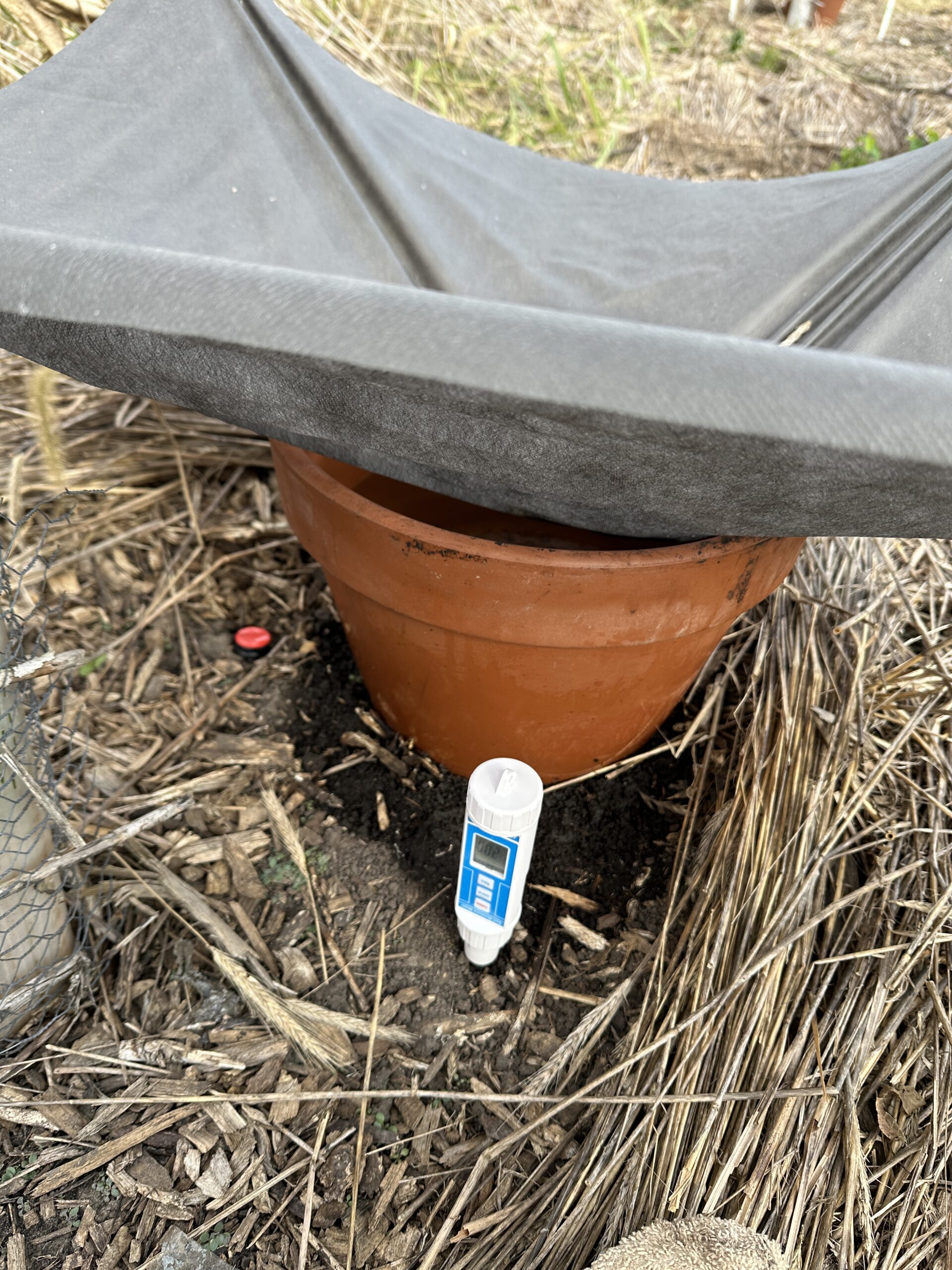
Our solution was clay pots with rain and dew catching sheets. Pots have been used for thousands of years as irrigation containers whose clay walls slowly transfer water from the pot to the surrounding soil, autoregulate by increasing irrigation in dry soil and decreasing irrigation in wet soil, provide water more directly to roots, and can be easily filled by hand. Rain and dew catching sheets were cut in 3 foot squares secured and supported by four poles, with one pole at each vertex of the square, to form an inverted pyramid which rain and dew trickled down the sides of to be collected in the pot.
Our research did not provide strong conclusions but did suggest beneficial practices and potential further areas of study. The containers and water catching sheets did measurably reduce soil moisture loss over time, but frequently had minor problems and irregular data. The containers and water catching sheets did not measurably impede or promote normal growth of the trees as compared to averaged growth of all other trees in the field.
There were no local farmer adoption actions. In different environmental settings, with infrequent heavy rains, high daily temperature variation, mild winds, sandy soil, and easy access to materials, these systems may be beneficial.
The trials of this research project will use different configurations of pots and water collectors to maximize data gained, minimize costs, and quantify the influences of the many variables. Cylindrical pots will be buried an inch deep near a tree. Water collectors will be 3 foot squares that are secured and supported by four 2 foot high poles, with one pole at each vertex of the square, and a weight in the middle, to form an inverted pyramid which rain and dew will trickle down the sides of to be collected in the pot. A hole will be made in the sheeting to fit the tree into.
A majority of the pots and water collectors will provide an experimental baseline. The other trials will provide comparisons with modified configurations with an additional dew condenser, no water collector, and a small barrier designed to direct water flow more primarily towards the tree.
2 plastic pots impermeable to water and with water collectors will be used as controls for rain and dew to measure these as the water will be partially absorbed and distributed in the trials.
For controls we will measure the soil moisture of nearby areas of mulched trees without pots.
Rainfall will be measured locally using a rain gauge.
Our objective is to demonstrate the viability of pots with water collectors by measuring irrigation rate, dew collection rate, and soil moisture dispersion rate in a wide variety of trials, control configurations, and weather. The data will be collected during the growing season of second half of April to October, and analyzed and disseminated during the dormant season of November to first half of April.
Research
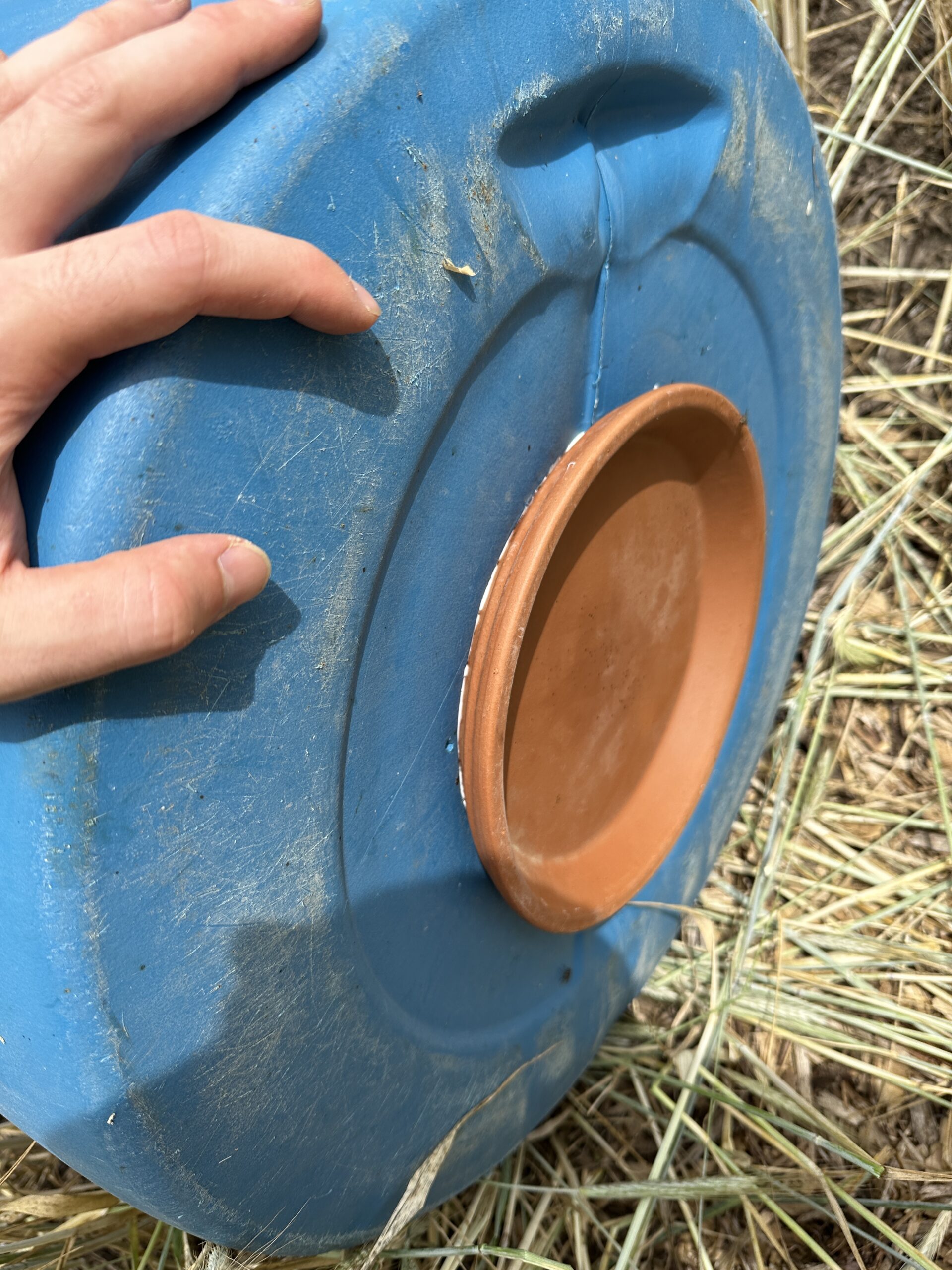
Clay pots of the intended dimensions were not commercially available, and couldn't be easily or cheaply custom made. Smaller clay pots with drainage holes were available but more expensive than anticipated. As a compromise, some smaller clay pots were purchased and their holes were sealed with a small piece of HDPE and silicone caulk, and large barrel containers were made by cutting a used standard 55 gallon HDPE plastic barrel in half, cutting a hole in the base of each half, and sealing the hole with a clay saucer secured with silicone caulk. The barrel half was oriented with the clay saucer in the soil and the open end pointed up.
The clay pots and the barrel's clay saucer were both placed only about an inch within the soil. This was done to save time and labor for installation and removal for winter, and to reduce soil disruptions for the growing trees.
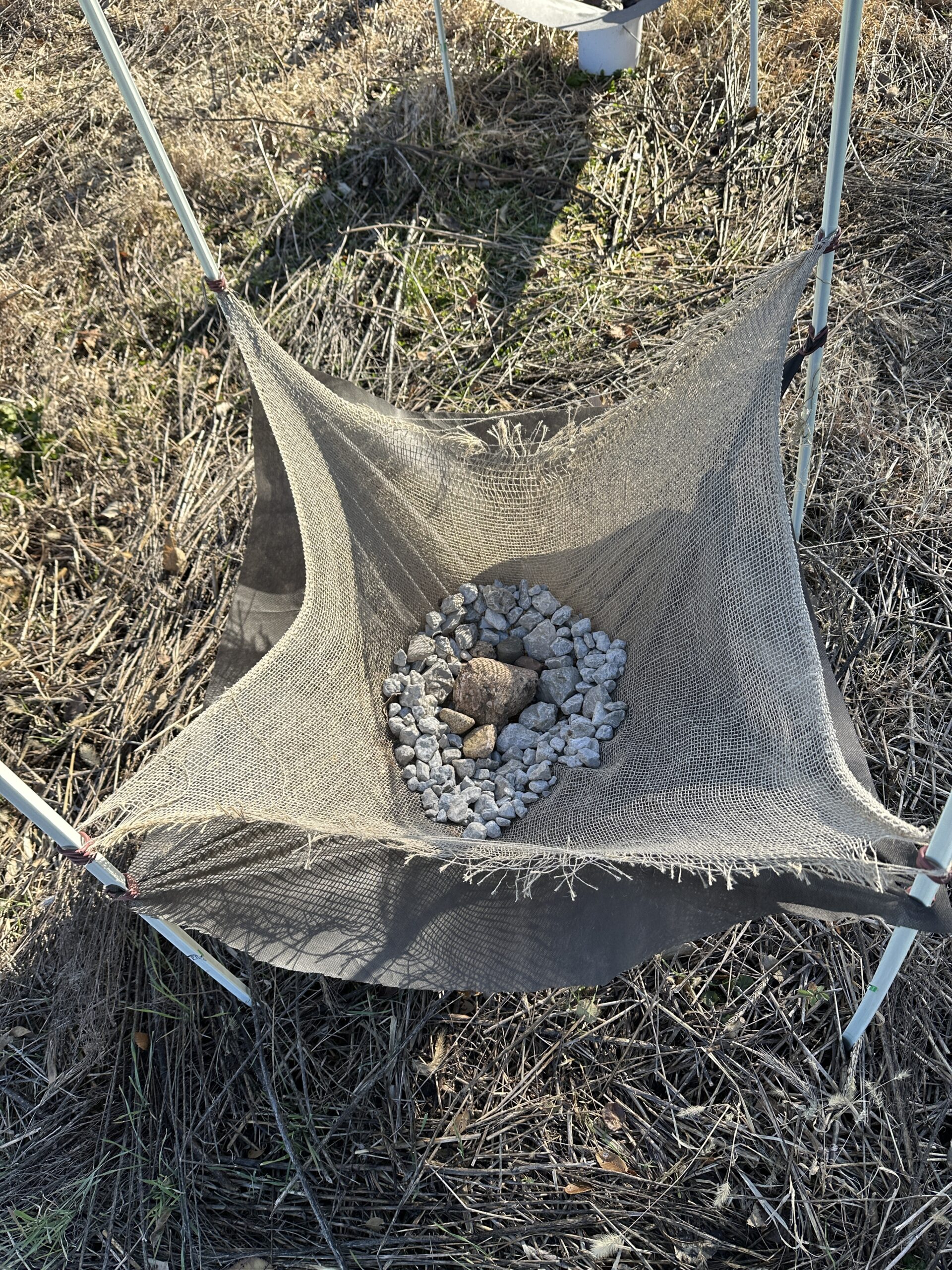
The thick plastic sheeting intended to catch rain and dew in the field was not used in 2024 because of the lack of rain, but a section used for set up and testing became brittle and began to break into pieces, probably because of ambient UV radiation. In 2025, sheeting composed of solid fabric weed barrier and woven burlap fabric was used for both rain and dew collection. After negligible dew collection from the sheeting, other methods were improvised to increase surface area for the dew to deposit on. These included using two sheets, modifying the angle of the sheets, and layering gravel within the sheets, similar to traditional farming practices done by the Zuni and other indigenous peoples in the southwest.
Rain was measured using an onsite rain gauge.
At about 0900 at each site, water levels within the containers and soil moisture probe readings were recorded using a Lutron Soil Moisture Meter PMS-714 designed to measure at a depth of about 7.5 inches. Two soil sites equidistant from the container were probed and averaged to obtain the soil's water percentage. After probing the resulting soil site cavity was covered by a bottle cap to reduce environmental variables.
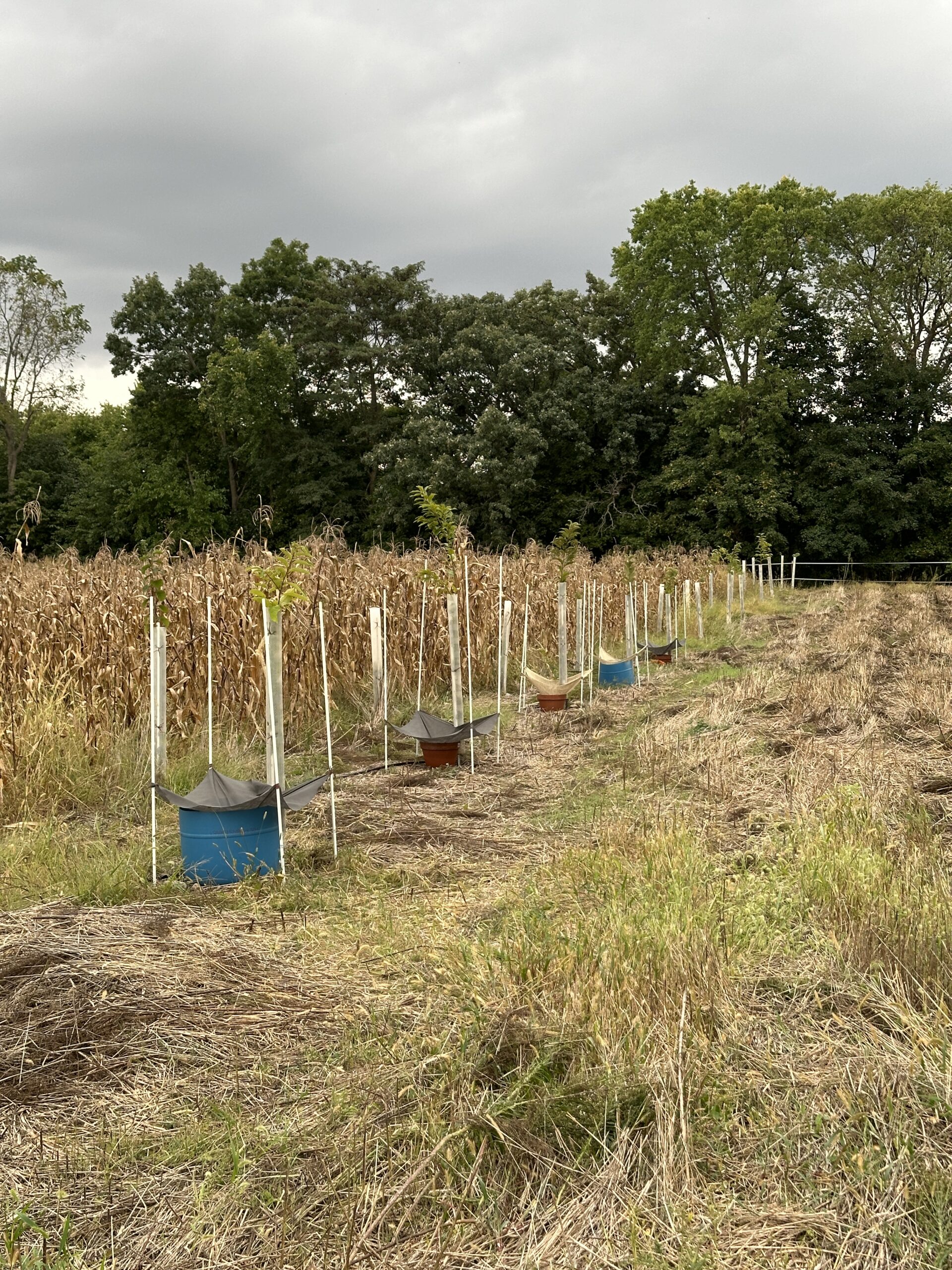
Tree height across the entire field was roughly recorded using a marked ten foot pole in early spring 2025 and late fall 2025. Dead or stunted trees with height of less than two feet were not included for height analysis.
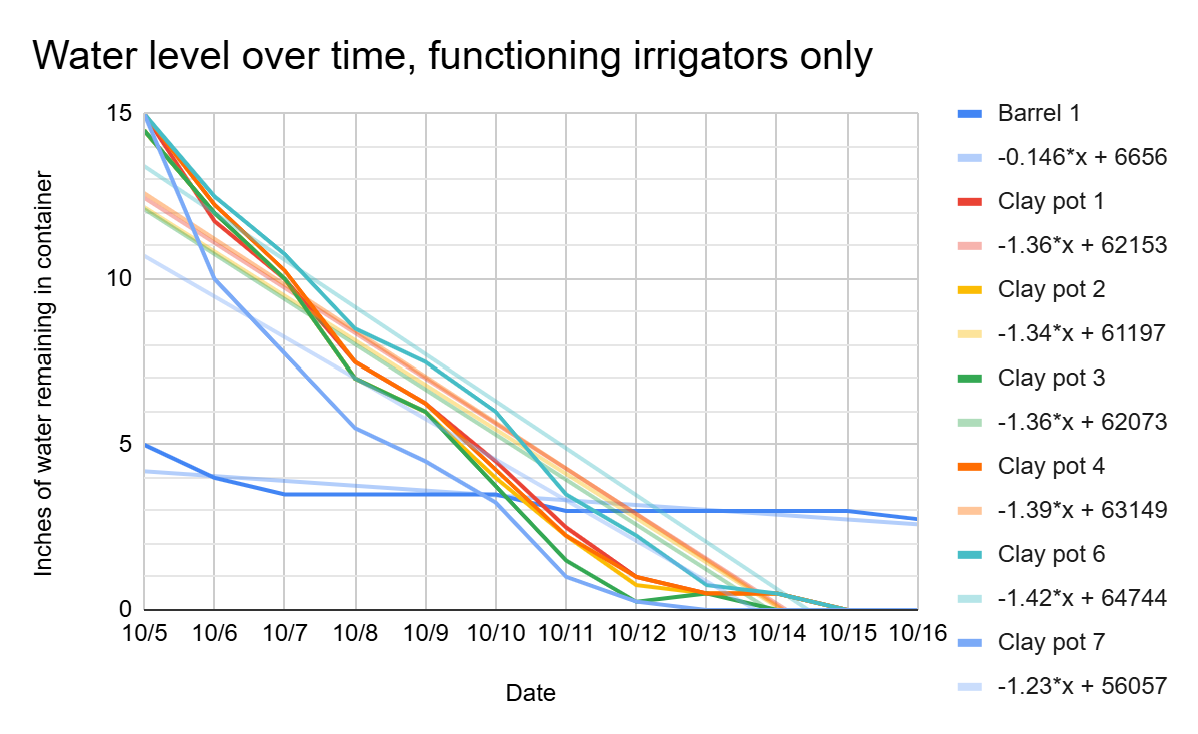
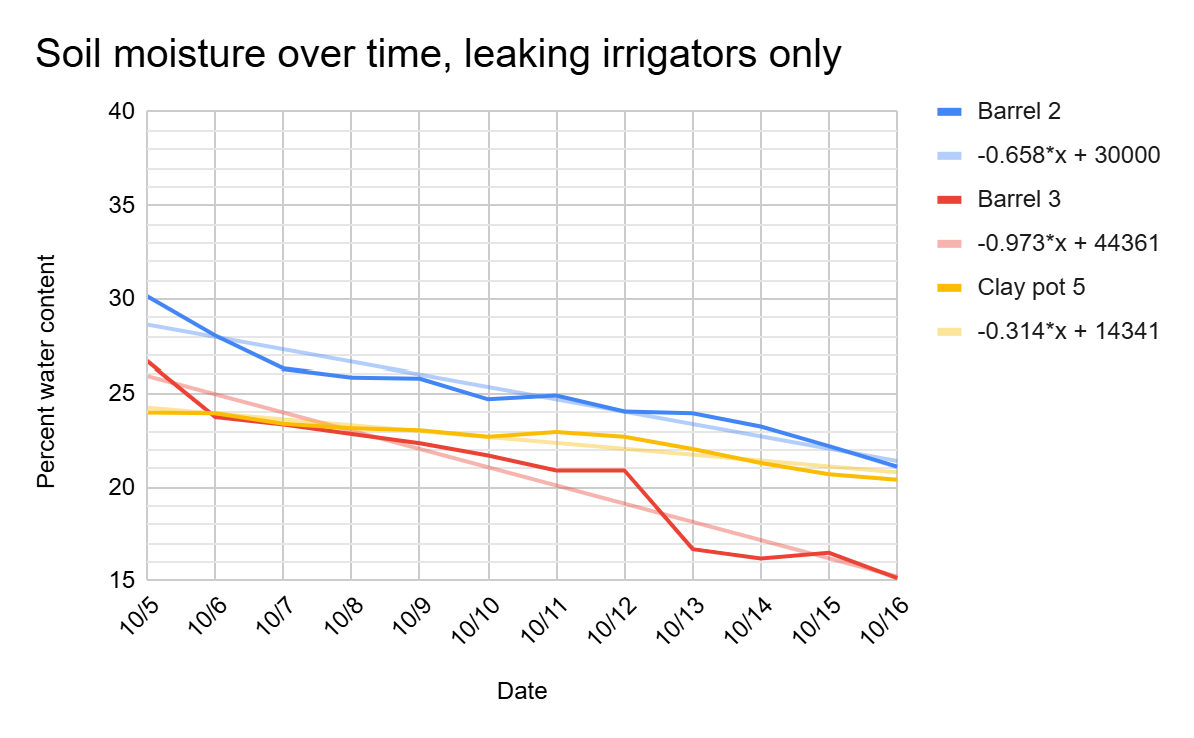
In 2024, a field trial was conducted to test the functionality of the irrigators and determine the rate of water distribution into the soil. Ten containers were deployed and each initially filled with about three gallons of water. No additional water was added, and no rain fell during this time. The containers were topped with heavy pieces of wood to prevent wildlife interference. Three of the ten irrigators leaked all their water after the first day, but thereafter served as unirrigated control sites.
Of the seven non leaking irrigators, four produced data that fit decently well with a linear trendline (average slope -0.32 with std dev 0.15, average R squared of 0.77). Three had large outliers that did not fit well with a linear trendline (average slope -0.83 with std dev 0.33, average R squared of 0.47). The leaking irrigators fit very well with a linear trendline (average slope -0.65 with std dev 0.38, average R squared of 0.92). Finally the water levels of the non leaking clay pots fit very well with a linear trendline (average slope -1.35 with std dev 0.06, average R squared of 0.9).
The reduced soil moisture loss -0.32 for the non leaking irrigators vs -0.83 for the leaking irrigators suggest water moving effectively from the container to the soil and / or the container blocking soil moisture loss from sun and wind.
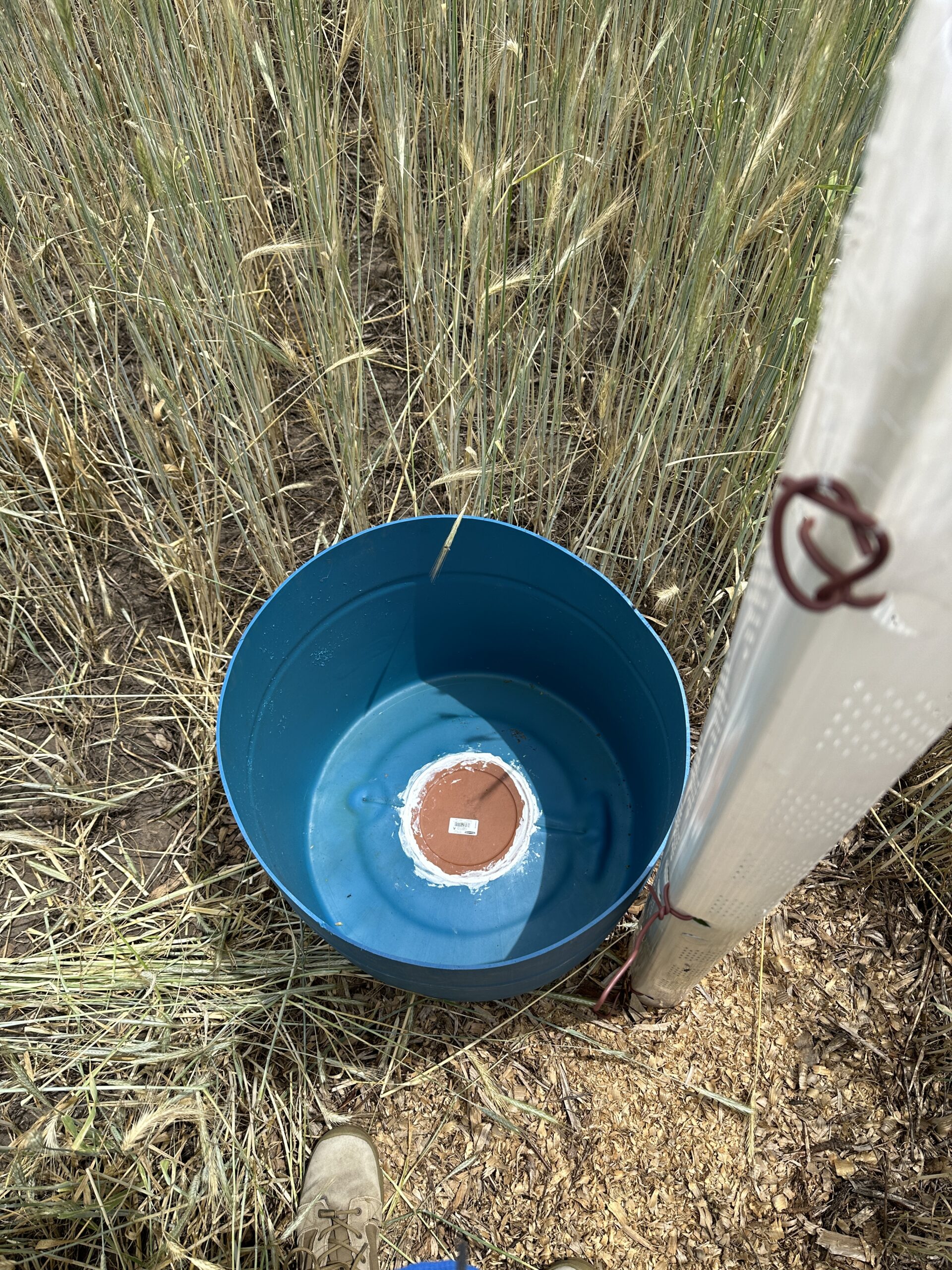
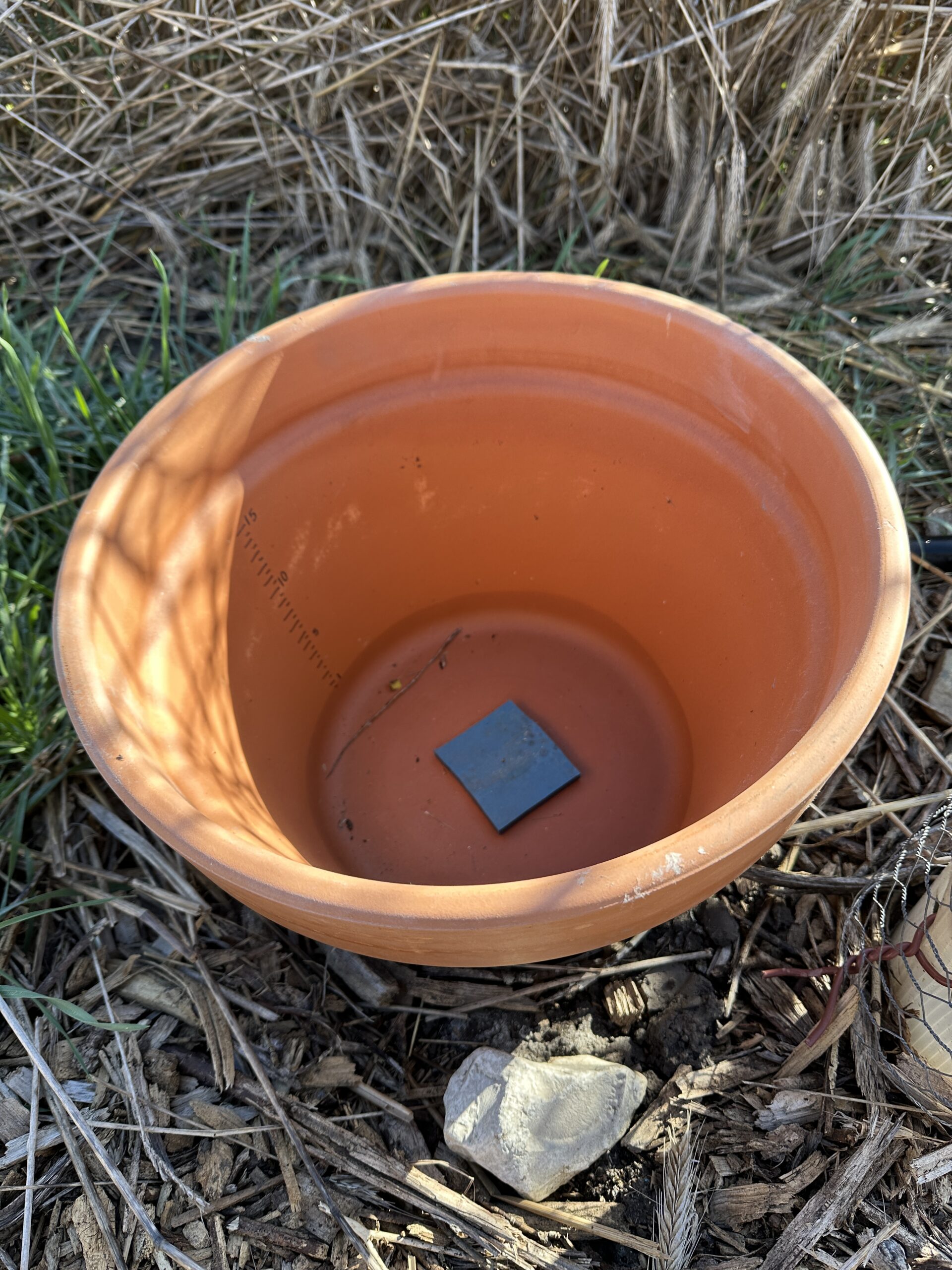

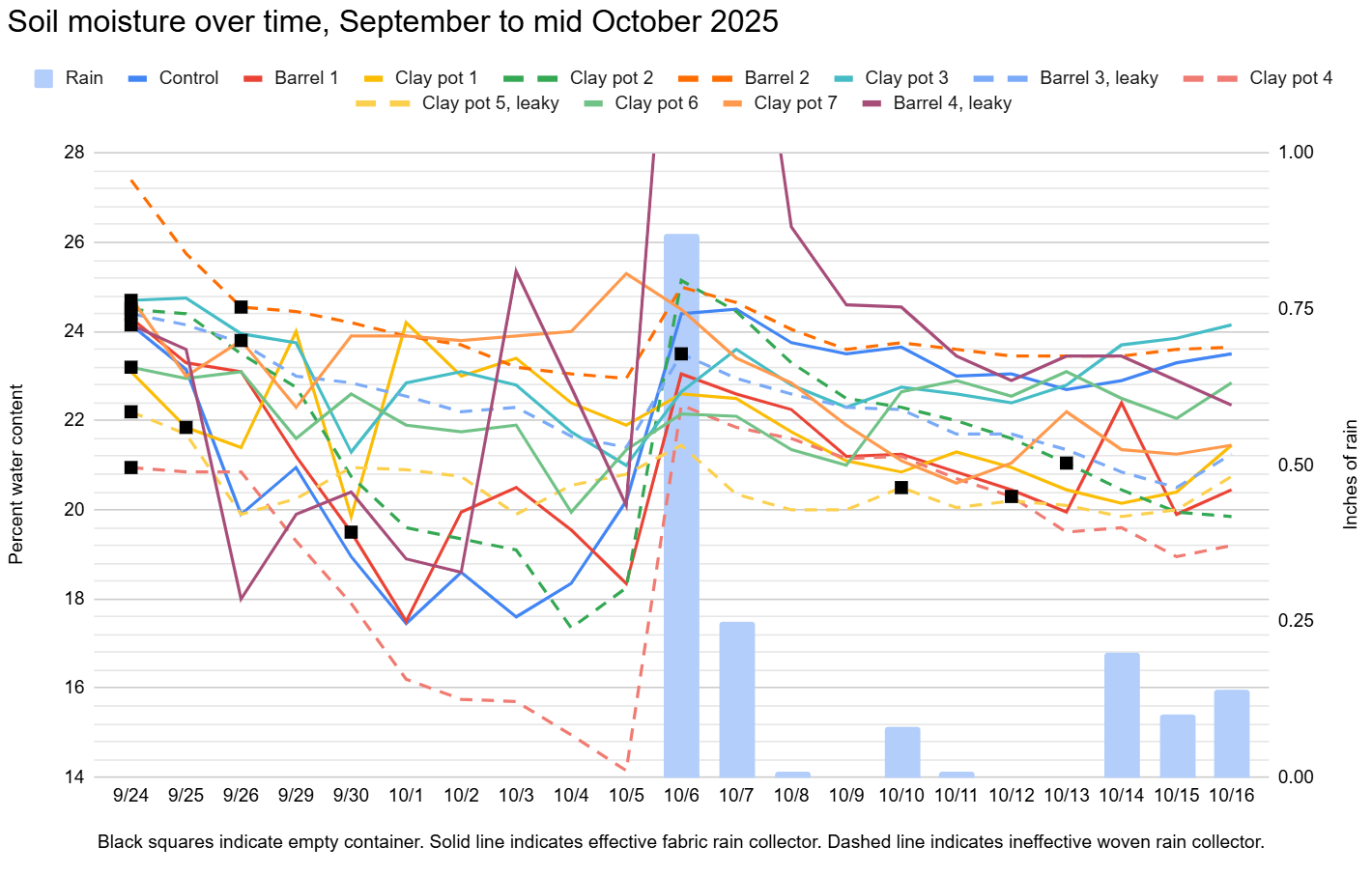
In 2025, one additional container along with the same ten containers were used for irrigating the trees. They were fitted with the water collection sheets. Two plastic impermeable containers measuring dew and rain collection were also set up. A control site at the base of another growing tree a few feet away from the containers had its water percentage data collected as well. No initial water was provided, although some was leftover in one of the containers from previous rain.
| Site | Container integrity | Water collection sheet | 9/24 to 10/5 soil moisture slope when empty container | R squared | 10/6 to 10/16 soil moisture slope when water in container | R squared | Determination |
| Control | None | None | -0.45 | 0.58 | -0.13 | 0.53 | Possible local minimum |
| Barrel 1 | OK | Effective | -0.5 | 0.74 | -0.24 | 0.52 | OK |
| Clay pot 1 | OK | Effective | 0.09 | 0.05 | -0.18 | 0.57 | Outlier |
| Clay pot 2 | OK | Ineffective | -0.67 | 0.95 | -0.66 | 0.94 | Possible impermeable container |
| Barrel 2 | OK | Ineffective | -0.21 | 0.91 | -0.12 | 0.6 | OK |
| Clay pot 3 | OK | Effective | -0.29 | 0.72 | 0.11 | 0.31 | OK |
| Barrel 3 | Leaky | Ineffective | -0.26 | 0.99 | -0.26 | 0.91 | OK |
| Clay pot 4 | OK | Ineffective | -0.67 | 0.96 | -0.32 | 0.97 | OK |
| Clay pot 5 | Leaky | Ineffective | -0.09 | 0.24 | -0.23 | 0.36 | Outlier |
| Clay pot 6 | OK | Effective | -0.21 | 0.69 | 0.1 | 0.25 | OK |
| Clay pot 7 | OK | Effective | 0.16 | 0.34 | -0.25 | 0.5 | Outlier |
| Barrel 4 | Leaky | Effective | -0.08 | 0.01 | -0.39 | 0.77 | Outlier |
Their collected data was difficult to interpret. After the rain most containers slowly lost their water over time. Barrel 3 and barrel 4 leaked any gained water almost immediately. Clay pot 5 also leaked all its gained water after one or two days. Barrel 3 and clay pot 5 leaking agree with 2024, but barrel 2 leaked in 2024 and did not leak in 2025. It would be expected the leaking containers would have soil moisture data similar to each other and the control site. However they differed significantly with very low R squared values except for barrel 3.
In the ten days from 9/24 to 10/5 without any water input, it would be expected all sites would show similar negatively sloped soil moisture data, with perhaps some reduced loss because of large barrels or effective collection sheets blocking sun and wind. However values had very little similarity to each other, with an average daily slope of -0.27 with absurdly high standard deviation of 0.27. Clay pot 1 and clay pot 7 showed a positive slope indicating gaining soil moisture despite no additional water. For this reason they were labelled as outliers with data too heavily influenced by their environment. Control had a positive soil moisture slope on 10/4 and 10/5, before any water input, suggesting it may be a local drainage site receiving water from the rest of the field, and is very heavily influenced by its environment.
In the ten days from 10/7 to 10/16 after a large rain input, all sites have increased soil moisture except clay pot 7. It would be expected soil moisture data from all sites would return to similar negative slope after their containers were empty. However values had very little similarity to each other, with an average daily slope of -0.21 with absurdly high standard deviation of 0.21. Clay pot 5 and barrel 4 had greatly increased negative slope despite leaking all their water almost immediately. For this reason they were labelled as outliers with data too heavily influenced by their environment. Clay pot 2 had increased soil moisture but did not show any change to its soil moisture slope despite having water, suggesting its water was not passing into the soil effectively or another environmental mechanism was removing the water it was providing.
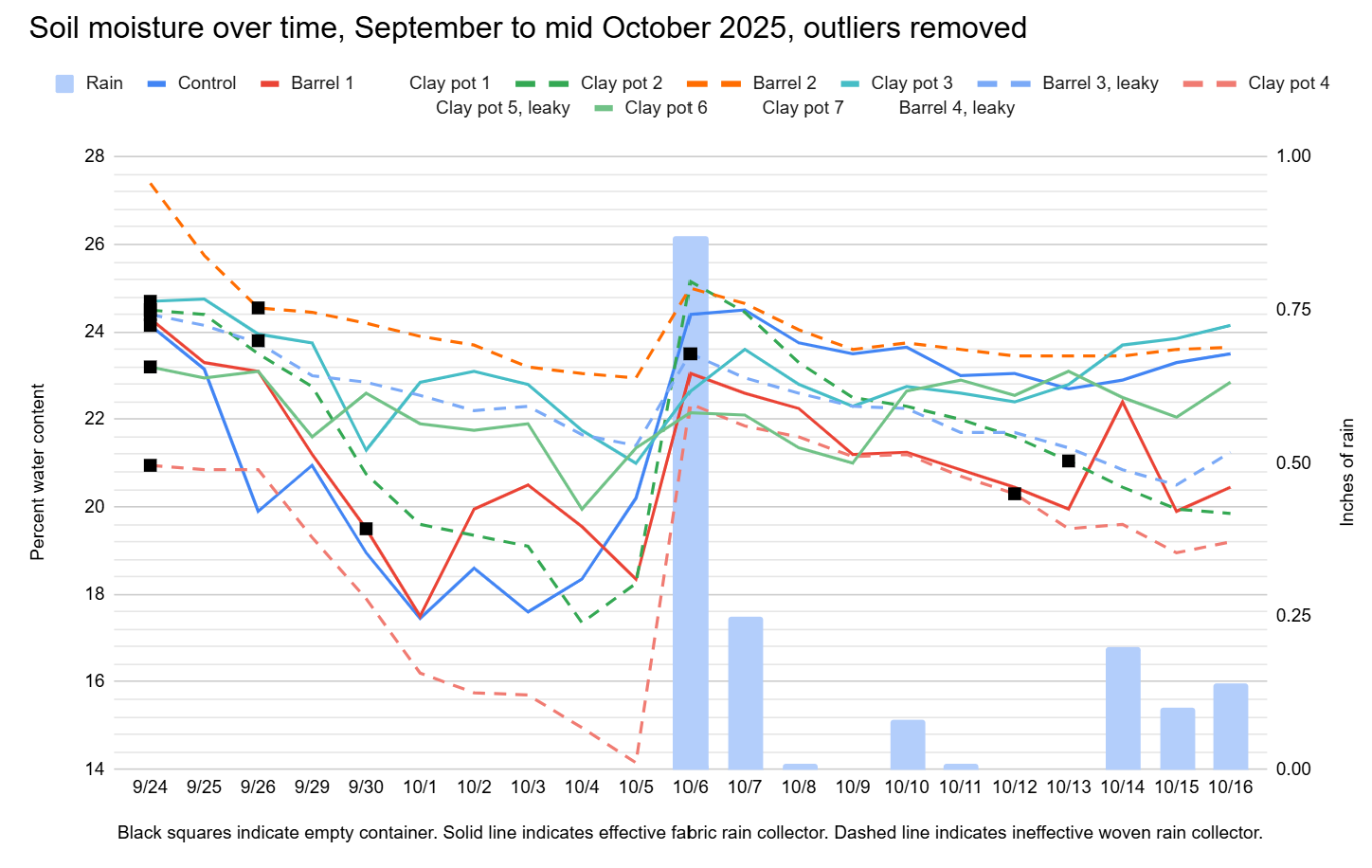
Removing the outliers provides an average daily slope prior to rain of -0.41 with standard deviation 0.19. After rain, the average daily slope of the control site was -0.13, and the average daily slope of the test sites was -0.2 with high standard deviation of 0.27. These data are strongly driven by clay pot 2; its removal reduces the average daily slope to -0.12 and standard deviation of 0.19. High standard deviation may be expected as each container has different physical properties, soil structure, and location. The high reduction of the average daily soil moisture slope suggests the containers are effectively providing water to the soil.
Comparing non outlier data of barrels against pots, prior to rain barrels had average daily slope of -0.32 with standard deviation 0.16 and pots had average daily slope of -0.46 with standard deviation of 0.24. This suggests the barrels are more effective at reducing soil moisture loss over time simply because they are much larger than the pots. After rain barrels had average daily slope of -0.21 with standard deviation of 0.08, or -0.18 with 0.08 if barrel 3 is excluded, and pots had average daily slope of -0.19 with standard deviation of 0.37, or -0.04 with 0.25 if clay pot 2 is excluded. This suggests both containers are effectively providing water to the soil, but that pots are more effective.
Comparing non outlier data of effective fabric barrier sheets against ineffective burlap weave sheets, prior to rain fabric had average daily slope of -0.33 with standard deviation 0.15 and burlap had average daily slope of -0.45 with standard deviation of 0.25. This suggests the fabric is more effective at reducing soil moisture loss over time simply because it is a solid barrier that helps block direct sun. After rain fabric had average daily slope of -0.01 with standard deviation of 0.2, and burlap had average daily slope of -0.34 with standard deviation of 0.23, or -0.22 with 0.14 if clay pot 2 and barrel 3 are excluded. This suggests a similar effect to dry conditions. After rain non leaky clay pots with fabric had average water gain of 14.25, and non leaky clay pots with burlap had average water gain of 5.5, as measured by regular interior markings. This suggests the fabric is very effectively diverting rain from the soil to the pot.
It would be expected non leaking sites would have a reduced increase in soil moisture after the rain on 10/6 as the containers and collection sheets divert and store the rain into the container, with perhaps some further reduced increase at the barrel and effective collection sheet sites. However the data were not similar and did not follow any expected patterns or values.
The solid fabric weed barrier worked very well for collecting rain. It was easy to set up, but difficult to secure against even the relatively mild winds of September and October. Its shade could contribute to reduced weed growth around the tree, although this was not measured. It was qualitatively noted in early November that cover crop and weeds were sprouting more vigorously under the barrier, possibly because the barrier prevented exposure to the night sky and thus kept the soil warmer than surrounding areas.
The woven burlap fabric worked poorly for collecting rain, but it was easy to set up and mostly immune to wind. As expected sites with woven burlap fabric collected less rain water and emptied sooner than sites with solid weed barrier.
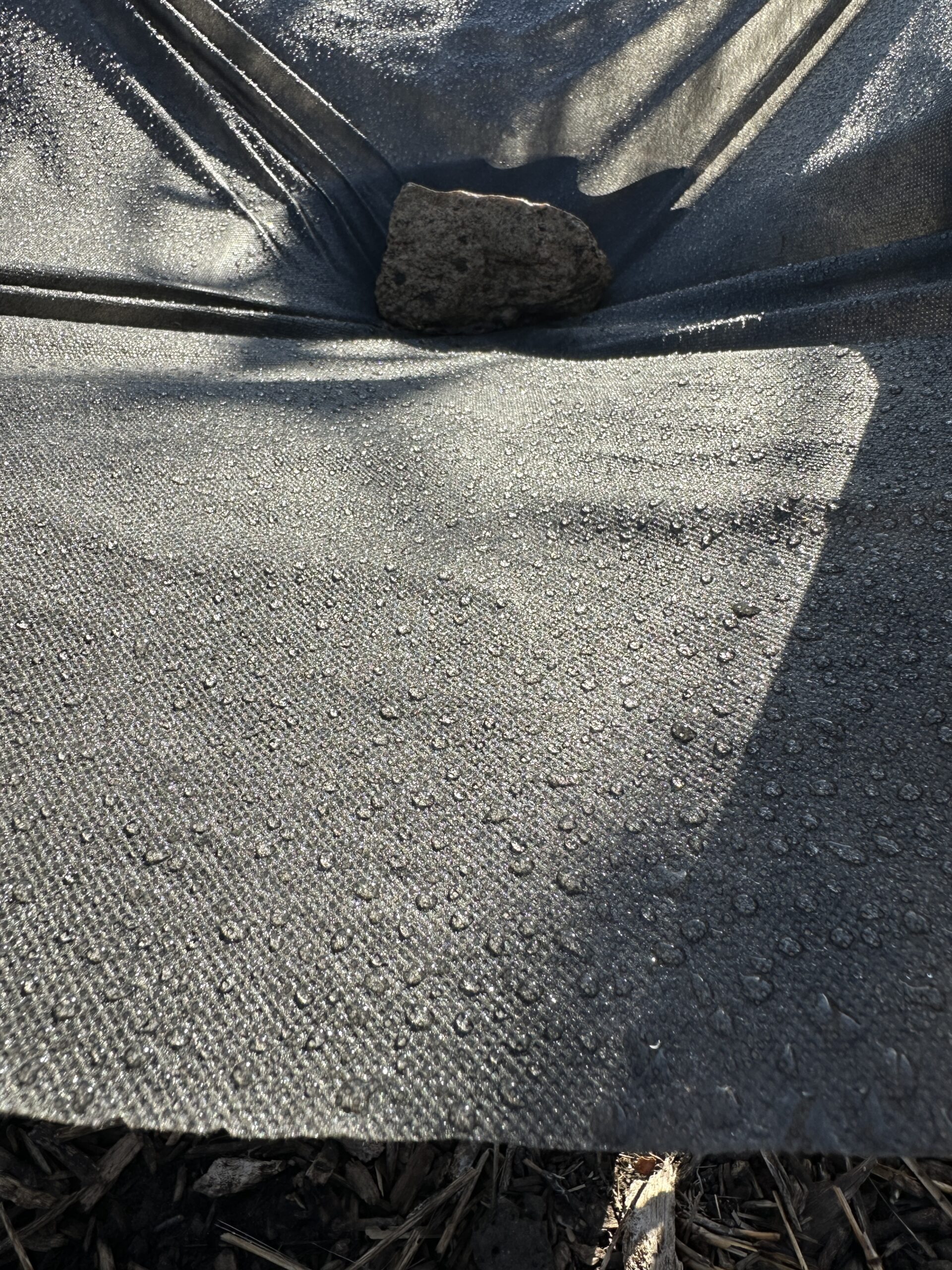
Measurable dew collection was a persistent challenge. Although dew drops were frequently observed on the collection sheets, these drops did not readily move into the container, and were probably evaporated by the morning sun. This occurred even with steeply angled collection sheets. Lightly tapping the collection sheets allowed the dew drops to roll into the containers. However the amount of water within the plastic containers on days without rain did not follow any clear signal; they were frequently empty or the amount of water was so small it was difficult to measure.
The eleven trees with the containers had slightly above average height of 87 inches compared to average height of 81 inches from the rest of the field. The eleven trees with the containers had average height gain of 43 inches which was equal to the average height gain from the rest of the field.
Educational & Outreach Activities
Participation summary:
2024: consultations between farmer Reuben Peterson and consultant Dr. Kapil Arora.
Learning Outcomes
When they worked, the containers appear to be effective collectors of rain and distributors of water. The pots required less labor, did not leak as often, and more effectively distributed water as compared to the barrels. Dew collection was not measurably done with any design. Heavy rain events that might provide data on the container's ability to reduce flooding did not occur during the data collection window.
The cost of the materials and labor are probably the biggest barriers to adoption. Each container cost about $30 and 60 minutes of labor. Frequently the system had minor wind damage and would require simple repairs. Several containers leaked all their water out within a day; this was probably caused by imperfect silicone caulk seals or cracks in the clay pots and saucers.
Although these containers did effectively reduce soil moisture loss over time, simply mulching the trees with free woodchips is a much cheaper faster technique that accomplishes the same thing with no plastic waste, improved aesthetics, improved soil nutrition, and improved wildlife habitat. Therefore this did not affect my farm operation.
Other farmers who have these materials on hand or are in a different environment with sandy soil and infrequent heavy rains may be interested in this technique.
Occasionally bugs and rarely mice were found trapped and drowned in the containers. Algae quickly grew in the containers while the weather was warm and when the containers were covered with a piece of wood to create a humid interior environment.
The trees did not appear to be significantly helped or hindered by the containers. However effects on tree growth and health may take a long time to manifest and were probably beyond the scope of this research.