Final report for FNC24-1430
Project Information
Dr. Petran founded Twin Cities Berry Company (TCBC) in 2018 as a research and production farm dedicated to increasing the Twin Cities' supply and access to healthy, locally produced fruit. TCBC is entering its seventh field season of production and Dr. Petran has been researching strawberry production techniques in the Upper Midwest for over 10 years, both at the farm and through his doctoral research at the University of Minnesota. TCBC operates out of a brand new farm property, located in Isanti, MN, purchased by Dr. Petran in August of 2023. Dr. Petran works on-farm full time and contributes approx. 75% of TCBC's total labor, with the remaining 25% contributed by seasonal employees. TCBC is located on a 15-acre property, but only actively farms less than 1-acre. The purpose of TCBC's research mission is to reduce the physical footprint of agricultural production, freeing up more land to be restored to native habitat (such as forest, prairie, wetland) and the superior ecosystem services they provide.
TCBC sells primarily at local farmers markets throughout the Twin Cities Metro, vending fresh local strawberries from June through October, in addition to a growing processed goods division, including jams, syrups, sodas, shrubs and fruit leather. Dr. Petran works closely with University and agricultural non-profits throughout the state and currently serves on the farmer advisory panel for the Land Stewardship Project effort to expand crop insurance benefits to small and specialty growing groups.
TCBC has created and implemented a methodology for affordable, climate-resilient, and high density strawberry production within modified caterpillar tunnel structures we call 'Fruit Factories' (FF) [Photos 1-3]. These techniques are geared specifically towards new and emerging farmers with limited access to land and/or startup capital. We have found FF production to provide:
- higher yields
- superior quality fruit
- lower total labor requirements compared to open field strawberry production, using a fraction of the physical space. Summary statistics of our 2023 field season, including yield and labor metrics can be found here.
For open-field strawberry pests looking to make their way into the tunnels (such as lygus and spotted wing drosophila), our previous SARE research has found netting to be even more effective than traditional spray regimens at controlling populations. However, volunteer pests(namely 2-spotted spider mite and thrips) often 'piggyback' their way into tunnels during planting. The hot and dry tunnel conditions are an ideal environment for unchecked infestation of these pests. The traditional control method for these pests are sprays such as Grandevo or Venerate. However, this practice is antithetical to the goal of many farmers (and of insect netting particularly) to eliminate the use of sprays on their farms. Our solution was to deploy beneficial insect Amblysius swirskii in several, distinct densities within separate production tunnels, compared to a traditional spray control. By doing this, we could determine which biocontrol density (if any) would be able able to match the efficacy of organic sprays for the control of several common pests. After the data collection, we could then run an economic analysis to determine the cost of matching spray control with biocontrol.
After 2 years of thorough data collection, we found that placing sachets of Amblysius swirskii on every plant within a tunnel provided spray-free control of spider mites and aphids inside tunnel environments at a similar (and sometimes superior) efficacy to traditional spray regimens. It cost $302.13 more per tunnel to achieve comparable suppression of spider mites and aphids using biocontrol techniques versus a traditional spray regimen. This extra cost should be considered when pricing the goods for sale.
Amblysius swirskii can be purchased in individual paper sachets, or in a shaker bottle, where they can be deposited loosely. Economically, we recommend the shaker option, making sure to cover each plant, as this method will reduce total application and cleanup time for the grower.
We compared the use of modern biocontrol techniques against sprays to investigate the potential of a true spray-free production environment.
OBJECTIVE 1- Compare the efficacy of utilizing beneficial insects vs traditional spray regimen for the control of 2-spotted spider mite and thrips inside tunnels for high-density strawberry production.
OBJECTIVE 2- Compare the economic impact of utilizing beneficial insects vs traditional spray regimen for the control of 2-spotted spider mite and thrips inside tunnels for high-density strawberry production.
EXPERIMENTAL DESIGN
The investigation took place within four caterpillar tunnels modified for high-density strawberry production, also known as 'Fruit Factories' [Photos 1-3]. Each tunnel is 1600 sq feet (16' x 100') and will function as separate experimental units for the project. Within each unit, we randomly assigned one of four treatments:
- Control: traditional spray regimen using Grandevo and Venerate sprays according to technical cooperator recommendations, BFG Supply Company
- Biocontrol (Bioline Starskii 500 CRS, utilizing benefical insect Amblyseius swirsk) with control sachets placed in every strawberry container
- Biocontrol (Bioline Starskii 500 CRS, utilizing benefical insect Amblyseius swirsk) with control sachets placed in every two strawberry containers
- Biocontrol (Bioline Starskii 500 CRS, utilizing benefical insect Amblyseius swirsk) with control sachets placed in every three strawberry containers
Photos of biocontrol sachets are shown in Photos 5 and 6, with visual outline of experimental design presented in Figure 1. Bioline sachet treatment densities were based on BFG recommendation. Biocontrol within high-density strawberry tunnels have not has been formally tested by BFG, but our BFG technical cooperator (Daniel Graham-Boire) recommended a sachet every other container as a 'baseline'. Therefore, we assigned a stepwise incrementation in either direction of that baseline (every container and every 3 containers, respectively) to create our 3 experimental treatments. Spray frequency inside the control treatment are also determined in consultation with the BFG technical cooperator: Grandevo at 1oz/gallon, functioning as a 'maintenance' spray every 2 weeks with the option of Venerate spray for 'knockdown' events, if thrip numbers cause bronzing of fruit or spider mite densities create visual 'webs' on the strawberry leaf tissue [Photos 7 and 8].
TIMELINE
The project took place over 2 growing seasons, 2024 and 2025. Strawberry planting concluded within each tunnel by the first week of May. Placing biocontrol sachets and insect sticky traps began immediately after planting within each experimental treatment. Grandevo spray events began in the control treatment on May 15 of each growing season, with Venerate spray events ocurring as needed. Analysis of sticky trap and observational data took place in the 2024/2025 and 2025/2026 off-seasons. Data analysis coincided with MDA Specialty Crop Block project B0423F91268X which also measures yield and labor metrics within each tunnel. Visualization of timeline is outlined in Figure 2.
Research
Four tunnels total were used in this experiment, with each tunnel representing an experimental unit:
- Sachets placed every container
- Sachets placed every other container
- Sachets placed every 3 containers
- No sachets, control tunnel using conventional spray techniques
Sachets were applied immediately after planting in late May, 2024. Weekly data collection occurred every Monday, with recording of pest presence on a 0-5 scale (0 = no pest, 5= severe pest damage) for spider mites and thrips. Sticky traps were used in every tunnel to further document pest presence. Analysis and comparison of each treatment will be compiled at the end of the experiment in 2025.
Objective 1
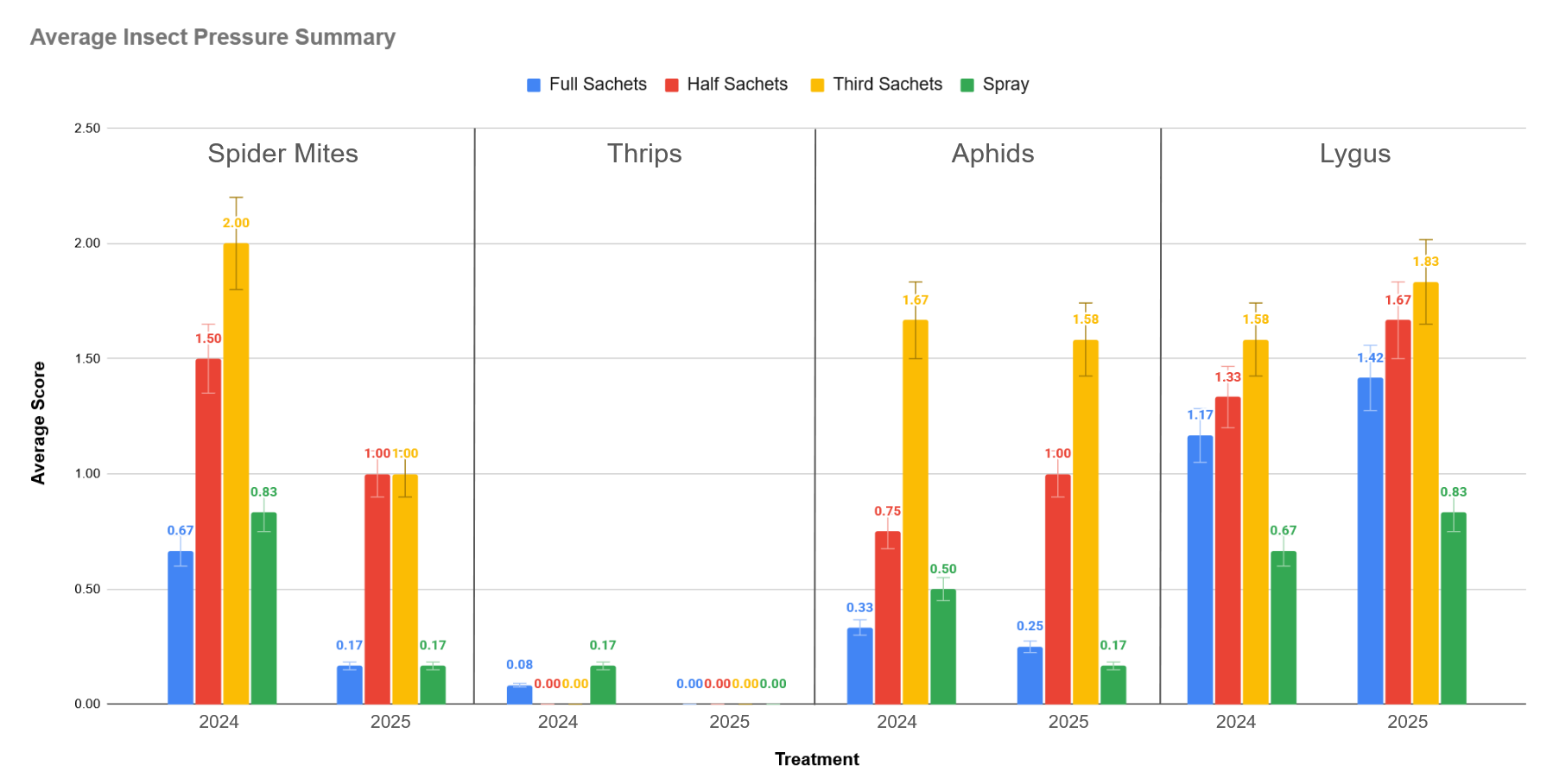
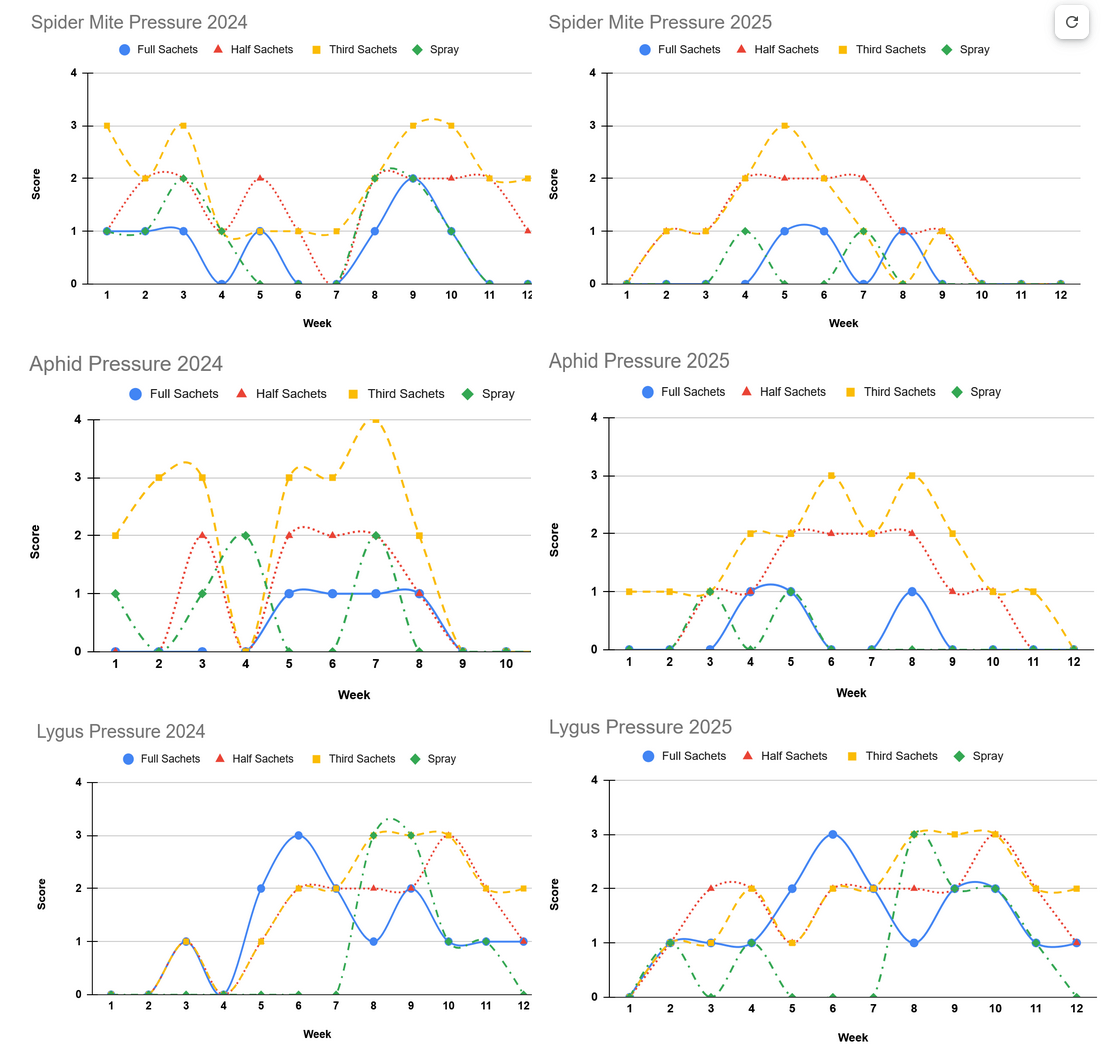
Efficacy of stepwise densities of biocontrol solution Amblysius swirskii (AS) for control of various high tunnel pests vs organic spray control is summarized in Figure 1, with weekly breakdowns displayed in Figure 2. Overall, placing an AS sachet in every container was able to match the efficacy of our spray control for both spider mites and aphids, and in several instances provided superior control (Figure 1). We did not observe enough native thrip presence either year to make reliable conclusions on comparative efficacy.
In addition to our proposed pest observations, we also were able to monitor AS biocontrol efficacy for 2 additional pests: Myzus persicae, the most common greenhouse aphid for horticultural crops, and a pest of day-neutral strawberries in the Upper Midwest, the tarnished plant bug Lygus lineolaris. Similar to spider mites, AS sachets in every plant container provided similar control of aphids to the organic spray control. While AS sachets every container seemed to reduce lygus presence relative to the other density treatments, it was not able to match the efficacy of spray control (Figures 1 and 2). This is not surprising, as AS is not advertised as an effective control for lygus. Taken together, we can see that at the highest sachet density, AS can provide spray-free control of spider mites and aphids inside tunnel environments at a similar (and sometimes superior) efficacy to traditional spray regimens. We cannot make recommendations regarding thrip control, as measurable thrip presence was not detected in our project either year.
Objective 2
OBJECTIVE 2:
Total annual cost of each biocontrol treatment, as sachets acquired by BFG Supply Company, was the following:
Sachets every container- $385.38 annually
Sachets every other container- $256.92 annually
Sachets every third container- S128.46 annually
Total cost of each spray for the control regimen, over a 1-year period was the following:
Pyganic: $60
Grandevo: $11.25
Oxidate: $12
The biocontrol regimen that matched the efficacy of the spray regimen for spider mites and aphids required a sachet in every container, for a total of $385.38 in annual costs. This is compared to the spray regimen, which required a total annual cost of $83.25. Therefore, the premium of achieving suitable biocontrol of spider mites and aphids within our caterpillar tunnels was 4.6 times what it cost to achieve using traditional sprays. In short, it cost $302.13 more per tunnel to achieve comparable suppression of spider mites and aphids using biocontrol techniques versus a traditional spray regimen. This also does not account for the fact that the spray regimen controlled tarnished plant bug presence considerably more than the biocontrol, regardless of biocontrol density.
For growers who are not affected by tarnished plant bug, within-tunnel biocontrol using amblysius swirskii is shown here to be a viable option. The ability to market the crop as 'pesticide free' may allow for an associated price increase that can more than make up for the increased cost of pest control. For an example, a crop that yields 3,000 lbs inside a tunnel and normally sells for $5/lb could be marked up to $5.10, and recoup the entire extra cost of biocontrol. Or, the price can be marked up even more, providing both the producer with an increased profit margin and certain consumers with a product that aligns with their values.


Educational & Outreach Activities
Participation summary:
Tour of TCBC caterpillar tunnels and high tunnels which the biocontrol project was being conducted. Visitors learned about the economic, environmental and social benefits of high-density strawberry production compared to the open field, in addition to an overview of the biocontrol research. Visitors were able to see exactly how the sachets were deployed in each tunnel, and discussed opportunities for implementation on their own operations.
Learning Outcomes
We have learned that effective biocontrol of spider mites, thrips and aphids requires the placement of Amblysius swirskii sachets inside each container (or, for other crops, on each plant). This was the only treatment that matched the control spray of these pests in 2024 and 2025. Amblysius swirskii sachets did not achieve control of lygus, the tarnished plant bug. We suspect a more comprehensive biocontrol technique will be needed to achieve broad control and eliminate the need for pesticides inside caterpillar and high tunnels for strawberry production.
These are some management tips we would suggest for folks looking to replicate or implement our work:
1. Amblysius swirskii can be applied in 'sachets', as we did in this project, or ‘loosely’, via a shaker, similar to a salt shaker. We opted for the sachets in our project as it allowed us to more perfectly ‘dose’ out each treatment tunnel. However, now that we know which density provides efficacy (every plant), we would recommend purchasing the shaker version of the biocontrol, and simply shake the predatory mites over each plant. This would considerably reduce cleanup and management of the sachets throughout the field season.
2. If you plan on using organic sprays within tunnel environments, we highly recommend purchasing a backpack sprayer that is battery powered. Not only does this make the application process easier and faster, but the pump mechanism that the manual sprayers utilize are often the first piece to malfunction, requiring a total replacement, often within the same field season.
3. Make sure that the biocontrol option you apply can handle the significantly hotter and drier environments inside protected cultures like tunnels. These environments are beneficial for disease control but often detrimental to the predatory insects being applied. Ensure that the biocontrol solution you are applying is rated for the temperatures you expect to see in each tunnel.
Project Outcomes
I have had multiple conversations with other farmers, at the farmers markets I vend at, about this project, in addition to the field day in 2024. Several have expressed interest in the biocontrol sachets and I have even matched up several farmers with our biocontrol sachet provider, BFG Supply, to purchase Amblysius swirskii for their own operations.