Progress report for FNC25-1458
Project Information
Representing Farm #1 (Southern Ohio Chestnut Company in New Marshfield, OH) the Project Manager Badger Johnson will oversee project design, implementation, outreach and reporting. Badger has located suitable mother plants and spore-source porcini mushrooms from Ohio, and secured landowner permission and forager contracts. Badger manages a 31 acre chestnut-pawpaw orchard. He also owns a consulting forestry firm (Paradise Ecological Services), specializing in habitat management, forest farming, and silviculture for oak regeneration. He is a Certified Forester through the Society of American Foresters and holds degrees in forest management, plant biology and agroforestry. Badger has worked for NGOs including Community Food Initiatives and Rural Action, where he designed and led educational workshops on agriculture and nutrition topics.
Representing Farm #2 Chris Smyth, DBA Deer Orchard in Cincinnati, OH, will serve as the Tree Nursery Operator. Chris studied organic orcharding practices with Michael Phillips, and has expertise in mail order nursery production. Chris has hands-on experience with Chinese chestnuts throughout the lifecycle, from harvesting the seed all the way through bare-root seedling production and grafting. Chris will produce the seedlings and care for these before and after inoculation.
Dietrich Epp Schmidt holds a PhD in soil microbial ecology and statistical inference from the University of Maryland. He has a long-standing interest in mycosilviculture, and a strong commitment to disseminating useful information on this topic, including a commitment to publishing a peer-reviewed paper based on this project. As the Scientific Advisor, he will work closely with the Project Manager and Mycelial Culture Specialist, to guide the experimental design and data analysis.
Thomas Lodge, as the Mycelial Culture Specialist, will provide liquid mycelial culture and assist with inoculating chestnut seedlings. Founder of Mid-Am Mushrooms, Thomas has expertise in mycology and advanced mushroom cultivation. His company’s focus on sustainable agriculture and innovative methods, including specialized equipment for growing liquid cultures, ensures high-quality mycelial culture and guidance for successful inoculation.
Martha Bishop will play an advisory role. Martha’s extensive experience in lab coordination at Ohio University, as Foray Leader with the Ohio Mushroom Society, and her work at Friends of Strouds Run State Park position her to make useful introductions. Her mushroom identification skills, knowledge of public lands in Ohio, and professional connections may be quite useful to the success of the project.
Porcini mushrooms (Boletus spp.) are culturally and economically significant edible ectomycorrhizal fungi (EMF), commonly harvested in natural and cultivated chestnut forests spanning Europe1 and Asia2. Prior to the devastation of chestnut blight3, Boletus spp. were closely associated with American chestnut4,5. Our project is developing techniques to artificially induce chestnut-porcini mutualism in chestnut orchards as a North American agroforestry practice.
We did a literature review on species of porcini native to Ohio, and scouted for these mushrooms in Christmas tree plantations, chestnut orchards, and oak-hickory woodland, so we could understand better the inoculation of Chinese chestnut seedlings1,6–9.
We were able to locate a Chinese chestnut orchard containing a patch of 20 trees that have Boletus variipes fagicola, one of the native porcini species, growing beneath it. The patch fruited twice in 2025, once at the beginning of June, and once towards the end of October.
Our literature review revealed that certain “mycorrhiza helper bacteria” are beneficial for porcini spontaneously fruiting in chestnut-porcini orchards overseas11 and that Amanita muscaria (fly agaric) mushrooms usually fruiting alongside porcini. Finally, moss of various species are used as an indicator species of productive porcini patches by professional forager Tom Patterson. These observations suggest that having this specific community of soil-based organisms could benefit porcini inoculation, and subsequent porcini commercial production. With this notion in mind, we signed an MOU with the owners of a Chinese chestnut orchard, to use an existing patch of their orchard floor for our project. We had observed abundant porcini, moss and fly agaric mushrooms fruiting there, which point to it being an ideal site to establish and mycorrhize chestnut seedlings with porcini.
We hope that this community-level inoculation will persist in the soil and on the roots of the chestnut seedling, even after transplanting the seedlings into a different orchard. Because the new orchard will be on the site of a former hayfield, and because there is a general lack of ectomycorrhizal species and microbial diversity in legacy agricultural soils12, the chance of bringing the porcini’s native soil microbiome along with it may prove necessary. The literature already shows a significant, positive relationship between low-tech EMF inoculation and chestnut seedling performance on former hay ground13, and we are doing a version of that.
If the porcini inoculation proves successful, future research could assess porcini inoculation effects on chestnut growth, as well as porcini harvest and farmer income. To our knowledge, no other chestnut grower in North America has yet derived income from selling the ecto-mycorrhizal fungi harvested in their orchard. We hope to be the first.
Solution:
Our study examines the viability of porcini-chestnut agroforestry by: 1. Evaluating three inoculation techniques (mother tree, liquid culture, spore solution) for mycorrhizing chestnut seedlings; and 2. Establishing a commercially available culture for porcini that is native to the SARE NC region.
Porcini are a group of closely related species16. Porcini have successfully colonized chestnut seedlings from liquid mycelial culture, enhancing growth and nutrient uptake rates under laboratory conditions9. Another inoculation technique, the “mother-plant method,” uses mature myccorhized trees to inoculate seedlings 18. Both liquid mycelial culture19 and the mother-plant method6 have been used to commercially produce the culinary “saffron milkcap” EMF in pine plantations and are intuitive, cost-effective strategies for EMF inoculation. We will test these techniques in a North American setting with porcini and Chinese chestnut.
If these techniques are successfully implemented in North American orchards, they offer long-term co-benefits to farmers. EMF form mutualistic relationships with their host trees, increasing nutrient uptake, growth rates, and drought resistance 2,14,15. After inoculation with EMF, chestnut seedlings planted in former hay fields exhibit improved growth rates and drought resistance13, which is desirable within a context of climate change. Inoculating chestnuts with porcini may improve the growth rates and survival of chestnut seedlings during the critical establishment period. Additionally, porcini mushrooms themselves could be a valuable secondary crop. Research using spore solutions and existing porcini sites to inoculate chestnut seedlings found that the spore-inoculated seedlings produced porcini mushrooms after 10 years17. Inoculated plantations can yield 36 lbs/acre/year of dried porcini20,21, which if sold at $15.10-$148.52/lb16 could generate $544 - $5,346/acre/year, making porcini more valuable than the chestnuts depending on price realization.
Methods:
200 chestnut seedlings were grown at the nursery, in pots and in air pruning beds at the Camp Washington Perennial Farm in Cincinnati. These will be assigned a treatment randomly and introduced to their respective treatment conditions in Summer 2026, as production of inoculant allows. It is easy to over-water chestnut seedlings, so be careful to visually inspect soil moisture before initiating irrigation. Seedlings have been watered on an as-needed basis during the 2025 growing season. In 2026, 6 months after inoculation, 10 seedlings from each treatment will be destructively sampled, with root tips prepared and sent to Mycota Lab for sequencing following protocols described in Epp Schmidt et al 24,25. Outplanting of all seedlings is planned for early summer 2027, after this grant cycle is completed.
Mother Tree Treatment
A known porcini host tree location was selected, not from one of the 26 candidate locations in Ohio where porcini have been collected in the past, but at a new host tree location. This was in a northeast Appalachian Ohio county. It was discovered while conducting Integrated Pest Management scouting, where the workers were looking for evidence of the destructive pathogen known as oak wilt, Bretziella fagacearum, which had been discovered and treated nearby after killing several Chinese chestnut trees. The native porcini species Boletus variipes fagicola was discovered flushing abundantly in June 2025, and a smaller flush in October 2025. In March 2026, 400 germinating chestnut seeds (double planted, for a total of 200 planting sites) will be planted in mother tree root zones in July 2025. Seeds will grow into seedlings. These seedlings will be mulched and protected from rabbits by milk carton protectors. This site is already protected from deer by a sturdy, effective, permanent deer fence. These seedlings will be dug up for transplanting to a new orchard site after they go dormant.
Liquid Culture Treatment
In June 2026 we harvested mushrooms from the Mother Tree Treatment site. Some of these were used immediately, when mushrooms are fresh and not decomposing or buggy, to begin producing liquid mycelial culture. This process has been undergone by Thomas Lodge at MidAm Mushrooms. Mushrooms were transported to the lab, and a clean bit of mushroom flesh was cut out of the center of the stipe of the mushroom. Note, it is preferably at button stage when this is done. Take this bit of mushroom flesh and put into onto the growing medium in a petri dish. The petri dishes should be prepared with Modified Melin-Norkrans (MMN) medium. The petri dish should be kept in the dark at 70 deg F. Some people add oxalic acid to this. These plates grow slowly and eventually will be used make a liquid mycelial culture the following spring, this has not happened yet. You must avoid putting too much nutrient in the liquid mycelial culture. 100 seedlings will be removed from their pots, submerged in an aliquot of the liquid mycelial culture and repotted in freshly prepared potting mix in July 2026. This is pending the successful development of liquid mycelial culture. The growth of the mycelium on the plates has been very slow.
Spore Solution Treatment
100 seedlings will have an aliquot of fresh spore solution applied in summer 2026. The solution will be prepared using the sporocarps of fresh, wild-harvested porcini from oak forests in the region. It will also contain 4 oz of soil from underneath the volva of each harvested sporocarp. 1 lb of fresh mushrooms, cap and stem, in 5 gallons of water, with 1/4 cup of soil from underneat each mushroom mixed in, stirred for 15 minutes by hand in a 5 gallon bucket, will constitute the fresh spore solution.
Control
100 seedlings will be grown from seed in nursery beds, not pots, and will not receive inoculation with any treatment. Testing the soil microbiome of these seedlings will allow us to control for two (2) potential effects: an increase in mortality due to transplant shock in the two treatments; and a relationship between soil microbiome in potting medium and seedling mycorrhization. We do not expect porcini to be present in the potting medium, but we will verify this with Mycota Lab's help.
ATTACHED: Works_cited
Cooperators
- - Producer
- - Producer
- - Producer
- - Producer
Research
Our process for Chinese chestnut seedling mycorrhization with porcini is as follows. Locate appropriate porcini mushrooms in the wild, and put them in contact with the living fine roots of young, healthy Chinese chestnut seedlings. Outplant inoculated chestnuts after the first season of growth into the area that will be their permanent home.
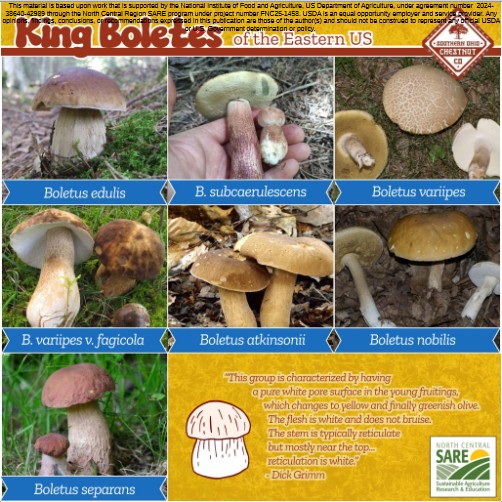
There are many species of mushroom sold as porcini, so in this process, we had to narrow down which porcini species we were interested in. This ended up being a result of what species were feasible for us to get our hands on that would work, and that would also meet the criteria of being definitively native to Ohio. We made an infographic showing the different species. We secured access to a known, verified source of mushrooms from under “Mother Trees” of the same species that we are attempting to grow- the Chinese chestnut, Castanea mollissima.
There are several bottlenecks in this process, the first is having the porcini available for your use when your seedlings are ready. A second bottleneck is the short shelf life of the mushrooms when you do find them, if you’re going to use the fresh mushrooms in the inoculation process. If that is the case, many steps must be taken in quick succession once the fresh mushrooms have been procured, and you must prepare ahead of time in order to be ready for that.
The steps we recommend taking are as follows.
First step: locate a patch of ground where porcini mushrooms reliably come up. The trees should be in family Fagacaea and have healthy crowns. Dry some of the mushrooms and send to Mycota Lab (along with your iNaturalist observation ID number, for their purposes). This will help you verify the species of mushroom that you’re dealing with.
Second Step: come to an agreement with the owner/manager of the land. If you do not hold a lease or title to it. You need usufructary rights to the space. It is possible this will have to be done a year in advance from when you are inoculating the trees, because finding the site and getting permission depends on both weather, fungal life cycle, and the sometimes stochastic human factor of negotiating a deal.
Third Step: Build Air Pruning beds and fill with potting medium. Potting medium can be pine fines or ProMix, a low-nutrient mix is better. The potting mix we used was sourced from Nathan Rutz of Tilth Organic Living Soil. He designed this mix for us based on lengthy conversations about the need for some nitrogen in the form of dead organic matter, good water-handling capabilities, an acidic pH of less than 6.5, and reviewing the literature for what others had used. Others may raise their eyebrows at the addition of compost, but given the hard to predict nature about when our King Bolete inoculants would be ready, we decided that some rich compost could be an important source of nitrogen for ectomycorrhizal fungi to enzymatically break apart and disperse to chestnut seedlings. Sand: 5%, Compost: 15%, Perlite: 20%, Pine Bark: 20%, Peat: 40%.
As of 2026.01.31, We have taken the above steps. What follows are the steps we plan to do in the coming months.
Fourth Step: Direct sew seeds of Chinese chestnut, germinated in moist peat in a refrigerator at 38 deg F, in the mushroom patch (Mother Tree Treatment) in March. Plant two seeds per planting site. Cover each seed with a tree tube and 2 cups of finished compost to protect it from freezing.
Fifth Step: In June and October, harvest mushrooms. Use these immediately, when mushrooms are fresh and not decomposing or buggy. To produce the liquid mycelial culture, harvest some of the fresh mushrooms, and in the same day as harvest, transport those mushrooms to your lab to a clear sample cut out of the center of the stipe of the mushroom (preferably at button stage) onto the growing medium in a petri dish. The petri dishes should be prepared with Modified Melin-Norkrans (MMN) medium. The petri dish should be kept in the dark at 70 deg F. Some people add oxalic acid to this. These plates grow slowly and eventually will be used make a liquid mycelial culture the following spring. We sent in a plate of this to Mycota Lab to verify the species was the same as the mushrooms we saw… Irrigate an air pruning bed full of Chinese chestnut seedlings with 10 gallons of the liquid mycelial culture. Additionally, irrigate 100 potted Chinese chestnut seedlings with 12 fl oz of the liquid mycelial culture. Let those trees grow with the spore solution having been applied for the rest of the growing season, transplanting them out of the air pruning bed and pots the following spring with as much of their fine root system intact as possible.
Sixth Step: In June and October, harvest mushrooms. Use the ones that are not pristine little buttons to prepare the Spore Solution Treatment. Mushrooms must be identifiable to species but can be past the point of culinary ripeness. Transport to tree nursery. Macerate the mushrooms in a blender, and mix 2 lb of fresh mushroom slurry into 10 gallons of rainwater or spring water and irrigate an air pruning bed full of Chinese chestnut seedlings with it. Additionally, irrigate 100 potted Chinese chestnut seedlings with 12 fl oz of the spore solution. Let those trees grow with the spore solution having been applied for the rest of the growing season, transplanting them out of the air pruning bed and pots the following spring with as much of their fine root system intact as possible.
Seventh Step: mulch all seedlings with 2” to 4” deep of wood chips to help keep the soil moist.
Educational & Outreach Activities
Participation summary:
So far we have produced two research updates to the public, gotten a newspaper article, discussed the research on social media with chestnut growers, had 10 private showings with 20 people using, the slide deck we’re developing for conferences. We made an infographic to help would-be foragers identify the porcini species of Ohio. In the future, we will have an on-farm field day, catered with dishes featuring chestnut and porcini as ingredients. We will also be speaking to a class of undergraduate students studying fungi at Ohio State University.
2025.06.24 #1 research update on “Chinese chestnut seedling mycorrhization with porcini”
2026.01.31 #2 research update on “Chinese chestnut seedling mycorrhization with porcini”
https://paradiseecologicalservices.com/2026/01/14/2026-01-31-2-research-update-on-chinese-chestnut-seedling-mycorrhization-with-porcini/
We put these links out on social media to the chestnut growers group, which leads back to the website. So far that has brought in 338 unique visitors to the website. Roughly half of those would likely be farmers, the other half agricultural professionals. People are generally interested, and seemingly have had an intuition that there was something interesting going on with the fungi under chestnut orchards.
We have also developed an extensive slide deck on the project and shown it to 20 people, chestnut growers, mycology professionals, and their students, in person and over Zoom. Generally the questions we get are, who is already doing this? The answer is, we hope to be the first ones in the United States doing this.
We also got a piece published in the local newspaper, The Athens Messenger. Growers pioneer mushroom farming on trees in Athens County by Ashley Bunton! A traditional, for-profit newspaper with a local circulation in rural southeast Ohio has to make it to some farmers, we are not sure how many though.
https://www.athensmessenger.com/news/growers-pioneer-mushroom-farming-on-trees-in-athens-county/article_8838026e-2293-4542-b089-ca60ca60aabc.html
Developing the slide deck and practicing the presentation was in preparation for the giving a talk at the Ohio State University class PLNTPTH 2000: Mushrooms, Molds and Mankind on March 4th. In the past there have been 90 students in attendance at that class, unsure how many will be in attendance there.
In the future, this year, we plan to have an on-farm field day with 50 people, where we cater a mushroom and chestnut meal, and participants see the slide show and examine our Mother Tree nursery, after the seedlings have had 1 year of growth. We also plan to go to two conferences and present there. But that can only happen after we’ve gotten the results of the research.
Learning Outcomes
Lessons Learned
Planting chestnuts and growing seedlings is more predictable and controllable activity than annual fluctuations in weather, which is what drives porcini mycelial networks to produce fruiting bodies in the wild. So to replicate our process, the first step is finding a known porcini patch, where the mushrooms fruit abundantly. Then you are ready to get chestnut seedlings ready for planting and inoculation.
We tried and failed to produce a sterilized potting medium. Based on that experience, it now seems unrealistic to us to have a chestnut seedling in its first year of growth, growing in a sterile potting medium, in an ordinary nursery. And especially, it seem unrealistic to have chestnut seedlings growing in sterilized potting medium, without having a ready source of the right species of porcini on hand! Due to the fickleness of sterilization of soil, and weather-induced mushroom fruiting, we learned to set more realistic expectations over the course of the project. Laboratory conditions do not exist out in the field or in horticultural nurseries, and this is field research.
Species selection of porcini was a surprise. Because Boletus edulis growing in Ohio appears to be mostly if not exclusively associated with Norway Spruce, there has been the idea that it is not actually a native specie to Ohio, and only came in on Norway spruce. The genetic evidence does not necessarily bear that out, but it's above our pay grade. We are glad that we found a patch of Boletus variipes fagicola, a native porcini species, already growing beneath a monoculture planting of Chinese chestnut trees. This finding supports one of the predictions of this study, namely that novel species pairings between Boletus and Castanea would be feasible, vis a vis what we call the Compatible Genera Generalization. Stated simply, if one species in an EMF genus is known to pair with one species in a tree genus, then pairings of other species from those two genii will probably work, especially if the EMF species is a generalist. In Asia, the King Bolete species Boletus bainiugan associates with the Chinese chestnut species Castanea mollissima. This fact was why we suspected that a North American King Bolete species would pair with C. mollissima. Dr. Dietrich shared this Compatible Genera Generalization as a postulate from the broader mycosilviculture research community.