Progress report for FNC25-1461
Project Information
Aizza Kerchenfaut
We operate conventional and regenerative farms. We recently transitioned one of our regenerative farms into organic in 2023. In order to complement the organic farm, we have included hogs and a diverse population of prairie natives in the rotation. The current economic environment has challenged us to search out alternative and less costly sources of inputs. My role will be to ensure we are meeting goals and meeting budgets for the project.
Will Glazik
Will draws on over eight years of organic farming. His family has been in organic production for over twenty years. They operate a diversified cropping operation specializing in food grade grains and beef production. Will's role will be to provide the organic grain distillery waste and design the foliar treatment.
Tim Roth
Tim is new to organic grain farming. He has been in organic grain farming for about three years, but has a strong drive to learn and adapt his operation. He has also been increasingly successful in pasture-based livestock systems that complement organic grain production. Tim's role will be to assist in the design of the foliar treatment and design the application trials.
OMRI approved fertility inputs are increasing in price, and is increasingly more difficult to acquire in central Illinois. In addition, these typically come from non-organic sources. We are hoping that the spent mash wash from a local, organic distillery can supplement fertility for our organic crop.
Solution: Over a two-year period we will develop four replicated block treatments across three organic corn fields and four replicated block treatments across three soybeans fields. These will be in alternating blocks of treated and untreated. The treatment will include the liquid portion of the spent distiller’s mash. This will need to be separated from the grain portion using a continuous screen. Then it will be buffered to a neutral pH using a calcium carbonate source before being applied to the crops at roughly the V-5 stage for corn and V-7 stage for soybeans. These trials will be conducted for two growing seasons and three different farms and yields will be calculated from the treated to the untreated using either a yield monitor or weigh wagon depending on the equipment available for each farmer. A nutrient analysis and PFAS test will also be conducted on the distiller’s mash to determine the quantity and quality of the solution.
Objectives: First objective is assess the feasibility of using the liquid from the spent mash for use as a foliar fertilizer. The first step is to separate the grain from the liquid of the spent mash using a continuous screen, then we will buffer the pH to neutral using a calcium carbonate product. After that we will submit the solution for fertilizer analysis. We will evaluate the solution for use as a foliar fertilizer before applying to the test blocks. Finally, the yields will be evaluated of the treated and untreated blocks. A SAP analysis will be used to observe nutrient content in the crops.
Cooperators
- - Producer
- - Producer
Research
Progress: 1/2026
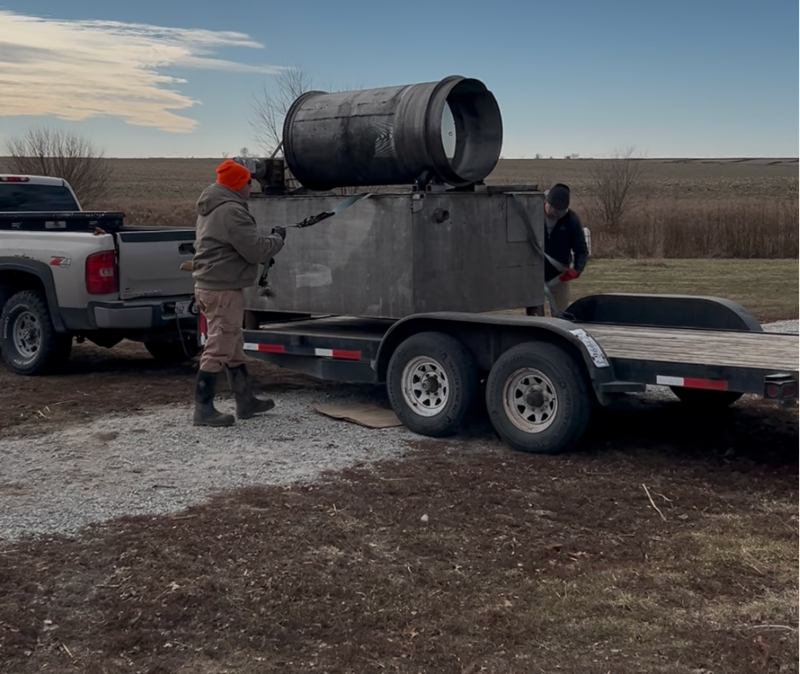
We were able to do some SAP testing in June of 2025 to obtain a basis. One of the objectives is to separate the grain from the liquid. We had an issue of coordinating time and resources to obtain the large screen to separate the liquid and grain. It is a much larger tool than expected, so we needed to coordinate a truck, a large enough trailer and two bodies to move and put it on a trailer. In addition, there were production issues at the distillery. We finally achieved obtaining the separator at the end of December 2025. Weather, time and resources finally aligned and were able to obtain it.
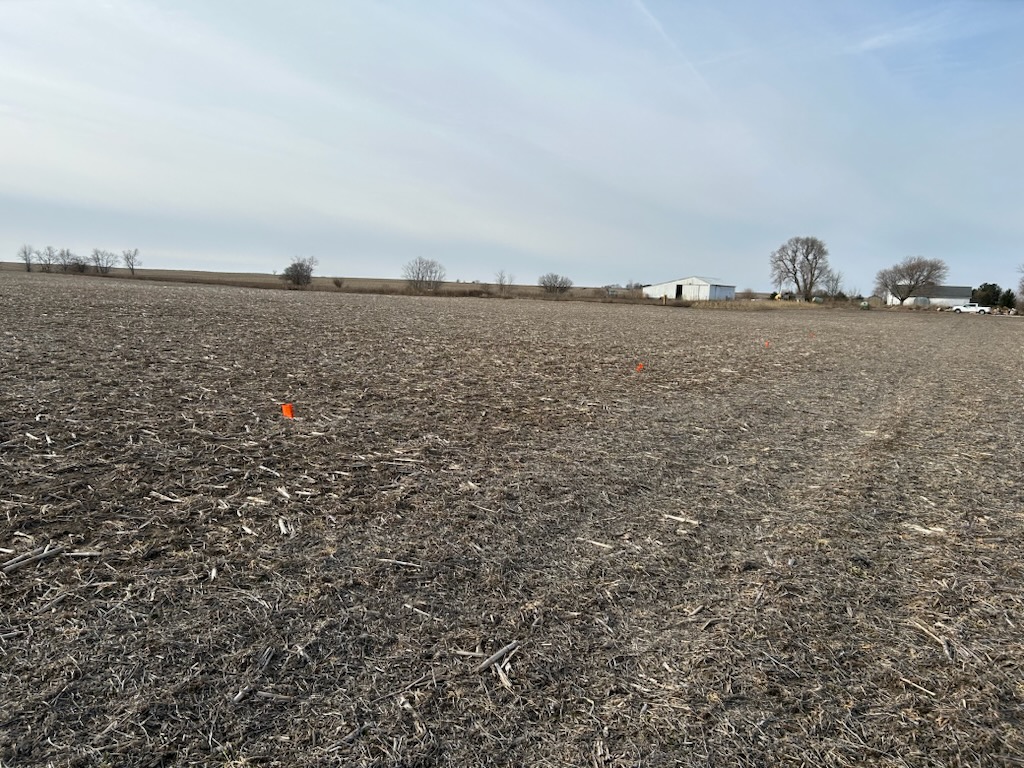
In the meantime however, we were able to create a smaller quantity of the foliar and test on a couple rows in the bean field stubble. We were able to obtain a less than 250 gal tote of mash, manually separate the mash and liquid and buffer using the calcium carbonate. Two rows that are approximately 20' wide x 1,800' long were sprayed. Flags were used to indicate the sprayed area. (Nov 2025). to gauge the efficacy of the residue breakdown. After the corn emerges, we will spray the same foliar on those rows.

Learning Outcomes
Operational:
One of the lessons learned is that things always take longer than you expect. Our biggest challenge at the beginning was gathering the necessary resources to obtain the sifter. It was larger than we thought, so we needed two bodies, a trailer and a large truck to pick up the equipment.
The second lesson is learning to schedule around other people's schedules. We all have busy schedules and time gets away from all of us. We need to do a better job of managing that.
Budget:
Equipment pickup needs to include labor and time to pick them up. Labor and time were not initially included.