Progress report for FNC25-1480
Project Information
I grew up on the corn and soybean farm that my family and I currently operate. During my childhood and teens I helped my Dad and Grandfather on the farm, running machinery and picking rock. I then went on to study Agriculture Animal Science at the university of Hawaii. I worked on the university farm for 3 years and graduated with a B.S. in Agriculture with a minor in Chemistry. After graduation, I went on working on the Big Island of Hawaii at different ranches training horses and working cattle. After meeting my husband in 2014, we moved back to Pennsylvania to run his uncle's cow/calf operation for 3 years. Then, we shifted and worked on a nearby regenerative organic farm managing the cattle, bees and a variety of other projects at Spring Creek Farm. In 2021, we came to Minnesota to take over my family farm. Since then we have been working on transitioning the corn and soy operation into a diversified regenerative farm. We have moved away from GMO crops and are weaning off of synthetic fertilzers. Also, we have incorporated pasture-raised chicken and pork along with expanding the vegetable crops, microgreens and orchard trees. This year we are adding peas and oats to the rotation along with intensive rotational grazing of beef cattle. Every year we have been taking on more land from my family and our acres are up to 524 for the 2025 year.
Chemical farming has been and continues to be one of the most destructive human activities on the planet. The pollution of air water and soil from the chemical inputs is the main culprit to ecosystem degradation. Water soluble chemicals like glyphosate reach every corner of the Earth and glyphosate is the most common herbicide used in agriculture. These compounds are like antibiotics to the soil- killing the beneficial microorganisms off that are essential for nutrient cycling, building soil structure, and armoring the plants. Synthetic fertilizers have been poisoning our soil and waterways with excess nitrates causing major issues down stream all the way to the dead zone in the Gulf of Mexico. Since the time that I realized the harm that agricultural practices are causing, it has been my goal to return to my family land and figure out a way to farm in a ecologically friendly way that will heal the damage that has been done for generations past.
This project will be set up using 4 different plots: 2 plots will be non-GMO corn and soybeans farmed organically and 2 plots will be GMO corn and soybeans done with chemical inputs. The plots will be one-acre squares that will have multiple samples taken randomly within the one acre area. We will start with a soil sample (8 cores taken randomly within the one acre plot and mixed together) in the spring time before planting or applying anything and a biological assessment will be done. Another sample will be done mid-season and a final one done late in the season. All of the plots will have a multispecies cover crop mix. In the organic plots, the weeds will be managed with an in-row roller crimper mower and the chemical plots will be terminated with roundup. After the harvest, we will calculate the return on investment of each of the plots and compare, along with measuring the difference in biomass of microorganism groups. We will then see not only the difference in these practices biologically but also in the financial return.
Research
In the spring time we took soil samples from 4 one acre plots. A plot was placed in a conventional corn field, a conventional soy field, a transitional soy field, and a transitional corn field. This was done to get a base line of what biological activity was present before we made any applications of anything. The samples were gathered by taking 8 cores randomly from different areas of the one acre plot and then mixed together in a bag. A one mL sample was taken and placed into a test tube with 9 mL of water added and shaken, one drop of the solution was placed on a microscope slide for a complete assessment. In the assessment the different microbe groups are observed and biomasses tabulated (fungi, bacteria, protozoa, and nematodes).
This process was done again mid growing season and then again during harvest. The plots received two application of compost tea. One in furrow with the planter and one in late June/early July with the sprayer. The conventional plots were sprayed with herbicide. The conventional corn was sprayed once May 6th and the conventional beans were sprayed twice, on May 23rd and June 16th. The transitional plots were roller crimped for the weed management. Both the corn and beans were rolled on June 22, 23. The beans were rolled again July 22.
The roller crimping went pretty well considering it was the first year we implemented this tool. We had a few issues come up with the roller crimper slipping out of the quick hitch and rolling off the row and into the cash crop. This was because the toolbar was a category 3 implement and the quick hitch was a category 4. Lesson learned and we are currently adjusting the brackets on the tool bar to fit the quick hitch correctly. Other than that we were impressed with how well the crimper worked. Timing plays a big role with crimping. If it is muddy at all in the field the rollers clog up with mud and forms a big pile of residue and mud. It is important to get into the field to cut the cover back in time to let the cash crop get ahead of the covers, but you also need to think about trying to only go through the field twice in the season so you drive over the crop the least amount of times on the endrows. The crimper is a 12 row implement so it does drive over quite a bit of crops on the end rows and point rows. Along our crick we are planning to plant the endrows with pasture grass or natives so that we don't drive over so much crop on the point rows.


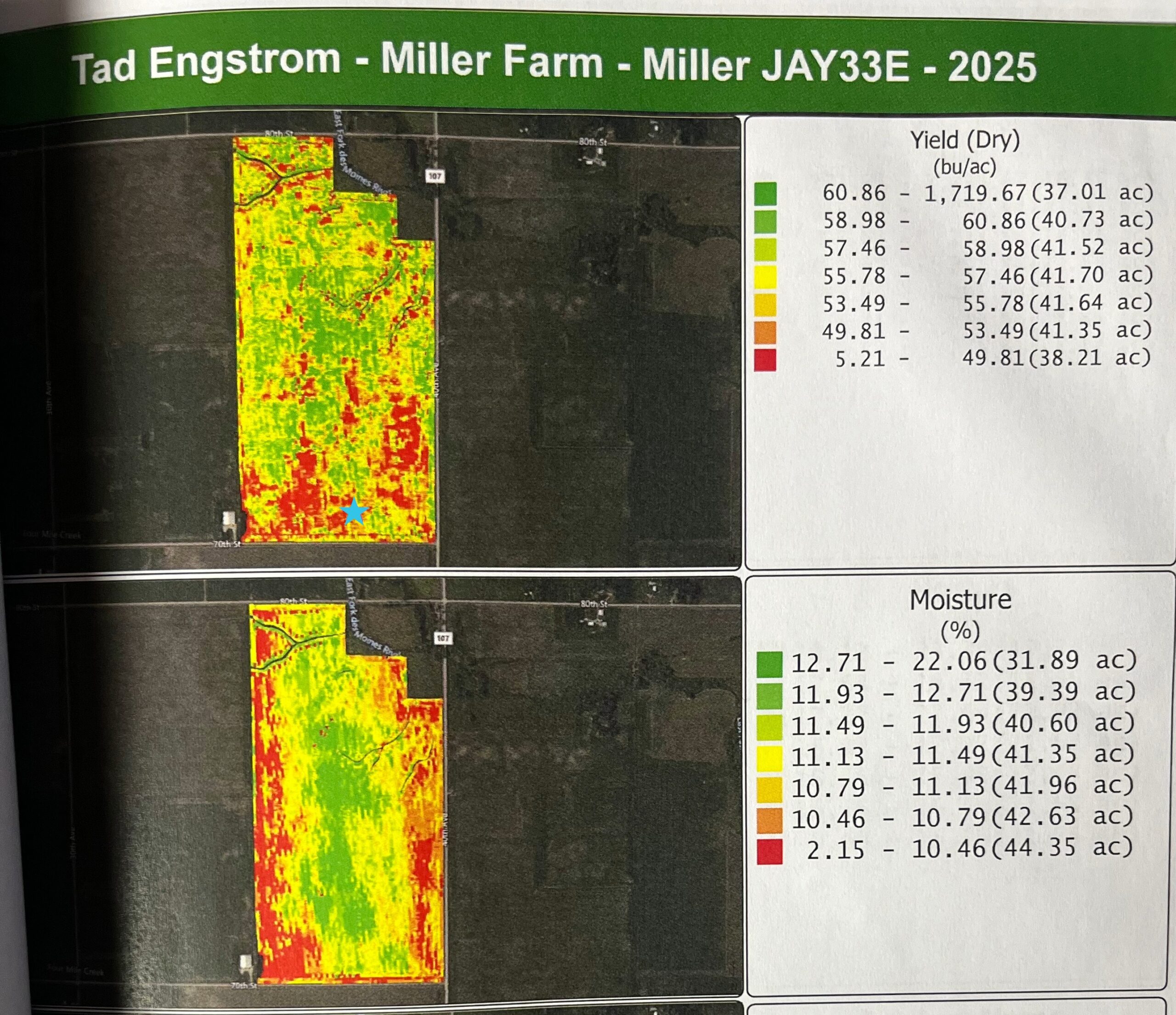
During harvest the yield data was gathered and the average price received for the crop was calculated to be able to look at the ROI between all the plots.

Our results clearly showed the plots without chemical disturbances had the highest fungal to bacterial ratios and microorganism diversity through out the season. This was measured by the soil assessments done 3 times through out the season. We found it interesting that there was a fungal presence well after the herbicide was sprayed on the conventional fields, but then disappeared by the harvest soil assessment. We hypothesized that this was due to a lack of moisture and coverage for the microorganisms. Further exemplifying how important cover plants are for water holding capacities in the soil to feed the plants and microbes.
| Field | F:B ratio | Aerobic protozoa #/g | Beneficial nematodes #/g |
| Conventional Corn 5-8-25 | 0 | 11,413 | 0 |
| Conventional Corn 7-26-25 | .38 | 0 | 0 |
| Conventional Corn 9-19-25 | .02 | 0 | 0 |
| Conventional Beans (Miller) 5-19-25 | 0 | 34,238 | 0 |
| Conventional Beans (Miller) 7-27-25 | .07 | 0 | 0 |
| Conventional Beans (Miller)9-19-25 | 0 | 0 | 0 |
| Organic Corn 5-11-25 | .03 | 34,238 | 0 |
| Organic Corn 7-26-25 | .13 | 45,651 | 0 |
| Organic Corn 9-18-25 | .41 | 3,261 | 10 |
| Transitional Beans (Dorr's) 5-11-25 | .03 | 11,413 | 0 |
| Transitional Beans (Dorr's) 7-27-25 | .13 | 11,413 | 0 |
| Transitional Beans (Dorr's) 9-20-25 | .72 | 11,413 | 0 |
report Organic Corn 9-18-2025 report Organic corn 7-26-2025 report Organic Corn 5-11-2025 report Miller Farm 9-19-2025 report Miller Farm 7-27-2025 report Miller Farm 5-19-2025 report Dorr's 9-20-2025 report Dorr's 7-27-2025 report Dorr 5-11-2025 report Conventional Corn 9-20-2025 report Conventional corn 7-26-2025 report Conventional Corn 5-8-2025
Our results also indicate that the first year of transition to organic can be hard on yield while the soil biology is establishing and dealing with more weed pressure. The Miller farm conventional beans averaged 55 bushels per acre and the Dorr farm of transitional beans yielded 40 bushels per acre.
All of the corn struggled this year from late application of nitrogen due to wet field conditions. The fertilizer for the transitinal corn plot seemed to be insufficient in nitrogen and phosphorus because the corn was stunted all year and the yield was approximately 70 bushels an acre while the conventional corn yielded 178 bushels per acre.
| Per Acre | Conventional Corn | Conventional Beans (Miller) | Transtional Beans (Dorr's) | Transitional Corn |
| Herbicide cost | $34.14 | $45.00 | $0 | $0 |
| Weed Management application | $8.70 | $8.70 | $15.60 | $15.60 |
| Fertilizer cost | $114.09 | $0 | $0 | $125.90 |
| Fertilizer application cost | $9.10 | $7.30 | ||
| Average yield bushels/acre | 178 | 55 | 40 | 70 |
| Average sale price per bushel | $4.75 | $10.40 | $13.15 | $5.75 |
| Total Cost per acre | $166.03 | $53.7 | $15.60 | $148.8 |
| Total income per acre | $845.5 | 572 | $526 | $402.5 |
| ROI | $679.47 | $518.30 | $510.4 | $253.7 |
From the table we can gather that beans can be successful in having a pretty even ROI in the first year of transition when comparing to conventional systems. The corn however has a much harder time working out favorably in the first year of transition, due to higher fertilizer costs and a drastically lower yields. I do believe that if we had found a more effecient and affordable nitrogen source to transition with the numbers would have worked out better for us. It is exciting to think of when we are certified organic both of the prices that we receive for the crops will go up dramatically, which will help the ROI work out more favorably. There are also other things to consider that you can't quite put a price on such as, environmental and personal benefits. As a farmer I felt much better spending time in the transitional fields with my family, not worrying about exposure to toxins like in a conventional fields. Another notable aspect was the sound of insects and more wildlife present in the transitional fields. It felt more like an ecosystem than a monoculture dead zone. Very inspiring to see how quickly the environment changes when biology is allowed to hold space.
Educational & Outreach Activities
Participation summary:


 We hosted a field day in partnership with Practical Farmer's of Iowa on June 21st 2025. There were 48 people who attended the field day. We started this field day with a slide show and presentation talking about our family and farm history, then went on to talk about how we are transitioning our farming practices to be more biologically focused. We shared about our process for assessing the soil under the microscope and what the different microorganism groups do in the soil. Also, we shared about the roller crimper build process and demonstrated how it works out in the field. We toured around the farm to show how our compost making and tea brewing process is executed as well as showing the other diversifications of our farm like the pasture pigs and microgreens.
https://practicalfarmers.org/events/field-days/2025-field-days/mindful-change-for-a-row-crop-farm/
I spoke at the PFI cooperators meeting about the transition soybean field. Pictures of the perennial cover crop and roller crimper through out the season were shared, along with yield maps and input costs. There were approximately 20 farmers and researchers listening to the presentation.
Practical Farmers also had me on a panel for their reducing nitrogen rate portion of their annual conference in Des Moines Iowa. I answered questions people had about our practices and how we have been reducing our nitrogen rate gradually over the years There were 25 people in the conference room listening to the panel. 


Learning Outcomes
We learned that chemical use like herbicide and synthetic fertilizers greatly diminish if not completely wipe out microbial populations other than bacteria. This disruption then never really allows the biology to reproduce and establish themselves enough to make nutrient cycling in the soil occur naturally. This has affected our farm by showing us the importance of getting the chemicals out of our protocals for farm inputs to successfully farm in a more ecologically balanced way.
We partially overcame some of our barriers by utilizing the roller crimper in our transitional fields. This allowed us to have a chemical free weed management option. In the plots that were chemical free we saw a great increase in biology over the growing season. Some advantages of a project like ours is that we are at the forefront of figuring out how to transition a commodity corn and soy farm to a diversified organic hub. The disadvantages are being the only fields in the community that look very different from the normal corn and soy rotation causing concern from our landlord need for deep discussions about what "best practice" actually means for us.
I would tell other farmers to find a microscope and take a look at what is going on in their soil first hand. Also, take a small plot and implement a more biologically minded protocal to see and feel the difference of soil coming back to life. As time goes by continue to expand this plot larger and larger and see how it feels different in this area compared to the rest of the farm.
Project Outcomes
There was a farmer at the field day that was impressed with the cover crop portion of the tour. "An edible hundred acres, wow" he said excited at the thought of a cover crop mix that you can make a salad out of. It was cool to see him think about growing something you can eat, in my mind that is what a farmer is, but so many have lost sight of that being a goal of farming.
I am excited for this years continued research for this project. I feel that as farmers the learning really happens as you monitor the changes from season to season and factor in the different environmental and economic variables each year. For this year I am especially excited to see how the perennial cover crop comes back after winter and how the cash crop emerges through this thicker cover. Also, to see how different biological activity is at the beginning of the season after an entire year of covers and no chemicals. Hoping to see the microbes present and active at the start of the season.