Progress report for FNE25-116
Project Information
Our project objective is to determine whether growing tomato plants in a clover cover crop in high tunnels in muck soil increases overall soil health, reduces pest and weed pressure, and results in healthier, more productive plants, and increased farm revenue.
Will clover perform similar or better functions than landscape fabric in high tunnels? Will it improve growing conditions for tomatoes? Improve flood resistance/drainage? Improve pest pressure? Increase yield? Have unfavorable weed pressure?
Objective 1: Measure soil moisture in high tunnel area covered in clover cover crop versus area covered with landscape fabric
Objective 2: Measure pest pressure of tomato plants grown in clover cover crop versus plants grown in landscape fabric, focusing specifically on tomato hornworms and the presence of parasitic wasps.
Objective 3: Measure economic viability of tomato plants grown in clover cover crop versus plants grown in landscape fabric
Objective 4: Measure weed pressure of tomato plants grown in clover cover crop
Objective 5: Share our findings with other farmers and farm adjacent professionals
The National Oceanic and Atmospheric Administration notes that flooding in the Northeast is exacerbated by more frequent rainstorms as a result of changing environmental conditions. In July 2023, severe storms brought up to eight inches of rain in some areas, causing catastrophic flooding in the Northeast. (July 2023: Record High Temperatures and Devastating Floods ) The National Climate Assessment shows increasingly intense rain in the Northeast (Extreme Precipitation in the Northeast).
In addition to increased precipitation and flooding in the region, Rise & Root Farm is increasingly challenged by periods of drought, such as we are currently experiencing. (NYC declares a drought watch, asks residents to conserve water) (Keeping muck soils sustainable)
Amidst the trend of increasingly extreme weather events that Northeast farmers are facing, RRF is building strategies that mitigate disruption while increasing crop yield and economic viability. The goal is to share this research widely within the farming community in NY’s Black Dirt Region, encompassing approximately 26,000 acres of fertile muck soil, and home to over 630 farms. Tomatoes are a primary crop in the region. (Orange County Produce.)
RRF’s goal is to research the impact of establishing a clover / oat cover crop in the tunnels which the tomatoes are then transplanted into. Our project is to test our hypothesis that growing tomatoes in a living clover mulch is a significant way to build healthy soils, control soil moisture, and reap increased yield and tunnel revenue.
Rise & Root Farm is deeply committed to equitable food access. Extreme weather events cause serious disruptions in the food supply, often impacting underserved communities the hardest, as seen during the pandemic. Establishing methods for stable crop production during irregular and unpredictable weather is a priority for RRF, specifically ensuring that food insecure communities have access to fresh produce amidst extreme weather events.
The Black Dirt region of NY is known for its nutrient rich soils, but is also low-lying and prone to flooding. Through this study, we aim to increase water drainage and root penetration, while mitigating soil erosion and pest pressure. Our project matters not only for RRF’s goal to maximize high tunnel plant health and value, but also to the multiple farmers in our region growing tomatoes in high tunnels in Black Dirt.
During increased precipitation high tunnels flood from the ground up. When the muck soils hold the water, soil compacts, algae grows, there is increased weed pressure and ultimately lower yields, affecting the farm’s bottom line negatively. In the decade that RRF has been farming, we have built multiple drainage systems to account for the saturated soils, however, these systems alone are not able to fully handle the increased flooding from below, which is a particular problem in the tunnels where high yield and high value crops (tomatoes and greens) are grown.
Problems with saturated soils we are addressing:
- Reduced water drainage, leading to root rot and inadequate nutrient uptake;
- Decreased root penetration, limiting the depths roots can reach for nutrients;
- Nutrient leaching: when water cannot penetrate the soil, it often runs off the top, taking nutrients with it
- Erosion: water runoff and flooding contribute to erosion.
Growing tomatoes in high tunnels is an important part of production in the Northeast, as season extension is vital for crop yield and economic viability. RRF collaborates with farmers throughout the region who express frustration with tomato production in high tunnels in muck soil, as drainage systems are failing during increased regional precipitation and flooding.
RRF’s project will be useful not only for farmers growing in muck soils, but also for high tunnel producers who grow in tunnels year round and have difficulty incorporating a cover crop. Growing tomatoes in the living clover provides the benefits of a cover crop without sacrificing a growing season.
RRF’s approach is to build healthy soils and mitigate flooding in high tunnels, improving tomato yield in black dirt soils, by transplanting tomatoes in a living clover cover crop. Our approach is to increase farm resilience by building soils and replacing plastic; increase economic viability by generating greater value from our tunnel production; address inequities in our food system by sharing our process and knowledge within our robust farmer networks; and enjoy a high quality of life by doing what we love, which is growing food!
Reduction of environmental and/or health risks in agriculture: RRF’s project will reduce environmental risks such as erosion and nutrient runoff by utilizing cover cropping, which has been well established to decrease soil erosion and soil compaction (NRCS -Cover Crop, Cover Crops for Sustainable Crop Rotations - SARE)
Improved productivity, reduction of costs and/or increase of net farm income: By planting tomatoes in cover crops in high tunnels, RRF anticipates higher crop productivity, reduction of labor (from weeding, ditch digging, and pest maintenance) resulting in increased net farm income;
Conservation of soil, improvement of water quality, and protection of natural resources: Planting tomatoes in new and established clover will prevent erosion from flooding and runoff, ultimately conserving soil and nutrients needed for crop yields;
Enhancement of employment in farm communities: RRF’s project will demonstrate improved farm efficiency and reduce barriers muck soil farmers face in tunnel production, leading to greater incentive for production in Orange County, which has tremendous access to NYC and Upstate markets.
Improvement of quality of life for farmers, their families, employees, and the farming community: The ability to grow tomatoes from spring to fall, and then greens over the winter, not only improves the quality of life for the farmers at RRF, but also for their families and food access partners. Our project can help all the farmers growing at CAC, and in muck soils, to mitigate flooding, increase productivity and economic benefits. More stable food production benefits food access communities with whom the farm partners who count on RRF for nutritious and local food throughout the year.
Cooperators
- - Technical Advisor
- - Producer
Research
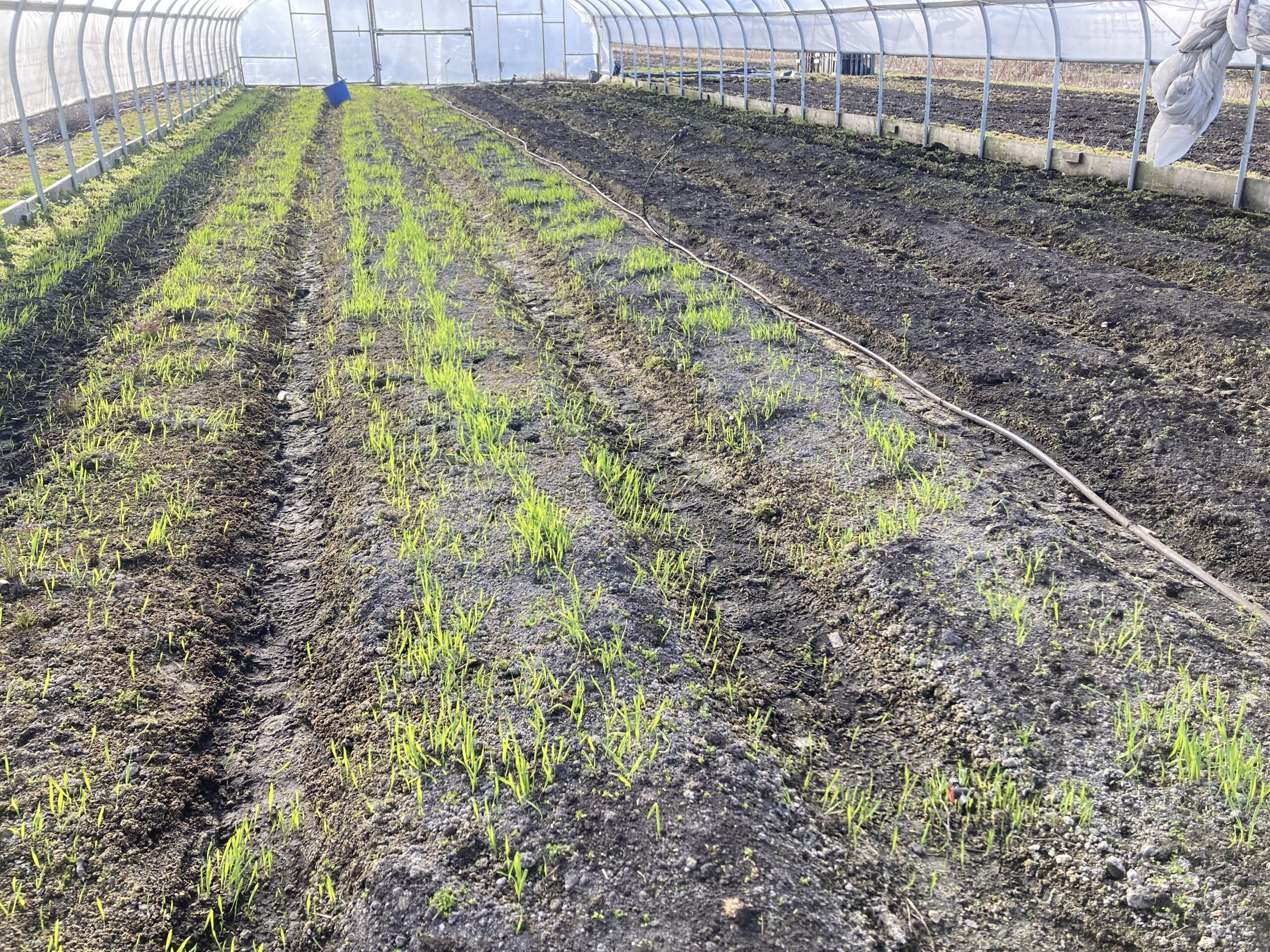
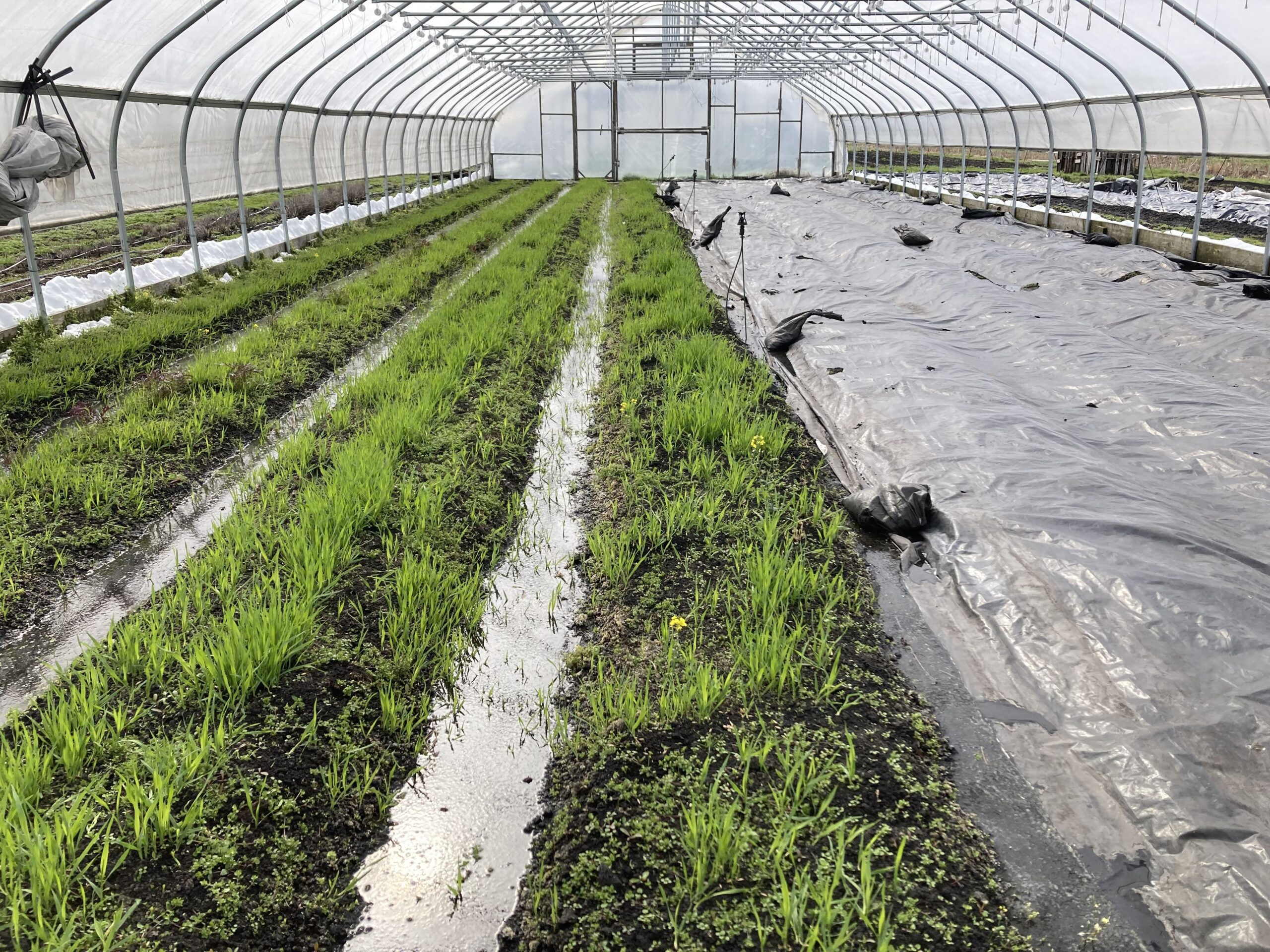
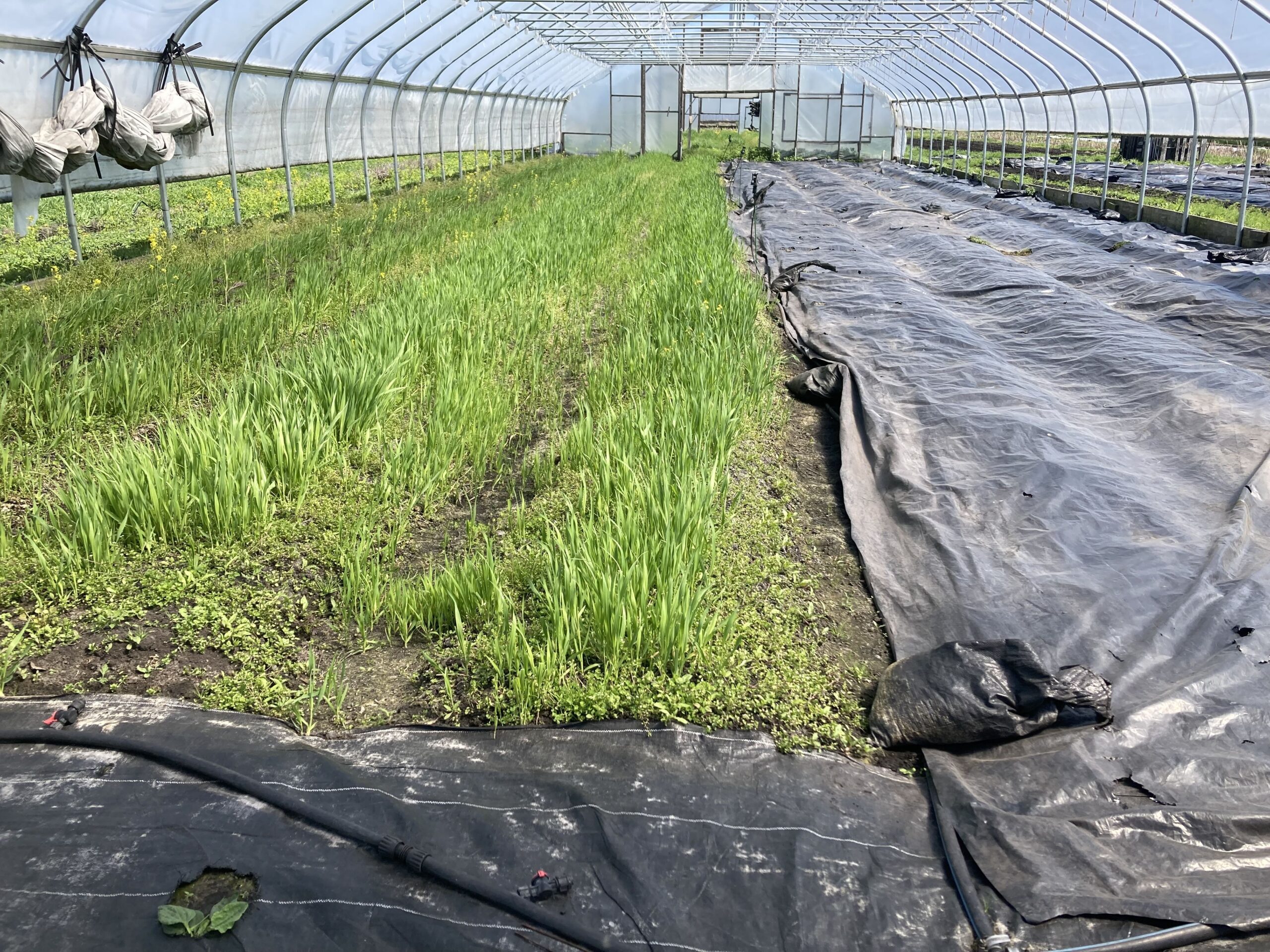
Our research took place in a single 30’ x 96’ high tunnel (High Tunnel 4). Half the tunnel was planted with an oat and white clover cover crop mix on March 5th. The ratio of oats to clover was 9:1. The seeding rate was 5.75lbs oats and .75 lbs of clover for 1500 sq feet. Unfortunately this was not dense enough to establish in the wet soils and to outcompete the weed pressure on the black dirt and impacted the success of the research project. The oats acted as a nursery crop for the clover. Once the clover was established, we mowed the oats on June 10th to terminate that crop. As oats are mildly allopathic, we waited at least 2 weeks for the roots to die back and then planted tomatoes directly into the clover on June 26th. This planting date was massively delayed by flooding from intense rainfall - see Results and Discussion section below.
The other half of the tunnel was tarped. In our application, we had planned to tarp at the same time the oat and clover mix was seeded. In reality, we didn't put a tarp on the Landscape Fabric (LF) block until April 8th. We left that silage tarp on the LF block until we were prepping both blocks for planting. We laid drip tape on both blocks in preparation for planting and landscape fabric on LF block on June 25th. Both LF block and C (Clover) block were planted with tomatoes on June 26th.
Because of the massive amounts of rainfall, we were unable to do appropriate and timely pruning and trellising. Consequently, the two halves of the tunnel were in different states and it did not make sense to track yield.
Ethan Grundberg did come and install granular matrix moisture sensors on July 29th. He has data from the entire latter half of the 2025 season and we will be synthesizing it together this winter as we plan for the 2026 season and our second attempt at a balanced tunnel for research purposes.
It is important to note that the planting period and of our project was majorly delayed due to flooding and in addition, measuring economic viability and productivity was massively impacted due to flooding as well. From April 1st to the end of June, we experienced 14.5 inches of rain with major events necessitating us digging auxiliary trenches on June 19th and following up on June 25th in order to remove water from the tunnel so the soil was drained enough for planting.
The high tunnel continued to be so wet that walking in it was compacting the soil and treacherous (slippery and mucky); consequently, tomato plants were not pruned and trellised in a timely manner. Ideally our tomatoes are planted in mid to late April or by the end of May at the latest. Our seasonal flow then allows us to prune and trellis the tomatoes, giving them a healthy start before the bulk of our other plantings kick in. Because of the delay this season we had massive production pressure during the tomatoes peak care period and they did not get the care they usually would.
We did get to measure moisture on both halves of the tunnel, beginning with moisture sensor installation on July 29th.Our technical advisor, Ethan Grundberg, has all of that data and we have plans to go over it together when we meet in February to lay out plans for this season's research implementation.
Even though we did not get all of the data that we had planned, we were able to share our hypothesis and research methods with other farmers and farm adjacent professionals at multiple events throughout the season. Excitement and interest in the project were quite high as many of our mission aligned visitors are similarly looking for ways to cut down on plastic usage, to build healthier soils and to make tomato growing more economical and efficient.
Due to weather issues and consequential capacity restrictions, we did not get to implement the research project to the extent that we had hoped. We did get some anecdotal as well as numerical data that helped the project to feel somewhat successful. And we did spread the word about the research project and our hypothesis to quite a few people.
We are looking forward to the second year of the project and to having our data collection systems and our implementation timeline more on track.
Education & outreach activities and participation summary
Participation summary:
Rise & Root Farm hosted on farm demos during our season long mentorship with youth from Newburgh, partnering with Our Core. These youth are experiencing agriculture as a supplement to their high school and early college education and came to the farm one day a week during the season. They were able to experience the research high tunnel and to see the impact of the side by side treatment on the soil over the course of the season. Over the course of the season, there were 6 to 10 mentees at the farm from March to October.
In addition, we hosted multiple workshops this season where the research tunnel was an important aspect. These included a Soil Science workshop on 4/17/25 with 30 people, including a mix of youth, current and aspiring farmers; the Chester Academy Ecology class on 5/13/25 with 15 people including 13 ninth graders and two adult teaching staff; and a Low/no till workshop on 7/15/25 with 20 people, again a mix of youth and farmers. In each of these workshops, we walked through the research tunnel, encouraging participants to touch and smell and even taste the difference in the soil that was under cover crop versus landscape fabric, and to notice the visual health of the plants.
We hosted additional workshops and events where the research tunnel was discussed as part of a tour. These included a Pest & Disease Management workshop (with our advisor Ethan Grundberg) on 8/5/25 with 20 people, including farmers and youth. A Hudson Valley Apprenticeship Swap Day where three farmers from Phillies Bridge Farm came to Rise & Root Farm to work and learn on 8/13/25 and a High Tunnels Workshop on 10/18/25 with 20 people, including farmers from as far away as Akron, Ohio. The tunnel was talked about and participants could observe the difference in treatment as well as our research premise.
We hosted two larger Field Day type events where many participants came to the farm and were able to tour around singly or with individual staff. These included our 10 year anniversary event on 4/18/25 with 200 people including at least 50 farmers, and the Black Farmer Fund Abundance Event on 9/27/25 with 150 people, again including at least 50 farmers. The Black Farmer Fund event was at the peak of tomato season and participants would have been able to see the research tunnel at the height of its growth.
Learning Outcomes
As our first year of the research was marred by weather and capacity challenges, we didn't have many hard changes in knowledge.
We do, as a farm, believe that farming in clover feels better. One of our staff noted in the log "I love block C". Workshop participants noticed that the soil in Block C smelled better than the soil in Block LF, especially after being waterlogged.
As researchers, we did learn that in the Black Dirt, we need to sow our cover crop seed much denser than we did this season in order to crowd out the intense weed seed bank. Also sowing more densely to combat the challenging weather conditions (intense wetness) is important to note as well.
Project Outcomes
Staff at the farm, myself perhaps most of all, are very excited to see this practice of planting into clover instead of landscape fabric be successful and expand. The tunnel feels more alive and more resilient with clover cover crop. We cut down on the amount of plastic we use and build more biomass and soil health. It feels like regenerative agriculture at its finest.
Additionally we are excited to be part of a project that could positively impact other farmers.
We are grateful to be strengthening our working relationship with Ethan Grunberg of Cornell Cooperative Extension and looking forward to digging through data with him to make assessments and move forward in a more knowledgeable way. Ethan is excited about the project as well. As a mainly pest and disease focused Extension Agent, when we first showed him our experimental tunnel the year before our research grant, he was very excited and stated "No one ever shows me a win!"
The weather was our biggest challenge this spring. It was difficult to get the project started on time because of the flooded fields and then the delay created a snowball effect and we didn't stay on top of the pruning and trellising that kept the halves of our tunnel as equal as possible.
Additionally, our data gathering materials are somewhat convoluted and need to be reworked to make it easier to compile the data in a way that is easy to read.
This season we will re-implement the research tunnel and work to stay on track with out timeline, collect all the data we want to collect. We've learned from our attempt last season and are excited to create a trial and collect data that shows the benefits of farming tomatoes in clover cover crop.
Black dirt farmers, as well as other farmers who grow tomatoes in high tunnels, would all be interested in this data. People who want to work on building greater soil health and biomass, extension agents who can share this knowledge, ecology students would all be interested. As a side note, herbalists would also be interested in this practice as oat tops, and more sought after milky oat tops, are an important herbal medicine and the cover crop could bring in revenue in addition to bringing better soil health and tomato yields.