Progress report for FW25-025
Project Information
This project aims to investigate the effects of PM feeding versus traditional AM feeding on feed yard cattle performance and heat stress mitigation. Heat stress in feedlot cattle is a significant challenge in the Western region, impacting animal welfare, productivity, and profitability. By shifting feeding times to cooler parts of the day, we hypothesize that pens of cattle fed in PM will have decreased panting scores, increased feed intake, decreased water intake, and improved carcass characteristics (higher carcass weight, better marbling score) compared to AM-fed cattle.
Our research will compare pens of cattle fed in the PM versus AM, measuring panting scores, feed intake, water consumption, and carcass characteristics. We expect PM-fed cattle to show decreased panting scores, increased feed intake, decreased water intake, and improved carcass characteristics compared to AM-fed cattle.
This project addresses a critical need in sustainable agriculture by exploring an innovative, low-cost approach to managing heat stress without requiring significant infrastructure investments. The potential benefits include improved animal welfare, enhanced feed efficiency, and increased profitability for feedlots.
Our comprehensive education plan will disseminate findings through an on-site field day, a peer-reviewed scientific publication, presentations at major industry conferences, and features on the BCI Cattle Chat podcast. This multi-faceted approach will reach a diverse audience of producers, nutritionists, veterinarians, and researchers.
By investigating PM feeding as a heat stress mitigation strategy, this project has the potential to influence industry guidelines, improve cattle welfare, and contribute to the long-term sustainability of beef production in regions facing increasing climate challenges.
Research Objective: Compare daily performance outcomes and carcass characteristics from cattle fed in AM versus PM.
Educational Objective: Our education plan aims to disseminate findings to a diverse audience of stakeholders, including producers, nutritionists, veterinarians, and researchers. We will use multiple communication channels to maximize reach and impact.
April 2025:
- Week 1: Finalize study design and protocols
- Week 2: Record pre-project BCI Cattle Chat podcast episode discussing study design and objectives
- Weeks 3-4: Prepare for cattle arrival and study initiation
May 2025:
- Weeks 1-4: Set up data collection systems and train personnel
- Week 4: Final preparations for cattle arrival
June 2025:
- Week 1 - 4: Cattle arrival and allocation to treatment groups
- Week 1: Daily data collection begins (feed intake, water intake, health observations)
- Week 1: First panting score assessment
July 2025:
- Weeks 1-4: Continue daily data collection and daily panting behavior
- July 15: Host on-site field day
- Prepare presentations and materials (Weeks 1-2)
- Conduct event and collect participant feedback (Week 3)
- Review and analyze feedback (Week 4)
- Week 4: Mid-project team meeting to review progress and address any issues
August-October 2025:
- Weeks 1-4 (August): Continue daily data collection and daily panting behavior
- Week 4 (August): Final body weights collected
- Week 4 (August) - Week 2 (October): Ship cattle to packing plant and collect carcass data
- Weeks 3-4 (October): Draft scientific manuscript and two-page fact sheet
November 2025:
- Weeks 1-2: Start to finalize two-page fact sheet for producers and industry professionals
- Weeks 3-4: Begin preparation for conference presentations
December 2025:
- Weeks 1-2: Complete data analysis and finalize two-page fact sheet distribution
- Weeks 3-4: Continue developing conference presentation materials
January 2026:
- Week 2: Record post-project BCI Cattle Chat podcast episode presenting final results, practical implications, and notification of upcoming educational outreach conferences
- Weeks 3-4: Finalize conference presentations
February-April 2026:
- Submit abstracts to selected conferences (dates TBD)
- Present findings at first selected conference (date TBD)
- Continue manuscript development
May 2026:
- Week 1: Submit manuscript to target journal
- Weeks 1-4: Compile final project report for Western SARE
- Week 4: Submit final report to Western SARE
June-December 2026:
- Present findings at second selected conference (exact date TBD)
- Continue to track impacts of published manuscript and fact sheet
- Respond to any inquiries or requests for additional information resulting from conference presentations and podcast episodes
Throughout 2025-2026:
- Continuously monitor and record:
- Downloads and distribution of the fact sheet
- Citations of the published manuscript
- Inquiries resulting from conference presentations and podcast episodes
- Industry feedback and potential adoption of PM feeding strategies
Cooperators
- - Technical Advisor
Research
A pen-level randomized controlled trial was conducted at a commercial feed yard in the Pacific Northwest during the summer of 2025. Terminally sorted steers housed on roller-compacted concrete were enrolled at terminal sort and randomly assigned to one of two treatment groups: AM-fed (positive control, standard morning feeding schedule) or PM-fed (evening feeding with deliveries at 8pm, 11pm, and 2am). Cattle were enrolled across 8 blocks between June 4 and September 25, 2025.
Study parameters:
|
Parameter |
AM-Fed |
PM-Fed |
|
Total head count |
3,924 |
3,924 |
|
Total pens (n) |
24 |
24 |
|
Avg. enrollment weight (lbs) |
1,324 |
1,323 |
|
Enrollment blocks |
8 |
8 |
|
Study period |
June 4 – Sept 25, 2025 |
|
|
THI ≥80 (% of study days) |
14% |
|
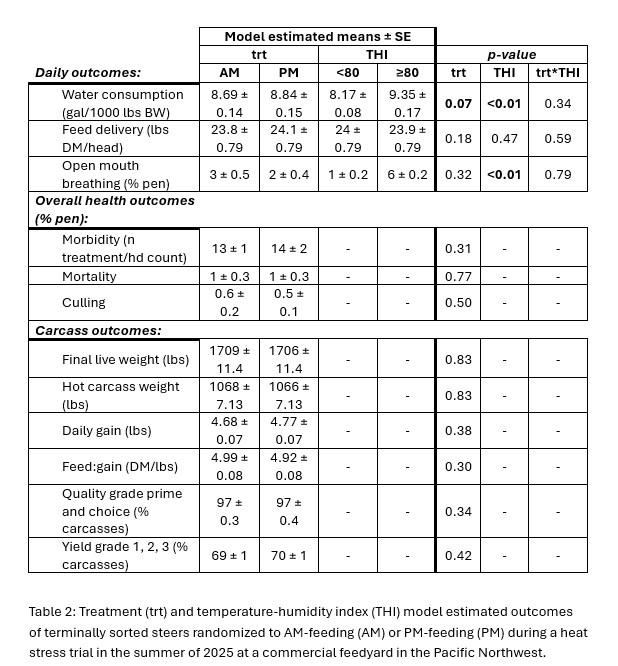
Daily data collection included feed delivered (dry matter basis), water consumption (gallons per pen), health events (morbidity, mortality, culling), and panting behavior assessed by open mouth breathing prevalence at the pen level. Panting behavior was assessed daily with photographs taken from the front and back of each pen, scoring the proportion of animals exhibiting open mouth breathing. Carcass data collected at harvest included final live weight, hot carcass weight, daily gain, feed-to-gain ratio, quality grade (proportion grading prime and choice), and yield grade. Temperature-humidity index (THI) was captured throughout the study period.
Statistical analysis was conducted using linear mixed effects models and generalized linear mixed effects models. Models included treatment (AM vs. PM) and THI category (<80 vs. ≥80) as fixed effects, with appropriate random effects to account for pen-level clustering and enrollment block. Analysis was performed by the Beef Cattle Institute at Kansas State University (M. Mancke, B.J. White, E.M. Bortoluzzi, R.L. Larson).
Summary of findings:
PM feeding was successfully implemented across all 24 treatment pens with feedings at 8pm, 11pm, and 2am. The transition to PM feeding was accomplished without operational issues. No statistically significant differences were observed between AM- and PM-fed groups for any measured outcome. See chart above.
Discussion:
The absence of statistically significant differences between AM- and PM-fed groups is itself a meaningful finding. Key considerations include:
- Successful commercial implementation: PM feeding was operationally feasible at commercial scale with no adverse effects on performance, health, or carcass quality. This demonstrates feed yards can adopt PM feeding without risk of performance losses.
- Heat exposure context: Only 14% of study days had THI ≥80, which may have limited the opportunity to detect treatment differences. The significant main effect of THI on water consumption (p<0.01) and open mouth breathing (p<0.01) confirms cattle responded physiologically to heat regardless of feeding time, consistent with published literature.
- Water consumption tendency: The tendency for PM steers to consume more water (p=0.07) is a novel observation warranting further investigation and may relate to timing of metabolic heat production relative to environmental temperature peaks.
- Literature contribution: Limited peer-reviewed research exists on night-time feeding in feedlot cattle. This study provides rigorous, commercially relevant data filling a gap in the literature, establishing a foundation for future research under more sustained heat stress conditions.
- Further research recommended: Future studies should evaluate PM feeding under conditions with a higher proportion of days exceeding THI ≥80, potentially in more southerly locations or during more extreme heat years, to better test the hypothesis that shifting metabolic heat production to cooler periods provides measurable benefit.
Research outcomes
Producers considering PM feeding as a heat stress mitigation strategy should be aware that under moderate heat conditions (14% of study days with THI ≥80), our trial found no significant performance advantages over traditional AM feeding. However, PM feeding was successfully implemented at commercial scale with no adverse effects on cattle performance, health, or carcass quality, meaning producers can trial this approach without risk of performance losses.
Based on our findings, we recommend the following for sustainable agricultural production and future research:
PM feeding should not be dismissed as a heat stress tool based on this single trial. The relatively low proportion of days with THI ≥80 during our study period may have limited our ability to detect treatment differences. Future studies should evaluate PM feeding in locations or years with more sustained heat stress — particularly in the Southern Plains or desert Southwest where THI ≥80 conditions are more prevalent and prolonged.
The significant THI effects on water consumption and open mouth breathing observed across both treatment groups confirm that heat stress remains a meaningful challenge for feedlot cattle in the Western region. Producers should continue investing in heat stress monitoring, including daily panting behavior assessment, which proved to be a practical and effective indicator in our study.
Further research should evaluate PM feeding under conditions with a higher proportion of days exceeding THI ≥80, as well as whether PM feeding effects differ across cattle types, weights, or acclimatization periods. Exploring whether PM feeding combined with other management strategies produces additive benefits may also be warranted.
Education and Outreach
Participation summary:
Our education plan disseminates findings to a diverse audience of stakeholders through multiple communication channels.
Completed outreach activities:
- On-Site Field Day — Agricultural Financial Professionals (Summer 2025)
An on-site field day was conducted during the active trial for agricultural financial professionals from the banking industry (approximately 5–10 attendees). Participants toured AM- and PM-fed pens side-by-side, observed open mouth breathing assessment methodology, reviewed feed delivery timing (8pm, 11pm, 2am for evening groups), and discussed daily performance monitoring systems. Attendees received a field day flyer acknowledging Western SARE funding and were provided a feedback survey. The group lead completed the survey, rating understanding of heat stress challenges, evening feeding strategy, and Beef Northwest’s sustainability initiatives at 5/5 (highest rating) across all categories, and indicated willingness to share findings with colleagues and consider the research when making lending decisions. This audience was strategically selected because agricultural financial professionals maintain extensive networks of ranchers and producers and serve as influential intermediaries for adoption of sustainable practices.
- On-Site Field Day — Agricultural Industry Professionals (Summer 2025)
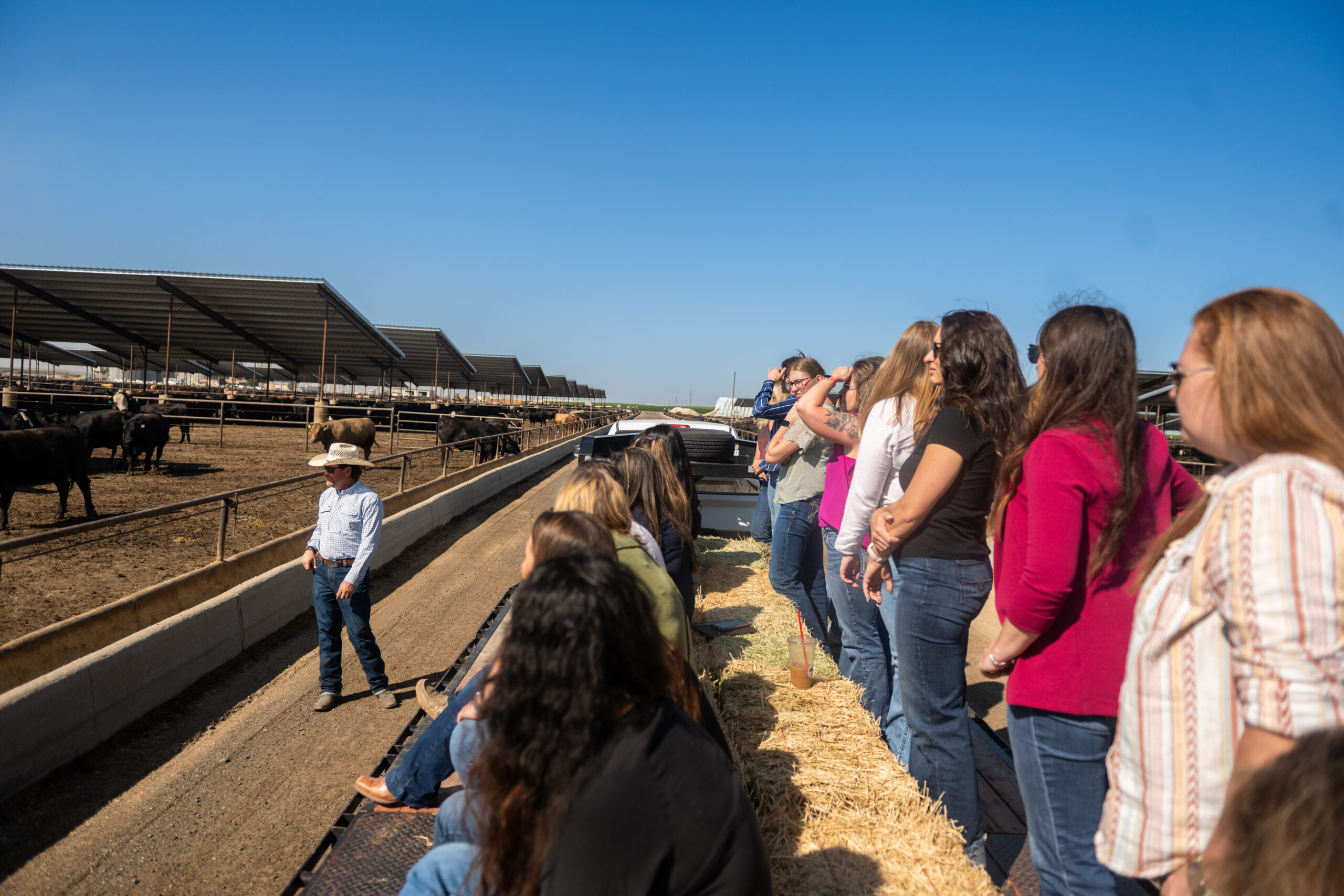
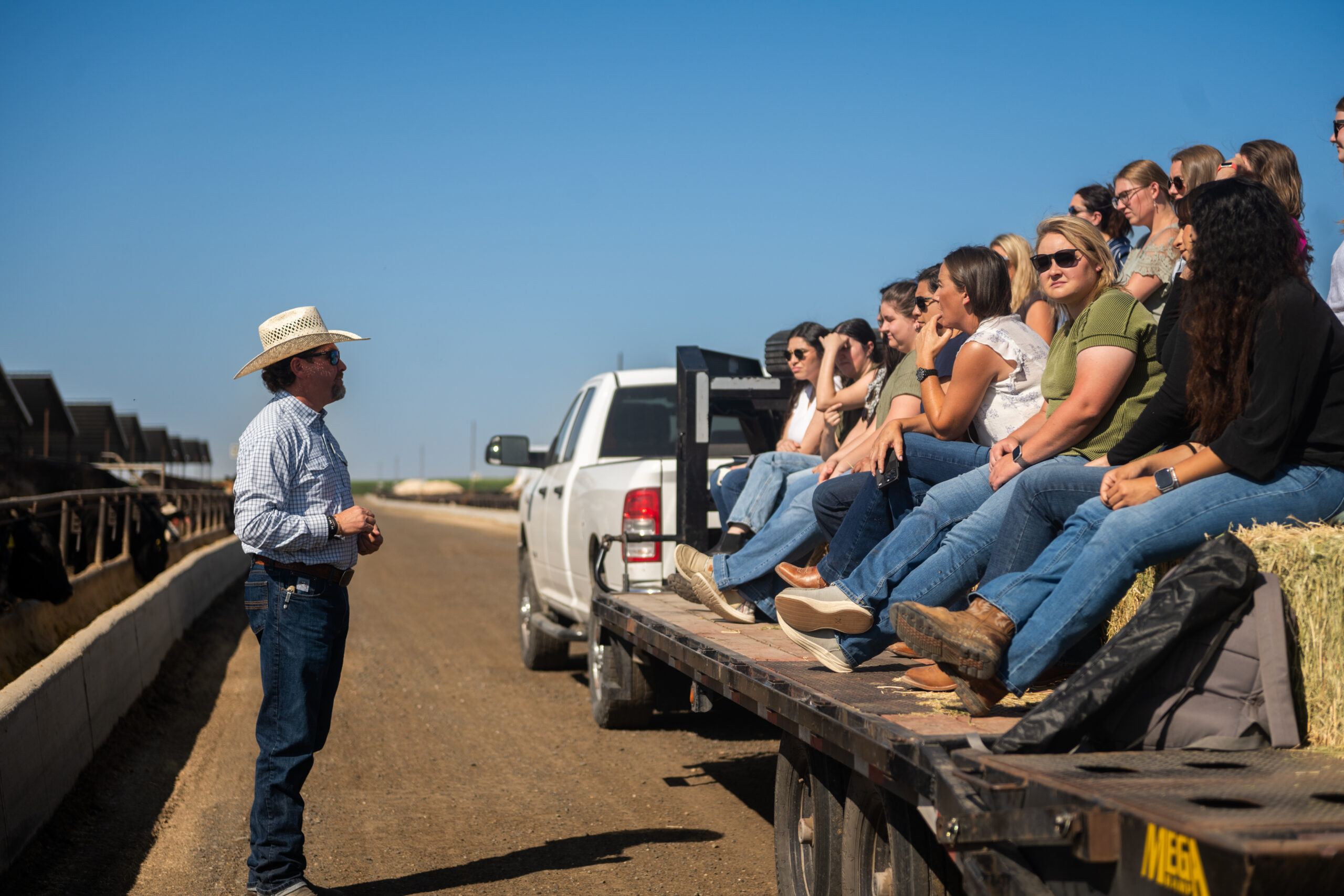
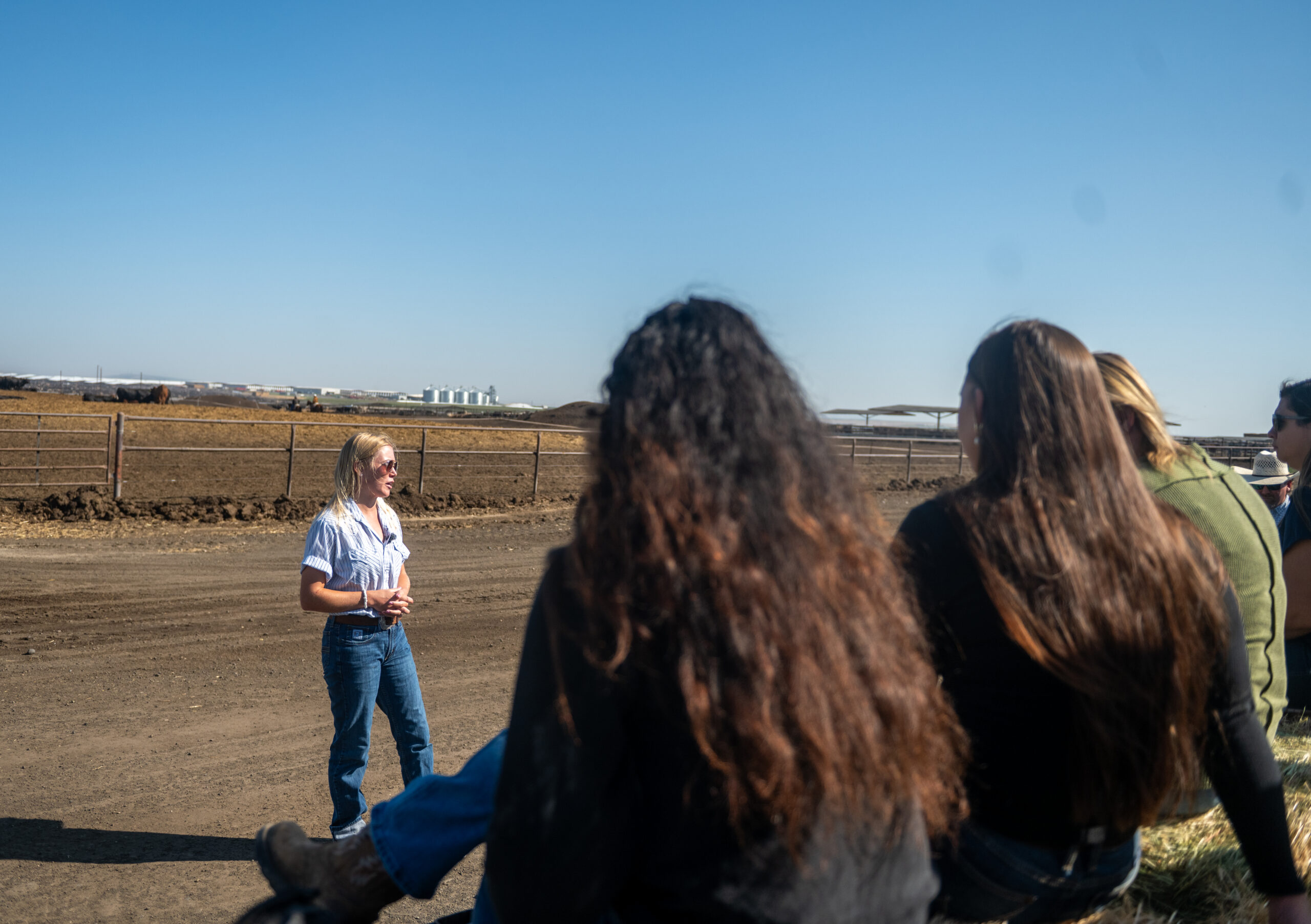
A second field day was conducted during the active trial for approximately 38 agricultural professionals representing grow yards, cow-calf operations, and cattle trucking companies. The event featured a formal presentation by Madeline Mancke on study design and preliminary observations, co-facilitated by Wes Killion. Attendees received the field day flyer acknowledging Western SARE funding. Photos and video were captured during the presentation. This event reached a diverse cross-section of the beef supply chain, exposing multiple industry segments to the research and the SARE program.
- Kansas State University Collegiate Cattlemen’s Club Presentation (February 17, 2026)
Presented to the Kansas State University Collegiate Cattlemen’s Club (Department of Animal Sciences and Industry) on February 17, 2026, delivering a ~45-minute presentation to approximately 30 students on heat stress and heat stress mitigation strategies in the feed yard sector, including the PM-feeding trial results. This presentation reached the next generation of beef industry professionals and introduced them to SARE-funded on-farm research as a model for producer-driven innovation.
- BCI Cattle Chat Podcast
The Beef Cattle Institute’s Cattle Chat podcast featured the PM-feeding research in a May 2025 episode that reached 1,683 listeners and was rated 94% impactful by the audience. A follow-up episode with full trial results is scheduled for release in March. The release will be promoted on Instagram, tagging the Western SARE grant program and directing followers to the project page at projects.sare.org for additional information.
Planned outreach activities:
- Plains Nutrition Council Conference (April 8–10, 2026, San Antonio, TX)
An abstract, research poster, and 3-minute video presentation have been submitted; awaiting acceptance. If accepted, will present scientific findings.
- Western Section Animal Science Conference (June 1–4, 2026, Estes Park, CO)
Planned presentation of research findings.
- Oregon Ag in the Classroom — Virtual Farm Field Trip (May 14, 2026, 9:30–10:00 AM)
A Virtual Farm Field Trip is scheduled for May 14, 2026 (9:30–10:00 AM) through the Oregon Agriculture in the Classroom Virtual Field Trip program (oregonaitc.org/programs/virtual-farm-field-trips/). Oregon AITC is a statewide 501(c)(3) nonprofit affiliated with Oregon State University’s College of Agricultural Sciences that provides free agricultural curriculum, resources, and training to K–12 educators across Oregon. Their programs reached nearly 19,500 students through their literacy project alone in 2024. Virtual Field Trips are a free, Zoom-based format allowing students to interact with agricultural producers in real time, with Q&A. This 30-minute presentation will introduce SARE-funded on-farm research to classrooms statewide.
- Peer-Reviewed Manuscript (In Preparation)
A manuscript is in preparation covering heat stress effects on cattle performance, current mitigation strategies, study methods, results, and discussion relating findings to published work. The research team includes M. Mancke, B.J. White, E.M. Bortoluzzi, and R.L. Larson (Beef Cattle Institute, Kansas State University). Target submission: mid-2026.
Learning outcomes to date:
- Field day participants demonstrated increased understanding of heat stress challenges, evening feeding as a mitigation strategy, and our sustainability initiatives (rated 5/5 across all categories by survey respondent).
- Field day attendees indicated willingness to share findings with colleagues, extending reach beyond direct participants.
- Attendees indicated willingness to consider this research when making agricultural lending decisions, demonstrating potential for the research to influence financial support for sustainable practices.
- Podcast audience engagement: 1,683 listeners for the May 2025 episode with 94% impact rating, indicating strong relevance and accessibility of the content for producer audiences.
- Collegiate Cattlemen’s Club members were exposed to SARE-funded on-farm research methodology, supporting development of the next generation of producer-researchers.
- Multiple industry segments reached: agricultural financial professionals, grow yard operators, cow-calf producers, cattle trucking professionals, college students, and podcast listeners spanning producers, nutritionists, veterinarians, and researchers.
Anticipated future outcomes:
- Conference presentations at PNC and Western Section Animal Science will expose findings to approximately 1,000+ industry professionals.
- Oregon Ag in the Classroom partnership will introduce sustainable agriculture research concepts to K–12 educators who collectively reach thousands of Oregon students.
- Peer-reviewed publication will make findings permanently available in the scientific literature for citation and replication.
- Instagram promotion of the March 2026 podcast episode will drive traffic to the SARE project page, increasing visibility of both the findings and the SARE program.
Education and Outreach Outcomes
Multi-channel outreach proved most effective for disseminating results. On-site field days during the active trial allowed attendees to observe AM vs. PM pens in real time, which generated strong engagement. Presentations gave audiences both the practical and scientific perspective, which was well received. Podcast episodes through BCI Cattle Chat reached the broadest audience (1,683 listeners, 94% impact rating). We recommend that future SARE-funded cattle research projects leverage multiple existing industry podcast platforms for dissemination, as producer audiences are already engaged there. Virtual field trips through programs like Oregon Ag in the Classroom offer a zero-cost way to extend findings to K-12 educators and students statewide.
Understanding of heat stress physiology in feedlot cattle and the relationship between feeding time, metabolic heat production, and environmental heat load
Awareness of evidence-based, low-cost management strategies for heat stress mitigation that require no infrastructure investment
Understanding of on-farm research methodology and how producers can partner with researchers to conduct rigorous trials
Importance of environmental stewardship and forward-thinking management in beef production, including proactive approaches to climate adaptation
Value of animal husbandry practices grounded in science — using data-driven decision making to evaluate welfare interventions rather than relying on assumptions and or trends