Final report for GNC23-365
Project Information
Kansas State University, Grain Craft, and in collaboration with farmers (Knopf, Jordan, and Guetterman Brothers) built a team to provide integrated research, extension, and education efforts to farmers and future agriculture generations in understanding the role of regenerative agriculture practices on grain nutritional quality. The adoption of conservation practices has the potential to be a relevant path not only for food security but also for biofortification. Despite the wide range of soil health benefits through the adoption of no-tillage systems and cover crops, the effect of these practices on grain nutritional quality remains unknown. This project was built upon the two current on-farm networks (RAIN Farmer to Farmer Network and the Kansas Soil Health Network) and was conducted in collaboration with farmers across the state (Knopf, Solomon, KS; Jordan, Beloit, KS; and Guetterman Brothers, Bucyrus, KS). The goals for this project were to: i) evaluate the effect of the adoption of cover crops in grain nutritional quality of wheat and soybean crops, ii) assess the interaction between management, environment (soil x weather), crop yield, and grain nutrient density under enhanced agricultural practices, and iii) inform farmers on potential opportunities to obtain a differential price due to grain quality segregation and explore premium prices via new markets. The research was conducted using a randomized complete block design that compared a farmer-standard treatment (no-till) with an improved treatment (no-till + cover crops). Wheat was evaluated at Solomon and Beloit, KS, and soybean at Beloit and Bucyrus, KS. Grain was analyzed for protein, oil, and mineral concentrations (including zinc, phosphorus, iron, potassium, magnesium, and calcium). Alongside the research, the team delivered field days at the on-farm sites and extension presentations. Through these activities, farmers, students, legislators, and the general public gained an evidence-based understanding of how cover crops relate to grain quality and of the environmental factors that most influence grain composition. Cover crops did not significantly change grain nutritional quality for the large majority of parameters in either wheat or soybean. One exception was wheat grain protein, which was significantly higher under the no-cover treatment than under cover crops at both Solomon and Beloit. Across the remaining wheat minerals and all measured soybean parameters (protein, oil, and minerals), no significant difference between cover-crop and no-cover treatments was detected. Where grain composition did differ, site and environment were the dominant drivers — more influential than the cover-crop treatment itself. The practical implication for the project's premium-market goal is that cover cropping on its own did not create a measurable grain-quality differential over the study period; environment, crop, and site were the stronger determinants of grain nutritional quality.
Learning outcomes: (1) provide integrated and continued extension and education benefitting farmers to understand the advantages of regenerative agriculture practices on grain quality; (2) develop new foundational knowledge that can help farmers access to differentiated grain markets and receive premium prices for their products; (3) assist on improving quality of life, as well as the financial well-being, of farmers and surrounding communities through the use of regenerative agricultural practices, food production with improved grain quality, and conservation of natural resources. The action outcomes for this project will be: (1) improve wheat and soybean grain nutritional quality through the adoption of regenerative agricultural practices (cover crops); (2) explore new market niches to commercialize grain with better nutritional composition; (3) assist on improving farmer and community’s overall quality of life, economic well-being, and knowledge about better agronomic practices that can improve short and long-term sustainability. The sum of all these outcomes will help us to understand better the relationship between management, yield, and nutrient content on wheat and soybean grain. Furthermore, we also expect to generate knowledge that will improve farming practices in the North Central region.
Research
Sites and Treatments Descriptive
This project was built upon the RAIN Farmer to Farmer Network and the Kansas Soil Health Partnership and intended to be a complement on the on-farm soil research already being conducted for more than three years located in the Jordan’s Farm in Beloit - KS, Flickner’s Innovation Farm in Moundridge-KS, and Knopf’s Farm located in Solomon-KS (Figure 1). The soil health assessment is conducted with soil sampling for soil health measurements being taken every 3 years. The study design consists of a randomized complete block design with four replications and with GPS-coordinated sampling points for the 3 study sites. The treatments consist of each of the farmer standard agronomic practices (no-till) and the improved practices (no-till + cover crops). The coordinates, elevation, average annual precipitation, average annual temperature, and soil taxonomy for the three on-farm research sites are described in Table 1.
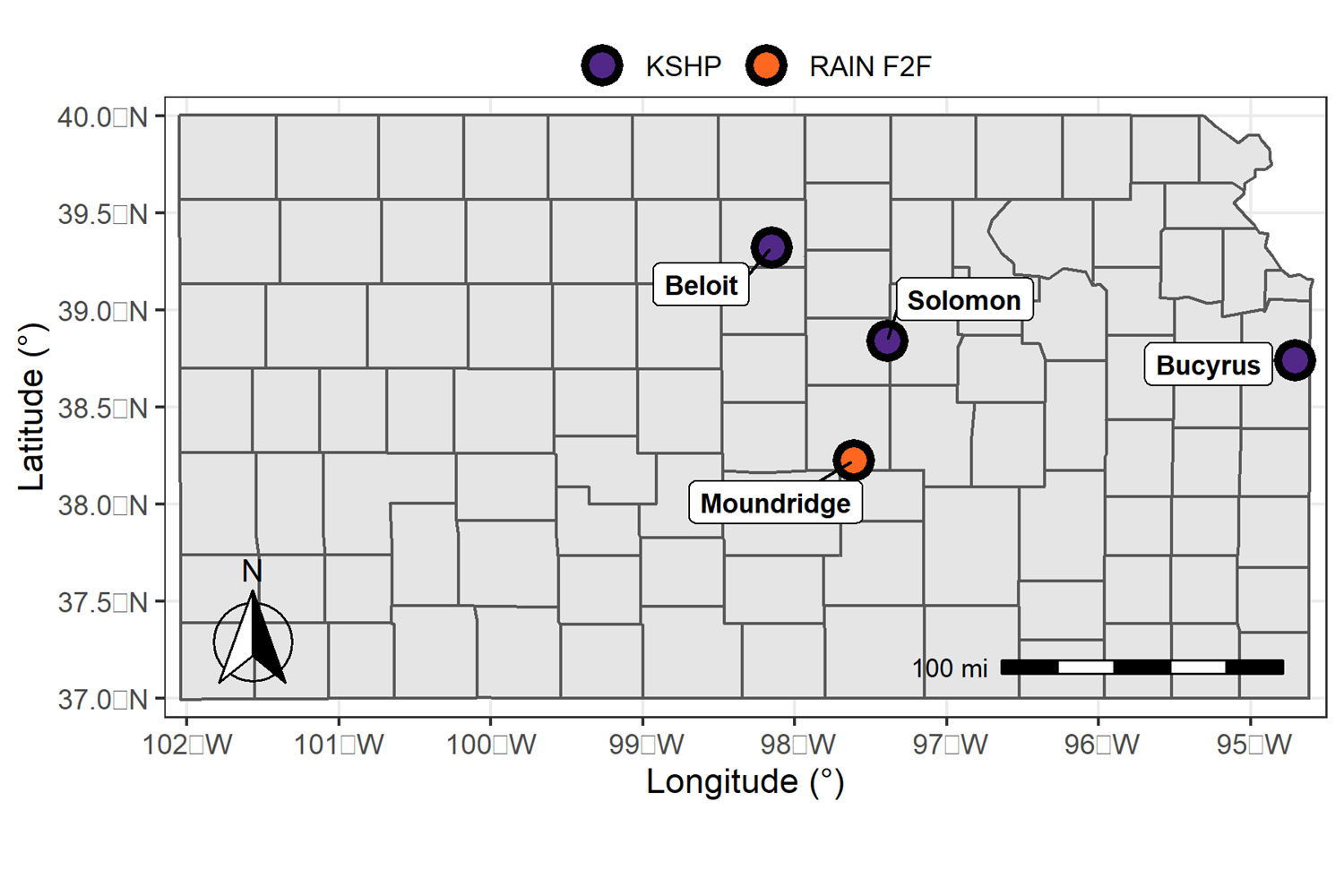
Table 1. Site name, coordinates, elevation, soil type, average annual precipitation, and average annual temperature.
|
Site |
Coordinates |
Elevation |
Soil type |
Average annual precipitation |
Average annual temperature |
|
|
|
m |
|
mm |
°C |
|
Beloit |
39.3226N -98.1545W |
460 |
Fine, smectitic, mesic Typic Argiustoll |
700 |
12 |
|
Bucyrus |
38.7395N -94.7068W |
341 |
Fine, smectitic, mesic Aquertic Argiudoll |
998 |
13 |
|
Solomon |
38.8406N -97.3928W |
381 |
Fine, mixed, superactive, mesic Pachic Argiustoll |
848 |
13 |
Grain samples were taken immediately before harvest for each GPS-coordinated sampling point within each replicate of the treatments and placed in plastic/paper bags and placed in insulated boxes containing ice. The parameters analyzed include wheat and soybeans grain mineral (Calcium, Phosphorus, Magnesium, Zinc, Iron, Manganese, Copper, Sulfur, Sodium and Molybdenum), wheat and soybeans grain oil and protein concentration, wheat and soybeans grain’s amino acid concentration (glutamic acid, linolenic acid, linoleic acid, oleic acid, palmitic acid, aspartic acid, and stearic acid), and wheat grain’s test weight (Table 1).
Data analysis
The grain dataset was spatially transformed into an sf object using latitude and longitude coordinates from the GPS sampling points before statistical analysis (Pebesma & Bivand, 2023). Grain data were analyzed separately for each site and year to account for spatial and temporal variation across the on-farm network. For each crop, linear mixed models from the nlme R package (Pinheiro & Bates, 2000) were used to quantify the effects of cover cropping and year on grain nutritional composition. Treatment in each year-location combination was treated as a fixed effect, while replications (blocks) were treated as random effects to account for non-independence among observations within sites. Model residuals were examined to verify assumptions of normality and homoscedasticity, and yield values were transformed when necessary to meet model assumptions. The normality of the model’s residuals was tested using the Shapiro-Wilk test, and square root transformations were used when necessary. Exponential, spherical, Gaussian, and rational spatial correlation structures were tested in each model, and the spatial correlation structure was selected using the Akaike Information Criterion (AIC). Model means were extracted using the emmeans package in RStudio (version 2024.4.1.748) (R Core Team 2025), and pairwise comparisons were performed to assess significant differences between treatments for the fixed effects. The significance levels for all tests reported in this study were evaluated using p-values level of 0.05. All statistical analyses were performed in R (R Core Team, 2025), and all figures were generated using the ggplot2 package (Wickham, 2016).
References
Pebesma, E., & Bivand, R. (2023). Spatial Data Science: With Applications in R. Chapman and Hall/CRC. https://doi.org/10.1201/9780429459016
Pinheiro, J. C., & Bates, D. M. (Eds.). (2000). Fitting Nonlinear Mixed-Effects Models. In Mixed-Effects Models in S and S-PLUS (pp. 337–421). Springer. https://doi.org/10.1007/0-387-22747-4_8
Wickham, H. (2016). Getting started with ggplot2. In H. Wickham, Ggplot2 (pp. 11–31). Springer International Publishing. https://doi.org/10.1007/978-3-319-24277-4_2
Results
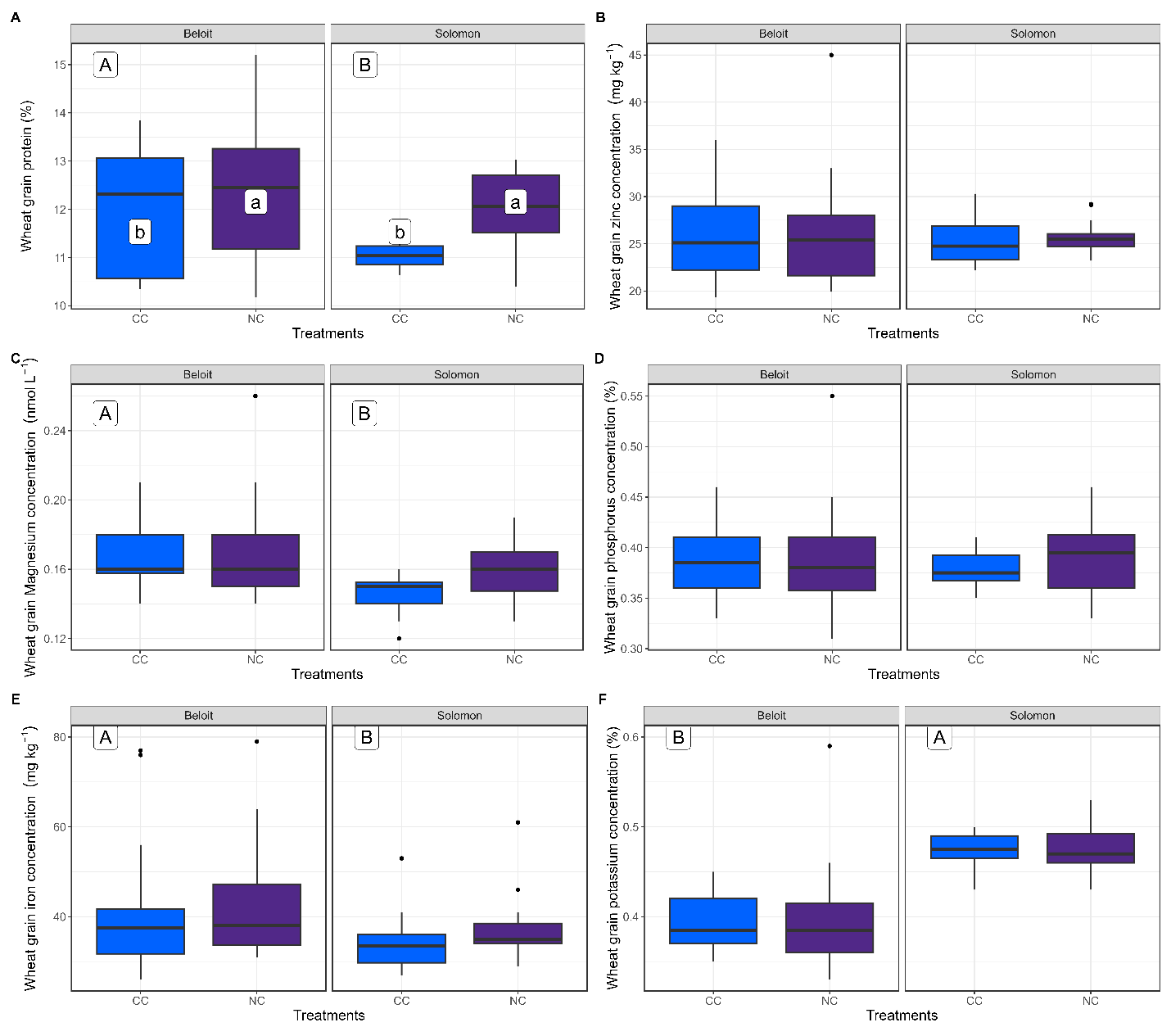
For wheat, grain protein concentration was the most responsive indicator, showing a tendency toward higher values in the no cover crop treatment in both Beloit and Solomon. In contrast, other grain nutrient concentrations (zinc, magnesium, phosphorus, iron, and potassium) had minor differences between treatments, with variability largely driven by site-specific conditions rather than management effects (Fig. 1).
For soybean, protein and oil concentrations had minimal differences between treatments across locations (Fig. 2). Micronutrients such as zinc, iron, and magnesium, as well as macronutrients such as phosphorus, potassium, and calcium, showed no significant differences between treatments at any location. In some cases, small increases in nutrient concentrations were observed under the no-cover treatments; however, these differences were not consistent across sites or variables, suggesting limited significance.
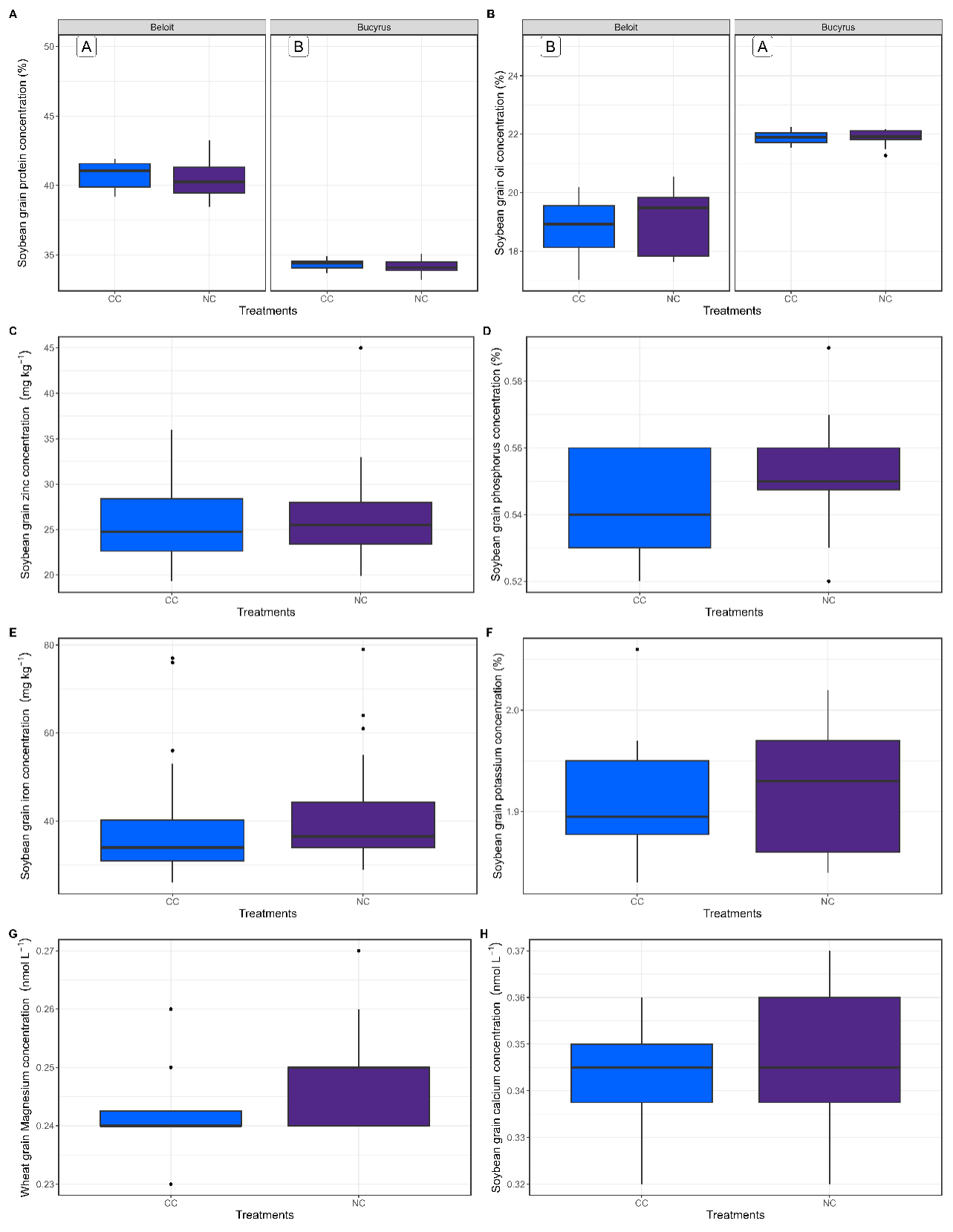
Figure 2. Treatment differences in soybean protein (A), oil (B), zinc (C), phosphorus (D), iron (E), potassium (F), magnesium (G), and calcium (H) concentrations in cover crop (CC) and no-cover (NC) treatments. Uppercase letters indicate significant differences between locations, and lowercase letters indicate significant differences between treatments within each location.
Discussion
Cover crop adoption within a well-established no-tillage system produced few measurable changes in the nutritional composition of wheat and soybean grain across the site as years evaluated in this project. These results contrast with the expectation that regenerative agriculture practices increase grain nutrient density (Montgomery & Biklé, 2021). Most of the variation detected in the results occurred among locations rather than between treatments, indicating that soil and environmental conditions, rather than cover cropping, were the main drivers of the observed results of grain quality.
Wheat grain protein was the only response influenced by treatment, and it was higher under the no-cover crop treatment (NC) at both Beloit and Solomon. This pattern is consistent with wheat nitrogen physiology, where grain protein concentration depends upon crop nitrogen uptake and remobilization to the grain, particularly nitrogen acquired during and after anthesis (Bogard et al., 2010; Sharma et al., 2023). High carbon-to-nitrogen residues immobilize soil nitrogen during decomposition and reduce the supply available to the subsequent crop, and this effect is well documented for cereal cover crops (Preza-Fontes et al., 2022). Where non-legume covers precede wheat, a transient reduction in available nitrogen is the most parsimonious explanation for the lower grain protein levels observed. The effect is species- and management-dependent and would be expected to diminish under legume covers or nitrogen application timed to grain-filling stages. Moreover, protein concentration must also be interpreted in the context of the dilution effect. Grain protein and yield are inversely related in cereals because a largely fixed pool of grain nitrogen is distributed across a variable carbohydrate mass, where higher yields therefore dilute protein concentration even when nitrogen uptake is constant (Simmonds, 1995). The same principle applies to grain minerals, where declines in wheat grain zinc, iron, copper, and magnesium over 160 years were attributed to increasing yield and harvest index rather than to reduced soil nutrient supply (Fan et al., 2008). Small, inconsistent concentration differences among treatments are consistent with this mechanism when yield and nutrient uptake vary between fields, years, and locations.
Soybean protein and oil did not differ between treatments at either location, and the significant differences occurred between Beloit and Bucyrus. As a nitrogen-fixing legume, soybean is buffered against nitrogen fluctuations induced by cover crops, and grain composition is governed primarily by genotype and by environmental conditions during grain fill, especially temperature and water availability (Piper & Boote, 1999; Rotundo & Westgate, 2009). Regional surveys confirm that protein and oil concentration in soybean vary more with the environment than with agronomic inputs (Assefa et al., 2019). The observed site differences therefore reflect environmental control rather than treatment differences. Grain mineral concentrations had the same pattern, where bi whet or soybean mineral concentrations differed by treatment. Grain mineral concentration is strongly mediated by soil properties and genotype, with management effects that are small and inconsistent over short periods (Gómez-Becerra et al., 2010). Thus, the two-year duration of this study was perhaps insufficient to resolve gradual changes in nutrient cycling attributable to cover crops, and any such signal was masked by larger differences between fields, years, and locations.
For the market objective of this project, cover cropping did not generate a grain-quality differential exploitable as a nutritional premium within the study period. Crops, sites, and environments were the dominant drivers of the variability observed in grain nutritional composition. This conclusion, however, does not diminish the established benefits of cover crops for soil health, but it indicates that grain nutritional quality is not a short-term outcome of their adoption. It is also consistent with reports that farmers express interest in composition-based premiums while lacking baseline data on their own grain quality (Borja Reis et al., 2022). Resolving these smaller, slower effects of cover crops on grain composition will require multi-year datasets and trials that pair specific cover crop species with defined nitrogen management to separate the effects of nitrogen supply, crop yield, and nutrient concentration.
References
Assefa, Y., et al. (2019). Assessing variation in US soybean seed composition (protein and oil). Frontiers in Plant Science, 10, 298. https://doi.org/10.3389/fpls.2019.00298
Bogard, M., Allard, V., Brancourt-Hulmel, M., et al. (2010). Deviation from the grain protein concentration–grain yield negative relationship is highly correlated to post-anthesis N uptake in winter wheat. Journal of Experimental Botany, 61, 4303–4312. https://doi.org/10.1093/jxb/erq238
Borja Reis, A. F., et al. (2022). Soybean management for seed composition: the perspective of U.S. farmers. Agronomy Journal, 114(4), 2608–2617.
Fan, M.-S., Zhao, F.-J., Fairweather-Tait, S. J., Poulton, P. R., Dunham, S. J., & McGrath, S. P. (2008). Evidence of decreasing mineral density in wheat grain over the last 160 years. Journal of Trace Elements in Medicine and Biology, 22(4), 315–324. https://doi.org/10.1016/j.jtemb.2008.07.002
Gómez-Becerra, H. F., et al. (2010). Genetic variation and environmental stability of grain mineral nutrient concentrations in Triticum dicoccoides under five environments. Euphytica, 171, 39–52. https://doi.org/10.1007/s10681-009-9987-3
Montgomery, D. R., & Biklé, A. (2021). Soil health and nutrient density: beyond organic vs. conventional farming. Frontiers in Sustainable Food Systems, 5, 699147. https://doi.org/10.3389/fsufs.2021.699147
Piper, E. L., & Boote, K. J. (1999). Temperature and cultivar effects on soybean seed oil and protein concentrations. Journal of the American Oil Chemists' Society, 76(10), 1233–1241. https://doi.org/10.1007/s11746-999-0099-y
Preza-Fontes, G., et al. (2022). Corn yield response to starter nitrogen rates following a cereal rye cover crop. Crop, Forage & Turfgrass Management, 8(1), e20187. https://doi.org/10.1002/cft2.20187
Rotundo, J. L., & Westgate, M. E. (2009). Meta-analysis of environmental effects on soybean seed composition. Field Crops Research, 110(2), 147–156. https://doi.org/10.1016/j.fcr.2008.10.004
Sharma, S., Kumar, T., Foulkes, M. J., et al. (2023). Nitrogen uptake and remobilization from pre- and post-anthesis stages contribute towards grain yield and grain protein concentration in wheat grown in limited nitrogen conditions. CABI Agriculture and Bioscience, 4, 29. https://doi.org/10.1186/s43170-023-00153-7
Simmonds, N. W. (1995). The relation between yield and protein in cereal grain. Journal of the Science of Food and Agriculture, 67(3), 309–315. https://doi.org/10.1002/jsfa.2740670306
Educational & Outreach Activities
Participation summary:
Results obtained from Jordan's Farm location in Beloit-KS , Guetterman Brother's Family Farm in Bucyrus-KS, and Knopf Farms in Solomon-KS were communicated on four occasions in events promoted by federal, state, and local agencies. The public impacted was farmers, ranchers, researchers, consultants, extension agents, graduate students, as well as the general public. We collected additional samples at the three locations to generate a more robust dataset and be able to fill this knowledge gap with a more robust analysis and conclusions.
- Field Day at Knopf Farm, 130 attendees. Solomon, KS.
- Field Day at Guetterman Brothers Family Farm, 130 attendees. Bucyrus, KS.
- Regenerative Ag talk at Flickner Innovation Farm, 50 attendees. Inman, KS.
- Regenerative Ag presentation to industry partners (King Arthur and Farmer Direct) in Hays, KS. 50 attendees.
- Presentations at scientific conferences made by Dr. Charles W. Rice. > 150 attendees,
- Peer-reviewed publication at the end of the project in progress.
- Extension publications regarding regenerative agriculture practices and their correlations and effects on grain quality, as well as the links of soil health – plant health – human health (one health), in progress.
Project Outcomes
This project contributes to agricultural sustainability primarily by establishing an evidence-based expectation for the relationship between regenerative practices and grain nutritional quality. By demonstrating that cover crops did not measurably improve grain nutrient density over the study period, and that site and environment were the dominant drivers of grain composition, the project provides farmers with realistic guidance for practice and investment decisions. This is a durable contribution: it prevents the misallocation of resources toward cover cropping as a grain-quality strategy while directing attention to the factors, crop selection, environment, and nitrogen management, that actually govern grain composition.
The economic benefits are largely protective and informational. The results indicate that cover cropping does not, on its own and within a short time frame, generate a grain-quality differential that can be marketed as a nutritional premium. Communicating this outcome helps farmers avoid committing to composition-based market strategies that current evidence does not support, and reframes the economic case for cover crops around their established returns in erosion reduction, nutrient retention, and long-term soil productivity rather than around uncertain grain-quality premiums. The finding also identifies where premium opportunities are more plausibly located—in matching site, environment, and variety, which can inform future marketing and segregation efforts.
The environmental benefits derive from reinforcing the continued adoption of conservation practices on the correct rationale. The project affirms that the value of cover crops lies in their well-documented contributions to soil health, water retention, and reduced erosion, and separates those benefits from grain nutritional quality, which operates on different mechanisms and timescales. By clarifying this distinction, the project supports sustained cover-crop use for the outcomes it reliably delivers and discourages abandonment of the practice when short-term grain-quality gains fail to appear.
The social benefits include stronger connections among farmers, researchers, and industry, and increased farmer awareness of grain quality and its determinants. Working within the RAIN Farmer-to-Farmer Network and the Kansas Soil Health Partnership, the project engaged producers directly in on-farm research and demonstrated the value of transparent reporting of unexpected results. This transparency builds trust in research-based recommendations and supports informed decision-making across the wider agricultural community.
Future contributions to sustainability will depend on extending this work through multi-year, multi-location datasets and trials that deliberately pair cover-crop species with defined nitrogen management. Such research would resolve the smaller, slower changes in grain composition that a short-term study cannot detect and would refine the conditions, if any, under which regenerative practices influence grain nutritional quality.
This project clarified the relationship between regenerative practices and grain nutritional quality. At the outset, cover crops were expected to measurably improve grain nutrient density, consistent with much of the current literature and market messaging around regenerative agriculture. The results demonstrated instead that grain composition is governed primarily by site, environment, and crop physiology, and that cover cropping alone does not alter it over a short time frame. This outcome reframed the working expectation for the project: soil-health benefits and grain-quality benefits operate on different timescales and through different mechanisms, and the former cannot be assumed to produce the latter. The single treatment response observed, higher wheat grain protein under the no-cover system, reinforced the central role of nitrogen dynamics and of the dilution relationship between yield and grain composition, underscoring that concentration data must be interpreted in the context of yield rather than in isolation.
The project also demonstrated both the value and the limitations of on-farm research. Working across multiple producer-managed sites showed how strongly environmental variability influences results and why multi-year, multi-location datasets are necessary to detect gradual changes in grain composition. Communicating the findings to farmers highlighted the importance of presenting negative or unexpected results honestly and constructively, in this case, that cover crops did not create a grain-quality premium, while emphasizing their well-established agronomic and conservation benefits. Coordinating data collection, laboratory analysis, statistical modeling, budget management, and outreach across academic and industry partners strengthened the technical and professional capacity of the project team and informed continued work in soil-health research and applied agronomy.