Progress report for GNC24-402
Project Information
Developing Practical On-Farm Research Tools for In-Season Field-Specific Nitrogen Recommendations
Context
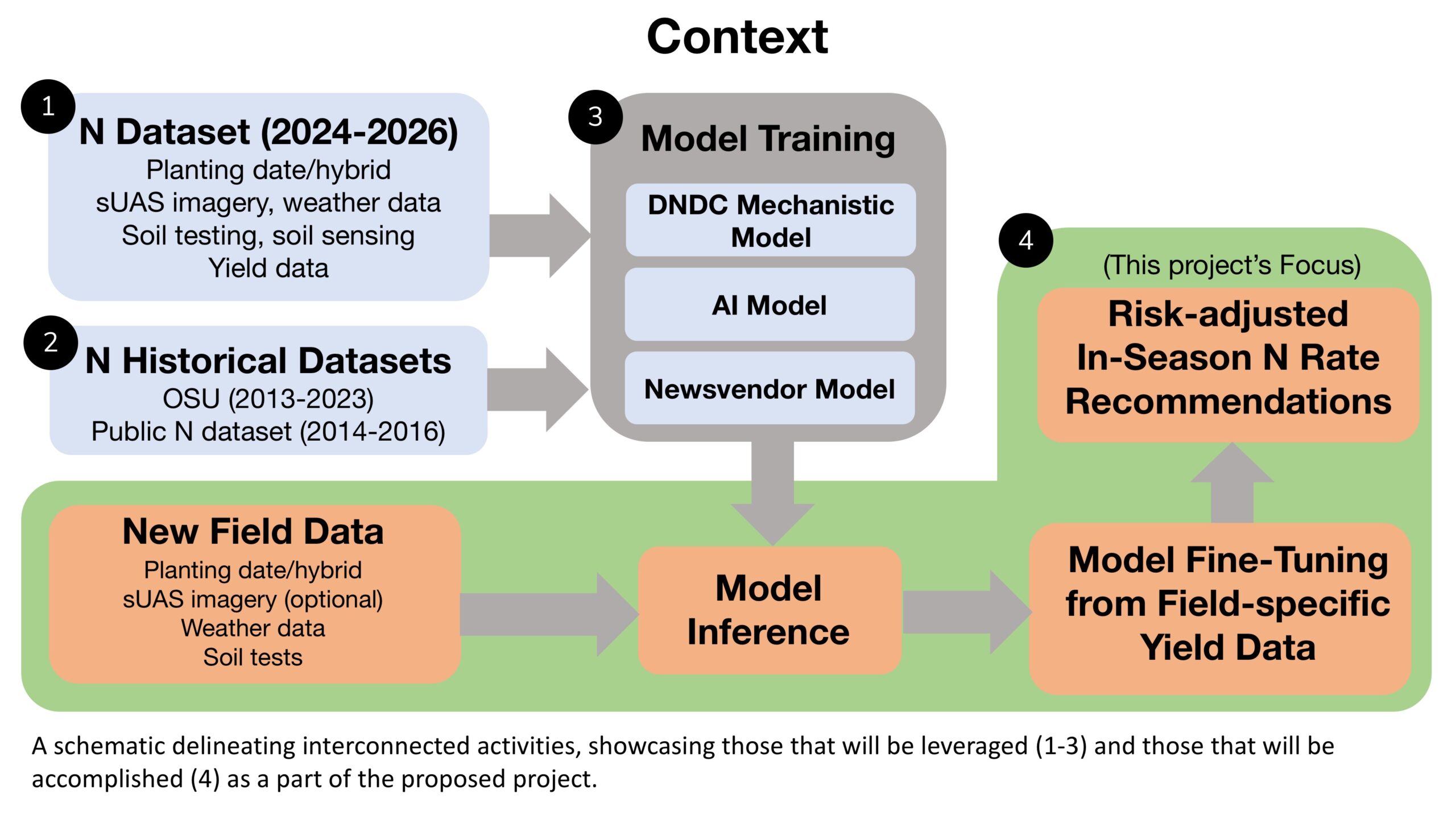
This project is an integral part of a PhD research plan that seeks to ultimately provide tools for farmers to be more precise in N application rates. The overall PhD research project has 4 dimensions to it, of which funding is being requested in this application for item 4:
- Improved data pipelines for creating datasets at scale for use in optimizing Nitrogen Use Efficiency (NUE). This includes aggregating soil moisture sensing, weather data, and Small Unmanned Aerial Systems (sUAS) imagery from both university plot-level and on-farm research locations.
- Aggregation of historical datasets for NUE including:
- Ohio State replicated nitrogen trials from 2013-2023 A public 47 site-year dataset from 2014-2016
- Application of the latest artificial intelligence approaches combined with the process-based DeNitrification-DeComposition (DNDC) model to provide improved generalized N recommendations.
- Development of practical on-farm research tools for fine-tuning of in-season field-specific N recommendations to be trialed with farmers for the 2025 and 2026 growing seasons.
The following graphic describes the overall PhD research plan with this project content in green:
Outputs
The outputs for this project (from item 4 above) include a digital tool with 3 features:
- Generation of prescriptions for replicated sidedress N trials.
- Visualization of yield response to nitrogen rates for a specific field to generate economic optimum nitrogen rates (EONR).
- Fine-tuning of an AI based nitrogen model based on field-specific data to generate field-specific in-season recommended nitrogen rates.
Outcomes
These outputs will enable participating farmers to realize that nitrogen can be managed more precisely (response-efficacy) and that the digital tool created enables them to be able to accomplish it (self-efficacy). This project will provide the basis for rolling the tools above out to a larger user base where the gains in profitability and reduced environmental impacts can be realized.
Approach / Methods
3 farmers in Western Ohio and a crop consulting and testing company in Central Ohio will participate in this research project. All 3 farmers and the crop consulting company are both technologically savvy and agronomically knowledgeable and can provide valuable feedback on the development of a digital tool that will be valuable for their farming operations. The tool will be developed to generate fine-tuning data from the 2025 growing season and to provide improved recommendations based on that fine-tuned data for the 2026 growing season.
Our primary outcomes of this project are to demonstrate response-efficacy and self-efficacy for precision nitrogen application enabled by a well-designed digital tool:
Response-efficacy: Confidence that completing the action will have the desired effect.
Self-efficacy: An individual's confidence in their ability to successfully perform an action.
- Farmers will have a greater understanding of N dynamics on their field and recognize that precision nitrogen management is possible (response efficacy).
-
Farmers participating in the project will be confident that they can more precisely manage N application using the digital tool (self-efficacy).
-
Understanding of farmer interest in scaling the tool beyond those participating in this project.
- Drive further research in academia of aggregating current and historical N datasets for AI model training as well as the importance of using on-farm research and digital tools for fine-tuning AI models in agriculture and drive adoption of precision N management practices.
The outcomes listed in this project are enabled by the digital tool that is intended to provide more accurate nitrogen recommendations for a specific season and field by fine-tuning a generalized nitrogen model, and are intended to engage farmers in a way that they trust the recommendations while also making it simple to execute the recommendations by creating digital prescriptions. From our discussions with farmers, we have found many to be using flat rates of nitrogen for their fields and have either been unaware of nitrogen frameworks such as MRTN or Adapt-N, or have been skeptical that they are appropriate for their fields.
Research
A literature review was conducted that both drew from seminal behavioral science papers (such as Kahneman and Tversky's Prospect Theory) as well as applied behavioral science literature that focuses on nutrient management in general and Nitrogen (N) fertilizer in particular. This literature review formed the basis for components and framework for a conceptual decision tool around the 3 thematic elements of "Understand", "Calibrate", and "Act".
The 3 farmers participating in this project were interviewed to get early feedback on this conceptual decision tool. These interviews were conducted in late 2024. This subject matter formed the basis for a final paper for ENR7150 course: Environment, Risk, and Decision-Making.
The goal of these interviews was to share various types of information and charts to farmers to understand their reaction and acceptance of the information. Preliminary findings from these 3 interviews include the following:
- When showed a range of charts and tables, all three farmers consistently preferred the versions that were more complex over versions that simplified the information. This preference appeared to be related to two things. First is they were interested in building their understanding of N dynamics and they wanted to see all of the variability. Secondly, they were looking at the results to assess the trustworthiness of the information.
- When asked about important factors for N application rates, no farmer indicated environmental impact as a consideration. When prompted about whether environmental impact was a factor for them, each one had a similar response, indicating that they are already using reasonable rates and application methods that minimize the potential for losses. However, when showing them various charts, each one found the nitrate leaching chart to be valuable and indicated that it could have an influence on their N rates. However, the reason appeared to be less related to environmental impact, and more related to the fact that they were losing N that they had paid for from their fields.
- They immediately understood the agronomic charts shown (Figure 5a and 5b in the linked paper) and indicated that they would influence their N rate choices "if they were accurate".
- One of the farmers indicated that their trust and confidence in the value of a digital tool to help them improve their N rates would be highly influenced by the motivations of the company or organization that created the tool. This is an important finding and deserves further exploration in terms of how to deliver the tool such that it can be trustworthy.
These preliminary findings are being used to inform the development of the prototype decision tool. The final course paper is attached for reference to this section. These initial interviews were conducted with realistic but conceptual data examples.
As described in the initial project proposal, there have been active efforts on developing a generalized model that combines the DNDC process model, ML models, and asymmetric risk (newsvendor model). This work is approaching a working generalized model in March 2026. This generalized model is an important prerequisite for developing the farmer-facing decision tool described in this proposal.
Additionally, N trials were conducted for 3 farmers' fields in 2025 in western Ohio. The Economic Optimum Nitrogen Rates (EONR) for these fields have been calculated. A web application designed to display spatial UAS image data was created in 2025 as part of a UAS Orchestration Engine (https://go.osu.edu/agriviewer_osu). This web application will form the basis for a Nitrogen decision support tool that has been started.
The next round of farmer interviews will occur in March and April of 2026 and will build upon the late 2024 interviews with an early prototype utilizing their own data from the 2025 N field trials. A final consultation with the farmers will occur in the 2nd half of 2026 that will incorporate refinements and additional functionality.