Progress report for GNC24-403
Project Information
Helping or hurting? Identifying the role of CP42 in promoting or diluting parasites for pollinators
Worldwide, sustainable agriculture is dependent on insect pollination. However, many different stressors such as habitat loss, pesticides, and parasites threaten pollinator health, leading to widespread declines. To combat these declines, the USDA has established pollinator habitat in cooperation with farmers through the Conservation Reserve Program’s Pollinator Habitat Initiative (CP42), but there exist no formal measures in place to evaluate the efficacy of these habitats in promoting the health of pollinators. This issue is heightened in the midwestern United States, where sparse natural habitat interacts with other pollinator stressors, like parasites, to exacerbate pollinator declines. Microbial gut parasites are frequently cited as a major concern for bee pollinator health, but patterns of parasite infection and transmission have only recently been studied in a landscape context, and have not at all been studied in the more agriculturally intensive areas of the United States. As isolated patches of flowers, CP42 habitat could concentrate parasites in one area, and as a result decrease the health of visiting pollinators. However, research conducted in other natural ecosystems shows that areas with increased plant diversity can dilute parasite transmission, leading to reduced pollinator infection. Thus, in regards to parasites, CP42 has the potential to both help and harm pollinator health in agroecosystems. My proposed project intends to address this concern by (1) determining the status of pollinator parasites in CP42 habitat and identifying landscape factors contributing to parasite incidence in Illinois and (2) exploring the efficacy of CP42 at locally diluting and mitigating parasite transmission. To achieve these objectives, I will sample bumble bees, an economically important group of pollinators whose parasites are well-studied, as well as the plant and bee parasite communities on the CP42 land of farmers in East-Central Illinois in summer 2025. I will evaluate what landscape-level factors in CP42 habitat influence parasite incidence and abundance, and what qualities of the plant community contribute to any detected patterns. These findings will be used to improve knowledge of CP42 in the Midwest and generate potential management strategies which farmers can implement on their CP42 land to mitigate parasites and produce healthier pollinators for sustainable agriculture. The results of this project will be summarized and distributed through scientific articles, personalized farmer reports, and extension publications, so as to reach researchers and farmers and increase the efficacy of CP42 in the Midwest.
Learning and action outcomes will target farmers in Illinois currently enrolled or interested in enrolling in the Conservation Reserve Program (CRP) Pollinator Habitat Initiative (CP42). This project intends to identify the hidden threats, specifically bee parasitism, in CP42 habitat while simultaneously identifying ways to mitigate those threats to contribute to improving the CP42 program and its benefits to pollinator communities. The overall learning outcome of this project is to inform farmers of the effectiveness of their CP42 land at supporting pollinators and reliably improving pollinator health by mediating bumble bee parasitism. Farmers have consistently expressed concern about the efficacy of the CP42 habitats given their landscape context (Harmon-Threatt, personal communications). By investigating some of those concerns, this project will provide concrete recommendations for improving CP42 habitats and help allay anxieties around the program. The ultimate action outcome of this project is that farmers will implement these recommendations to manage their CP42 lands to prevent parasite transmission and create a more beneficial environment for essential pollinators. For farmers not currently enrolled in CRP or CP42, this project will use extension documents and information sharing via NRCS to communicate that the program is effective at providing pollinators with quality habitat. The resulting action outcome is a potential increase in enrollments in the CRP and CP42 programs. Results from this project will thus form the basis for future improvement and foundation of pollinator habitat that efficiently serves sustainable agriculture by combating critical pollinator threats.
Cooperators
- (Researcher)
Research
Bumble bees and flowers were sampled from thirteen Conservation Reserve Program CP42 sites, owned by nine landowners in Ford, Champaign, Vermilion, Edgar, and Clark Counties. Seven of these sites were sampled in the summer of 2024 and 2025, and six additional sites were sampled in summer 2025. These six sites will be sampled a second time in summer 2026. CP42 landowners were contacted through existing university relationships, as well as via email and phone contact with Soil and Water Conservation Districts for each county, who helped advertise the project to CP42 landowners.
At each site, a 30x30m buffer was established in order to standardize the search area between CP42 sites, with a buffer of at least 10m from the edge of the plot. Specific location of a plot within a site was chosen based on estimated density of flowering plants so as to increase capture rate of bumble bees. Floral resources were evaluated monthly (June, July, and August) along two 30m transects within each plot. Researchers walked along the transects and counted the number of flowering species and the number of flowering units. If plant species were not encountered along the transect but were observed by the researcher elsewhere in the plot, they were recorded. Using species richness information, Floristic Quality Index (FQI), a metric developed to assess the vegetative quality, for each site. Land use around each site within 2km and 5km buffers was quantified using ArcGIS, the 2024 and 2025 Cropscape Data Layers (CDL), and R package CropScapeR.
To address Objective 1, starting between 10:00am and 11:00am, bumble bees were netted off flowers for 60 person-minutes inside the plot, excluding handling time. Upon capture, bees were placed in sterile 15 mL centrifuge tubes, labeled with their species, the name of the site, and which plant species they were visiting. They were then placed in a cool box adjacent to the field site. Upon returning to the lab, bees were euthanized and their guts dissected before storing them at -20C for future parasite detection. Only individuals of the bumble bee species Bombus impatiens and Bombus griseocollis were kept for parasite detection, as these are the most abundant bumble bee species in the area; individuals of all other bumble bee species were recorded and released.
In 2025, 10 flowers per site were collected to address Objective 2. This is smaller amount than originally planned due to the low growth of focal flower species at some sites. Flowers were placed in sterile 25mL centrifuge tubes and placed in a cool box adjacent to the site. In the lab, these flowers were stored at -20C for future parasite detection.
To detect parasites in the guts as stated in Objective 1, bee guts were homogenized, after which quantitative PCR (qPCR) was performed to detect two parasites: Nosema bombi and Apicystis bombi. In the future, we will use similar methods to detect a third parasite, Crithidia bombi, for which data is currently unavailable; qPCR troubleshooting for this parasite is currently in progress. Similar methods will also be used to screen for parasites on flowers collected for Objective 2. CT values from the qPCR were used to determine if a parasite was detected or not; any CT value higher than 35 was considered a non-detection. Due to low capture rates at some sites, not all sites had enough bees available for gut analysis; minimum sample size for each site was 5 individual bumble bees of the same species. qPCR was performed at the University of Illinois by myself, Annaliese Wargin, and at the National Center for Agricultural Utilization Research (USDA-ARS) in Peoria, IL by Dr. Shiloh Lueschow-Guijosa, whom our lab is collaborating with for microbiology assistance.
To analyze the relationship between parasite incidence and local and landscape-level variables, we used a Pearson’s correlation matrix. Analyses were performed for Bombus griseocollis and Bombus impatiens separately for each sampling year.
Current results are for Objective 1 from the years 2024 and 2025 of the project; one summer of data collection remains, so results are subject to change in the future. For Objective 2, flower specimens were collected in 2025, but have not yet been processed for parasite detection.
In 2024, seven sites were sampled, while in 2025, thirteen sites were sampled, comprised of the seven sampled in 2024 and six new sites sampled in 2025. The average prevalence (percentage of sampled bees with a positive detection) of Nosema and Apicystis parasites for each species is reported in Table 1. Prevalence of both parasites increased from 2024 to 2025, suggesting either year-to-year variation in parasite prevalence or increased parasite prevalence in sites newly sampled in 2025; future analyses will help to determine the potential drivers of this following the last season of data collection in summer 2026. Apicystis prevalence was consistently higher for both sampled bumble bee species in both years. A Nosema prevalence of 15-25% is expected for common bumble bee species in the Midwest (Ben Sadd, personal communication), consistent with our results.
| Species | Year | Average Nosema sp. prevalence | Average Apicystis sp. prevalence |
| Bombus griseocollis | 2024 | 10.16% | 23.17% |
| 2025 | 26.67% | 62.22% | |
| Bombus impatiens | 2024 | 15.51% | 37.55% |
| 2025 | 27.14% | 42.86% |
The variables which correlated with Nosema and Apicystis parasite prevalence varied by year (Figure 1), but some trends emerge. In both species in 2024 and in Bombus griseocollis in 2025, Apicystis prevalence was negatively correlated with number of floral units at a site, indicating that the more flowers a given CP42 site had, the less likely it was for bees to be infected with Apicystis parasites. This is consistent with other findings which suggest that natural areas with a greater number of floral resources can reduce parasite transmission via a “dilution effect”. For B. impatiens, no other local or landscape variable affected parasite prevalence. Contrastingly, in B. griseocollis the percentage of developed land around the CP42 habitat was negatively correlated with Nosema prevalence in sampled bees in 2024, although this trend reversed in 2025.
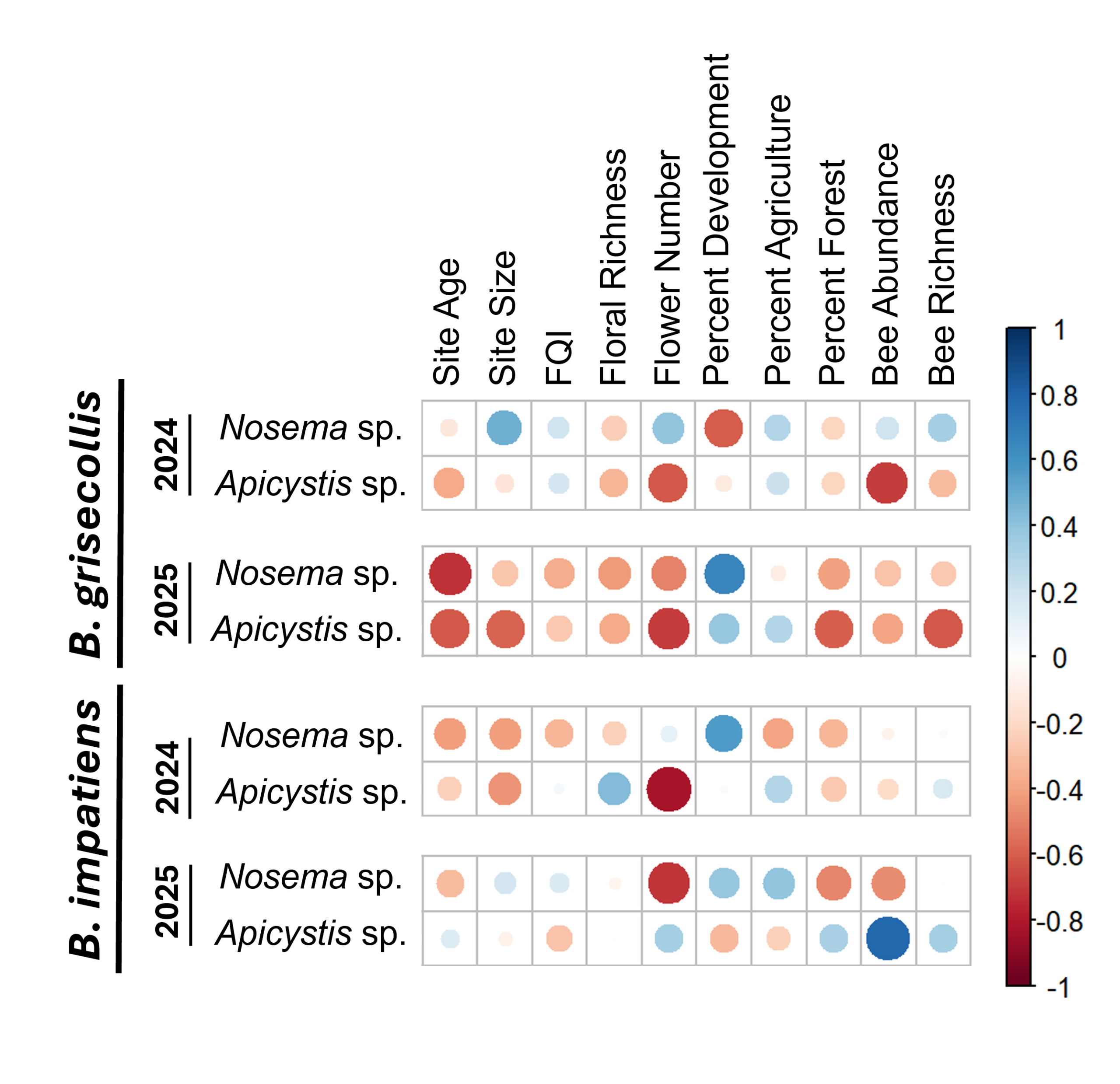
Thus far, our findings suggest that Nosema and Apicystis parasites occur at levels expected by previous assessments of common bumble bee species elsewhere in Illinois (Ben Sadd, personal communication). Notably, parasite prevalence is not higher than expected, indicating that CP42 as an initiative is likely not exacerbating parasite infection in Illinois. It is notable that surrounding land use (e.g agriculture, forest habitat, developed areas) does not appear to affect parasite prevalence, but rather local, on-site factors. In terms of improving habitat, some of our findings suggest that improving the number of floral resources in CP42 sites, for example, increasing the number of seeds in a seed mix, may decrease prevalence of Apicystis and Nosema, but further sampling in 2026 can help elucidate this.
Educational & Outreach Activities
Participation summary:
Data analysis for the project is currently in progress; we expect to produce fact sheets for five CP-42 landowners by April 2026 detailing the incidence of parasites on their land, and what they can do to improve their CP-42 habitat, if applicable. We sampled the CP-42 habitats owned by these for landowners in 2024 and 2025, so they will receive their fact sheets first. Fact sheets will be produced for the remaining four landowners, whose land will be sampled in summer 2026, by November 2026. From the findings for the entire experiment, we plan to develop a newsletter article for distribution in the Illinois Farm Bureau's newsletters, as well as fact sheets to be distributed by the University of Illinois Extension, NRCS, and NC-IPM Center. We have been invited to submit this research to Journal of Insect Science, which if accepted will result in a published article that will be distributed to the scientific community.
Project Outcomes
Knowledge generated by this research will inform future decisions made by landowners enrolled in the Conservation Reserve Program CP42 initiative, including the purchasing of improved seed mixes or changes made to the management of their CRP land. These decisions will improve the health of bee pollinator populations, thus enhancing the pollination services provided by bees and improving yield in major animal-pollinated crops in Illinois, such as soybeans and pumpkins. As CP42 sites are typically situated in agricultural land, all farmers bordering the site can benefit from the pollinators that CP42 attracts, not just the enrolled farmer. Furthermore, this project has already increased the environmental knowledge of farmers. The landowners participating in this research have demonstrated to me great curiosity about bees and their CP42 land, and have verbally communicated that they are eager to hear about the health of the bees on their land and know what they can do to improve it.
I have gained a number of skills during this project, including technical skills related to my research (e.g. qPCR techniques), as well as presentation and social skills. I’ve better developed communication skills through my conversations with farmers, conservationists, and other researchers during the course of this project. I’ve learned that many farmers are very invested in conservation, and I have learned of the challenges they face while balancing habitat maintenance for wild bees with pest management in their crop fields. While central Illinois is home to a great volume of row crop agriculture, farming and natural habitat conservation need not be opposed to one another.