Progress report for GNC24-405
Project Information
The result of “Creating a framework to facilitate land management relationships between non-operating landowners and beginning producers” will be the development of educational tools and materials that support third-party supports like Land Link program coordinators who are working to steward relationships between non-operator landowners (NOLs) and beginning farmers and ranchers (BFRs) seeking access to agricultural land.
With the number of NOLs on the rise, there is opportunity to meet the land access needs of BFRs while potentially increasing the implementation of regenerative agricultural practices on working landscapes. Cultivating land tenure relationships between these two parties and building new succession models requires evaluation of current Land Link programs in the United States; Land Link program coordinators have deep experience forming land tenure relationships between extrafamilial (non-related) parties. The primary methods will be 1) interviews with current land link coordinators, individuals who have experienced land transitions with varying levels of success, BFRs, and NOLs, 2) literature review; and 3) data synthesis research into the interests and motivations of NOLs. These sources will be combined to create usable facilitation guides, multimedia case studies, and outreach materials to develop and sustain successional networks between these groups of interest.
Learning outcome (1): Land Link coordinators share their experiences stewarding extrafamilial land tenure relationships and the successes and limitations of current Land Link program models, which contributes to the action outcome of creating tools that help to cultivate trusting, sustainable land tenure relationships between non-operator landowners (NOLs) and beginning farmers and ranchers (BFRs).
Learning outcome (2): deepened awareness among Land Link coordinators and other third-party supporters of BFRs’ interests, needs, and motivations in land transition relationships, which leads to the action outcome of improved advocacy for and increased participation of BFRs in Land Link partnerships, and higher success rate of facilitated relationships.
Learning outcome (3): new knowledge of NOLs’ interests, motivations, and information sources among Land Link coordinators and other third-party supporters, which leads to the action outcome of educational and informational materials targeted toward NOLs to increase their interest in regenerative agriculture practices on their properties and their participation in Land Link programming.
Research
Between November 2024 and July 2025, this project focused on conducting interviews with coordinators at 11 Land Link programs across the United States. The interviews were conducted virtually using an IRB-approved, semi-structured interview instrument. The interviewees were identified using the American Farmland Trust's Farm Link Finder tool and were initially recruited via email.
The results from these interviews were used to inform two different subsequent interview instruments - one for beginning farmers and ranchers and one for non-operator landowners. The interviewees from each of these groups were selected using a snowball sampling method, by which the Land Link coordinators who were interviewed during the first phase recommended non-operator landowner/BFR land seeker pairs to me who would be willing to participate in an interview. While I originally intended to interview only landowners and land seekers from the state of Kansas for this part of the project, we chose to broaden the scope of the interviews because it became apparent that I would not be able to connect with enough Kansas interview subjects to reach data saturation. Additionally, broadening the geographic scope allowed us to learn from a wider variety of non-operator landowner/beginning farmer and rancher experiences.
Since September 2025, semi-structured interviews have been conducted with seven beginning farmers/ranchers and six non-operator landowners. Three of the interviews have occurred in person, and the rest have occurred virtually. Interviews have largely been virtual because most of the interviewees reside out of state from the researcher. These interviews will be completed by mid-March 2026 and the results used for the development of grant outputs.
Most interviewees from both sets of interviews have declined compensation for their time. All interviews were transcribed using Rev transcription software.
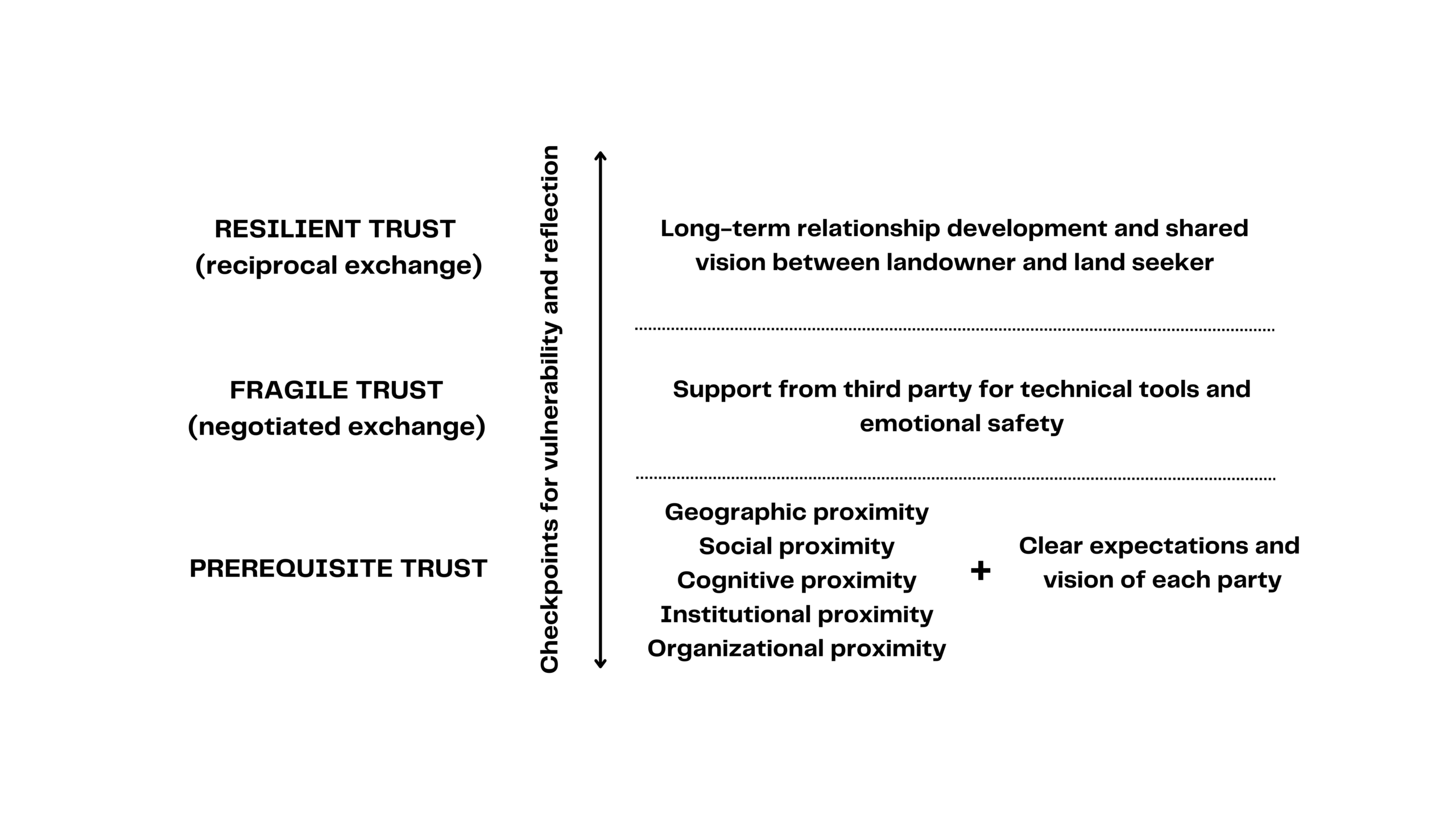
The initial interviews with Land Link coordinators were used to inform the creation of the above framework, which describes how trust develops between non-related parties in agricultural land tenure relationships. The framework was created using themes that arose from the Land Link coordinator interviews. I am currently conducting interviews with non-operator landowners and beginning farmers and ranchers engaged in land tenure relationships to understand how well their real-world experiences fit the framework and what needs to be refined. I will use the phases of this framework to guide the physical and educational outputs of this grant in late spring and summer 2026.
Educational & Outreach Activities
Participation summary:
I have presented the work from this project at two conferences: the 2026 National Agricultural Communications Symposium and the 2026 Kansas Natural Resources Conference. I will give an upcoming lecture on this research to a class of students taking a course on the Human Dimensions of Natural Resources Management in March 2026.