Progress report for GNE24-339
Project Information
Culinary trails are emerging as a new framework to organize, market, and brand the signature assets of a region. Through applied research, this project will make two significant contributions to the economic viability of sustainable agriculture: 1) it will be the first longitudinal study to determine whether engagement in agritourism generates consumer loyalty for state-branded farm products; and 2) it will be the first study to determine whether culinary trails are an effective form of branding for industries and destinations. For purposes of this research, cheese, a staple of the American diet, will serve as a proxy for local farm products. Approximately 1,300 U.S. consumers will participate in a binary choice experiment within three contexts: 1) online national research panel; 2) statewide festival promoting Maine cheese; and 3) on-farm agritourism experiences on Maine dairy farms participating in Open Creamery Day. Results will be shared through peer-reviewed journal articles and conference presentations to agritourism operators, state policymakers, Cooperative Extension agents, and marketing researchers at the state, national, and international level. By exploring how experiences on culinary trails affect consumer loyalty for state-branded farm products, this project will help producers and service providers alike determine whether limited marketing dollars on regional agritourism promotion provide a substantial return on investment compared to other forms of education.
The purpose of this research is to explore the factors that motivate consumers to pay a premium for local or state-branded farm products. Approximately 1,300 U.S. consumers will participate in a binary choice experiment within three contexts: 1) online national research panel; 2) statewide festival promoting Maine cheese; and 3) on-farm agritourism experiences on Maine dairy farms participating in Open Creamery Day. Respondents in contexts #2 and #3 will be surveyed twice – in real time on entry or exit to the event, and again, two months following the experience. Emotion is the strongest driver of consumer loyalty. Factors that contribute to emotional loyalty include trust, shared values, perceived quality, superior customer service, and a personalized experience. These factors not only promote repeat purchase behavior but engagement, commitment, and advocacy toward the brand.
The conceptual framework for this research design will address the following objectives (See Figure 1):
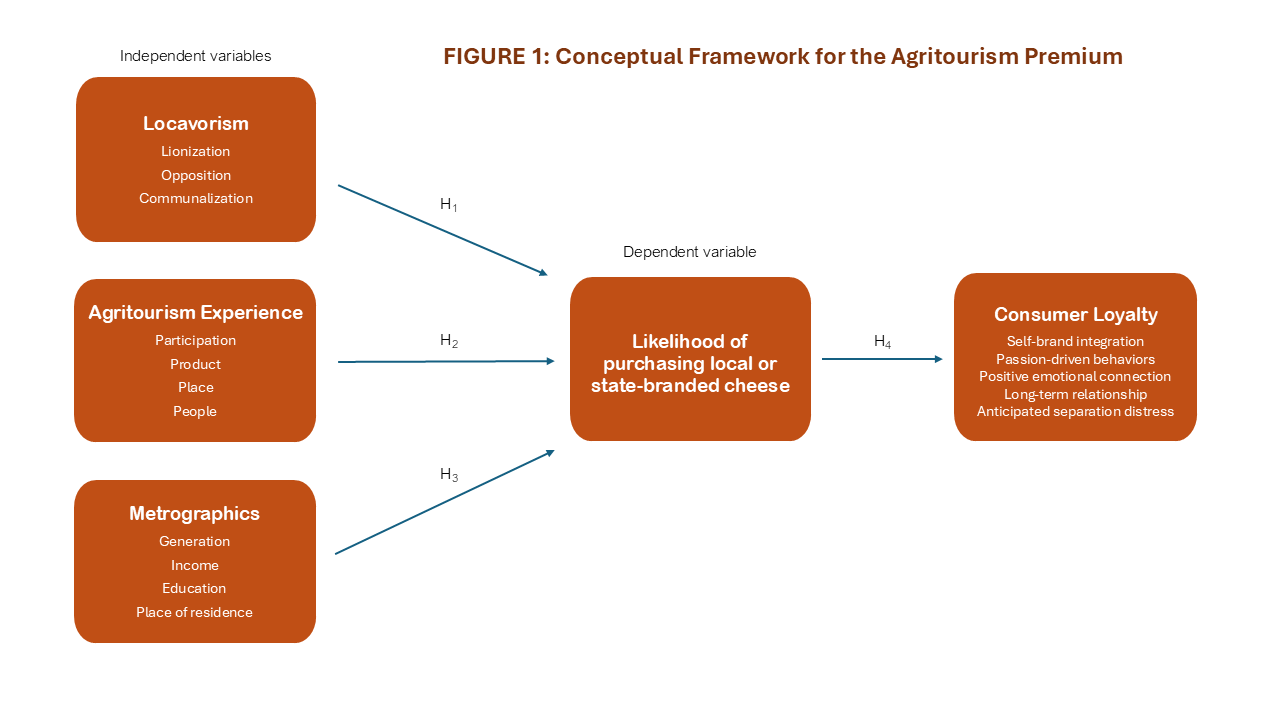
Locavorism. To determine whether consumer preferences, values, and attitudes influence the likelihood of purchasing local.
H0,1: Locavorism has no effect on the likelihood of purchasing a local or state‑branded cheese.
H1,1: Higher levels of locavorism will increase the likelihood of purchasing a local or state-branded cheese.
Agritourism Experience. To determine whether the quality of an agritourism experience influences the likelihood of purchasing local.
H0,2: Perceived quality of an agritourism experience has no effect on the likelihood of purchasing a local or state‑branded cheese.
H1,2: Higher perceived quality of an agritourism experience will increase the likelihood of purchasing a local or state-branded cheese.
Metrographics. To determine whether socio-demographic factors influence the likelhihood of purchasing local.
H0,3: Metrographic characteristics have no effect on the likelihood of purchasing a local or state‑branded cheese.
H1,3: Metrographic characteristics will increase the likelihood of purchasing a local or state‑branded cheese.
Consumer Loyalty. To determine whether emotional consumer loyalty has a latent impact on purchase behavior.
H0,4: Emotional attachment does not mediate the relationships between (a) locavorism, (b) agritourism experience quality, and (c) metrographic characteristics and the likelihood of purchasing a local or state‑branded cheese over a national brand.
H1,4: Emotional attachment mediates the relationships between locavorism, agritourism experience quality, and metrographic characteristics and the likelihood of purchasing a local or state‑branded cheese.
To achieve these positive consumer outcomes, food producers must work together to organize and market assets. In fact, agritourism can function as an industry cluster, a geographic concentration of suppliers, producers, and service providers in a related industry that improves productivity and performance across the value chain (Porter, 1998; Ruiz-Labrador et al, 2023; Wulandari et al, 2024). Established in 2003, the Maine Cheese Guild represents one such cluster: a state association that promotes the products of 50+ cheese producers.
The purpose of this qualitative research study is to examine how individual cheese producers in Maine who participate in the Maine Cheese Guild and Maine Cheese Trail perceive and describe the benefits and challenges of agritourism to their business and industry, along with the strategies their industry uses to work together to promote agritourism. This component of the research will explore the following questions:
- How do cheese producers in Maine perceive and describe the benefits and challenges of agritourism to their industries and regions?
- How do cheese producers in Maine describe how their members work together as an industry cluster to promote agritourism, for example, through strategies like cooperation, communication, coordination and collaboration?
This component of the study will help determine whether culinary trails are an effective form of branding for destinations and industries.
The purpose of this project is to determine how agritourism affects purchase intent, willingness-to-pay, and consumer loyalty for state-branded farm products compared to other forms of education. This new knowledge will advance Northeast SARE’s outcome of ensuring the economic viability of sustainable agriculture.
Agritourism offers a variety of benefits to producers, consumers, tourists, communities, and regions. For producers, agritourism is a form of economic diversification that enables them to increase sales revenue, generate supplemental income, attract new customers, and provide employment for family and friends (Chase, et al, 2021; Paras, et al, 2022; Schilling, et al, 2014; Tew & Barbieri, 2012).
Through agritourism, consumers have the opportunity to learn how food is raised, grown, and harvested while enjoying family-friendly activities, outdoor recreation, and other pursuits (Barbieri, et al, 2018; Brune, et al, 2021). For tourists, agritourism offers an authentic experience that connects them to a place (Andéhn & L’Espoir Decosta, 2021; Nazariadli, et al, 2018; Palmi & Lezzi, 2020). Communities that host a cluster of agritourism opportunities can market these assets as a distinctive culinary trail or destination (Niedbala, 2020; Paras & Michaud, 2023). By helping small farms diversify their income, regions can promote rural economic development (Van Sandt, et al, 2019) and brand their distinctive local food products (Che, 2006), thereby increasing the contribution of tourism, agriculture and fisheries to their Gross Domestic Product (Dhungana & Khanal, 2023; Rossi, et al, 2017).
Culinary trails are emerging as a new framework to organize, market, and brand the signature assets of a region for both agritourism and destination marketing. A trail may consist of an inventory of agritourism experiences on working farms and fisheries that invite visitors to curate their own itineraries. Beginning with the Maine Beer Trail in 2009, Maine has been a national leader in the design, development, and promotion of culinary trails, with the establishment of the Maine Cheese Trail, Maine Fiber Trail, and Maine Oyster Trail. In addition to trails, trade associations have also developed open farm days for specialty crops, including Maine Maple Sunday (March), Maine Seaweed Week (April), Wild Blueberry Weekend (August), Maine Apple Sunday (September) and Open Creamery Day (October). These events offer working producers that may not be open the rest of the year the opportunity to offer direct sales, as well as family-friendly activities. In addition, some associations, like those for seaweed and blueberries, partner with restaurants and other eating and drinking establishments to showcase signature menu items and specials made with seasonal ingredients.
Through tours, U-pick, and other outdoor activities in scenic landscapes, culinary trails engage visitors in co-creating authentic experiences with producers that have the potential to generate the emotional attachment that is the foundation of consumer loyalty (Ghorbanzadeh, & Rahehagh, 2021; Hwang, & Kandampully, 2012; Park & MacInnis, 2006; Yu & Dean, 2001). By generating consumer loyalty, producers can shape the brand of their establishment, industry, and region while facilitating repeat purchase behavior in real time as well as into the future. While research demonstrates that agritourism increases consumers’ intentions to purchase local food (Brune, et al, 2021; Kenebayeva, et al, 2014; Paras & Michaud, 2023), no study has explored whether this intention translates to actual purchase behavior following participation. Indeed, Brune, et al (2021) recommended that “future studies should include follow-up surveys to gauge the participants’ actual local food consumption behaviors over time” (p. 1328).
Beyond wine tourism, there is also a gap in the literature on the effectiveness of culinary trails as a branding strategy for industries and destinations. Iconic commodities indelibly linked to specific U.S. states include Alaskan salmon, Florida oranges, Georgia peaches, Hawaiian pineapple, Idaho potatoes, Iowa corn, Kentucky bourbon, Louisiana catfish, Maine lobster, Maryland crabs, Texas beef, Vermont maple syrup, Virginia ham, Washington apples, and Wisconsin cheese. Websites hosted by offices of tourism attract visitors to agritourism experiences in rural areas through search portals, itineraries, trails, and other tools. Indeed, there is just one U.S. states that does not market a distinct brand for local products. Yet peer- reviewed research on state brands has been limited to consumer awareness and willingness-to-pay studies and not actual participation in agritourism experiences.
Therefore, this stand-alone project seeks to answer the following questions:
- Does engagement in agritourism generate consumer loyalty for state-branded farm products?
- Are culinary trails an effective form of branding industries and destinations?
Research
Materials and methods:
Research design. The project will conduct a series of field experiments that generate quantitative and qualitative data to address the following objectives:
- To determine whether agritourism drives direct sales of state-branded farm products.
- To determine whether agritourism shapes values associated with emotional consumer loyalty.
- To determine whether emotional consumer loyalty has a latent impact on purchase behavior.
- To determine whether culinary trails are an effective form of industry
- To determine whether culinary trails are an effective form of destination
These experiments will be conducted from January 1, 2024 to October 30, 2026. Since the project involves human subjects research, approval from the University of Maine’s Institutional Review Board will be sought in three phases: 1) online research panel of 900 U.S. consumers; 2) in-person surveys of 400 consumers participating in a treatment – festival or on-farm agritourism experience; and 3) interviews with producers and industry professionals associated with trail planning and implementation.
Survey topics: Components of the consumer survey will include the following:
- Type of treatment in which the respondent participated: festival or agritourism activity, such as a tour, course, demonstration, outdoor recreation, and/or sampling (Objective 1).
- Willingness to pay for a local or state-branded product using a binary choice experiment (Objective 1).
- Consumer loyalty behavior toward local food using a validated scale (Bagozzi et al, 2017), including repeat purchase intention and/or behavior (Objectives 2, 3, 4, 5).
- Values, beliefs, and attitudes toward local food using a validated scale to measure locavorism (Reich et al, 2018).
- Demographics, including gender, age, race and ethnicity, household income, educational attainment, work status, and zip code.
- Perceived benefits of culinary trails at the establishment and industry level (Objectives 4, 5).
- Strategies for cooperation, communication, coordination, and collaboration at the industry and region level (Objectives 4, 5).
Participants: For the consumer survey, the target population for the survey is adults, age 18 and over, who live in the United States. Due to the context in which the survey is administered, approximately half of respondents will either be residents and/or tourists in New England. For the industry survey, the target population is producers who host agritourism opportunities on a culinary trail.
Data collection
Consumers. A 39-question, 5-part consumer survey will be implemented in three different formats (See Figure 2):
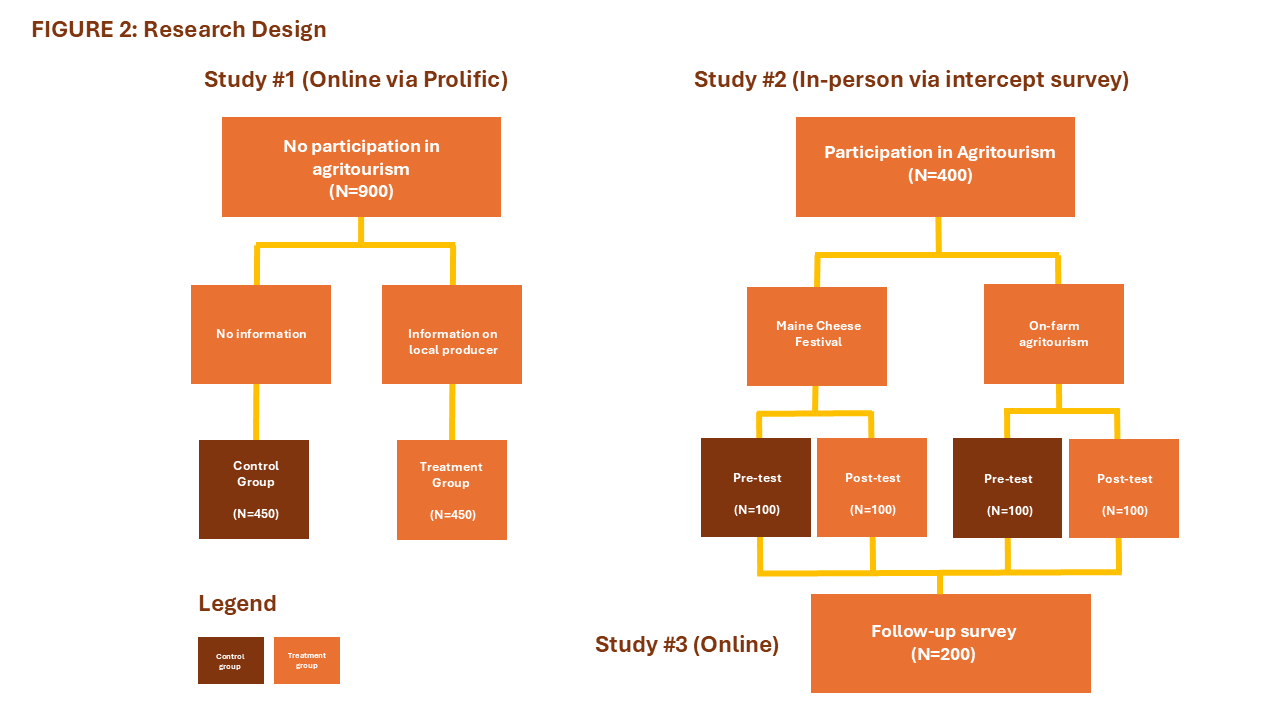
Study #1: This study will be conducted online via the research platform Prolific. In order to join the panel, participants are pre-screened by Prolific regarding their demographics, lifestyle, and research interests before they are eligible to participate in a survey.
- Control group: Panel of 450 consumers on Prolific representative of the U.S. population.
- Treatment group: Panel of 450 consumers on Prolific representative of the U.S. population. Unlike the control group, the treatment group will receive an information condition that includes a one-page description of the local food producer featured within the binary choice experiment.
Study #2: This study will be conducted as an intercept survey during two events: 1) the Maine Cheese Festival on September 13, 2026 in Pittsfield, Maine; and 2) Open Creamery Day on October 11, 2026 held at 8-10 farms throughout Southern, Midcoast, and Central Maine.
- Control group: The control groups will consist of 200 visitors randomly approached on their entry to the event.
- Treatment groups: The treatment group will consist of 200 visitors randomly approached on their exit from the event.
Study #3: Participants in Study #2 will be surveyed again 2-3 months following their participation in the event. This follow-up survey constitutes a within-subjects design where the responses from subjects will be compared with their prior responses to measure statistically significant differences in attitudes, norms, and behaviors around local cheese.
Both the control and treatment groups will participate in a binary choice experiment where they will make a choice on their willingness to purchase a local or state-branded product. Information about the product will include the price, price per pound, ingredients, place of origin, and the product label, which contributes to perceived quality.
Industry. In addition to consumers, 8-10 producers and industry professionals will be interviewed to explore 1) how individual farmers perceive and describe the benefits and challenges of agritourism to their industries and regions; and 2) how farmers describe how their members work together as an industry cluster to promote agritourism, for example, through strategies like capacity, cooperation, communication, coordination and collaboration. This dataset will be used to determine how effectively producers work together to plan, implement, and promote culinary trails (Porter, 1998; Ruiz-Labrador et al, 2023; Wulandari et al, 2024).
Research was scaled down from three sectors - cheese, fiber, and oysters – to one sector: cheese. First, cheese is a staple of the American diet, with $32 billion in U.S. demand. Second, Maine’s cheese industry has a 20+ year history of agritourism, offering an annual cheese festival as well as an Open Creamery Day with a choose-your-own adventure format marketed to consumers online. Third, cheese represents an emerging industry that Maine is not particularly known for. For example, Maine has a monopoly on the nation’s supply of lobster. Besides lobster being a non-SARE eligible product, it is considered a luxury good that consumers do not purchase frequently. Moreover, there are no comparable products on the market for comparison purposes. While potatoes are also one of Maine’s signature products, the industry has not developed any agritourism opportunities, only a summer festival that does not include tours of either factories or farms. While the state is home to 87 licensed cheese makers, Maine ranks just 41st in the country in cheese production. Virtually all are artisanal producers. Maine cheese retails for an average of $14.63 per pound, more than three times the U.S. average of $4-$5 per pound (Atlantic Corporation, 2022; IBISWorld, 2025). Thus, a great deal of consumer education, such as that offered by agritourism, is necessary to cultivate local, state, regional, and national markets for Maine-made cheese. Fourth, cheese represents a moderately priced product that consumers might be willing to order online after their visit, facilitating repeat purchase behavior.
Materials:
Quantitative Fieldwork. All survey responses will be entered by participants themselves on the Qualtrics platform. All subjects must be at least 18 years old to participants. Subjects will be recruited through two methods:
Study #1: Subjects for Study #1 will be recruited online through the www.prolific.com platform. Such platforms make online participant recruitment reliable and efficient, giving researchers immediate access to millions of diverse, high-quality respondents. To register for Prolific, respondents must be at least 18 years of age.
Study #2: Subjects for Study #2 will be recruited as part of a consumer survey conducted during two events. Researchers conducting the recruitment will wear an approved University of Maine t-shirt, sweatshirt, jacket, or name tag to easily identify them as students.
- Maine Cheese Festival on Sunday, September 13, 2026: The survey team will host a table with a pop-up tent labeled as a research station. Visitors will be randomly intercepted on either their entry or exit to the event, with survey input via iPad. In addition, respondents will be able to complete the survey via their own mobile device by scanning a QR code distributed via postcard. Since the event occurs on one day only from 11AM to 5PM, a team of six researchers will be necessary to intercept 30-35 visitors per hour.
- Open Creamery Day on Sunday, October 11, 2026: Since this event occurs on one day only at 8-10 farms throughout the state, students will be assigned to cover 1-2 farms in relative proximity to each other. Visitors will be randomly intercepted on either their entry or exit to the event, with survey input via iPad. Through this method, 10 researchers will interview 4-5 visitors per hour over 4-6 hours, for a total of 200-250 visitors.
Study #3: Participants in Study #2 who voluntarily provide their email will be sent a follow-up survey 2-3 months after the event to determine whether there is a statistically significant difference in their attitudes, norms, and behaviors around local cheese post-experience.
Qualitative Fieldwork. Participants who are cheese producers in Maine and who participate in agritourism will be invited to participate in the research study, with a target of 8-10 participants. All subjects must be at least 18 years old to participate. Participants will be recruited through two methods: direct recruitment through email by the graduate student based on personal and professional networks; and the gatekeeper approach whereby the executive director of the Maine Cheese Guild invites members to participate in the research study through an email. Of 87 licensed cheesemakers, 36 are engaged in commercial production, 24 in on-farm and/or off-farm agritourism, and 5, only in off-farm agritourism, e.g., festivals and farmers markets.
Each interview will take approximately 45-60 minutes and will be conducted either in person at the participant’s place of business or by Zoom, according to the participant’s preferences. Interviews will be audio-recorded using a portable device or through the Zoom platform and will be transcribed by the principal investigator. An audio-recording will ensure an accurate transcript for the purpose of data analysis. Interviews will follow a semi-structured interview protocol with 15 scripted questions.
Power analysis. A power analysis for each quantitative study was conducted using G*Power (Faul et al., 2009).
Study #1: A power analysis for a one-tailed test comparing two independent proportions (odds ratio ≈ 1.86, α = 0.05, power = 0.95) indicates that a minimum of 466 observations (233 per group) is required. With a planned sample size of 900 participants (approximately 450 per group), the study exceeds this requirement, ensuring high statistical power. This power is held in reserve for the possibility that more than one type of cheese, e.g., cheddar and mozzarella, is included in the experiment.
Study #2: Differences in the proportion choosing the local or state-branded cheese across four groups will be tested using a χ² test of independence (2×4 contingency table; df = 3). A G*Power analysis (χ² goodness-of-fit for contingency tables; Cohen’s w = 0.30 [medium], α = 0.05, df = 3) indicates a minimum total N of 191 to achieve 95% power. With a planned N = 400 (100 per group), the study exceeds this requirement, yielding high statistical power. This power is held in reserve for the possibility that more than one type of cheese, e.g., cheddar and mozzarella, is included in the experiment.
Study #3 will use Bayesian logistic regression to assess changes in the likelihood of respondents choosing a local or state-branded cheese from pre-event to post-event. Inference will focus on odds ratios, 95% credible intervals, and the posterior probability that the odds ratio exceeds a meaningful threshold (e.g., OR > 1.5). This approach emphasizes effect size and uncertainty rather than binary significance testing, which is appropriate given the limited sample size of the follow-up survey.
Analytics strategies. This study will deploy four analytical strategies:
- Descriptive statistics will be used to summarize the demographics of respondents.
- Logistic regression will be used to estimate the likelihood that consumers will choose a local or state-branded cheese.
- Hierarchical Linear Modeling will be used to model within-group and between-group effects in order to determine whether context (festival versus farm) significantly influences the likelihood of consumers choosing a local or state-branded cheese.
- Bayesian logistic regression will be used to assess changes in the likelihood of respondents choosing a local or state-branded cheese from pre-event to post-event.
- Qualitative analysis using the principles of Grounded Theory (Corbin & Strauss, 2015) will be used to analyze interviews with producers and industry.
In 2024-2025, the graduate student participated in four courses that directly advanced the project’s deliverables:
- Economics 503 (Experimental Economics) at the University of Maine
- Public Policy & Management 703 (Doctoral Economics) at the University of Southern Maine
- Education & Human Development (EHD) 571 and 572 (Qualitative Research Methods) at the University of Maine
- Education & Human Development 590 (Hierarchical Linear Modeling) at the University of Maine
These courses resulted in the following products: 1) comprehensive literature review of studies associated with willingness to pay for cheese as well as cheese tourism; 2) IRB for qualitative fieldwork approved on February 19, 2025; 3) beta testing of the interview protocol with three industry professionals; 4) development of a final code list and conceptual framework to guide interpretation of qualitative research; and 5) three iterations of a draft IRB for quantitative fieldwork, which is still under review.
Survey instruments were reviewed by ten professors affiliated with the University of Maine, University of Southern Maine, and the University of New England in the fields of Economics, Food Science, Business, Education and Human Development, and Tourism & Hospitality, including the PIs for the USDA SARE grant; members of the student's PhD dissertation committee; and professors associated with the courses.
Substantive feedback included the following:
Research design
- Scaling back the research project from three industry sectors to one
- Incorporating random assignment into the implementation of the intercept survey
Survey design
- Incorporating an information condition into the online experiment
- Drafting an information condition around a hypothetical cheese brand
- Using different types of cheese from the same farm in order to employ a consistent information condition that does not vary across subgroups
- Reducing the number of choices in the discrete choice experiment from four to two
- Randomizing the order of attributes in the choice experiment
- Offering the local choice at different price points
- Changing the focus from willingness to pay to intention or likelihood to purchase
The recommendations that were adopted include 1, 2, 3, 5, and 9, with recommendations 6, 7, and 8 rendered moot by the adoption of 9. These changes required a fundamental restructuring of both the research design and the budget. In order to include random assignment in the research design, the budget now includes funding for a team of research assistants who will be trained to conduct intercept surveys in person at both Maine Cheese Festival and Open Creamery Day. Because this budget approval was not received until September 15, 2025, the intercept survey component of this research will now occur in the summer and fall of 2026.
In order to prepare for fieldwork, the graduate student participated in a series of self-funded professional development activities:
- Participation in the 2025 Maine Cheese Festival and 2025 Open Creamery Day.
- Murray's Cheese Bootcamp in New York City, a two-day course on the taxonomy of cheese with the context of the global cheese trade.
- Basics of Cheese Making, a foundational two-day course in Maine that serves as the Maine Cheese Guild’s entry point into home or commercial production.
- Pasture to Plate, a four-day course at the Center for Dairy Research in Wisconsin featuring an immersive week of lectures, demonstrations, tastings, labs, and site visits to dairy farms and production plants.
References
Andéhn, M., & L’Espoir Decosta, J. N. P. (2021). Authenticity and product geography in the making of the agritourism destination. Journal of Travel Research, 60(6), 1282-1300. https://doi.org/10.1177/0047287520940796
Atlantic Corporation (2022). Maine Cheese Guild: Stakeholders Report.
Bagozzi, R. P., Batra, R., & Ahuvia, A. (2017). Brand love: development and validation of a practical scale. Marketing Letters, 28(1), 1–14. https://doi.org/10.1007/ s11002-016-9406-1
Barbieri, C., Stevenson, K. T., & Knollenberg, W. (2018). Broadening the utilitarian epistemology of agritourism research through children and families. Current Issues in Tourism, 22(19), 2333-2336. DOI: 10.1080/13683500.2018.1497011
Brune, S., Knollenberg, W., Stevenson, K. T., Barbieri, C., & Schroeder-Moreno, M. (2021). The influence of agritourism experiences on consumer behavior toward local food. Journal of Travel Research, 60(6), 1318-1332. DOI: 10.1177/0047287520938869
Chase, L., Wang, W., Bartlett, R., Conner, D., Quella, L., Leff, P., Feenstra, G., & Singh-Knights, D. (2021). Agritourism and on-farm direct sales survey: Results for the U.S. https://www.uvm.edu/sites/default/files/Vermont-Tourism-Research-Center/survey/US-Agritourism-Survey-Report-012021.pdf
Che, D. (2006). Select Michigan: Local food production, food safety, culinary heritage, and branding in Michigan agritourism. Tourism Review International, 9(4), 349-363. https://doi.org/10.3727/154427206776330616
Dhungana, P., & Khanal A. R. (2023). Spending on farms ripples into the region: agritourism impacts. Frontiers in Environmental Economics, (2), 1-15. DOI: 10.3389/frevc.2023.1219245
Faul, F., Erdfelder, E., Buchner, A., & Lang, A.-G. (2009). Statistical power analyses using G*Power 3.1: Tests for correlation and regression analyses. Behavior Research Methods, 41, 1149-1160.
Ghorbanzadeh, D., & Rahehagh, A. (2021). Emotional brand attachment and brand love: The emotional bridges in the process of transition from satisfaction to loyalty. Rajagiri Management Journal, 15(1), 16-38. DOI: https://doi.org/10.1108/RAMJ-05-2020-0024
Hwang, J. and Kandampully, J. (2012). The role of emotional aspects in younger consumer‐brand relationships. Journal of Product & Brand Management, 21(2), 98-108. DOI 10.1108/10610421211215517
IBISWorld (2025). Cheese production in the US. https://www.ibisworld.com/united-states/industry/cheese-production/4274/
Kenebayeva, A. S. (2014). Customer’s willingness to pay for agritourism products. Aktual'Ni Problemy Ekonomiky = Actual Problems in Economics, (154), 344-353.
Nazariadli, S., Morais, D. B., Barbieri, C., & Smith, J. W. (2018). Does perception of authenticity attract visitors to agricultural settings? Tourism Recreation Research, 43(1), 91-104, DOI: 10.1080/02508281.2017.1380144
Palmi, P., & Lezzi, G. E. (2020). How authenticity and tradition shift into sustainability and innovation: Evidence from Italian agritourism. International Journal of Environmental Research and Public Health, 17(15), 5389. DOI: 10.3390/ijerph17155389.
Paras, C., Michaud, T., & Hoffman, M. (2022). Sustaining New England’s iconic tourism landscapes: An exploratory study to examine perceptions of value from farmers and fishermen. Journal of Agriculture, Food Systems, and Community Development, 12(1), 141-156. https://doi.org/10.5304/jafscd.2022.121.014
Paras, C., & Michaud, T. (2023). The magic of experience: agritourism as an experiential marketing strategy for Maine farm and fishery products. International Workshop on Agritourism: 2022 Conference Proceedings edited by Lisa Chase, Chadley Hollas, Xinyi Qian, and Claire Whitehouse. pp. 54-60. https://extensiontourism.net/wp-content/uploads/2022-iwa-proceedings.pdf
Park, C. Whan, & MacInnis, D. J. (2006). What’s in and what’s out: Questions on the boundaries of the attitude construct. Journal of Consumer Research, 33(1), 16–18. https://doi.org/10.1086/504122
Porter, M. E. (1998). Clusters and the new economics of competition. Harvard Business Review, 76(6), 77.
Reich, B. J., Beck, J. T., & Price, J. (2018). Food as ideology: Measurement and validation of locavorism. The Journal of Consumer Research, 45(4), 849–868. https://doi.org/10.1093/jcr/ucy027
Rossi, J., Johnson, T., & Henrickson, M. (2017). The economic impacts of local and conventional food sales. Journal of Agricultural and Applied Economics, 49(4), 555-570. DOI:10.1017/aae.2017.14
Ruiz-Labrador, E.-E., Sánchez-Martín, J.-M., & Gurría-Gascón, J.-L. (2023). The agritourism value chain: An application to the Dehesa areas of Extremadura. Agriculture (Basel), 13(11), 2078-. https://doi.org/10.3390/agriculture13112078
Schilling, B. J., Attavanich, W., & Jin, Y. (2014). Does agritourism enhance farm profitability? Journal of Agricultural and Resource Economics, 39(1), 69–87. https://www.jstor.org/stable/44131315
Tew, C. & Barbieri, C. (2012). The perceived benefits of agritourism: The provider’s perspective, Tourism Management, 33(1), 215–224. https://doi.org/10.1016/j.tourman.2011.02.005
Van Sandt, A., Low, S., Jablonski, B. B. R., & Weiler, S. (2019). Place-based factors and the performance of farm-level entrepreneurship: A spatial interaction model of agritourism in the U.S. The Review of Regional Studies, 49(3), 10800.
Wulandari, S., Sutrisno, J., Yusuf, E. S., & Komalawati, K. (2024). Developing industry clusters based on 4As to support agritourism competitiveness. IOP Conference Series. Earth and Environmental Science, 1364(1), 12033-. https:// doi.org/10.1088/1755-1315/1364/1/012033
Yu, Y. and Dean, A. (2001). The contribution of emotional satisfaction to consumer loyalty. International Journal of Service Industry Management, 12(3), 234-250.
Education & outreach activities and participation summary
Participation summary:
This project will disseminate results to statewide, national, and international audiences. At the state level, dissemination will occur through the following channels:
Maine Agricultural Trade Show: Hosted by the Maine Department of Agriculture, Conservation, and Forestry, the trade show is an annual event held in the state’s capitol that attracts hundreds of producers and policymakers over a three-day period to learn about current research and business trends that affect agriculture, natural resource management, and food systems. In 2024, the state held its first agritourism summit as part of the trade show. The project will share results with the industry through both a presentation and a booth with collateral materials.
Food Industry Associations: Maine is home to 15,000 farmers and fishermen. These producers are supported by a robust group of trade associations for commodities, specialty crops, and value-added products, including wild blueberries, potatoes, oyster, cheese, fiber, milk, aquaculture, seaweed, grains, apples, maple syrup, lobster, beer, wine, and spirits. Project results will be distributed to the leaders of each trade group who, in turn, will distribute to their members via email. In addition, offers will be made to present results at a future board meeting. By recording these presentations, producers unable to attend will have another opportunity to watch on demand.
State Agencies: A user-friendly summary of results will also be prepared for distribution by state agencies, including Maine Department of Agriculture, Conservation & Fisheries, University of Maine Cooperative Extension, Maine Sea Grant, Maine Office of Tourism, and Maine Department of Economic and Community Development. These agencies have access to thousands of Maine entities that may be interested in results, including producers, manufacturers, industry associations, chambers of commerce, destination marketing organizations, and other interested parties that develop, promote, and/or operate agritourism activities. Letters of support from these agencies detailing their level of interest are attached.
Maine Policy Review is a peer-review journal published twice per year by the Margaret Chase Smith Policy Center at the University of Maine. The journal is an open-source publication available for free online without a subscription. Project results will be shared via a journal article intended to reach the academic, government, and business community, including agents with Cooperative Extension and Maine Sea Grant along with managers representing tourism, agriculture, fisheries, and economic development.
At a national and international level, dissemination will occur through the following channels:
Global Agritourism Conference is a three-day event held biennially that attracts agritourism operators, service providers, and educators. The 2022 event in Vermont attracted 500 representatives from 56 countries, including developing economies and underserved communities. The graduate student’s conference proposal for the 2026 conference in Aberdeen, Scotland has been accepted. This presentation, entitled Cheese please! The 5C’s of regional economic clusters that build an agritourism premium for local cheese in Maine USA, will focus on the state-level policy dimensions of the qualitative fieldwork supported by this SARE grant.
Journal of Agriculture, Food Systems, and Community Development is a quarterly peer-reviewed journal that focuses on applied research in agriculture and food systems. Established in 2010, the journal is an open-source publication available free online with an impact factor of 3.7.
Journal of Marketing Research is a bimonthly peer-reviewed journal that focuses on scholarly contributions to marketing methods. Established in 1964, it has an impact factor of 6.1.
National Extension Tourism Network Conference is a biennial event that attracts hundreds of agents for Cooperative Extension and Sea grant working in tourism and outdoor recreation. Project results will be shared through a conference presentation and/or poster session.