Final report for GS24-313
Project Information
Sheep welfare is related to their capacity to contribute to a sustainable agricultural system. A primary component of ensuring sheep welfare while on range are livestock guardian dogs (LGDs). These LGDs are trained to protect the herd from predation and can facilitate herd movement into areas where the sheep may not graze due to predators. They fill a unique niche as working animals, and how they are trained early in life can have lifelong implications for their ability to ensure sheep welfare as adults. This project integrates wildlife management techniques with agricultural management. We will evaluate the impact of hot wire during the bonding process while juveniles on the LGD’s efficacy and roaming behavior as adults.
Dogs will be reared at the Texas A&M AgriLife San Angelo Research Center, half will be housed in their bonding pens with hot wire while the other half will not. When dogs because adults, they will be fitted with GPS collars and their location recorded for 180 days. This project aims to identify socialization and bonding strategies that increase LGD efficacy as measured through flock predation rates and dog movement patterns.
Developing early life strategies that set up working animals for success is paramount to the long term management and use of LGD in sheep production.
Roaming can lead to premature death, increased sheep production costs, and loss of livestock to predation. Establishing a strong bond between LGD and livestock is paramount to long-term LGD success and subsequent sheep welfare. The efficacy of LGD is dependent on their early life experiences and bonding strategies. Dogs have a critical period of brain development in which socialization and bonding must occur, thus the strategies employed to bond the dogs to their livestock as juveniles can greatly impact the behavior of the dog as a protector when they become an adult. The bond that is created between dogs and livestock will influence the long-term efficacy of the LGD, subsequent sheep welfare, and the perseverance of rural stakeholders in the sheep industry.
The objective of this research is to evaluate the efficacy of post-weaning management on the efficacy (e.g., predation control) and roaming behavior of adult LGDs.
We propose to evaluate the impact of hot wire use (HWIRE), compared to a control (CON) during the bonding process, on LGD efficacy and roaming behavior as measured by GPS coordinates as adults. We plan to test the efficacy of housing dogs with their respective livestock during the bonding phase using hot wire compared to an unelectrified control on their roaming behavior as adult LGD. Adult behavior will be monitored using GPS collar data. The project results will show that properly trained and bonded LGDs cost less over time as they do not have to be replaced as often thus lowering overall production costs and increasing revenue through higher lamb crops.
Research
All procedures have been reviewed by the AgriLife Animal Care and Use Committee (2018-002A).
Animals and housing:
All puppies (n = 8 puppies) will be purchased and picked up by AgriLife personnel at 8 weeks of age from breeders in Texas and brought to Texas A&M AgriLife San Angelo Research Center. Puppies will be housed in pairs and randomly assigned to pens (60’ x 60’) that are either lined with electrified fencing (HOTWIRE; n = 2 pens) or not (CON; n = 2 pens).
Bonding strategies
Puppies will be bonded in pens as pairs according to the AgriLife developed bonding protocol (Figure 1) and housed in a 60 X 60-foot pen with livestock for one month. Two sets of bonding pens will contain electric fencing (HOTWIRE), and two pens will be the control group without electric fencing (CON).
After one month, dogs and livestock will be moved to a 1-acre pen that does not have hot wire for 3 months. Subsequently, the puppies and their charges will be released into 100-acre pastures with similar fencing and number of livestock to monitor. While in both the small and larger bonding pens, the livestock that are housed with the dog will be rotated every 2-3 days to minimize dog fidelity to any specific individual animal.
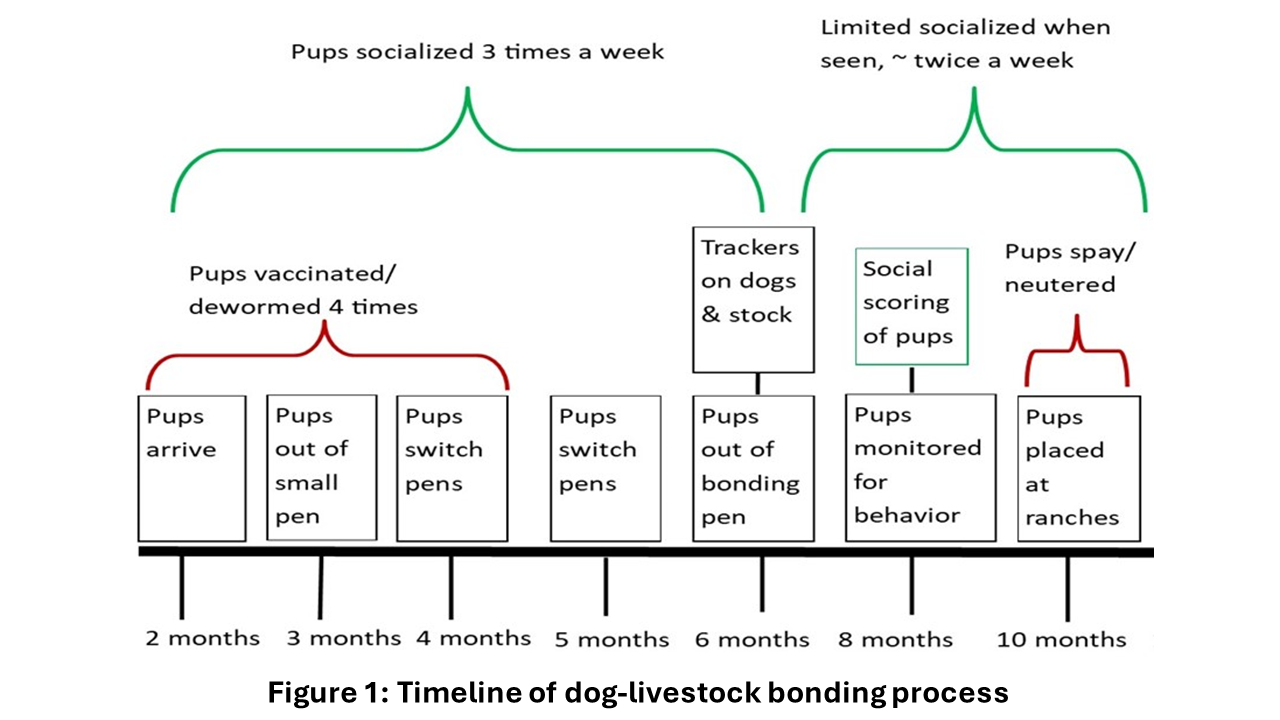
Monitoring LGD behavior as an adult
All dogs will be released with their own herd of livestock by 10 months of age and tracked using commercial GPS trackers until they are 18 months of age. AgriLife employees will monitor the dog’s behavior patterns via GPS tracking reports. Each pasture border has a geofence, so the software could send a geofence alert for daily totals per dog.
LGD Efficacy: Lambing percentages will be recorded before and after LGD deployment for each flock.
Roaming behavior: Analysis of GPS data using ArcGIS will characterize the movement patterns of LGD and determine how many times the dog leaves their home range (count/d; weekly totals). Data will be collected monthly from 10 to 18 months of age.
Statistical Analysis
Prior to analysis, response variables will be tested and transformed for normality and heterogeneity of variance.
Changes in lambing percentages and daily roaming frequencies will be compared among treatments. A generalized linear mixed model (PROC GLIMMIX) will evaluate the impact of hot wire use (presence vs. absence) on the efficacy of LGD and their roaming behavior. Differences among treatments will be evaluated using Least Squared Means with a Tukey-Kramer correction.
To evaluate changes in roaming behavior over time, a Generalized Linear Mixed Model (PROC GLIMMIX) will evaluate how the relationship between rearing location and hot wire use on LGD behavior changed over time. Pairwise comparisons among treatments will be evaluated using Least Squared Means with a Tukey-Kramer correction.
Eight LGDs were assigned to bonding pens either with (HW; n=4) or without (CON; n=4) hot wire fencing. Upon reaching adulthood, the LGD were then deployed on five commercial ranches in Texas and monitored for 10 months using GPS collars. Mixed models evaluated the effects of treatment and time on spatial position and kernel density estimation characterized space use. HW dogs crossed boundaries 2.00 ± 0.91 times, compared to 61.25 ± 4.63 times for CON dogs, although excursion distance and duration did not differ (P>0.05). Daily distance traveled differed by treatment and spatial location (P<0.0001). HW dogs traveled 2.84 km/d inside and 0.001 km/d outside ranch boundaries, compared to 5.30 and 0.17 km/d, respectively, for CON dogs. Both Daily Maximum speed (P=0.02) and average daily speed (P=0.05) were lower for HW dogs. HW dogs spent less time stationary within ranch boundaries than CON dogs (656.2 min/d versus 957.2 min/d; P<0.0001), indicating that reduced movement was not associated with decreased overall activity and that HW dogs increased patrolling within the ranch boundary.
These results suggest that exposing LGDs to electric fencing during the bonding period as puppies improved boundary fidelity in adulthood, indicating that this early-life management strategy may reduce roaming in adult LGDs. This is novel information that can be used to develop and modify current management practices.
Educational & Outreach Activities
Participation summary:
People who learned
Farmers and ranchers: 10 people at cooperating ranch sites; 1,184 additional attendees at events; recorded events could reach hundreds more via YouTube channels. Agricultural service providers: 25 County Extension Agents Others: 2 - a graduate student and an advisor
The project involved cooperation with five commercial Texas ranches, where researchers monitored eight livestock guardian dogs (LGDs) after their early-life bonding period. Ranch cooperators provided working ranch settings and producer-reported livestock production information. GPS tracking and ranch visits gave us opportunities to discuss dog location, management, health, and the practical use of monitoring technology with participating producers. We held producer trainings and updates every four to six weeks at ranch locations to verify that the dogs were working correctly and to address any adolescent LGD issues producers encountered.
We prepared and submitted a research manuscript (Effects of Early-Life Bonding Environments on the Spatial Behavior and Roaming Tendencies of Livestock Guardian Dogs) to the Graduate Department at Texas A&M University, describing the bonding treatments, GPS movement analysis, boundary crossings, and ranch production observations. The committee approved it on August 28, 2026, for the applicant's December 12, 2026 graduation. Its findings support producer education on early-life bonding, electric fencing, and GPS monitoring. We are submitting the literature review and thesis research paper to journals for publication.
We also prepared five producer case studies for the Campbell, Cude, Hudson, Lewey, and Smith operations. These describe producer experiences with puppy bonding, GPS monitoring, livestock protection, feeding, and other management challenges and provide practical examples for producer education. The case studies are official publications of the Texas A&M AgriLife Extension and are available online for download through AgriLife LEARN and the AgriLife LGD Program website.
We held two field days at the Texas A&M AgriLife Center – San Angelo in 2025 and 2026 to provide project updates and results. We also held over 25 workshops and 2 podcasts across Texas counties and the US throughout 2025-26 to present project data, and we will continue sharing results in the future, as the data showed that early bonding and training protocols drastically reduce roaming in adult dogs, a leading cause of death in LGDs. Texas county and out-of-state workshops drew 25 to 100 people to each event. University personnel recorded several out-of-state presentations for future use in Tennessee, Arkansas, and Ontario, Canada.
Project Outcomes
Texas Sheep and Goat Predator Management Board Grant – LGD Aerial Predator Training and Bonding, $40,750.00. This grant continues to examine early bonding and training protocols. Electric fencing is now standard in the protocol, and this project also focuses on virtual fence training after 6 months of age and adding training puppies for aerial predator threats. The project is currently funded for one round, but we expect to replicate the process for five total rounds.
USDA-NIFA Evans-Allen Grant - Ensuring Food Security through Livestock Guardian Dog Research and Extension Program at PVAMU, ~$1.6 million. This grant will formally establish an LGD Program at Prairie View A&M University. The grant will fund multiple LGD bonding and training projects with small ruminants and cattle. It will also provide for extension activities and undergraduate student training and work with LGDs on the campus farm.
Of the five ranchers in the cooperating study, four changed their bonding practices to include electric fencing in the bonding pens and now use some form of GPS tracking or virtual fence collar tracking for their LGDs. The single ranch that did not change its practices no longer has small ruminants and LGDs.
The case studies also document additional management changes: the Cude operation began breeding Kangal dogs for ranch use, and the Smith operation added dogs to protect Angora goats. These examples illustrate the kinds of changes that arose from participation; the reported count above is four ranchers who changed bonding practices.
The principal measured outcome was a difference in adult LGD movement associated with the early bonding environment. Hot-wire dogs crossed ranch boundaries less often and traveled less outside them than control dogs. The results offer preliminary evidence for a practical early-management approach that may help producers improve boundary fidelity. They do not demonstrate that every dog will stay within a fence or establish long-term retention, predator deterrence, or livestock protection.
Economic: Fewer departures could potentially reduce time spent recovering dogs and the risk of losing and replacing them. Better livestock protection might also support income from lambs and kids, but this study did not establish a causal reduction in predation or measure treatment-specific cost savings. Producer-reported lambing percentages increased after LGD use, but they were observational and could reflect nutrition, weather, reproductive performance, disease, and other management changes.
The case studies provide examples of producer-reported changes: Cude reported a marketed lamb crop increasing from 35% to 85%; Smith reported 85% to 125%; Hudson reported less than 20% before LGDs and more than 108% afterward, with some lambs still on ewes; and Campbell reported 16% to 120% for the Rambouillet flock and 90% to 115% for the Dorper flock. Reporting methods differed, and these observations cannot establish that LGDs or a particular bonding treatment caused the changes. The Lewey case study did not establish an actual post-LGD percentage.
LGDs are a nonlethal tool that can be incorporated into predator management. Improved boundary fidelity may support their use within designated livestock areas. The study did not measure wildlife populations, ecosystem effects, or changes in lethal predator control.
Social: Keeping dogs closer to assigned ranch areas could reduce neighbor conflicts and producers' concerns about missing dogs. Working with commercial ranches also helped frame the research around producer needs. These potential benefits were not measured directly. The small sample size, differences among ranches and dogs, and lack of simultaneous livestock tracking limit the conclusions and their generalizability.
The case studies also identified practical challenges. Campbell reported tracker failures and difficulty accessing location data; Cude noted continued mountain lion predation; Hudson described challenges maintaining dog body condition and preventing boundary crossings in non-treatment dogs; and Smith described adolescent chasing and a dog later lost to a snare. At the Lewey operation, staff removed dogs after care concerns were not resolved. These experiences highlight the importance of reliable feeding, monitoring, owner and employee training, and follow-up. The producers also followed basically the same overall process due to extensive producer education on bonding LGDs by AgriLife Extension personnel, so there was not enough difference between the groups to provide for accurate testing of producer bonding practices and AgriLife protocols.
The project was conducted with five commercial ranches that provided settings for monitoring working LGDs and supplied producer-reported livestock production information. These research–producer collaborations allowed the study to examine dog movement across different ranch environments and translate GPS findings into questions relevant to practical ranch management.
All five cooperating producers were new collaborations developed through the SARE project. Three of these producers are also participating in the 2026-27 LGD Aerial Predator Training and Bonding Project, which we received funding for from the Texas Sheep and Goat Predator Management Board. Four of the five producers have also given presentations at field day events on the outcome of the project, and one is assisting in lobbying for permanent Texas state funding for the AgriLife LGD Program due to the overwhelming success of the dogs on his ranch.
The SARE grant also led to a separate 2025-26 pilot project to bond LGDs with cattle to support a larger project protecting Swift Fox in the Rita Blanca National Grasslands. Those dogs currently protect cattle and are helping the recovery from coyote predation.
The SARE project also led to the Evans Allen Grant at Prairie View A&M, which established an LGD Research and Extension Program at that campus to expand research
and outreach capabilities using LGDs to protect small ruminants. That program will also have a student component allowing undergraduate students to work with LGDs and be a part of LGD research on campus.
This project strengthened our understanding of how early-life management may influence movement in working LGDs. We compared eight dogs bonded with livestock at the Texas A&M AgriLife Research and Extension Center in San Angelo: four were exposed to hot wire in their bonding pens, and four were not. We later monitored the dogs by GPS for 10 months on five commercial ranches. Dogs exposed to hot wire averaged 2.0 boundary crossings during the study compared with 61.25 for the control group, and traveled approximately 99% less distance outside ranch boundaries. Boundary departures in both groups were generally brief and localized.
These observations reinforced our understanding that early exposure to a boundary may affect later spatial behavior. GPS tracking and spatial analysis also provided skills and tools for assessing movement inside and outside ranch boundaries. However, the study did not directly track livestock and therefore cannot establish how closely dogs remained to their animals or whether a stronger bond caused the observed differences. With only four dogs per treatment, the results should be interpreted cautiously.
The broader project included producer-bonded and AgriLife-bonded dogs. The case studies describe differences in handling, movement, and management at cooperating operations. These observations are descriptive; the manuscript’s reported hot-wire and control results concern the eight AgriLife-bonded dogs and do not constitute a formal statistical comparison of producer-bonded versus AgriLife-bonded dogs, as the outcome did not differ enough to warrant one. The SARE project helped the graduate student confirm his belief that early bonding and training modify adult LGD behavior and can reduce roaming in adult dogs. The project also provided the graduate advisor with information on LGDs and their training process.
We would like to expand the study to include more dogs, ranches, breeds, and management settings, with sufficient replication to separate treatment effects from ranch and individual-dog differences. Tracking livestock and LGDs simultaneously to measure proximity directly, and monitoring predator activity and verified predation losses, would also benefit a future study. Collecting consistent production and cost data, including lamb survival, dog retention, replacement costs, and management time, may show whether changes in movement produce economic benefits and increase producer adoption of LGDs. Future research could also evaluate puppy welfare and the practical conditions needed for safe, effective hot-wire use. Further work should examine boundary learning and whether outcomes persist as dogs age.
Future work should also standardize lambing and weaning measures and evaluate GPS tracker performance in areas with limited cellular coverage. A standardized definition of LGD roaming vs. patrolling would greatly benefit future researchers, as definitions vary widely across current articles. Producer education should address feeding, health checks, safe handling, and clear responsibilities for owners and ranch staff. This project showed the value of pairing applied research with participation from commercial producers. Continued support for long-term field monitoring and producer-centered outreach would help translate preliminary findings into recommendations that can be evaluated across operations.