Final report for LNC21-448
Project Information
Small-scale hobby beekeepers and large-scale commercial beekeepers struggle to keep their honey bee colonies healthy. High colony losses mean that beekeepers need to purchase replacement colonies; low losses allow beekeepers to sustain or grow their apiaries, leading to more fiscal freedom and less stress, improving quality of life.
Pathogens can spread between colonies, so one beekeeper’s colony health can impact other beekeepers even a mile away. A unified strategy is therefore critical to the health of managed honey bees. In our project titled “Addressing honey bee health challenges in Minnesota through providing colony assessment tools and education for beekeepers,” we will develop unique support-systems: for hobby beekeepers the focus will be on developing a hands-on colony assessment and mentorship program; for commercial beekeepers, the focus will be on varroa mite diagnostics training.
With hobby beekeeper Advisory Board input, we will develop a colony assessment service and management guides to provide crucial honey bee health standards for hobby beekeepers. Our program will encourage hobbyists to participate in a community-focused beekeeping model; i.e., understanding how their bees affect the health of their neighbor’s bees, and together raising regional standards for bee health and longevity. Outcomes will include more beekeepers with increased knowledge and confidence in performing colony diagnostics, and adoption of these practices.
With commercial beekeeper Advisory Board input, we will empower commercial beekeepers to perform their own monitoring and through the development and use of a varroa mite monitoring kit. Operation-specific plans will be developed based on a beekeeper’s schedule and resource availability. On-farm, bilingual trainings will lead to increased knowledge and skills in varroa mite monitoring and confidence in implementing varroa mite control. Outcomes will include increased knowledge and use of timely mite monitoring in commercial operations, allowing for the detection of varroa issues before economic damage and resulting in more profitable businesses.
We will develop the programs in Minnesota and build a template for both small and large-scale beekeeper trainings that can be used in other regions with similar needs.
We are developing unique support-systems for different beekeepers: for small-scale hobby beekeepers the focus is on developing a hands-on colony assessment and mentorship program; for large-scale commercial beekeepers, the focus is on mite diagnostics training. Learning outcomes for hobby beekeepers will include more beekeepers with knowledge and confidence in performing colony diagnostics and monitoring for pests and diseases; action outcomes will be adoption of these practices into colony management. Learning outcomes for commercial beekeepers will be increased crew knowledge of mite monitoring; action outcomes will be timely implementation of mite monitoring into the operation.
Our five aims are:
For small-scale beekeepers:
1. Develop and provide a colony-assessment service
2. Collaboratively develop inspection and management guides with a seasonal componet
3. Design a scalable template of our assessment service model for other regions
For large-scale beekeepers:
4. Develop a mite monitoring kit that facilitates efficient disease and pest control
5. Create bilingual training guides, provide educational field days, and scale training protocols to other states within the North-Central region
Honey bees provide approximately $12 billion worth of pollination services in the US (Calderone 2012), making them essential to Minnesota and national agriculture. In addition, approximately 47% of US honey is produced in the North-Central region (USDA-NASS 2020). Beekeeping is also a popular hobby, side business or profession. Beekeepers are classified based on the number of colonies they manage: the hobby beekeeper group (fewer than 20 colonies), and the professional (called commercial or sideliner) beekeeper group (20 to 40,000 colonies). Nationally, all beekeepers struggle to keep their colonies healthy due to pests, pathogens, pesticides, and lack of forage. For commercial beekeepers keeping honey bees as their livelihood, high rates of colony mortality are not economically viable. For hobby beekeepers, colony loss is also a financial burden. Beyond economics, parasites and viruses from sick colonies can spread to neighboring colonies. With current knowledge about how pests and viruses can spread between honey bee colonies (Peck & Seeley 2019), and even between species of bees (Spivak & Cariveau 2020) there is an urgency for beekeepers to get a handle on their colonies’ health. While hobby and commercial beekeepers function very differently, beekeepers share a common need for research-based diagnostic services and best management practices to keep honey bees healthier.
Beekeeping is a complex system of biology-based management that changes throughout the season and from year to year. Being a responsive beekeeper requires understanding the biology of the bees, understanding what the colony needs at a given time of year, and knowing when to intervene. One of the most complex and critical challenges beekeepers need to understand is the parasitic varroa mite (Varroa destructor) and viruses transmitted by the mite; a primary cause of colony mortality (Dainat et al. 2012). Despite awareness of the issue, beekeepers struggle to implement effective, timely testing and management strategies for varroa. Controlling varroa infestations requires advanced understanding of mite and bee biologies. Varroa populations increase in spring and summer when the honey bee population grows. In fall, the varroa population reaches its peak and can cause irreversible damage to the colony if not controlled. Timely varroa management can be the difference between colony survival and death. There are narrow windows of time across the season to effectively treat colonies for this mite. For example, if floral bloom and thus honey harvesting runs unseasonably late one summer, the window to manage mites before fall might be delayed, causing irreparable health damage to the colony. Because controlling varroa increases the probability a colony survives (Lee 2018), our goal is to help beekeepers of all levels learn the skills to manage varroa in a timely and effective manner, using key skills such as mite sampling, early-stage disease diagnostics, and seasonal planning.
Beyond understanding varroa, new hobby beekeepers need additional instruction. These beekeepers are often overwhelmed by the experience of keeping bees and lack the knowledge and confidence in performing basic colony management tasks. Discerning a colony’s health status requires training and practice in recognizing what healthy bees look like and identifying subtle and overt signs of multiple diseases. Sick colonies are often initially asymptomatic, making management decisions difficult for beekeepers. Beekeepers needs support in understanding colony dynamics, identifying common pests and diseases, and assessing if a colony is healthy or unhealthy.
In Minnesota there is no health oversight for managed honey bees. Some city ordinances require minimal beekeeping training before acquiring bees, but there is little oversight for how beekeepers manage these animals once they obtain their bees. Managers of other animals may utilize veterinary services, but beekeepers need to be able to diagnose and treat bees themselves. Our goal is to provide Minnesota beekeepers with the training and tools they need to effectively combat issues in their honey bees colonies, leading to better bee health and lower bee mortality. Our approach to reaching this goal has two prongs based on if the beekeeper keeps honey bees as a hobby or as a commercial beekeeper. While these groups share similar concerns when it comes to the parasites and pathogens that threaten bee health today, support and solutions need to be tailored to the differing needs of these groups, and the varying natures of their respective operations.
Cooperators
- - Technical Advisor
- - Technical Advisor
- - Technical Advisor
- - Technical Advisor
- - Technical Advisor
- - Technical Advisor
- - Technical Advisor
- - Technical Advisor
- - Technical Advisor
- - Technical Advisor
- - Technical Advisor
Research
Education
We designed colony assessment tools for and by small-scale and large-scale beekeepers. For small-scale beekeepers, we are developed a guidebook that builds beekeeping skills throughout the changing bee season, including note taking, reading the size and health of a colony, recognizing signs of health and problems, and making management decisions based on colony assessments. For large-scale beekeepers, we developed tools to support effective varroa mite monitoring with the outcome of more confident beekeepers that are able to more quickly respond to an issue that arises. Both programs worked directly with representatives of audiences that were the audience for the educational materials. Working with beekeepers always heals to ensure the developed materials are useful, relevant, and easy to use.
Project Activities
Educational & Outreach Activities
Participation summary:
Mentoring
We trialed mentoring programs as described here: z.umn.edu/BeekeepingMentoringComparison
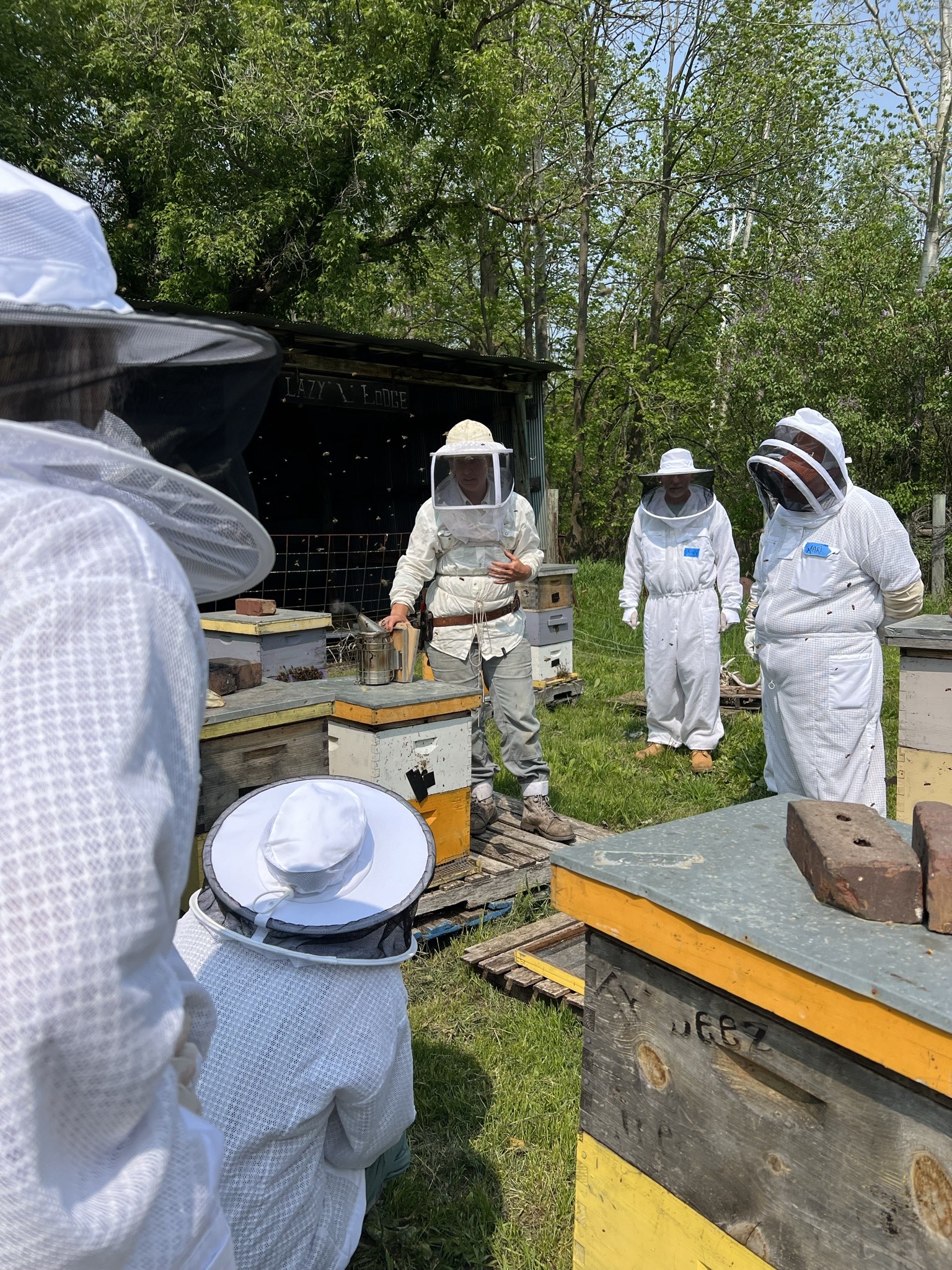
Essentially, we trialed different mentoring programs: workbook only, virtual + workbook, beekeepers attend field trainings + workbook, and individual mentoring sessions + workbook. The first version of the workbook did improve knowledge and led to management changes. Vitrutal mentoring would benefit from updated in communication and technology. Beekeepers prefer hands-on, in-colony sessions. Bringing beekeepers to a central location can work well and can reduce the time commitment for a mentor of multiple beekeepers.
Beekeeping Workbook/Guidebook
In 2022, we worked with an app development company to pilot an app-based beekeeping mentoring tool with 19 beekeepers, and moved to a non-app workbook in 2023. The app service that provided virtual mentoring guidance was also was paired with in-person beekeeping mentoring for 9 of the 19 beekeepers.
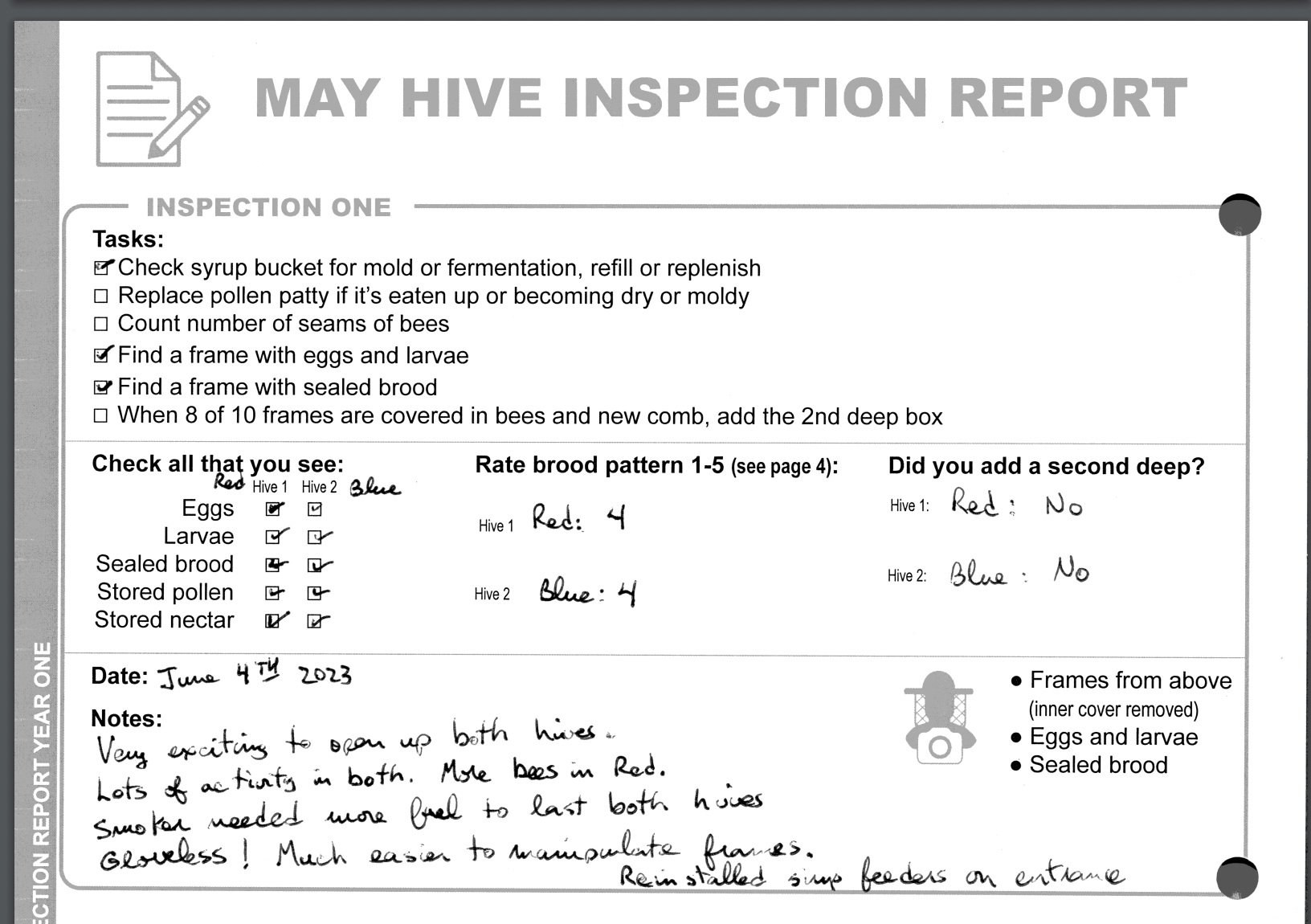
In 2023, we pivoted from the app to pilot a beekeeping workbook. The workbook was trialed by 113 participants, most of whom provided feedback at the conclusion of the beekeeping season. This feedback, along with feedback from the beekeeper advisory board, was used to develop the next version of the workbook.
In 2024, we developed a workbook that included trainings for the beekeepers paired with field datasheets for guided note taking. The workbook can be found on our website as a downloadable PDF. We gave a total of six presentations on the workbook to beekeeper groups, including at a Heroes to Hives conference for military Veterans that are also beekeepers. A summary of the workbook was also published in the 2023 Minnesota State Agency Pollinator Report by the Minnesota Environmental Quality Board.
In 2025, we produced a final workbook that includes explanations on how to inspect a colony for signs of health, instructions on making management decisions based on colony growth and health, and guided note taking. The final workbook is available online as a PDF and a flipbook, and as a printed booklet on our website: beelab.umn.edu/honeybeeguidebook
Outreach
2025 Guidebook Direct Distributions (email or tabling):
- 83 past participants in the program, board members, and sign ups online
- 223 students in the 2024 UMN online beekeeping course
- 212 students in the 2025 UMN online beekeeping course
- 1000+ in the MN Honey Producers beelines distributed at Farm Fest and the MN State Fair Honey Bee Booth
- National SARE email listserv
- NCR SARE email listserv
- 60 apiculture educators in the Apiculture Extension Educators Association (AEEA)
- 100+ CFANS table at the State Fair
- 2 copies given to a WI county beekeeping club
Newsletters
- Bee Lab Newsletter
- 705 Bee Veterans Newsletter
- U of MN Extension Women in Ag Network Newsletter
- U of MN Extension Small Farms Newsletter
- U of MN Extension Growers Network News
- U of MN Extension Agriculture, Horticulture & Natural Resources Update
- Included in an Iowa beekeeper club newsletter
Sales
- 18 via the UMN Bookstore
- 31 to northern MN beekeeping clubs
Downloads
- 2025: 691 “active users” on the website (number of unique users who had an engaged session on your site or app during a specific time frame), with 311 clicks on the guidebook pdf and 90 clicks on the inspection pages.
- 2024: 288 “active users” on the website (number of unique users who had an engaged session on your site or app during a specific time frame).
Presentations 2025
- Polk County Beekeepers Association (22)
- South East Minnesota Beekeepers Association (35)
- MHPA (60)
- North Central Beekeepers (40, Becky)
Presentations 2024
- West Metro Bee Club (28)
- Minnesota Hobby Beekeepers Association (70)
- North Central Beekeepers Association (40)
- Minnesota and Wisconsin Honey Producers Associations Summer Conference (50)
- Heroes to Hives Conference (20)
- Walworth County Beekeepers Association in WI (23)
Presentations 2023
- Tri-State Beekeepers Conference. Fargo, ND. (75)
- Thief River Falls, MN (11)
- North Central Beekeepers Association. Brainerd, MN. (45)
- South East Minnesota Beekeepers Association. Rochester, MN (65)
Publication
- Lee K, Mendel B, Masterman R. (2024) Towards Better Honey Bee Health in Northern Climates. 2023 Minnesota State Agency Pollinator Report. Minnesota Environmental Quality Board. https://www.eqb.state.mn.us/programs/pollinators/pollinator-reports
Varroa Mite Testing Kit
In 2022-2023, we querried our professional beekeeper advisory board on mite sampling and preferences in testing methods and troubleshooted with them as we put together options. Based on feedback, we developed several different testing kit models and trialed them in the field with two beekeepers. From those trials, we developed a professional mite sampling kit designed for and by beekeepers. One of the beekeepers on the advisory board is Spanish speaking and helped to film the videos and develop the materials in Spanish.
In 2024, we developed a field kit for testing for varroa mites in honey bee colonies. The kit included all the supplies needed to test, along with instructions and videos in Spanish. We traveled to six beekeeper businesses to work with 28 beekeepers in the north central region to distribute and test the kits in the field with the beekeepers that will use it. In addition, we worked with the beekeeper managers to discuss mite monitoring and how they can time the testing to pair with management windows. We also discussed the importance of utilizing brood breaks and varroa-resistant stock to keep mite levels low throughout the year.
Learning Outcomes
- 66 beekeepers trialling the workbook: Performing a hive inspection (i.e., knowing what to look for at each visit); Looking for signs of disease in the colony; Rating the quality of the brood pattern; Assessing overall colony size (i.e., seams of bees); Taking notes; Colony handling techniques; Colony management; Timing for managing varroa mites
- 24 beekeepers trialling the varroa testing kit: Testing for varroa levels with a mite kit
Project Outcomes
Performing a hive inspection (i.e., knowing what to look for at each visit); Looking for signs of disease in the colony; Rating the quality of the brood pattern; Assessing overall colony size (i.e., seams of bees); Taking notes; Feeding sugar syrup; Feeding pollen patties; Varroa mite monitoring; Varroa mite management
2022
Responses to the question "As a result of using the virtual mentoring service, have you implemented a new beekeeping technique or management strategy?":
- “I have definitely become more confidence as a result of the mentoring service. I have become more familiar with the challenges and with the remarkable animal, the honey bee. I am also more familiar with mite management.”
- “Standardized record keeping. More consistent record keeping (or realizing the need to do this :). Visualization of bee numbers in a colony.
2023
Select feedback received from the evaluation survey about the beekeeping workbook:
- The workbook was really helpful during the divide. The "tasks" section kept me organized and reminded me to put a new, empty deep on the parent as I had forgotten! I really like how it lays out each section with a "to-do" and has made the divide process much more clear.
- LOVE THIS PROGRAM and hope it’s going on next year. I definitely want to participate again
- This workbook = AMAZING! It's SO informative and easy to use, along with the help to visit the actual book pages and color coding months. If you publish for sale a workbook every year, I'm a buyer! Honestly this book is fantastic!
- Again I want to thank you. Your program has dramatically changed the way I work with and think about my bees.
- I’m really enjoying the workbook so far. This is exactly what I was looking for to help guide me through my first year. I know I’ll continue to use it as a guide in the years to come.
- Loving the workbook. Keeps me on track and let’s me spend more mental energy observing rather than worrying about what I need to observe.
- This workbook is amazing. It constantly teaching and reminding me of all task and how to do it. Between the workbook and manual, I am becoming a better bee keeper. Thank you!
- I follow a few bee groups on facebook and have realized just how valuable this workbook really is. The questions that are being asked are addressed in this book and I don't have to guess or wonder about many of the things that need to take place for proper beekeeping. Thanks so much for all of the time and energy that has gone into the making of this book!
- I liked the layout and the colors (different months) and the white space and the graphics. The writing was clear and to the point and the overall tone was friendly and encouraging.The workbook was VERY useful. The journey through the season was informative and inspiring.