Progress report for LNE23-473R
Project Information
Cover crops (CCs) are an integral part of the weed management package in rotational no-tillage-based organic crop production systems. We propose a novel research project to support farmers in the Northeast by improving CC rolling/crimping technology in rotational no-till systems. This 3-year project will address USDA-SARE’s vision: “Agriculture in the Northeast will be diversified and profitable, providing healthful products to customers (....)” by improving weed suppression with no additional fuel, labor, and cost, promoting two specialty crops to diversify mid-Atlantic agriculture, and promoting organic crops to provide healthful products to customers. The project is conceptualized and designed based on stakeholder input.
High bounce-back of CC after rolling/crimping, delayed response to crimping, and unbearable weed pressure even with substantial CC biomass are the key problems this project intended to address. Field research began in 2023 in Pennsylvania across two USDA plant hardiness zones (5b: Long Pond and 6a: Kutztown) to investigate the effect of rolling/crimping patterns on CC termination, cash crop establishment, weed dynamics, and allelopathic effect with three cover crops [cereal rye (Secale cereale), hairy vetch (Vicia villosa), and crimson clover (Trifolium incarnatum)) in no-till organic systems with sweet corn and fiber hemp at the Kutztown site, while soybean replaced sweet corn at the Long Pond site.
The experiment was laid out in a split-plot arrangement with 9 treatments plus one no-CC control with four replications. Main plot includes three cover crop species and subplots are rolling/crimping patterns with respect to CC rows (parallel, perpendicular, and 30° angled) to grow two main cash crops: industrial hemp and sweet corn on separate fields. This report summarizes annual activities and research progress for 2025.
By the end of 2025, we completed the second year of field research overall; however, this represented the first year of field data collection in Long Pond, as no main-crop data were obtained there during the 2024 growing season. The 2025 growing season began with planting cover crops in fall 2024, followed by main crops in early summer 2025. Soil samples (0-15 cm depth) were collected after CC germination for baseline nutrient profile. Cover crop biomass, density, bounced-back percentages, and were assessed. Lysimeters were installed 15 cm below the soil surface in each plot to collect leachate samples, which were analyzed for three allelochemicals (p-Hydroxybenzoxazinone, cyanamide, and polyethylene glycol) abundant in the CCs by using reversed-phase high-performance liquid chromatography (HPLC). Additional soil samples were collected in Spring 2025 after cover crop termination for allelochemical extraction.
Weed biomass and density were measured twice in the summer. Data on hemp biomass yield, sweetcorn cob yield, soybean grain yield, and grain quality were also measured. In addition, a soil seedbank germination assay was conducted. With these efforts, two years of field research have been completed at the Kutztown site, while research at the Long Pond site will continue through 2026 as its second year of field study.
Cover crops have been planted for 2026 season, which will be terminated using a roller/crimper, and then no-till planting with cash crops in following April/May. All parameters measured in 2025 will be repeated in 2026 field season, with the addition of a soil seedbank germination assay.
To involve farmers in the project, two demonstration trials will be established in the third year of the project in Kutztown location. Feedback and farmer's evaluation will be recorded. Outreach plans include field days, web article publications, social media posts, two webinars, one peer- reviewed publication, regional and international conferences, video production, educational materials production, newsletters publications, and face-to-face training. Technology that makes rolled/crimped surfaces smooth and suppressive to weeds would be appealing to growers.
The goal of this project is to demonstrate the ability of cover crops in suppressing weeds with different rolling/crimping approaches and promote it for no-till organic production.
Three objectives were defined to achieve the goals:
Research Obj.1: Compare the effect of three different roller crimping patterns on weed suppression.
Research Obj. 2: Evaluate the interaction between rolling/crimping patterns and cover crop species by measuring the weed dynamics, sweetcorn (Zea mays) and fiber-hemp (Cannabis sativa) yield as high-value cash crops.
Outreach Obj.1: Establish demonstration sites in two USDA plant hardiness zones to educate growers on rolling/crimping techniques in the Northeast agroecosystems.
A survey conducted by Organic Farming Research Foundation in 2020 identified weed management in organic cropping systems as the topmost priority for future research (Snyder et al., 2022). Several studies demonstrated that weed control in organic agriculture remains a major and enduring challenge and a barrier to organic transition. While synthetic chemicals and intensive tillage are not options for organic no-till systems, thick cover crops mulch can be the most effective weed-suppressing tool. Studies have shown that up to 75% of weed suppression can be achieved with adequate cover crop biomass if properly rolled and crimped (Mirsky et al., 2013). Growers in the region are still struggling to achieve >75% ground cover after rolling/crimping (Lap Amon, personal communication). Additional concerns are the need for rolling/crimping twice before planting and high weed pressure even with substantial cover crop biomass. The necessity of proper rolling/crimping for efficient termination and weed suppression highlights the importance of understanding the factors that influence this process.
There is a dire need for immediate solutions that “satisfy sustainable agriculture goals in the Northeast”. The proposed cover crop-based approach will complement and enhance the existing roller/crimper technology for organic high-value crops rather than displacing it, which will allow research outcomes to be seamlessly introduced and adopted in existing organic systems. The enhanced utilization of rolling/crimping technology has great potential to reduce pesticide use and intensive tillage and ensure environmental benefits and crop resilience. The use of cover crops for organic no-till systems offers tremendous ecosystem services (Blanco-Canqui et al., 2015; Crézé et al., 2021) while providing healthful products to customers.
There are 4003 certified organic farms in 12 Northeast states with over 735,438 acres (USDA-NASS, 2020). Rodale Institute’s consulting team’s HubSpot database showed that we reached out to 517 farms in 2022 with ~3,000 acres certified organic whereas Northeast represented 187 farms (26% grain & 14% hemp) having 122,000 acres in production (including conventional) with ~30,000 acres in transition to organic. Out of 187 farms, 27 are transitioning to regenerative organic and have been practicing rotational no-till with roller/crimper. The average size of the farm is 25 acres, mostly producing soybean, corn, and vegetables. We saw 27 growers as early adopters and innovators of this novel approach in the Northeast and >160 farms will be early and late majority in the innovation adoption lifecycle (Rogers, 1962).
From non-replicated assessment, we discovered that the pattern of rolling/crimping has a significant impact on cover crop bounce-back and the early emergence of weeds. The fractional weed cover at the parallel rolling was 28% while <5% with the perpendicular pattern, two weeks after termination. Out of 425 visitors during the field day event (21 July 2022), approximately 50 growers had concerns about soil water exhaustion before cash crop planting and high bounce-back of cereal rye tillers. This indicates the need for better solutions for cover crop rolling/crimping. Thus, systematic research is needed to assess the weed dynamics, potential allelochemical retention, and crop vigor associated with the rolling/crimping patterns for an informed decision.
Research
We hypothesize that pattern of cover crop rolling/crimping would affect surface mulch cover, weed emergence, weed seedbank, and crop productivity in no-till organic systems. Differences in cover crop desiccation duration among rolling/crimping patterns would affect surface soil moisture and the release and retention of allelochemicals into the soil. Differences in bounce-back percentages and weed emergence among three rolling/crimping patterns could impact in-season weed pressure and weed seedbank in the soil. The additional research questions include: Will crop stand establishment be affected by rolling/crimping patterns? Is the result cover crop-specific? What are the weed species mostly suppressed by the novel method?
Field research exploring the effect of cover crop rolling/crimping patterns on two high-value cash crops (sweetcorn and hemp) has been started through nesting research plots in two USDA plant hardiness zones: Rodale Institute, Kutztown, PA (6a), and Rodale Institute-Pocono Organic Center, Long Pond, PA (5b) since 2023. Both hemp and sweetcorn can be grown in these locations with shorter growing degree days than common row crops like soybean and grain corn, which would provide a longer cover crop window for even continuous hemp or sweetcorn production. This will enhance adoption likelihood and promote specialty crop production in organic systems.
1. Treatments
There are 10 (9+1) treatments in this project. Treatments include combination of three cover crop species (cereal rye, hairy vetch, and crimson clover) and three rolling/crimping patterns (parallel to the cover crop rows, perpendicular to the rows, and 30◦ angled with the rows) and no cover crop control.
Cereal rye and hairy vetch are the major cover crops in the Northeast (Mirky et al., 2013), where farmer adoption of cover crop-based no-till grain crop systems has focused on these crops. Introducing hemp in the same system would be of interest to the growers including conventional farmers. Sweetcorn would provide enough time to establish cover crops before a hard frost in the fall, which is especially critical for zone 5b. If performed well, angled rolling/crimping would address challenges associated with uneven terrain.
2. Methods
The experiment is laid out in a split-plot arrangement. The main plot consists of three cover crop species and subplots are three rolling/crimping patterns and one control treatment with four replications (40 plots x2 crops = 80 plots/site). The size of each plot is 20 ft x 40 ft. Two cash crops (hemp and corn) cover about 3 acres at each location.
In the spring, cover crops, after reaching their maturity, were terminated using a 10 ft wide roller/crimper and then followed no-till planting with cash crops: yellow sweetcorn and fiber-hemp at 30” and 7.5” row spacings, respectively. Tractor operations followed cover crop rows at parallel treatment, where perpendicular and angled patterns were achieved by rolling/crimping at 90◦ and 30◦ of the cover crop rows, respectively. For no-cover treatment, weeds were mowed, and plots were shallow tilled several times with Treffler Harrow before planting. Note that cover crop rolling was in proposed directions, however, cash crops planting was in one direction only due to large size of planter.
For the 2024-2025 growing season, both field sites were tilled in August and cover crops were planted in September 2024. Seed rates for cover crops were 180, 45 and 25 lb ac-1 for cereal rye, hairy vetch, and crimson clover, respectively. Baseline soil samples (0-15 cm depth) were collected after crop emergence in November 2024. Soil analysis revealed the following results:
Kutztown site: pH 6.4, organic matter (OM) 4.40%, N 0.17%, P 110.63 mg kg-1, and K 50.06 mg kg-1
Long Pond site: pH 7.0, OM 3.21%, N 0.15%, P 11.26 mg kg-1, and K 112.01 mg kg-1.
In spring 2025, cover crops were terminated using a 10 ft wide roller/crimper in three directions: vertical, horizontal and angled. Later yellow sweetcorn (variety: Allure) and fiber hemp (variety: Santhica 70) were planted at rate of 12 and 60 lb ac-1, at 30” and 7.5” row spacings, respectively in Kutztown, PA on June 23, 2025. At the Long Pond site, hemp (same seeding rate) and soybean (variety: Org Soy at rate of 55.2 lbs ac-1) was planted using an Esc no-till drill on June 25, 2025. Lysimeters were installed for water sample collection in each plot.
Fiber hemp was harvested in August 2025 whereas sweet corn in September 2025 at Kutztown site. Similarly, hemp was harvested in September and soybean in October at Long Pond site. A new field was selected in Long Pond for the second-year trial, where fields were tilled and planted to cover crops in September 2025.
3. Data Collection
Cover crop: The number of tillers m-2 for cereal rye and crimson clover, as well as number of upright flower buds m-2, were determined using a 0.25 m2 quadrat in late May 2025. Aboveground biomass samples were collected using quadrats from each plot and dried at a constant temperature of 55◦C for 72 hours to determine dry mass. In early June 2025, cover crops were terminated using roller/crimper, and bounced-back tillers (or buds) were post-rolling to assess termination efficacy. Soil moisture reading was taken within a week of cover crops rolling down.
Allelochemicals: Water samples were collected for allelochemical testing from cover crop field. Since all plots had not received sufficient rainfall, water was added to simulate rainfall events for sampling. As a backup, soil samples were collected at the same time and stored properly in the lab. These samples were later sent to a Penn State Mass Spectrometry Core Facility for analysis, and the results are pending.
Soil: Soil samples from 0-15 cm depth were collected in summer 2025 from both sites (80 samples in each site) for allelochemical test and were analyzed using the HPLC method (results are pending).
Weeds: Weed samples were collected from 0.56 m2 quadrats per plot, centered on crop rows, 5-6 weeks after planting. An overhead photo of 1 m2 quadrat was taken for species and green cover. At the end-of-season, weed density was assessed before crop reached physiological maturity. Weeds were categorized into broadleaf, sedge, and grass, then dried to a constant weight at 55°C to determine dry matter, and ground to pass a 1 mm screen for total N analysis. Species richness was estimated as the number of species kg-1 soil and diversity as the weighted average of species proportional abundances.
In addition, a soil seedbank germination assay as described in the project proposal was conducted at Kutztown site. Briefly, soil cores (0–10 cm) were collected using a bulb planter, composited by treatment, homogenized, and stored cold until processing. The soil was sieved, spread evenly in greenhouse trays over vermiculite and landscape fabric, and maintained under greenhouse conditions with regular watering to promote weed seed germination. Emerging weeds were identified, counted, and removed periodically until no further germination occurred.
Crops: In 2024-2025, hemp and sweetcorn were harvested in September, respectively at Kutztown site. During the growing season, crop stands were assessed by counting seedlings/m row length from 10 spots/plot. Hemp biomass was determined before harvest from two 0.56 m2 quadrat areas. Sweet corn cob yield was determined by harvesting two– 1 m transects. Cob weight, length, cobs per plant, kernel rows per cob, and seed index were determined for each treatment. Grain quality was analyzed for total N and C.
Both hemp and sweet corn experienced poor germination at Kutztown site, resulting in low plant stands, particularly in sweet corn, where many plots failed to produce marketable cobs. Hemp establishment was relatively better at Long Pond site, where the same data collection protocols were followed. Soybean biomass was sampled using a 0.56 m² quadrat per plot. Plant material was dried at 105°F for one week, after which total aboveground biomass and grain yield were measured.
4. Data Analysis
All statistical analyses will be performed in R version 3.6.1 (R Core Team, 2020). Weed data will be arcsine (√Y) transformed to satisfy the assumptions of normality and homoscedasticity. Analysis of variance (ANOVA) will test variance within crop yield, yield attributes, allelochemicals, weed density & biomass, seedbank density, and species richness and diversity at α=0.5. LSD will separate the means at α=0.5. Cover crops, rolling patterns, and the interaction between the factors will treat as fixed effects and replicate as random effect. Nonmetric multidimensional scaling (NMDS) ordination biplots will be used to determine degree of similarity between weed communities and second-order stochastic dominance to assess crop-weed risks (Nichols et al., 2020).
Preliminary Results
We will provide comprehensive results and discussion upon the completion of the two-year field study at both sites. Since this report focuses on most parameters assessed at Kutztown site, we are presenting few selective results only. Additional updates will be included in the next report.
Soil moisture: After cover crop termination, soil moisture levels were as follows: 25.1% (ranging from 10.2% to 37.9%) in cereal rye, 25.8% (ranging from 17.8% to 35.5%) in hairy vetch, and 20.8% (ranging from 9.2% to 33.2%) in crimson clover. Soil moisture was consistently higher in all plots at Long Pond site compared to the Kutztown site.
Cover crops bounce-back: Bounce-back counts were conducted twice using a 0.25 m² quadrat. At the Kutztown site, no bounce-back was observed in crimson clover plots in the previous year; however, up to five plants rebounded in 2025. Hairy vetch exhibited up to six plants bouncing back, with the lowest counts in plots terminated perpendicular to the planting direction. Cereal rye showed up to four plants bouncing back, with the lowest counts in angled termination plots. Bounce-back levels were higher at the Long Pond site, likely because cereal rye performed better in growth and development than the legume cover crops in this trial. The poorer performance of legume cover crops at the Long Pond site may be related to cooler temperatures, heavier soils, and a shorter growing season.
Weed pressure: Broadleaf and grass weeds were more dominant than sedge at both experimental field sites. Weeds within each 0.56 m² quadrat were categorized into three groups, oven-dried, and their total dry weight was measured. Results indicated that broadleaf weeds had higher dry weights under the control treatment, while grass weeds showed higher dry weights in crimson clover-terminated plots in the sweet corn field. No significant differences were observed based on cover crop termination patterns. Additional parameters are still being evaluated, and laboratory results for allelochemical analysis are pending. Soil seedbank germination data have been collected but require further analysis to compare with emerging weed communities based on species richness, total weed density, and relative abundance. These results are expected to provide a clearer understanding of the effects of the three roller crimping patterns on weed suppression and will be reported in a future report.
Cash crops stand count: Crop stand counts in a 0.25 m² quadrat revealed that corn stand counts were higher in hairy vetch and crimson clover-terminated plots compared to cereal rye-terminated plots. Similar trends were observed for fiber hemp.
Hemp biomass yield: At Kutztown site, hemp dry biomass yield averaged 1,702 lb ac⁻¹ in crimson clover, 2,286 lb ac⁻¹ in hairy vetch, and 1,869 lb ac⁻¹ in cereal rye, while control plots averaged 520 lb ac⁻¹. Among rolling directions, the parallel termination produced the highest average biomass (2,437 lb ac⁻¹), followed by diagonal (1,943 lb ac⁻¹) and perpendicular (1,479 lb ac⁻¹) directions. At Long Pond site, biomass yields were substantially lower across treatments. Crimson clover averaged 541 lb ac⁻¹, cereal rye 581 lb ac⁻¹, control plots 162 lb ac⁻¹, and hairy vetch 43 lb ac⁻¹. By rolling direction, average biomass yields were 445 lb ac⁻¹ for diagonal, 415 lb ac⁻¹ for perpendicular, and 305 lb ac⁻¹ for parallel termination. Overall, hemp biomass production was consistently higher at Kutztown than at Long Pond, reflecting stronger crop performance at Kutztown site.
Corn and soybean yields: Due to poor crop performance, yield data were collected but do not represent average production levels. In sweet corn, some harvested rows produced cobs without grain, and in some cases no cobs were harvested at all. Soybean yield data were more reliable. For example, dry soybean biomass averaged 360 g per 0.56 m² quadrat. Detailed soybean biomass and grain yield data are still being processed and are not reported here.
Although the study is ongoing, preliminary results indicate that cover crop type, termination direction, and site conditions collectively influenced soil moisture, cover crop bounce-back, weed pressure, and cash crop performance. Legume cover crops, particularly hairy vetch and crimson clover, generally improved corn and hemp stand counts compared to cereal rye. Termination direction affected cover crop regrowth, with angled and perpendicular rolling patterns reducing bounce-back, especially in cereal rye. Hemp biomass yields were substantially higher at Kutztown site than at Long Pond, reflecting strong site effects related to climate and soil conditions. Overall, these early findings emphasize the importance of site-specific, tailored cover crop and termination strategies in organic no-till systems, with continued data collection and analysis needed to fully evaluate long-term impacts on weed suppression and crop productivity.
Education & outreach activities and participation summary
Educational activities:
Participation summary:
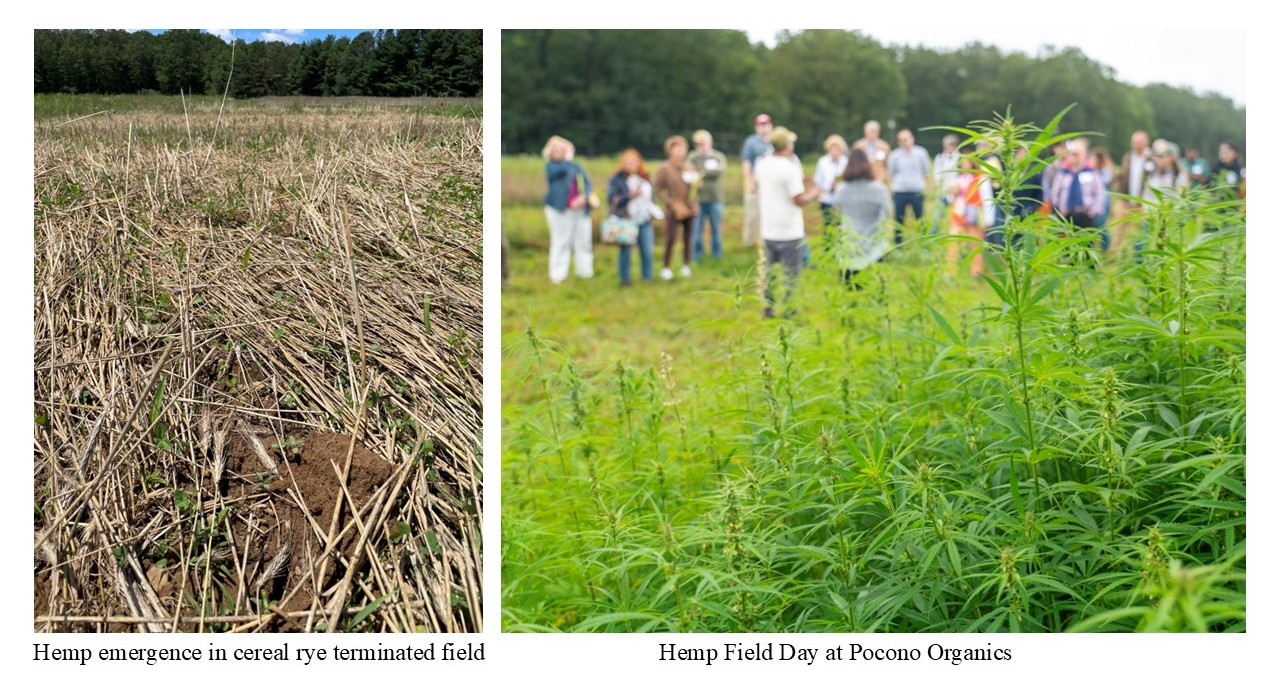
This project is ongoing, with field research continuing at the Long Pond site in 2026. During the reporting period, we conducted several outreach activities, including multiple field visits, one Fiber Hemp Field Day at Pocono Organics, and a webinar focused on fiber hemp production. Collectively, more than 500 participants attended these events throughout 2025. Key outreach activities included:
- Rodale Institute’s Annual Field Day, July 18, 2025, Kutztown, PA (450+ attendees)
- Hemp Field Day at Pocono Organics, August 21, 2025, Long Pond, PA (65+ attendees) (Figure 1)
- Advancing Sustainable Hemp Fiber Production and Processing in the Northeastern US, Rodale Institute’s Annual Webinar, September 3, 2025 (75+ virtual attendees; recording available at https://youtu.be/X5E-xYat7qo?si=3IopxSq4fHbB8cX6)
In addition, we published a blog article on the Rodale Institute website highlighting this research, which focuses on improving the effectiveness of cover crop rolling/crimping for weed control, soil moisture retention, and crop establishment in organic systems, particularly for hemp and sweet corn (https://rodaleinstitute.org/blog/improving-the-effectiveness-of-cover-crop-rolling-crimping-for-weed-control-and-soil-health-advancing-industrial-hemp-research-at-rodale-institute/). Other outreach and education activities outlined in the project proposal are also ongoing, as appropriate.
Learning Outcomes
Learning from Running Trial
From two years of field trials at Kutztown and Long Pond sites, we learned that cover crop selection is critical for fiber hemp and sweet corn production in the northeastern U.S., where cooler temperatures and shorter growing seasons prevail. Hemp establishment is highly sensitive to soil temperature, moisture, and surface residue, making cover crop choice, termination timing, and planting date essential for balancing crop establishment with soil health and weed suppression benefits.
Cereal rye provided reliable winter cover and weed suppression but sometimes restricted hemp emergence when residue was not well managed (Figure 1), particularly at the cooler (Long Pond) site. Hairy vetch grown alone performed inconsistently in colder conditions, suggesting that cover crop mixtures may offer more reliable performance.
Because field locations were rotated each year due to overlap between cover crop planting and cash crop harvest, it was not always possible to fully evaluate year-to-year treatment effects. High weed pressure across plots in further limited treatment differentiation; however, the study still highlighted important practical challenges and opportunities to refine cover crop and termination strategies in organic no-till systems.