Progress report for LNE25-489
Project Information
Project Focus:
This project addresses the urgent need for sustainable management of invasive jumping worms (JWs), specifically Amynthas tokionensis, Amynthas agrestis, and Metaphire hilgendorfi. These species are causing significant ecological and economic challenges for small-scale vegetable and nursery growers in Vermont (VT) and New York (NY). JWs degrade soil health by consuming organic matter, disrupting nutrient cycles, and leading to soil erosion, hydrophobic soils, and reduced water retention, all of which threaten crop productivity and the long-term viability of soils. The impacts are particularly severe for limited-resource growers, who face unique barriers to accessing pest management resources.
Feedback from regional gatherings like the Northeast Vegetable and Fruit Conference (NEVF) and NOFA-VT, combined with survey data by Dr. Vern Grubinger through the Vermont Vegetable and Berry Growers Association (VVBGA) and the Composting Association of Vermont, highlighted widespread concerns among growers about soil degradation, SOM loss, and ineffective pest control due to misidentification of JWs. These growers urgently need sustainable management strategies that both prevent the spread of JWs and restore soil health.
Growers have been directly involved in shaping the project, ensuring its relevance to real-world farming challenges. By addressing both ecological and economic impacts, this project aims to improve farm productivity, profitability, and soil health, especially for limited-resource growers.
Solution and Approach:
This project will implement a combined research and education program to offer growers proven, cost-effective strategies for managing JWs while improving soil health. Field trials on ten to twenty farms across VT and NY will test the effectiveness of Beauveria bassiana (a fungal biological control), mustard cover cropping, and soil solarization treatments. These trials are designed to produce robust, scalable data on the success of JW mitigation techniques and their effect on SOM retention, ensuring the results are applicable across diverse farming conditions.
The educational component of the project will provide hands-on training, workshops, and field days to engage growers directly. By working with local agricultural cooperatives and extension services, the program will include tailored outreach, personalized farm visits, and educational resources to ensure participation from underserved communities. Grower-to-grower learning opportunities will foster peer-led knowledge exchange, helping growers build community resilience and long-term sustainability. Growers will also receive molecular identification for earthworm specimens that cannot be identified morphologically, along with detailed soil health assessments to monitor improvements in SOM and farm productivity over time.
Collaborating with institutions such as the University of Vermont Extension, UVM Extension Community Horticulture Program, Cornell Cooperative Extension, and New York Invasive Species Research Institute, the project aims to support farm sustainability and economic success. Ultimately, this project not only addresses immediate pest management needs but also supports Northeast SARE's goals of enhancing environmental sustainability, improving grower quality of life, and fostering community-based learning.
By the project's end, 50-75 small-scale vegetable and nursery growers in VT and NY will adopt sustainable JW management techniques across 200 acres. These practices-including solarization, biological control, cover cropping, and education on JW prevention-will enhance soil fertility and increase SOM retention by 60-90%¹, leading to economic savings of $146 to $219 per acre². Growers could avoid $29,274 to $43,910 in losses across 200 acres, excluding labor, energy, and input costs. Changes will be verified through biannual soil tests and financial tracking,ensuring measurable improvements in soil OM retention, fertility,and farm profitability.
Invasive jumping worms (Amynthas tokioensis, A. agrestis, and Metaphire hilgendorfi) have become a growing concern for small vegetable and nursery farms in Vermont and New York. Growers reported that these worms rapidly break down organic matter, disrupt nutrient cycling, and leave soils loose, dry, and prone to erosion. As soil organic matter declines, soils hold less water and nutrients, directly affecting crop growth and farm productivity. Previous research has shown that jumping worms can reduce soil organic matter by as much as 90%, leading to estimated economic losses of up to $219 per acre each year. These losses were especially difficult for limited-resource, organic, and beginning growers, who depend on healthy soils to maintain productivity while limiting external inputs.
Through grower meetings, surveys, and conversations at regional events such as NOFA-VT and the Northeast Vegetable and Fruit Conference, growers consistently described two major challenges. First, jumping worms were often misidentified, leading some growers to invest time and money in treatments when worms were not actually present. Second, growers lacked clear, practical guidance on how to prevent the spread of jumping worms or manage infestations once established. Uncertainty around control options also made some growers hesitant to use compost and mulch, further limiting their ability to build and maintain soil health
This project responded to those needs through a combined research and education approach. Field and on-farm trials evaluated practical, non-chemical strategies—including soil solarization, mustard cover crops, minimal tillage, and biological control using Beauveria bassiana. At the same time, educational activities focused on helping growers accurately identify jumping worms, monitor populations, and make informed management decisions. Hands-on workshops, field days, individual consultations, and peer-to-peer learning ensured that research results were directly translated into usable, farm-scale tools that support soil health, reduce unnecessary costs, and strengthen long-term farm resilience.
Research
How effective are minimal tillage, mustard cover crops, and biological control (Beauveria bassiana) in reducing JWs populations compared to untreated control plots?
Can solarization and organic matter additions (mulch and compost) achieve long-term suppression of JWs populations while improving soil health indicators, such as SOM and water retention?
What are the economic and agronomic benefits of using these treatments, specifically in terms of crop yield, soil health, and cost savings from reduced soil amendment use on small farms?
Research Progress 2025
During the first project year, we established a replicated raised-bed experiment at the UVM Horticultural Research & Education Center designed to support multi-year evaluation of jumping worm (Amynthas spp.) management strategies. Forty galvanized raised beds were installed along a forest margin to provide suitable habitat while allowing controlled exclusion and monitoring (Figure 1). Environmental sensors (iButton temperature loggers in all enclosures and HOBO soil moisture/temperature sensors in select beds) were deployed to capture fine-scale abiotic conditions relevant to worm activity and treatment performance.
Multiple treatments were implemented, including crop-based treatments (lettuce/spinach with and without Amynthas, mustard cover crops with and without tillage), biological control treatments, and baited trap preference assays. Jumping worms were introduced at standardized densities using mixed species assemblages (A. tokioensis, A. agrestis, M. hilgendorfi).
Because Year 1 focused on site preparation, infrastructure installation, treatment establishment, and baseline population development, no strong or consistent treatment effects on jumping worm abundance were detected. This outcome was expected given the time required for population establishment, seasonal dynamics, and soil–biota feedbacks to develop in field settings. These data serve as a baseline for evaluating treatment responses in subsequent years.
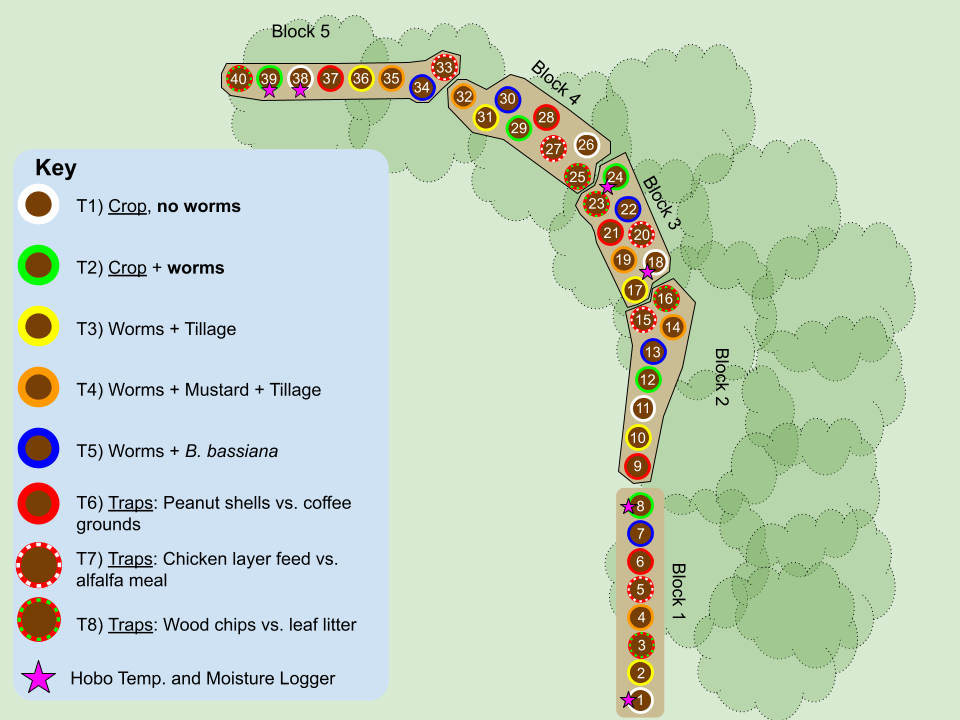
Figure 1. Raised-bed layout
Baited Trap Preference Assays
Exploratory baited trap assays were conducted to assess relative attraction of jumping worms to common organic substrates. Mean earthworm counts varied by bait type and species, with worms consistently detected at higher densities inside traps compared to adjacent soil. These results provide preliminary guidance for refining monitoring tools and trap-based approaches in future field seasons rather than evidence of treatment efficacy (Figure 2).
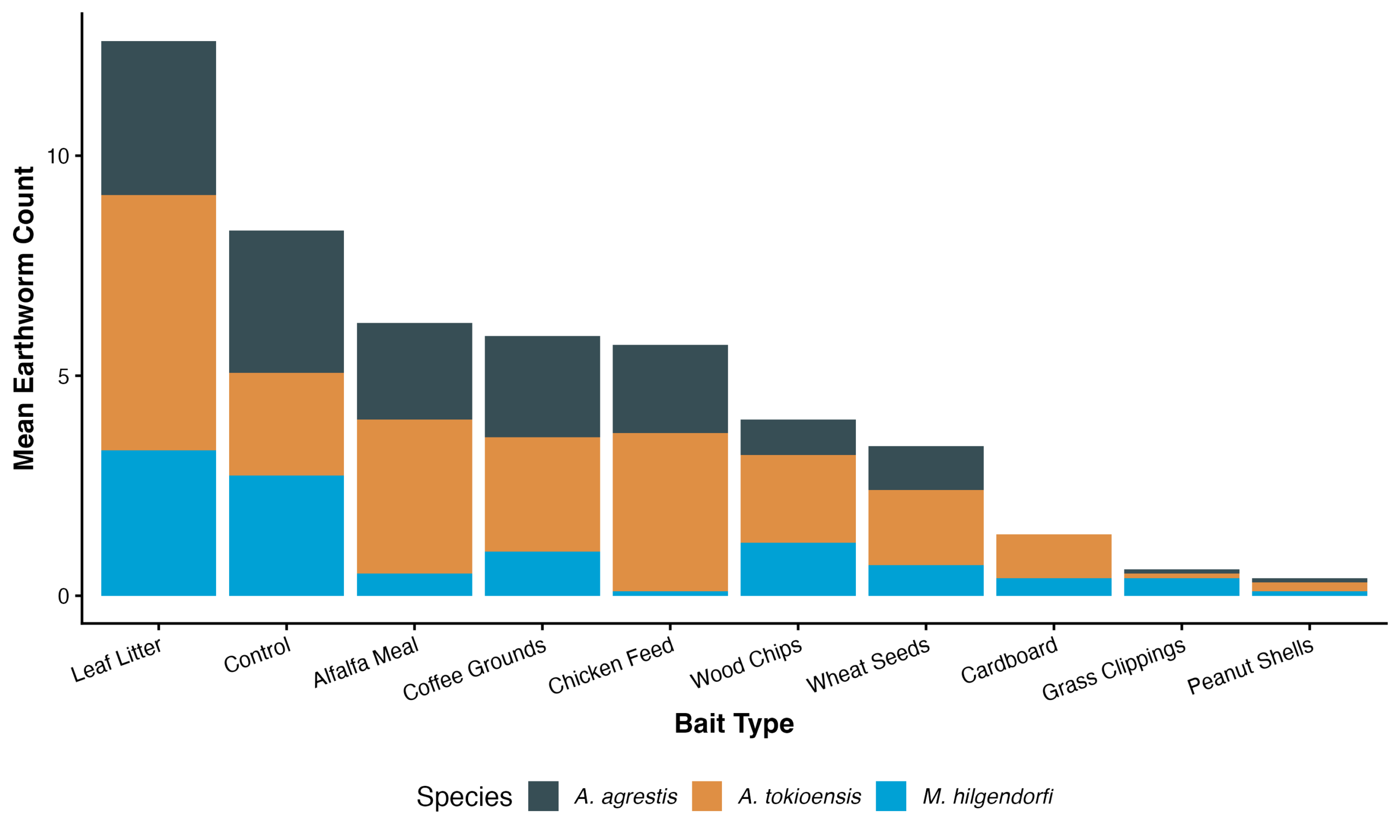
Figure 2. Baited trap preference assay
Farm Recruitment
In total, 26 operations were recruited, including vegetable farms, nurseries, native plant nurseries, a tree nursery, a compost company, and a landscape design operation across Vermont and New York for participation in on-farm sampling and future trials. Participating sites spanned a range of production systems and jumping worm status, with 15 operations reporting jumping worm presence and 11 reporting no known presence. This diversity of farm types and infestation status provides a strong foundation for comparative baseline sampling and for evaluating management strategies in subsequent years (Figure 3).

Figure 3. Farm recruitment by operation type and jumping worm presence
Although six New York growers reported the presence of jumping worms at their sites, cocoon surveys conducted during Year 1 detected jumping worm cocoons in soil samples from only two farms. This discrepancy highlights the ongoing challenge of accurate jumping worm identification and the patchy spatial distribution of cocoons within fields. These results underscore the importance of systematic, early-season sampling and repeated temporal surveys. To address this, more comprehensive and spatially explicit soil and cocoon sampling is planned for the upcoming reporting period to ensure that low-density or localized populations are not overlooked (Figure 4).
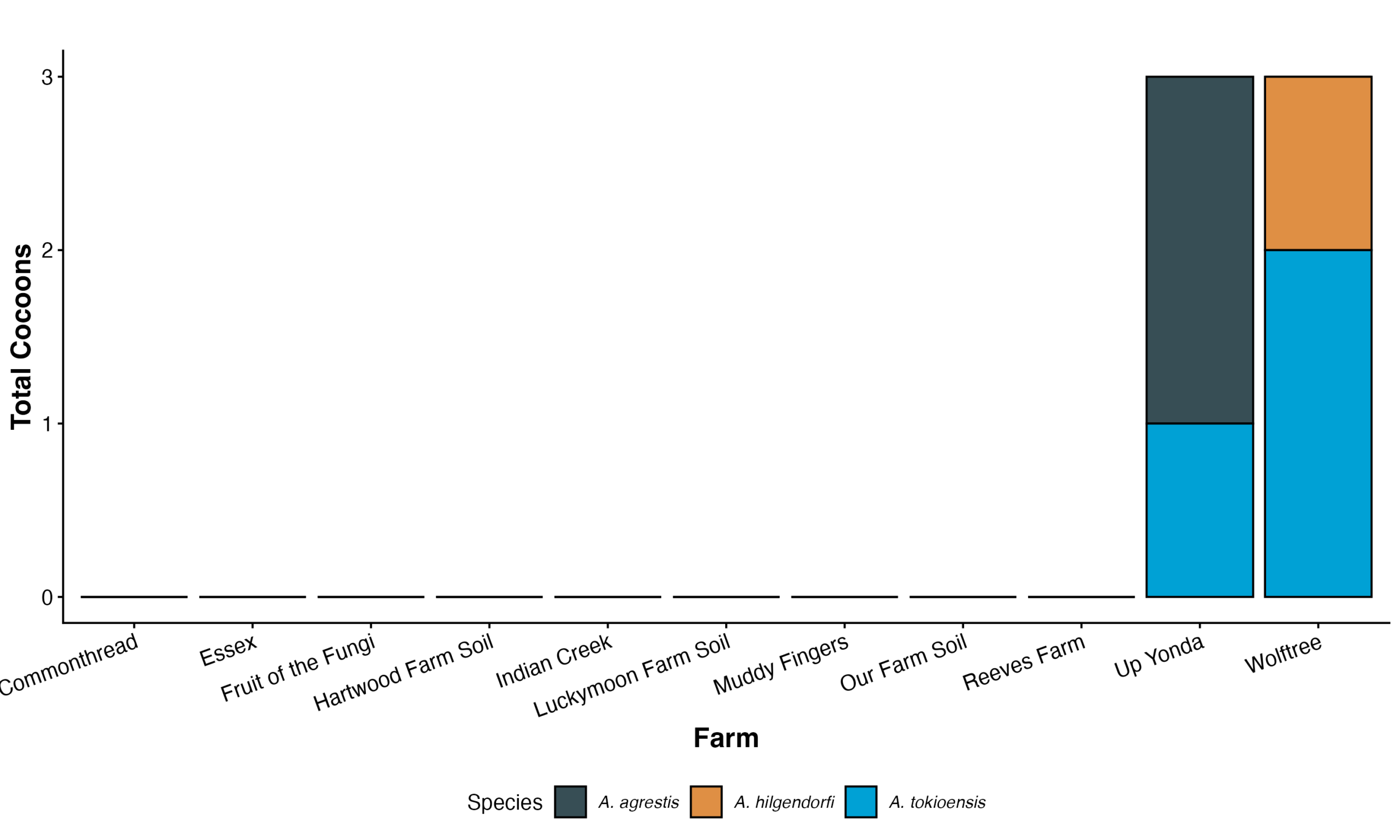
Figure 4. Baseline cocoon counts at New York farm sites
Advisory Committee & Outreach Activities
All advisory committee members were actively engaged through individual communications during the reporting period. Committee members provided feedback on experimental design, outreach priorities, and grower concerns related to identification, prevention, and management of jumping worms.
An annual advisory committee meeting is planned for March, prior to the start of the field season, to review Year-1 progress, refine Year-2 research priorities, and coordinate on-farm activities and outreach events.
Next Steps
- Conduct early-season soil and cocoon sampling at recruited farms (March–April)
- Hold annual advisory committee meeting prior to field season
- Continue raised-bed trials at the UVM research farm with full seasonal data collection
- Conduct solarization trails at the research farm
- Expand on-farm monitoring and treatment implementation
- Deliver additional workshops, field demonstrations, and extension materials
Education
Outreach:
- UVM Horticultural Research & Education Center Field Day (August 14, 2025): Demonstrations of field trial design, monitoring approaches, and biological control concepts; ~35 participants.
- UVM Extension Master Gardener Conference (2025): Presentation on jumping worm biology, identification, and management; ~73 participants. Educational materials were made available online.
Distribution of fact sheet at the following events:
- 2025 Vermont Flower Show. Essex, VT (3/7-3/9/2025). 1639 visitors.
- 2025 Addison County Fair and Field Days. New Haven, VT (7/29-8/2/2025). 401 visitors.
- 2025 Vermont State Fair. Rutland, VT (8/12-16/2025). 305 visitors.
- 2025 Champlain Valley Fair. Essex, VT (8/22-31/2025). 2737 visitors
- 2025 Extension Master Gardener course. 131 participants.
- 2025 VT Composter course. 57 participants.
Milestones
- Engagement: April 30, 2025
Educational Program Announcement and Email List Initiation
Action: Announce the educational program and initiate an email list through networks such as VEPART, VVBGA, MOFGA, NOFA-VT, UVM, Cornell Extension, and direct solicitations via peer-to-peer networks.
Participants: 100 - 200 growers
Outcomes: Growers express interest and sign up for the JW educational program.
Evaluation: Track sign-ups for the email list.
Lead: Nouri-Aiin, Heleba.
> Status Update: Completed — email list created, outreach initiated, list actively growing
- Engagement: May 30, 2025
Grower Recruitment
Action: Recruit growers through listservs and networks (VEPART, VVBGA, MOFGA, NOFA-VT, UVM, Cornell Extension), direct solicitations, and peer-to-peer networking.
Participants: 10 - 15 additional participants for field trials, supplementing 10 growers already committed.
Outcomes: Growers commit to hosting simplified field trials and agree to baseline assessments of soil health and JW infestation levels.
Evaluation: Track participant sign-ups and field trial commitments.
Lead: Nouri-Aiin, McCay, Izzo, Heleba.
> Status Update: Completed — 26 operations recruited across VT & NY
- Engagement: June 30, 2025
Project Launch
Action: Launch the project with a workshop.
Participants: 50 - 100 growers.
Outcomes: Growers attend workshops, gain knowledge in JW identification, monitoring, prevention, and management strategies.
Evaluation: Collect contact information through a sign-up sheet for follow-up focus groups. Use pre- and post-workshop surveys to measure knowledge gain. Workshops will be recorded and made available online.
Lead: Nouri-Aiin, McCay, Izzo, Görres, Heleba, an advisory committee member.
> Status Update: Ongoing — field day, outreach activities, personal emails, on-farm visit, the formal workshop will be lunched May-June 2026
- Learning: July 1 - September 30, 2025, 2026, 2027
Follow-up Consultations (Soil Testing and Identification)
Action: Provide follow-up consultations, including six soil test incentives (treated vs. untreated areas) and molecular identification of unidentified earthworm specimens.
Participants: 20 - 30 growers.
Outcomes: Growers implement practices tailored to their farm conditions, such as targeted solarization and biological controls.
Evaluation: Conduct pre- and post-consultation surveys to assess practice adoption and soil health improvements.
Lead: Nouri-Aiin, McCay, Görres.
> Status Update: In progress — baseline sampling and molecular ID beginning in Year 1
- Learning: August 30, 2025, 2026, 2027
Field Days
Action: Host two annual field demonstrations at the research farm and at a participating farm/nursery.
Participants: 100 - 150 growers.
Outcomes: Growers gain hands-on knowledge of JW identification, monitoring, and observe the application of prevention and management strategies, empowering them to implement these techniques on their farms.
Evaluation: Collect feedback on the relevance and practicality of the techniques.
Lead: Nouri-Aiin, McCay, Görres, an advisory committee member.
> Status Update: Completed for 2025, ongoing for 2026–27, Aug 14 HREC field day
- Learning and Evaluation: February 30, 2026, 2027
Workshops and Webinars
Action: Hold two annual workshops/webinars.
Participants: 200 - 300 growers (virtual or in-person).
Outcomes: Growers adopt prevention practices and integrate JW management into broader pest management systems.
Evaluation: Conduct pre- and post-workshop assessments to track knowledge gain, practice adoption, and changes in JW population density, soil health indicators, and BMP adoption rates.
Lead: Nouri-Aiin, McCay, Izzo, Heleba, Görres, an advisory committee member.
> Status Update: Rescheduled — to collect grower input prior to field implementation
- Learning: February 30, 2026, 2027
Educational Materials Distribution
Action: Distribute factsheets and research briefs on JW identification, biology, monitoring, prevention, and management through VVBGA, the PAR network, and the UVM Extension, UVM Community Horticulture Program, Cornell Cooperative Extension, and NY Invasive Species Research Institute websites.
Participants: 250 - 400 growers.
Outcomes: 60-70% of growers report improved ability to identify and manage JWs.
Evaluation: Measure knowledge improvements through feedback and surveys.
Lead: Nouri-Aiin, McCay, Heleba.
- Engagement and Learning: March 30, 2026, 2027
Conference Presentations
Action: Present project findings and grower testimonials at NEVF, NOFA-VT, and the Entomological Society of America conferences.
Participants: 300 - 500 growers and agricultural service providers.
Outcomes: Growers discuss results, share experiences, and refine prevention strategies.
Evaluation: Conduct follow-up surveys and interviews to assess practice adoption among participants.
Lead: Nouri-Aiin, Izzo, Görres.
- Engagement and Learning: December 25, 2025, February 30, 2026, 2027
PAR Focus Group Meetings
Action: Host annual Participatory Action Research focus group meetings to showcase successful JW monitoring, prevention, and management practices.
Participants: 40 - 50 growers.
Outcomes: Growers discuss results, share experiences, and refine prevention and management strategies based on collective learning.
Evaluation: Record participant feedback on learning outcomes and practice adjustments.
Lead: Nouri-Aiin, McCay, Izzo, Görres, an advisory committee member.
> Status Update: In progress — educational content is being developed based on Year-1 baseline results, individualized grower outreach, and input from the PAR meeting held on December 15, 2025
- Evaluation: December 30, 2027
Final Project Evaluation
Action: Conduct final project evaluations, including feedback on economic and environmental impacts.
Participants: 50 growers submitting final evaluations.
Outcomes: Growers provide feedback on soil health improvements, JW control success, and economic benefits from BMP adoption.
Evaluation: Compare baseline and final data on soil health, JW populations, and grower costs.
Lead: Nouri-Aiin, Heleba, McCay, Izzo, Görres, and advisory committee members.
- Post-Project Evaluation: January 30, 2028
Long-Term Impact Assessment
Action: Conduct post-project evaluations to assess long-term impacts on soil health and JW management success.
Participants: 40 - 50 growers providing follow-up data on continued practice use.
Outcomes: Growers report long-term JW management success and soil health improvements.
Evaluation: Use post-project surveys and interviews to evaluate sustained outcomes.
Lead: Nouri-Aiin, Heleba, McCay, Izzo, Görres.