Progress report for LNE25-493R
Project Information
Project Focus:
This project looks to engage small-to-medium-sized vegetable growers across the Northeastern United States, many of whom are looking to address the the excessive use of plastic mulch in their farming systems. A significant number of organic farmers rely on single-use black plastic for soil warming and weed suppression. However, recent participatory-action research (PAR) meetings with our research team identified growing concerns about the environmental impact of plastics, including potential contamination risks and contributions to greenhouse gas emissions. This reliance not only raises sustainability issues but also leaves farmers vulnerable to potential soil contamination (e.g. PFAS). As such, there is an urgent need to identify new alternatives to plastic mulches and evaluate their performance.
Solution and Approach:
To address these challenges, our project will conduct an agronomic and economic comparison of new commercially available paper mulches against commonly used plastic options, including biodegradable mulches. This evaluation will provide insights into the feasibility of "second-generation" paper mulches for diversified vegetable farms in the Northeast. Our approach combines replicated controlled trials with on-farm trials within a participatory framework, allowing farmers to iteratively contribute to research questions and hypotheses. We will also test a prototype manure-based upcycled paper mulch based on the popular Cowpots™ formulation.
Directly engaging approximately 20-30 farmers within our educational program and upwards of 500 growers with our web-based outreach, we will facilitate workshops, field days, and ongoing consultations. These activities will demonstrate the application and performance of paper mulches, helping to address concerns about implementation, soil temperature effects, and pest management. The information generated will equip growers with valuable knowledge about the benefits and limitations of paper mulches in Northeastern agroecosystems.
This proposal not only looks to provide farmers with the skills needed to transition to paper mulches but will also foster a community-oriented approach to sustainable agriculture. By emphasizing local participation and feedback, we will build trust that will facilitate the adoption of innovative strategies.
Ultimately, this project serves a dual purpose: supporting farmers' economic viability while generating valuable information for reducing plastic usage on farms. By exploring alternatives to plastic, we aim to contribute to a growing movement to reduce waste and improve efficiency on Northeastern farms.
This research looks to conduct an agronomic and economic comparison of new commercially available paper mulches with popularly used plastic mulches (including biodegradable formulations). The evaluation will provide valuable insights into the feasibility of these "second generation" paper mulches for use on Northeastern diversified vegetable farms. Information and data generated from this project will provide growers with new knowledge regarding the benefits and limitations of using paper mulches in Northeastern agroecosystems, to help to reduce waste while maintaining yields and economic viability.
As part of our ongoing farmer participatory-action-research (PAR), we consistently engage with vegetable growers in New York and New England through a co-creative process that is farmer-centered and invites growers to directly generate hypotheses and research questions with our team. Annually, we convene a group of approximately 20 farmers to discuss pressing issues, explore potential projects, and share research updates. This PAR approach allows us to co-create projects that directly address the needs of growers while also establishing a foundation of trust that facilitates the development and adoption of innovative strategies for advancing sustainable agriculture.
A significant concern that emerged during our recent PAR meetings involved the excessive use of plastics on Northeastern vegetable farms. Currently, a substantial proportion of farmers in the region rely on single-use black plastic mulches for various crops. Among the 20 farmers within our PAR community, all utilize plastic mulches in some way. While the benefits of plastic mulch were highlighted-ranging from soil warming properties for crops like melons and peppers to reducing cultivation/tillage in weed-sensitive crops such as onions-many also expressed concerns with the long-term implications of their excessive use. The over-reliance on plastic not only raises obvious cost concerns but also leaves farmers vulnerable to unknown contamination issues (e.g. PFAS).
Owing to the growing concerns related to plastic mulches, many farmers expressed interest in evaluating the performance of new, more flexible "creped" paper mulches as a substitute for conventional plastic. However, there remains hesitation, as many question their feasibility. Specifically, growers express uncertainty around the ease of implementation, effects on soil temperature, and impacts on pest and disease pressures. Additionally, concerns about the suitability of these mulches in the Northeast's increasingly variable climate, underscore the need for a study directly testing these new mulches within the region. This proposed project represents a perfect opportunity for growers to explore practices that aligns with the principles of organic agriculture, while remaining economically viable.
Our project aims to support the 1000+ small-to-medium sized (1-100acre) diversified Northeastern vegetable growers consistently using plastic mulch. By evaluating the viability of alternative mulching options, this project aligns with Northeast SARE's mission to support accessible, sustainable, and equitable agricultural systems. By collaborating closely with a wide-range of local growers, particularly beginning small-holder farms, we ensure our research meets their needs and provides actionable solutions, supporting farmer livelihoods and advancing climate-resilient practices.
Ultimately, our project serves a dual purpose: to support the economic viability of farmers while fostering a more sustainable agricultural landscape that aligns with the values of both SARE and organic/agroecological farming. By testing and exploring alternatives, to one of the more common (and potentially harmful) practices, we hope that this project contributes to a supporting resilient and cost effective farms. In doing so, we not only address immediate concerns of farmers looking to use less plastic, but we hope to help build a model that may inspire research in other potential areas of production.
Research
Research Progress 2025
During the 2025 growing season, a replicated field trial was conducted at the University of Vermont Horticulture Research and Education Center (HREC) to evaluate the performance of alternative ground-cover mulches in onion production. Six treatments were tested: Silver mulch, Black plastic, Diamond mulch, Black paper, Tan paper, and a bare soil control. Mulch treatments were installed on 12 May 2025, and onions were planted on 13 May 2025. Treatments were arranged across five raised beds in a blocked design, with each treatment replicated five times. Each plot contained ten onion plants, resulting in a total of 300 onions measured across the experiment. Bed was treated as a blocking factor to account for spatial variability across the field site.
Preliminary analysis of onion bulb weight indicated significant differences among mulch treatments. Mixed-effects modeling revealed a strong overall treatment effect on bulb weight (F₅,₂₉₀ = 9.99, P < 0.001). Mean bulb weight was highest under Silver mulch (0.85 ± 0.24 g, mean ± SD) and lowest in the bare soil control (0.64 ± 0.27 g), with intermediate values observed for Black plastic, Diamond mulch, Tan paper, and Black paper treatments. When accounting for bed-level variation, Silver mulch produced significantly heavier bulbs relative to the bare soil control (β = 0.147 ± 0.028, P < 0.001), while Black paper mulch resulted in significantly lower bulb weights. Differences among Black plastic, Diamond mulch, and Tan paper relative to bare soil were not statistically significant. Results were consistent when accounting for heterogeneity in variance among treatments, confirming the robustness of the observed Silver mulch effect.
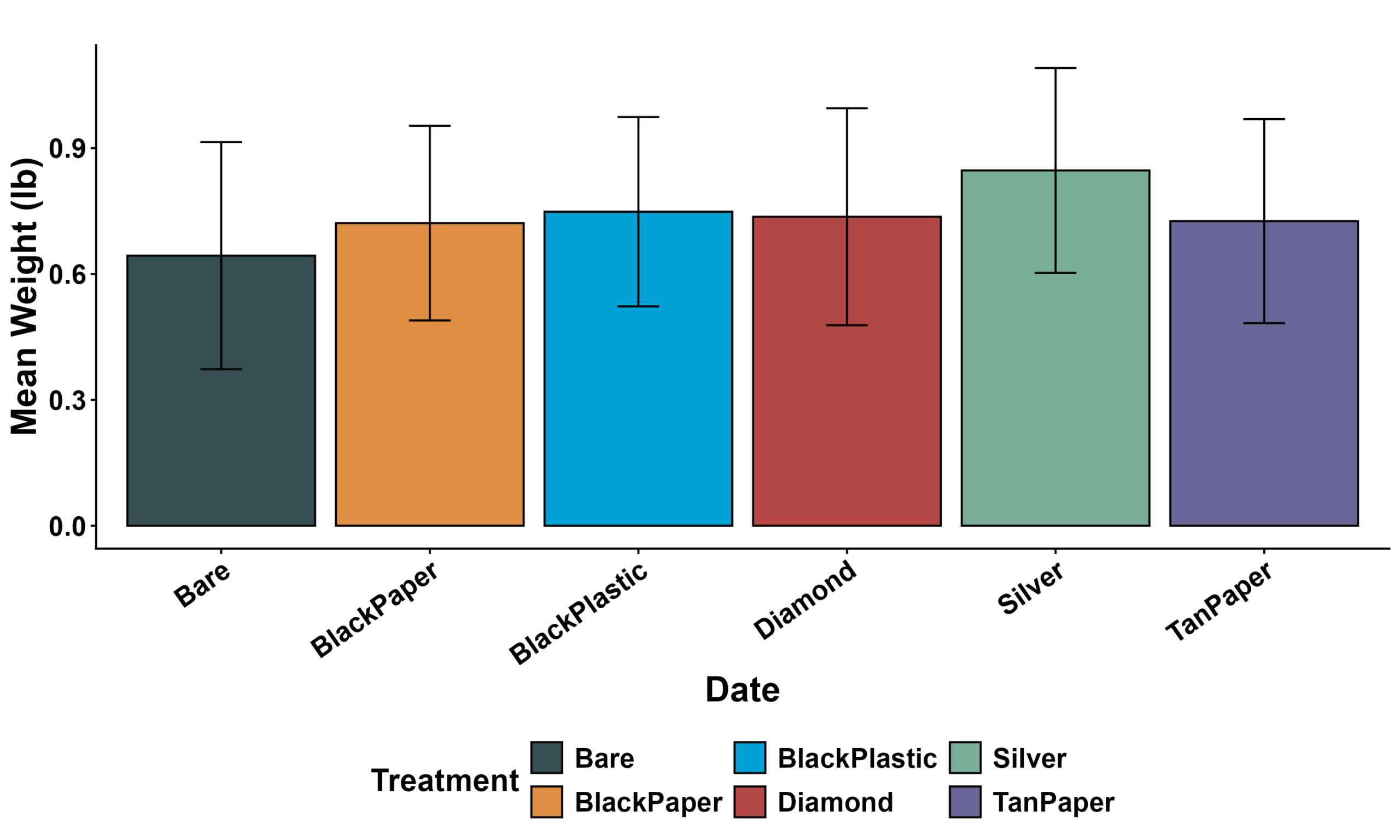
Fig 1.Mean onion bulb weight (± SD) across six ground-cover treatments.
Data from this trial will inform subsequent on-farm trials and contribute to grower-facing decision-making tools developed later in the project.
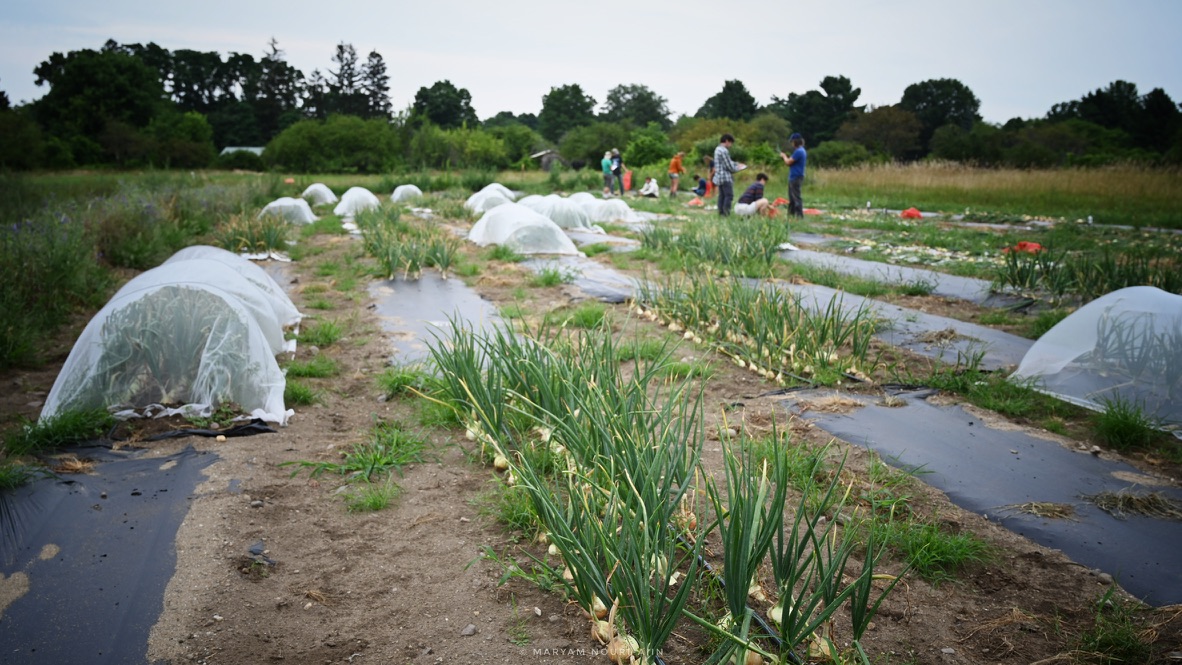
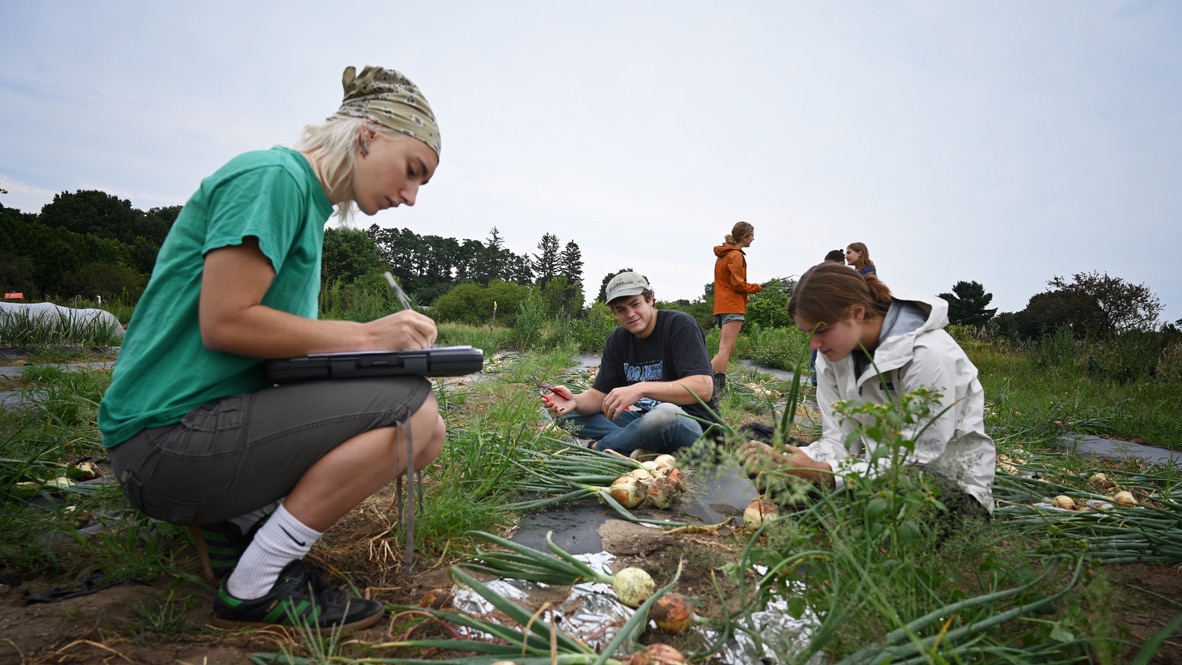
Fig 2. Research plot set up and team scoring onions.
Outreach Activities:
- Participatory Action Research (PAR) Meeting (March 12, 2025). The meeting focused on CPB pressure, wireworm species updates, and planning for the 2025 field season. Participants: 8.
- Izzo, V. (August 14, 2025). UVM Horticultural Research & Education Center Field Day. Demonstrations included CPB monitoring, fungal application methods, and field trial design, presented by project staff. Participants ~35.
- Participatory Action Research (PAR) Meeting (December 15, 2025). The meeting focused on CPB planting challenges, research updates, and planning for the 2026 field season. Participants: 11.
Learning Outcomes
- Participatory Action Research (PAR) Meeting (March 12, 2025). The meeting focused on planning for the 2025 field season. Participants: 8.
- Izzo, V. (August 14, 2025). UVM Horticultural Research & Education Center Field Day. Demonstrations included mulch applications and field trial design, presented by project staff. Participants ~35.
- Participatory Action Research (PAR) Meeting (December 15, 2025). The meeting focused on the first year of mulch experimentation, research updates, and planning for the 2026 field season. Participants: 11.