Progress report for LNE25-496R
Project Information
Project Focus
Beekeepers are facing significant challenges, with annual colony losses reaching unsustainable levels due to various factors, including pests and pathogens. This high mortality threatens the availability of nucleus colonies and honey production, essential for maintaining slim profit margins and providing pollination services for food crops. Rather than relying on chemical treatments that can lead to pathogen resistance, Vermont beekeepers are eager to adopt sustainable practices focused on selecting for hygienic behavior in their bees. This initiative aims to support beekeepers in developing more resilient operations while enhancing colony health.
Solution and Approach
Since 2020, the Vermont Bee Lab has partnered with four of Vermont’s largest bee producers to incorporate the novel hygienic behavior test, UBeeO, into their breeding programs. Our research indicates that UBeeO can effectively identify colonies resistant to Varroa mites, fungal pathogens like chalkbrood (Ascosphaera apis and Vairimorpha spp.), and various viruses (Alger et al., 2025). By focusing on selective breeding for disease resistance, beekeepers can reduce their reliance on chemical treatments, promoting a holistic approach to improving colony health and resilience.
Despite the promise of UBeeO, barriers to adoption persist. Seasonal testing has shown significant variations in hygienic scores, indicating that temporal factors may affect hygienic behavior performance. Such discrepancies may lead beekeepers to exclude low-scoring colonies that could perform hygienically under more favorable conditions. Additionally, an increase in hygienic behavior has been observed in apiaries experiencing disease outbreaks, such as European foulbrood. This suggests a potential priming effect, where colonies detect infections in neighboring hives and recruit hygienic worker bees before becoming infected themselves. Understanding how pathogen virulence and the environment influence hygienic performance could enhance testing methods.
To address these knowledge gaps, our proposed research will investigate external factors influencing hygienic behavior. By determining the ideal conditions for UBeeO testing, we aim to help beekeepers make accurate breeder selections and effectively incorporate hygienic genetics into their operations.
To engage with farmers, we will implement a multi-faceted approach promoting collaboration and knowledge exchange. This includes hands-on workshops to educate beekeepers about the UBeeO protocol and field demonstrations to showcase real-time testing. We will establish a support network for ongoing consultation and conduct collaborative research to monitor the impacts of our efforts over time. Annual meetings with the Vermont Bee Producer Collective (VBPC) will facilitate feedback and ensure that our strategies align with farmers’ needs.
This project aspires to improve the sustainability and productivity of Vermont's beekeeping industry. By enhancing bee populations' resilience through innovative breeding practices, we aim to bolster the critical role of honey bees in crop pollination and contribute to the economic viability of local beekeepers, aligning with Northeast SARE’s goals of increasing sustainability, resilience, and economic viability in agriculture.
The objective of this project is to investigate external factors influencing hygienic behavior in honeybee colonies using the UBeeO testing protocol. By generating knowledge on optimal testing conditions and enhancing selective breeding practices, we aim to empower Northeast beekeepers to adopt sustainable, disease-resistant bee populations. This approach is expected to improve colony health and resilience, ultimately reducing reliance on chemical treatments and enhancing the economic viability of farms through increased honey production and effective pollination services.
Beekeepers in Vermont lose an unsustainable number of colonies each year, reaching upwards of 60%, due to numerous stressors including pests and pathogens. Colony loss impacts beekeepers' ability to produce sufficient nucleus colonies, packages, and honey to overcome slim profit margins. Rather than using chemical treatments to combat pests and diseases, which in many cases, have led to target pathogen resistance, Vermont beekeepers are interested in selecting hygienic behavior as a sustainable alternative. In 2020, we began leveraging our lab's capabilities to offer field and lab support for Vermont honey bee producers to further goals of developing more pest and disease resistant stock (SARE funded project ONE-355). Since then, the Vermont Bee Producer Collaborative (VBPC) has grown to four of VT's largest bee producers who consult on the usefulness and practicality of our efforts. Each year, we host annual meetings with VBPC to share results, solicit feedback, discuss challenges and solutions, and develop action items.
One of the major tools we have helped to implement for VBPC is the incorporation of a novel hygienic test (UBeeO) into breeding programs. To conduct a UBeeO test, the practitioner applies a blend of synthetic pheromones that mimics diseased brood to a section of capped brood. The frame is returned to the hive and after two hours, the frame is retrieved. By counting the number of brood cells that were manipulated, a hygienic "UBeeO score" is calculated. In highly hygienic colonies, the bees will uncap and/or remove 60% or more of the cells. Since hygienic behavior is heritable, highly hygienic colonies may be used as breeder colonies to propagate hygienic offspring.
Since incorporating UBeeO testing into four commercial operations in Vermont, beekeepers have reported an overall improvement in their Varroa levels, suggesting a promising avenue towards increasing disease resistance in honey bee colonies. Additionally, beekeepers in the state have shown significant interest in purchasing UBeeO-selected stock from commercial bee breeders that have adopted the UBeeO tool. In turn, this increased demand for UBeeO-selected bees has increased the interest of Vermont bee producers in implementing UBeeO in their own operations.
By leveraging tools like UBeeO to identify and breed colonies that are highly hygienic, beekeepers may significantly improve honey bee colony resistance to a broad spectrum of pests and pathogens, increasing the sustainability of the beekeeping industry and augmenting the contributions of honey bees to crop pollination. This proposed work contributes to Northeast SARE's outcome statement by increasing sustainability, resilience, and economic viability for the beekeeping industry.
Goal setting and decision-making at the Vermont Bee Lab are accomplished in partnership with our Advisory Board to ensure that we remain aligned with our original goals and focused on answering industry-relevant questions that are both scientifically valid and applicable to beekeepers’ operations. By consulting with leaders in the Vermont beekeeping industry, we make sure that farmers’ voices are central in decisions about the best ways to reduce barriers to adopting the UBeeO technology and what specific questions beekeepers need answered to feel confident about the tool.
We attempt to empower the communities we work with by seeking feedback directly from beekeepers across multiple geographic regions. This provides valuable outside perspectives and allows the farming communities we aim to benefit to voice their concerns and priorities. Our engagement with the Advisory Board, composed of external researchers and commercial beekeepers, has demonstrated the value of this approach. We plan to expand our direct consultation with beekeepers on this project by expanding our Vermont Bee Producers Collective (VBPC) and inviting new members to the producer network. Meeting with the VBPC in Spring 2026 will allow us to gather input from additional community members and key industry stakeholders, including beekeepers interested in adopting the tool. At VBPC meetings, we will share current scientific results from Year 1 and discuss the future of the group, including how it can function most successfully and effectively for the beekeeper members. Through this process, decision-making is collaborative, inclusive, and driven by the needs and insights of the communities we serve.
Cooperators
- (Educator and Researcher)
- (Researcher)
Research
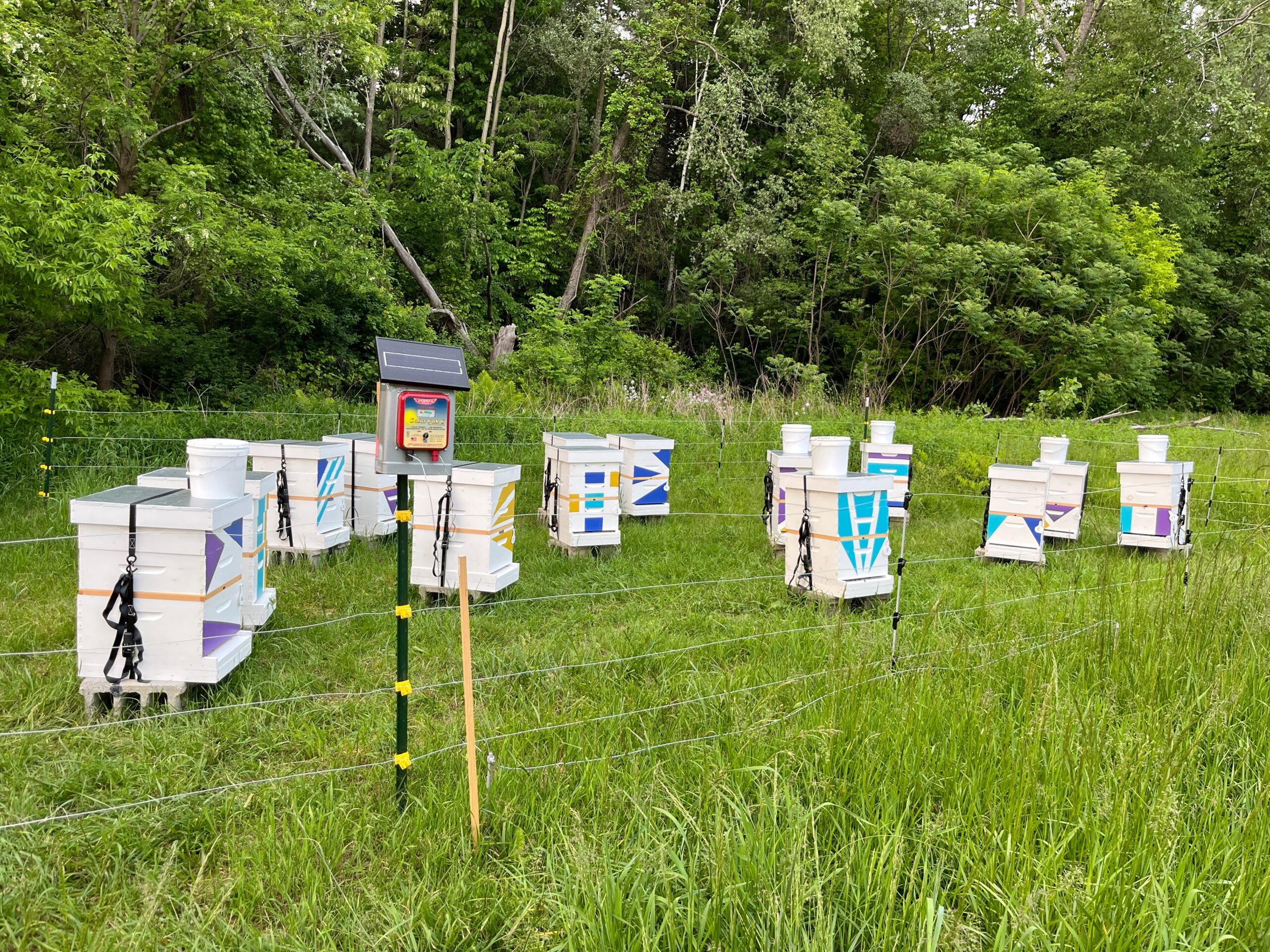
In early May 2025, we established our research apiaries at two locations (S. Burlington & North Hero VT) by installing 30 nucleus colonies purchased from Hundred Acre Wood Apiaries and Betterbee supply company (Photo 1). Throughout the season, we ensured that our research apiaries were well maintained by conducting regular hive inspections, feeding, adding supers, and disease monitoring. We conducted our first experiment to test which in-hive honey bee behaviors were associated with changes in hygienic behavior performance from late-May to mid-June. Our findings aimed to elucidate the behavioral reasons for variation in hygienic behavior and provide within-colony context for our other experiments.
Treatments: The experiment was carried out using a regression design in which six colonies were established in 5-frame observation hives, ranging in UBeeO scores from low-range (10-20%), mid-range (50%-59%), and high-range (70-80%). Observation hives contained 5 frames of bees, brood, food resources, and resident queen and provided outdoor foraging access to best simulate natural hive conditions.
Methods: To select our six observation colonies, we measured the UBeeO scores of 15 full-size production colonies representing a range of UBeeO scores. Study colonies were relocated to observation hives based on their UBeeO scores.
An ethogram was developed to guide data collection, listing relevant behaviors and metrics with detailed descriptions. These included: rate of wax manipulation (uncapped cells per hour), reaction time (time to first hygienic bee), bee recruitment (maximum number of bees observed over two hours), work dispersal (uncapped cells divided by maximum number of bees), and uncapping consistency (rate of uncapping compared between the first and second hours).
To increase sampling and examine whether repeated UBeeO testing influenced hygienic responses, each observation hive underwent UBeeO testing (assay periods) four times over the course of two weeks. During each test, colonies were observed in real time and filmed for two hours using light-sensitive cameras in a dark red-lit room. Once UBeeO tests were performed on each colony, by spraying an isolated section of capped brood, a photo of the test site was taken, a two-hour timer was set, and data collection commenced for the duration of the test period.
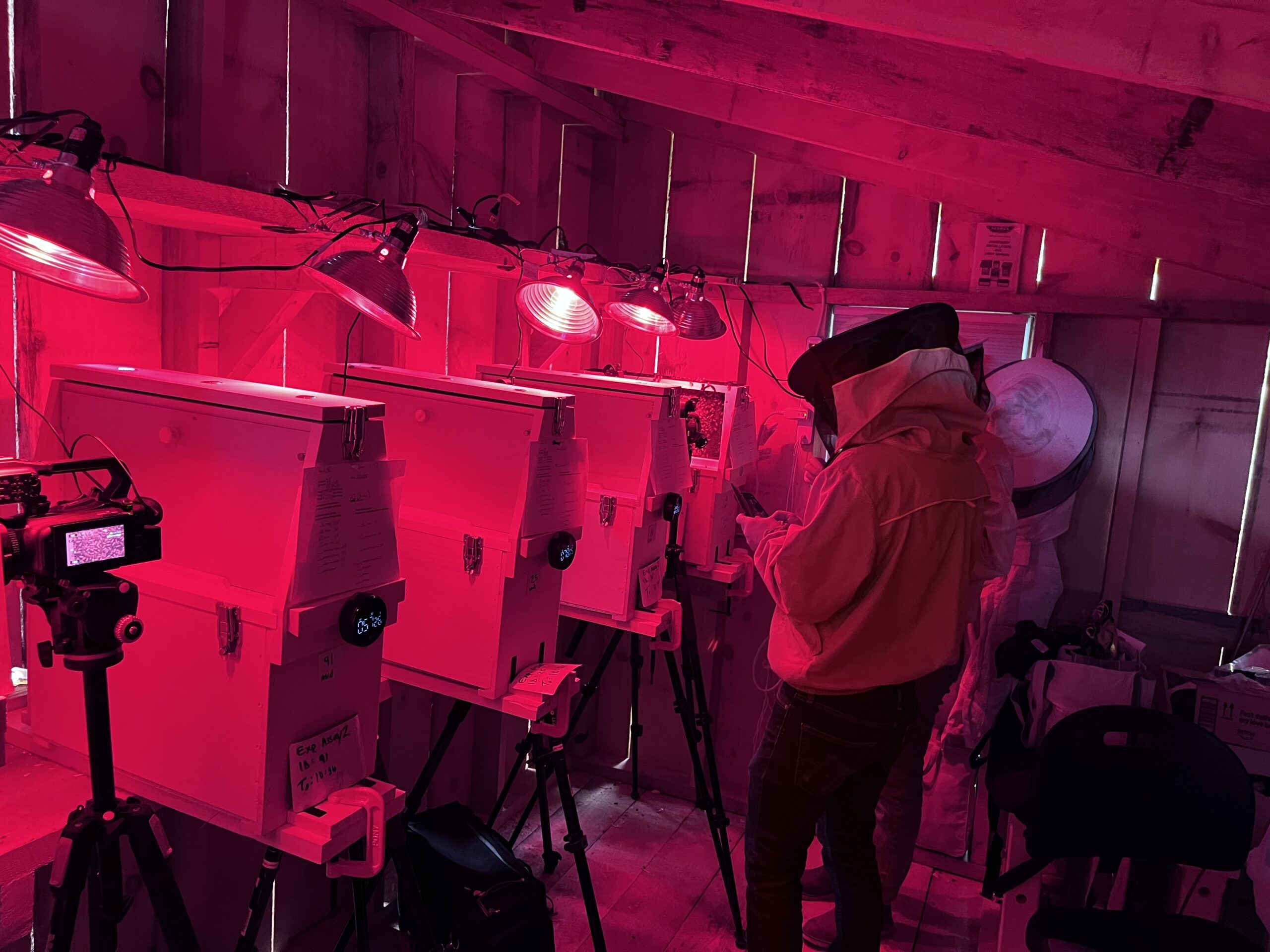
Data Collection: Data was collected in real time by observers during the test period (Photo 2). The time at which the first bee was observed performing hygiene behaviors was recorded; the number of hygiene performing bees was recorded every 15 minutes; the number of uncapped cells in the UBeeO site was recorded every 30 minutes for 2 hours through the observation hive, and at 3hrs, 24hrs, and 48hrs by removing the frame from the observation hive and photographing the site. Footage from all UBeeO tests was stored on a cloud-based server to ensure accessibility and data security. Video recordings were analyzed to fill in gaps in observational data.
Data Analysis: Each behavioral variable was analyzed using a separate generalized linear mixed model (GLMM) with UBeeO score as the continuous predictor. Colony ID and sampling events were included as blocking variables. An additional GLMM was constructed to evaluate the effects of repeated UBeeO testing on both UBeeO scores and bee behavior. UBeeO scores from all 24 tests were analyzed by sampling event, with behavioral variables included and colony ID treated as a random effect.
Results from our first experiment revealed the in-hive honey bee behaviors that are most associated with changes in hygienic behavior performance. We compared colonies expressing a range of UBeeO scores on metrics including rate of wax manipulation (uncapped cells per hour), reaction time (time to first hygienic bee), bee recruitment (maximum number of bees observed over two hours), work dispersal (uncapped cells divided by maximum number of bees), and uncapping consistency (rate of uncapping compared between the first and second hours).
Overall, UBeeO scores measured on the source production colonies prior to the observational experiment had no correlation with the hygienic scores measured during the course of the study (p = 0.66) (Figure 1). While individual colonies showed an increase or decrease in hygienic scores and reaction time after repeated measurement across four assay periods, the average trends showed no significant response of these two variables to measuring multiple times (Figure 2), indicating that repeated UBeeO testing does not impact the average behavioral response of the colonies and does not seem to create a priming effect where bees might perform the behavior from memory.
We found that over the course of the test period, the number of bees performing hygienic behavior increased (p < 0.0001). On average, hygienic colonies recruited more bees during the study (p = 0.002) and the number of performers increased more rapidly than in non-hygienic colonies (p = 0.001) (Figure 3). Additionally, the reaction time of the first hygiene-performing bee to the test site was negatively correlated with hygienic score, where colonies showing high hygienic behavior performance required less time to respond to the test site, indicating that hygienic colonies respond to unhealthy brood more quickly (p = 0.017) (Figure 4). On average, the proportion of chewed cappings was higher for hygienic colonies (p < 0.0001). The rate of uncapping increased more rapidly for hygienic colonies as well (p < 0.0001). This difference was driven by 60 minutes, 90 minutes, 120 minutes, 180 minutes, and 24 hours time points (p = 0.002). No difference was found at 48 hours (p = 0.18), due to the continued uncapping behavior of non-hygienic colonies and the re-capping of hygienic colonies after 120 minutes (Figure 5). This finding indicates that the two hour test period currently recommended by the UBeeO manufacturer most likely reflects the maximum hygienic behavior performance that can be expressed by hygienic colonies over time. In hygienic colonies, worker bees appear to recognize that the brood are healthy after initial inspection and begin recapping the cells after two hours. In contrast, non-hygienic colonies respond primarily to structural changes to the cells; once uncapping begins, they continue the behavior even when the brood are healthy.
Hygienic behavior performance varied significantly across assay periods and test periods in our experiment. However, bee recruitment measured as the maximum number of hygiene performers detected for each colony for each assay period was found to increase significantly with increased UBeeO score (p = 0.006) (Figure 6). Similarly, work dispersal measured as the number of uncapped cells divided by the number of hygiene-performing bees increased significantly with hygienic (UBeeO) score as well (p < 0.0001) (Figure 7). This result coupled with the bee recruitment results indicate that hygienic bees recruit more bees that uncap cells more efficiently. Lastly, the rate of manipulation (manipulated cells/min.) in the first hour period and the second hour period increased significantly with higher hygienic colonies (p<0.0001). The second hour period had significantly higher rates on average (p<0.001), which increased at a more rapid rate with higher hygienic scores (p=0.007) (Figure 8).
Collectively, these results indicate that hygienic colonies outperform non-hygienic colonies through multiple, non-mutually exclusive worker-level mechanisms. Individual workers in hygienic colonies respond more quickly, recruit nestmates more rapidly, and uncap cells at higher rates, resulting in faster and more efficient task completion. Variation in hygienic behavior performance therefore likely arises from a combination of factors, including individual reaction time, recruitment dynamics, task dispersal among workers, and the total number of bees engaged, rather than any single behavioral trait. This multifaceted structure of hygienic behavior helps explain why differences among colonies can emerge through diverse pathways in worker organization and efficiency.
In our second experiment, we will evaluate the external and environmental factors that may influence these in-hive behaviors observed in our first experiment. We aim to develop clear guidelines for the optimal conditions under which UBeeO testing should be conducted in order to promote maximum expression of hygienic behavior in honey bee colonies.
Education & outreach activities and participation summary
Educational activities:
Participation summary:
In Summer 2025, our established research apiaries served both as sources for observation colonies and as sites for educational activities. We taught new beekeepers to conduct proper hive inspections, identify queens, and test for Varroa mites through the UVM Hands-on Beekeeping course (10 enrolled students) and the Vermont Women in Beekeeping Varroa Testing workshop (20 enrolled participants). During these educational opportunities, we presented our ongoing work supporting Vermont’s bee producers, including prior research and new efforts to promote adoption of the UBeeO assay. Attendees gained an understanding of how UBeeO works, current knowledge about pest and disease resistance, and the research questions we plan to pursue over the next three years.
Managing our research apiaries also provided valuable opportunities to consult with Vermont beekeepers on best management practices, including preferred feeding methods, Varroa treatments, and overwintering strategies. We shared anecdotal evidence from our behavioral experiments and observations of disease loads in our apiaries in relation to UBeeO scores.
During our observational experiment from late May to mid-June, six observation colonies were set up in the Vermont Bee Lab observation shed. Educational attendees and other visitors were given tours of the setup, allowing them to observe data collection in action and understand our methods for collecting behavioral data from observation hives.
In 2026, we plan to expand beekeeper consultations by hosting a Vermont Bee Producers Collective meeting and recruiting new members through the Vermont Beekeepers Association’s networks. Two in-field UBeeO workshops will be offered during the summer at participating beekeepers’ operations to train new users on the tool and its use in selective breeding programs. Additionally, we will share research findings at the Vermont Beekeepers Association Winter Meeting in February and at the Franklin County Beekeeping Club monthly meeting to disseminate results and encourage adoption of UBeeO based on new insights into honey bee hygienic performance. VBPC members and workshop attendees will be surveyed after events to help us improve outreach, identify outstanding questions about UBeeO and selective breeding, and develop a pipeline for sharing data, bee genetics, and knowledge across beekeepers interested in integrating UBeeO into their operations.
Learning Outcomes
Farmers that attended our educational opportunities and tours gained an understanding of UBeeO, current knowledge about pest and disease resistance, and the research questions we plan to pursue over the next three years. Summer 2025 was primarily focused on research and development of UBeeO and gaining a better understanding of what drives hygienic behavior performance inside of the hive, therefore, we did not have any new data to share over the summer. Research findings from Summer 2025 will be disseminated to beekeepers this Winter and Summer 2026 through scientific presentations reaching up to 100 farmers and our UBeeO workshops, which will offer hands-on training to interested participants. In addition to researcher-to-farmer education, we anticipate our Vermont Bee Producers Collective meeting (to be held in Spring 2026) to foster farmer-to-farmer education around apiary management challenges, statewide pest and disease levels, UBeeO adoption, and next steps for the group.
Project Outcomes
Our lab collaborated with two other institutions (Dr. Esmaeil Amiri from University of Mississippi) and Dr. Kaira Wagoner of University of North Carolina Greensboro) on a grant proposal submission to USDA-AFRI “ PARTNERSHIP: Promoting Honey Bee Colony Health Through Hygiene: Integrating Multi-State Breeding and Applied Research for Pest and Disease Resistance”. The proposal builds from the SARE work with three interconnected objectives: (1) investigate how hygiene-based breeding influences viral dynamics within colonies, (2) evaluate the performance, economic benefits, and regional adaptation of hygienic stock across diverse U.S. environments (Mississippi, North Carolina, Vermont), and (3) identify biotic and abiotic factors—including paternal genetics and pesticide exposure—that shape the reliability of hygienic expression. Through coordinated multi-state breeding networks, beekeeper partnerships, and advanced assay tools such as UBeeO, this project will deliver both applied and fundamental outcomes. We will provide evidence-based guidance on breeding and management, quantify the economic returns of hygienic stock, and expand regional queen production capacity. Together, these outcomes directly advance USDA’s pollinator health priorities by strengthening agricultural resilience, reducing chemical dependence, and safeguarding pollination services vital to U.S. food security.