Progress report for ONC23-129
Project Information
This farmer-driven proposal builds on previously NC SARE funded projects (FNC15-1018; ONC20-078) that evaluated precision planting of cover crops to increase farm resiliency and cover crop adoption prior to planting corn. Our data indicate precision planted rye has similar benefits to solid planting of rye but provides warmer soil temperature in the planting zone and lower seed costs due to skipping the corn row. Furthermore, precision planting increases corn stand count, results in quicker corn germination, and decreases corn nitrogen requirement. Additionally, decreased rye seeding rate prior to corn increases corn stand count that contributes to grain yield. Unfortunately, precision planting lacks adoption due to the required investment. This proposal aims to answer grower questions including (1) does planting rye perpendicular to corn row benefit corn like precision planting? (2) does reducing the seeding rate or increasing row spacing to 15” in perpendicular planting further improve the corn stand count and yield? and (3) what are the economic benefits of these systems? Outreach approaches include hosting on-farm field days, writing a fact sheet being integrated into student’s course material, and presenting at regional/national meeting, this project will increase cover crop adoption before corn and improve sustainability of corn-soybean cropping systems.
The objective of this proposal is to compare the effectiveness of perpendicular planting of rye (solid planting) with precision planting (skipping the corn row) and decreasing the rye seeding rate or row spacing (from 7.5” to 15”) in perpendicular planting vs. solid planting and a no-cover crop before corn in a corn-soybean cropping system to:
- Quantify cover crop performance
- Assess corn performance and quantify the end of season N following corn harvest
- Evaluate the economics of each cropping system
- Demonstrate the agronomic and economic benefits through on-farm research and novel outreach methods
Cooperators
- (Educator)
Research
A trial was conducted at 3 different locations, (i) the Agronomy Research Center (ARC) in Carbondale, IL; (ii) a farmer’s field in Belleville, IL; and a farmer’s field in Salem, IL during the 2023-2024 growing season. Another 3-site-yr trial was conducted (2 in Carbondale; 1 in a production field and 1 at ARC) along with the farmer’s field in Belleville, IL during the 2024-2025 growing season (Fig. 1).
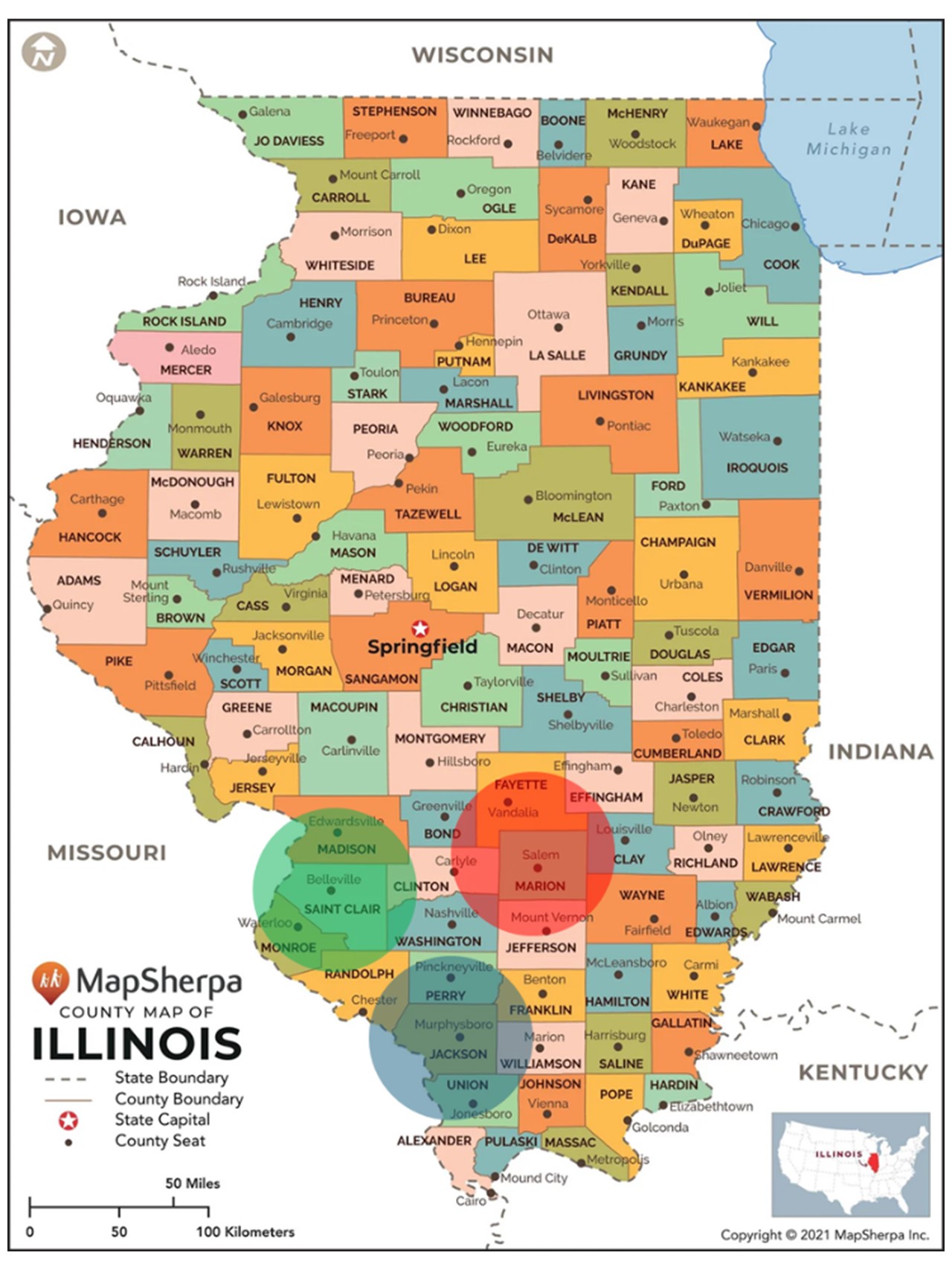
Fig. 1. Location of each site-yr where the project was implemented.
Treatments were laid out in a randomized complete block design with four replicates. Those include: (1) no-cover crop control (NOCC) (2) normal (solid) planting of rye (SP) (3) precision planted rye (PRP) (4) perpendicular planted rye (PP) (5) perpendicular planted rye at a seeding rate similar to precision planted rye (PPLSR) and (6) perpendicular planting of rye at 15” row spacing (wider rows; PPW). The on-farm trials omitted treatment 3 due to difficulty in its implementation. Fig. 2 is a plot map that shows the trial implementation at the ARC.
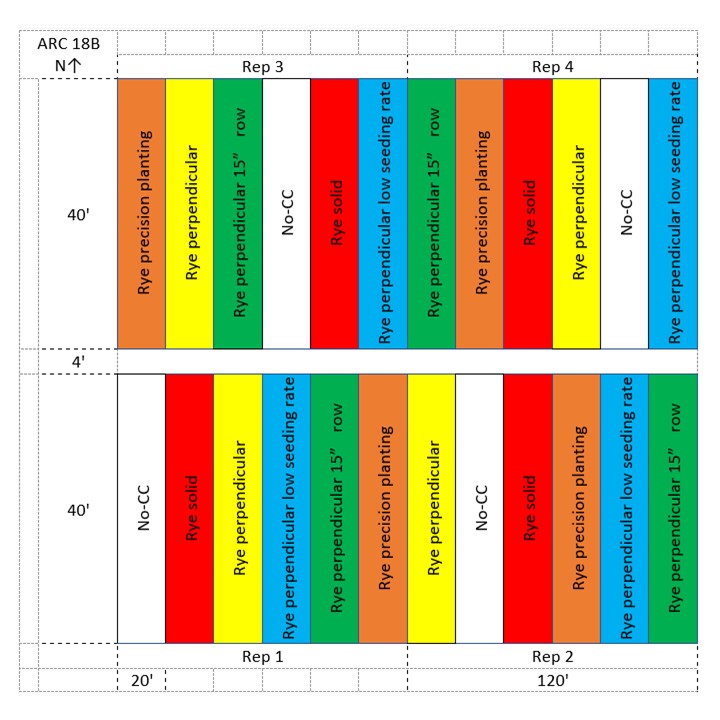
Fig. 2. Map of the trial at the ARC site in 2023-2024.
Cover crop planting dates varied slightly from site-to-site. Cereal rye was planted on Nov. 2, Oct. 27, and Nov. 19 at ARC, Belleville, and Salem, respectively in year 1. In year 2, the cereal rye planting dates were Oct. 21, Oct. 21, and Nov. 20 in the production field (Carbondale), ARC (Carbondale), and Belleville sites, respectively. Cereal rye biomass (3 samplings of 0.2 m2 area (2.15 ft2) for a total of 0.6 m2 (6.45 ft2)) was taken in spring prior to burndown from each site-yr. The cereal rye sampling dates in year 1 were April 15, March 28, and April 4, 2024 for ARC, Belleville, and Salem, respectively. In year 2, the biomass sampling dates were April 24, April 24, and April 28 for the production field in Carbondale, ARC, and the Belleville site, respectively. Biomass samples have been analyzed to determine (i) N uptake and (ii) C/N ratio. Table 1 summarizes the results for cover crop biomass, C:N, and N uptake in both years of the study that compares SP with PRP, PP, and PPLSR.
Table 1. Effect of cereal rye planting method on its biomass, C:N ratio, N uptake, and C accumulation over 3 site-yrs.
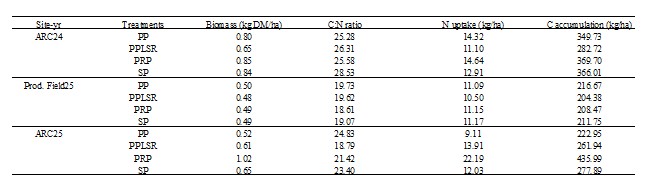
* PP: perpendicular planting; PPLSR: perpendicular planting at seeding rate similar to precision planting; PRP: precision planting; SP: solid planting.
As can be observed in Table 1, a shift from SP (farmer planting method) to PP (our novel proposed method) does not reduce cereal rye performance, with comparable biomass, C:N, N uptake, and C accumulation recorded. Table 1 also suggests that PRP is slightly superior to PPLSR at least in ARC25. This means the PRP method of planting is effective in helping cereal rye consistently produce biomass.
Table 2 answers question about shifting from SP to PP that is planted in 15” row spacing (PPW) and compares other treatments to see if wider planting effects cereal rye production. It can be seen that PPW consistently produced comparable biomass as compared to SP, suggesting growers could shift from planting SP to PPW without losing N uptake benefits or biomass production (C input) benefits.
Table 2. Effect of cereal rye planting method on its biomass, C:N ratio, N uptake, and C accumulation over six site-yrs.
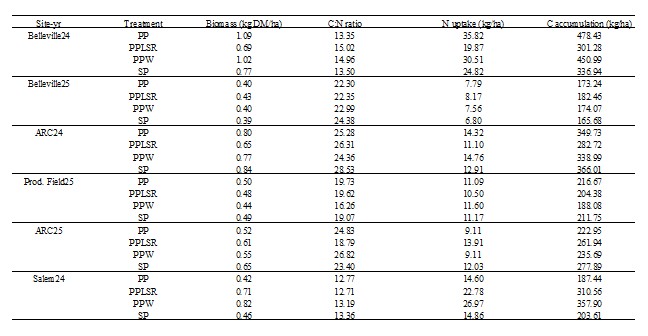
* PP: perpendicular planting; PPLSR: perpendicular planting at a lower seeding rate; PPW: perpendicular planting at 15” row spacings; SP: solid planting.
Corn was planted in 2024 for year 1 of this project. Corn planting dates at ARC, Belleville, and Salem were May 28, May 20, and May 31, respectively. Corn was planted for another 3-site-years in year 2 of the project but that data is still being finalized. Corn planting dates in year 2 were June 2, May 15, and May 24 for the production field in Carbondale, ARC, and the Belleville site, respectively. Harvest dates for year 1 were Oct. 16, Oct. 3, and Oct. 3 for ARC, Belleville, and Salem sites, respectively. Corn grain samples were collected at harvest in year 1 of the project and sent to a lab to determine N% and thus allow for N removal calculations. The same is being done with year 2 corn samples.
Table 3. Corn plant population, number of kernels/m2, kernel weight/ear, and grain yield as influenced by cereal rye planting methods in 2024.
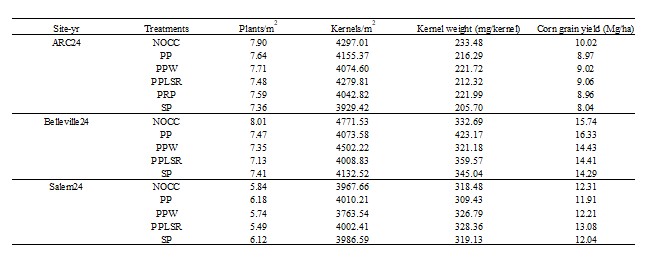
* NOCC: no-cover crop control; PP: perpendicular planting; PPW: perpendicular planting at 15” row spacings; PPLSR: perpendicular planting at a seeding rate similar to precision planting; PRP: precision planting; SP: solid planting.
Our data from year 1 indicate that SP was never a high-yielding treatment and resulted in decreased corn grain yield in both ARC24 and Belleville24. PP or PPLSR provided corn grain yields comparable to the NOCC treatment, suggesting that by manipulating cereal rye planting and early termination, cereal rye can be utilized prior to corn without a yield penalty. Year 2 of this study will confirm whether these results hold and could be recommended to growers.
We have also collected end of season soil nitrate-N data but the data for year 1 and year 2 that is being processed.
Outreach activities, student presentations, and publications:
Field days/education and outreach:
Sadeghpour, A. 2025. Cover cropping and double cropping impact on cash crop yield and soil health. Belleville Research Center Field Day, Belleville, IL. July 17. >150 attendees
Sadeghpour, A. 2024. An update on cover crop management prior to corn. Belleville Research Center Field Day, Belleville, IL. July 11. >120 attendees
Student presentation:
Guebert, H., et al., A. Sadeghpour. 2024. Interactive Effect of Precision Planting and Seeding Rate on Winter Rye Performance, Corn Grain Yield and Yield Components. ASA-CSSA-SSSA Annual Meeting, San Antonio, TX, Nov. 10-13.
Fact sheet:
Sadeghpour, A., E. Brevik. 2025. Fact sheet on cereal rye planting methods (In-Preparation).
Planned journal articles (these will also be chapters in Ms. Guebert’s thesis):
Guebert, H., E. Brevik, A. Weidhuner, A. Sadeghpour. 2026. Perpendicular planting as a novel cereal rye planting strategy to minimize cereal rye impact on the following corn performance (In-Preparation).
Guebert, H., E. Brevik, A. Weidhuner, A. Sadeghpour. 2026. Does increasing cereal rye planting width benefit cereal rye and the following corn? (In-Preparation).
Educational & Outreach Activities
Participation summary:
We have not yet started any educational activity for this project.
Learning Outcomes
Not available yet. The project just started.
Project Outcomes
Through conducting this project, we have two growers and an extension educator who are working with us during this project.
Nothing as of yet. We just initiated the project.
Nothing yet. We just initiated the project.