Progress report for ONC24-152
Project Information
With a goal to use less land and resources, we will research how to create more feed per acre so fewer acres are needed to grow feed for our cows. No-till and cover crop farming practices will use less energy and fossil fuels while also reducing the amount of soil erosion on the fields. We are looking for forages that are highly digestible and allow the cows to more readily utilize nutrients. As a demonstration site in Calmar, Iowa, we will plant a three-crop rotation of triticale, cocktail forage mix, and corn silage. Three local farmers will replicate this crop rotation on their own acres of cropland. These farmers will operate medium-sized dairy cattle operations and own cropland in northeast Iowa.
After each harvest, a sample will be taken for a forage analysis. We will evaluate the differences between the three forages in the rotation to determine which one produces the best yield per acre, nutrient composition, and digestibility rate. For education and outreach purposes, we will be hosting a field day and writing a summary report of our findings for local farmers and beyond to learn from our research and adopt these practices themselves.
- Increase yield per acre of nutrient-dense, highly digestible forage
- Increase soil organic matter
- Increase water quality in surrounding streams and ponds
- Decrease fossil fuel usage by utilizing no-till farming practice
- Reduce the amount of commercial fertilizer through the use of manure
- Serve as a demonstration site for local farmers to learn how to implement no-till and cover crop practices effectively
- Educate local farmers on the benefits of cover crops
- Show cattle producers the benefits of different forages
- Demonstrate a three-crop rotation that can be replicated by local farmers
- Evaluate the differences in nutritional value and digestibility in 3 different forages
Cooperators
Research
Educational & Outreach Activities
Participation summary:
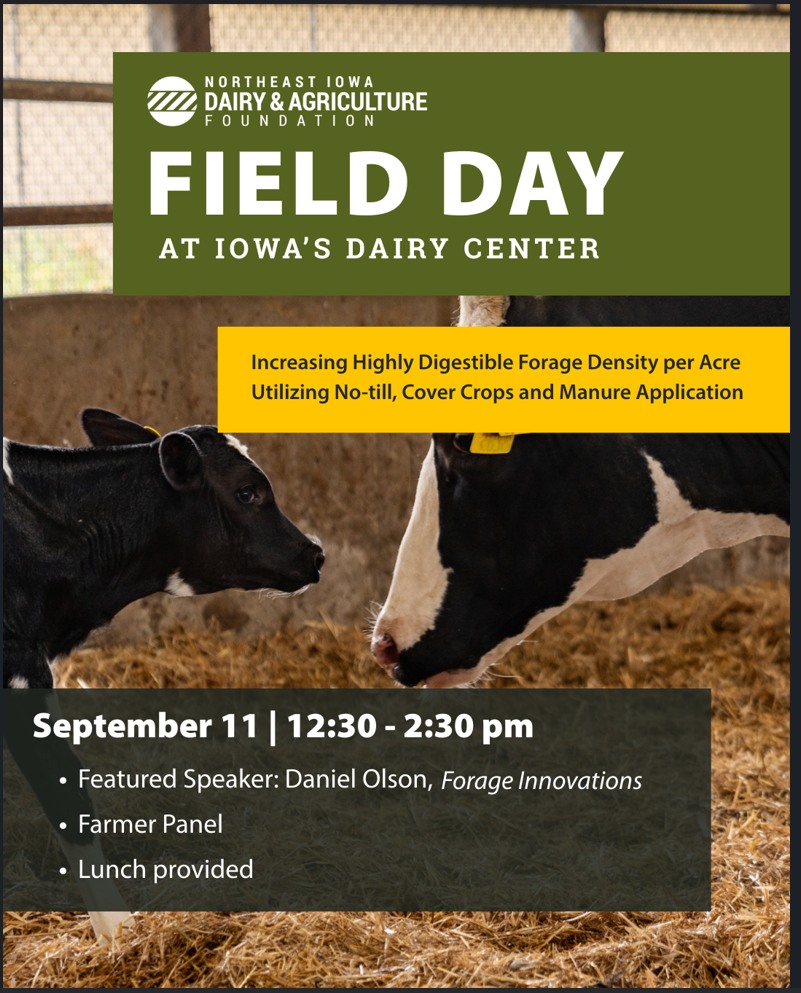
SARE Forage Field Day was held on Thursday, September 11th. Special attention was given to forage innovation presented by our guest speaker, Daniel Olson: Increasing highly-digestible forage density per acre utilizing no-till, cover crops and manure application. Dairy and Ag students were in attendance, as well as faculty, farmers and industry partners.
Learning Outcomes
Awareness in benefits of using cover crop and no-till farming.
Project Outcomes
Triticale seed was planted and manure application completed late September 2024. The effects of this application will be observed come Spring and following years.
________________________________________________________________________________________
Farmer feedback on grant implementation:
Vagts Dairy, West Union, IA
1. Have you/will you change any long-term farming practices related to cover crops? Why or why not?
We are very committed to continuing cover crops, but we would likely change the species selection. The triticale winter-killed on most of our acres, so we didn’t receive the expected spring growth or soil cover. We would consider hardier winter cereals like winter rye in the future and possibly simplify the cocktail mix to make management easier.
2. What successes or challenges have you experienced? Beneficial or negative changes?
The biggest challenge was establishment and overwinter survival of the triticale. The cocktail mix produced decent biomass, but harvest timing was tricky and weather narrowed the window. We did notice some improvement in soil softness and less surface runoff in the fields where the cocktail established well. We also liked the ability to apply manure throughout the summer on the cocktail acres
3. How has this practice impacted your herd?
We harvested a portion of the cocktail mix for heifers. Feed quality was acceptable but inconsistent because maturity varied across species.
4. Do you feel more positive, negative, or neutral about cover crops for foraging than 3 years ago? Explain.
Neutral to slightly positive. We believe the concept has value, but winter kill and harvest challenges made this season less successful than expected.
Hilltop Dairy, Calmar, IA
1. Have you/will you change any long-term farming practices related to cover crops? Why or why not?
We will likely continue experimenting but with adjustments. The triticale winter kill was disappointing, and we would consider either earlier seeding dates or different winter-hardy varieties. We may also reduce the number of species in the cocktail mix to improve uniformity and harvest efficiency.
2. What successes or challenges have you experienced? Beneficial or negative changes?
The cocktail forage provided good ground cover and weed suppression where it established well. However, harvesting it was difficult due to uneven growth and moisture differences among plant types. Equipment setup and timing added labor. Soil moisture retention appeared slightly better in those fields, but fertilizer or fuel savings were not clearly measurable this year.
3. How has this practice impacted your herd?
We fed a limited amount of the cocktail forage to dry cows. Nutritional value tested fairly well, but variability meant we blended it with other forages. No noticeable change in production or herd health.
4. Do you feel more positive, negative, or neutral about cover crops for foraging than 3 years ago? Explain.
Slightly positive. Despite the setbacks, we saw enough soil and forage potential to keep trying with modifications.
Full Bohr Dairy, Ridgeway, IA
1.Have you/will you change any long-term farming practices related to cover crops? Why or why not?
Yes, but with significant changes. The winter kill of the triticale limited the tons harvested, and the cocktail mix created harvest bottlenecks at our scale. We would only continue if species selection and planting/harvest logistics are simplified and more winter-hardy options are used.
2.What successes or challenges have you experienced? Beneficial or negative changes?
The cocktail mix produced high biomass and good soil coverage, which helped reduce visible erosion. The main challenges were equipment scheduling, inconsistent crop maturity, and added labor. Because the triticale failed overwinter, we did not realize the expected spring soil or nutrient benefits.
3.How has this practice impacted your herd?
Minimal overall impact. We ensiled a small portion of the cocktail forage, but due to harvest timing issues, quality was variable. It did not significantly change feed costs or milk output across the herd. We recognize the potential of highly digestible fiber for the cows, but are concerned about the ability to harvest a good quality crop each season.
4.Do you feel more positive, negative, or neutral about cover crops for foraging than 3 years ago? Explain.
Neutral. We recognize environmental and soil benefits, but operational challenges and winter kill reduced the economic incentive. Future participation would depend on improved crop survival and streamlined harvest management.
Brodie Bushman, Northeast Iowa Dairy & Ag Foundation
1.Have you / will you change any long-term farming practices as it relates to cover crops? Why or why not?
We have not made major long-term changes yet, but this project has influenced how we think about cover crops moving forward. We have enjoyed feeding the highly digestible fiber and see value in it from a nutritional standpoint. However, we have really struggled with consistent yields and quality harvesting. Because of that inconsistency, we are hesitant to fully commit to major long-term changes until we can better manage the variability in production and harvest timing.
2.What successes or challenges have you experienced in relation to this project? Have you noticed any beneficial or negative changes in the areas farmed with this project?
The biggest success has been the highly digestible fiber we were able to feed. When the crop was harvested at good quality, it provided valuable forage. Another huge success was the soil health benefit and improved corn harvest due to the cover crop rotation. The main challenge has been inconsistent yields and difficulty achieving consistent quality at harvest. Weather and timing have made it hard to reliably produce a uniform product. Because of that, it has been difficult to depend on it as a steady forage source. We have not seen major negative impacts on the farmed areas, but due to the inconsistency, it has been hard to clearly measure economic benefits such as reduced fertilizer costs or lower feed costs.
3.How has this practice impacted your herd? (Cost of feed, nutritional impacts)
When harvested well, the highly digestible fiber has been a positive addition to the ration. It has provided good nutritional value and fit well into the feeding program. However, because yields and quality have not been consistent, it has not significantly reduced overall feed costs. Its impact on the herd has been positive from a nutritional standpoint when available, but unreliable from a budgeting and planning perspective.
4. Do you feel more positive, negative, or neutral about cover crops in relation to foraging than 3 years ago? Explain.
We feel cautiously positive compared to three years ago. We see the nutritional potential and value of highly digestible fiber in the ration. However, our enthusiasm is tempered by the challenges with consistent production and harvesting. We believe cover crops have promise as a forage source, but improvements in consistency and management will be necessary before fully embracing them as a dependable long-term component of our forage program.
The weather cooperated for fall planting and fertilizer application.