Progress report for ONC25-164
Project Information
Winter cereals, especially cereal rye, remain the sole cover crop option for farmers in the Upper Midwest within the predominant corn and soybean rotations. While there are many conservation benefits–reducing erosion, nitrogen scavenging, weed control–of cereal rye, its rapid spring growth immobilizes nitrogen, which can reduce corn yield. Winter camelina, which has a similar planting window to cereal rye, has the potential to strike a compromise between the conservation benefits of our more conventional cover crops while minimizing the yield drag on the subsequent corn crop. In order to investigate this potential, we will use a novel, easy to deploy method of measuring cumulative nitrate loss using resin lysimeters to compare between treatments of winter camelina, winter rye, and winter fallow following soybeans on 4 farms. Furthermore, an additional treatment of a drone seeding of winter camelina prior to leaf drop in soybean will evaluate how new technology can facilitate earlier seeding and affect conservation benefits of these cover crops. Results will be worked into fact sheets and Extension recommendations as well as presented at field days and conferences.
- Quantify nitrate leaching during winter of winter camelina vs. winter cereal rye vs. fallow using resin lysimeters.
- Measure nitrogen available to corn and subsequent yield in treatment plots to determine if winter camelina can mitigate cover crop yield drag seen in corn following winter rye.
- Provide outreach on project results through Extension articles, field days, and conference presentations.
- Evaluate feasibility of using resin lysimeters as a tool for measuring cumulative nitrate leaching in on-farm research.
- As a result, increase farmer understanding and options for cover crop management to reduce nitrogen loss and immobilization.
Cooperators
- (Researcher)
- (Researcher)
- (Researcher)
- (Researcher)
Research
Project formulation
A key challenge integrating cover crops in corn-soybean rotations in the Upper Midwest is the lack of species other than cereal rye or other winter cereals that will reliably overwinter when planted following the harvest of either crop. This hampers the ability to add diversity to the rotation and can result in the need for adaptive management, especially when corn follows rye. Rye's explosive growth after May 1 results in much of the soil nitrogen tied up in its biomass, which is slowly released because of the higher carbon to nitrogen ratio of the maturing plant. Later termination timings because of wet springs or a desire to plant green can then result in early season nitrogen deficiencies for corn. Furthermore, rye and corn are both grasses, so at-planting or delayed terminations can enhance the green bridge effect, increasing the potential for pathogens, especially seedling diseases like Pythium spp. to be passed from the cover crop to the corn, potentially affecting yield.
Winter camelina is a winter-hardy brassica with a similar planting window and survivability to cereal rye. Even after bolting in the early spring, winter camelina maintains a lower carbon to nitrogen ratio and does not pull as much nitrogen out of the soil as cereal rye. As a brassica, it has a reduced likelihood of passing shared pathogens onto the following corn crop. This opens up a pathway for cover crop-curious farmers who may not be as comfortable with the risks posed in managing a cereal rye cover crop in the spring. While these traits looked good on paper it had still not been tested extensively on farm
One of the realms where cereal rye shines as a cover crop is in reducing overwinter nitrate leaching. If winter camelina were to replace rye acres, how would it fare in the nitrate leaching realm? These two questions guided our research approach.
Methods
In order to evaluate the yield differences between camelina and rye, farmer collaborators interested in the potential of camelina as a cover crop planted strips of both cover crops into a soybean field following harvest in the fall. These strips were at least 500 feet long and replicated 3 times to facilitate harvest with a yield monitor on certain farms--minimum harvest length for yield monitor accuracy is typically 300-500 feet--and encompass in-field variability. Strip width was determined by drill width and the need to accommodate the width of the farmer's corn head for their combine, typically 15 feet wide, but double passes for some farms with larger corn platforms resulted in 30 feet wide strips. An additional camelina drone seeding treatment was used to test if an earlier establishment of camelina during soybean leaf drop would increase biomass in the fall and result in more overall biomass. A no cover control served as a baseline for yield and nitrate leaching measurements. The 4 total treatments: rye (30-50 lbs/acre), camelina-drill (6-8 lbs/acre), camelina-drone (10 lbs/acre), and a no cover control with 3 replications resulted in 12 total strips. In the spring, the cover crop was chemically terminated at the timing desired by the farmer, either prior to or at corn planting. Yields and moisture were recorded in the fall with either a yield monitor or weigh wagon.
To evaluate the ability of these cover crop treatments to prevent nitrate leaching, a relatively novel and low-cost method of resin lysimeters was deployed. These devices sandwich a mixed bed ion exchange resin that is used in water filtration systems between two pieces of mesh suspended in a short PVC pipe to passively intercept nitrates in the soil water. These lysimeters were placed beneath the root zone of the cover crops (20 inches). To reduce soil disturbance above the lysimeter, a 6 inch diameter earth auger was used at a 45 degree angle to the soil surface to dig a slanted hole. A side pocket was then excavated with a soil knife to ensure the lysimeter was under undisturbed ground at a vertical depth of 20 inches for the lysimeter. The lysimeters were installed just prior to cover crop planting. This placement did disturb the drone seeding, but the angled nature of the access hole placed the lysimeters beneath a significant portion of undisturbed cover crop. The lysimeters were left over winter to measure nitrate leaching after cover crop seeding and removed just prior to corn planting. Following removal, the lysimeters were sent to a Dr. Steven Hall's lab at UW Madison for the resin extraction, and the nitrate load analyzed via a potassium chloride extraction. As an additional method for evaluating soil nitrate loss, composite soil nitrate samples were taken at 1 and 2 foot depths with a soil probe in each strip. Baseline samples were taken in the fall at time of resin installation and in the spring, another sample was taken at time of removal. One final soil sample taken prior to sidedress in mid-June sought to evaluate the speed of cover crop decomposition and nitrogen availability for the corn crop as it begins to substantially increase nitrogen uptake following the V4-6 growth stages.
Additional sampling included clipping biomass samples at the soil surface within a quadrat of a known area randomly dropped in each strip 4 times. These 4 samples were compiled, weighed fresh in the field, and a subsample sent to the lab to be analyzed for percent dry matter, percent nitrogen, and carbon to nitrogen ratio. These data aided interpretation in being able to show stand variability across strips and farms. When paired with the soil sample and lysimeter nitrogen data, these analyses provide data for a partial nitrogen budget, accounting for baseline nitrogen levels, loss, uptake, and soil nitrogen remaining at corn planting.
Spring stand and biomass
Entering spring 2026, stands of the camelina, particularly the drone seeding, were successful on two farms. One of the farms in Dane County planted a VNS winter camelina obtained from another source that did not overwinter. All Joelle-labeled varieties overwintered. Hearing anecdotes from other farmers and according to our research, Joelle is the only reliable overwintering variety for Wisconsin. This variety was developed by the USDA and is not subject to any intellectual property laws. The other farm with inconsistent camelina stands had issues with herbicide carryover from their soybean spray program. Changes made during the 2025 growing season will hopefully rectify these issues. Therefore, the majority of the data for the project stems from the two farms with good stands.
Figure 1 shows the variability in biomass produced by the different treatments at the two f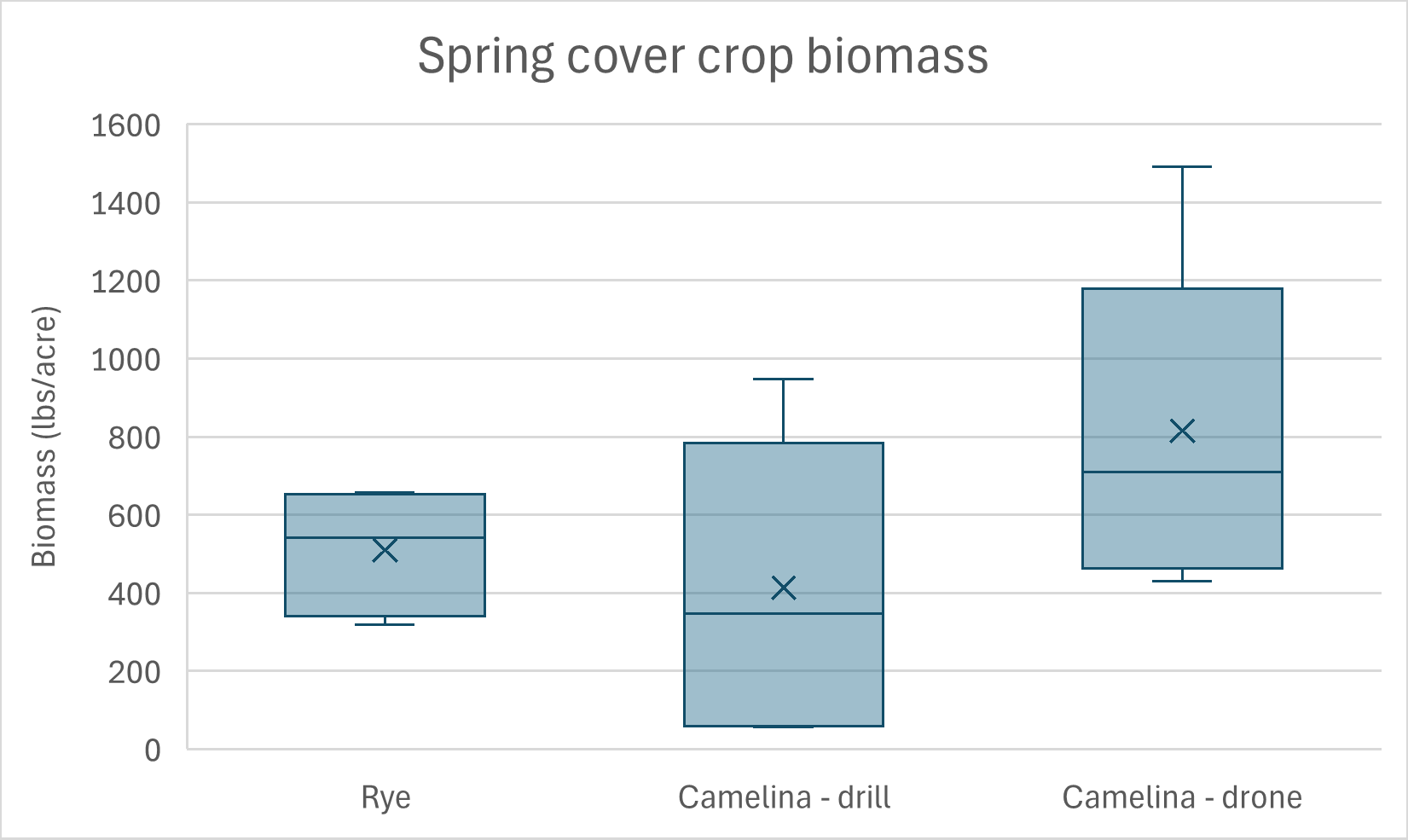 arms. Camelina drone seeding (882 lbs dry matter/acre) produced more than double the biomass on average compared to the drill seeding (414 lbs dry matter/acre). Because of the drone, the camelina was able to be seeded about a month earlier than in the drill treatments and the broadcast-style application covered more of the soil surface. This earlier seeding also led to more mature camelina plants at the time of termination with the drill seeding camelina having a very low carbon to nitrogen ratio of 13.5:1, while the drone seeding was 17.4:1. Even though higher, the carbon to nitrogen ratio of the drone seeding would likely still be a net mineralizer of nitrogen as immobilization tends to occur with carbon to nitrogen ratios above 20:1.
Research from UW Madison has shown that a rye cover crop prior to corn that accumulates less than 1,000 lbs of dry matter biomass per acre does not immobilize nitrogen and therefore, is unlikely to result in corn yield drag. Because of the relatively early termination timing of both camelina and rye at both farms, rye biomass did not exceed 1,000 lbs, and as will be shown, yield was unaffected.
 Lysimeter data
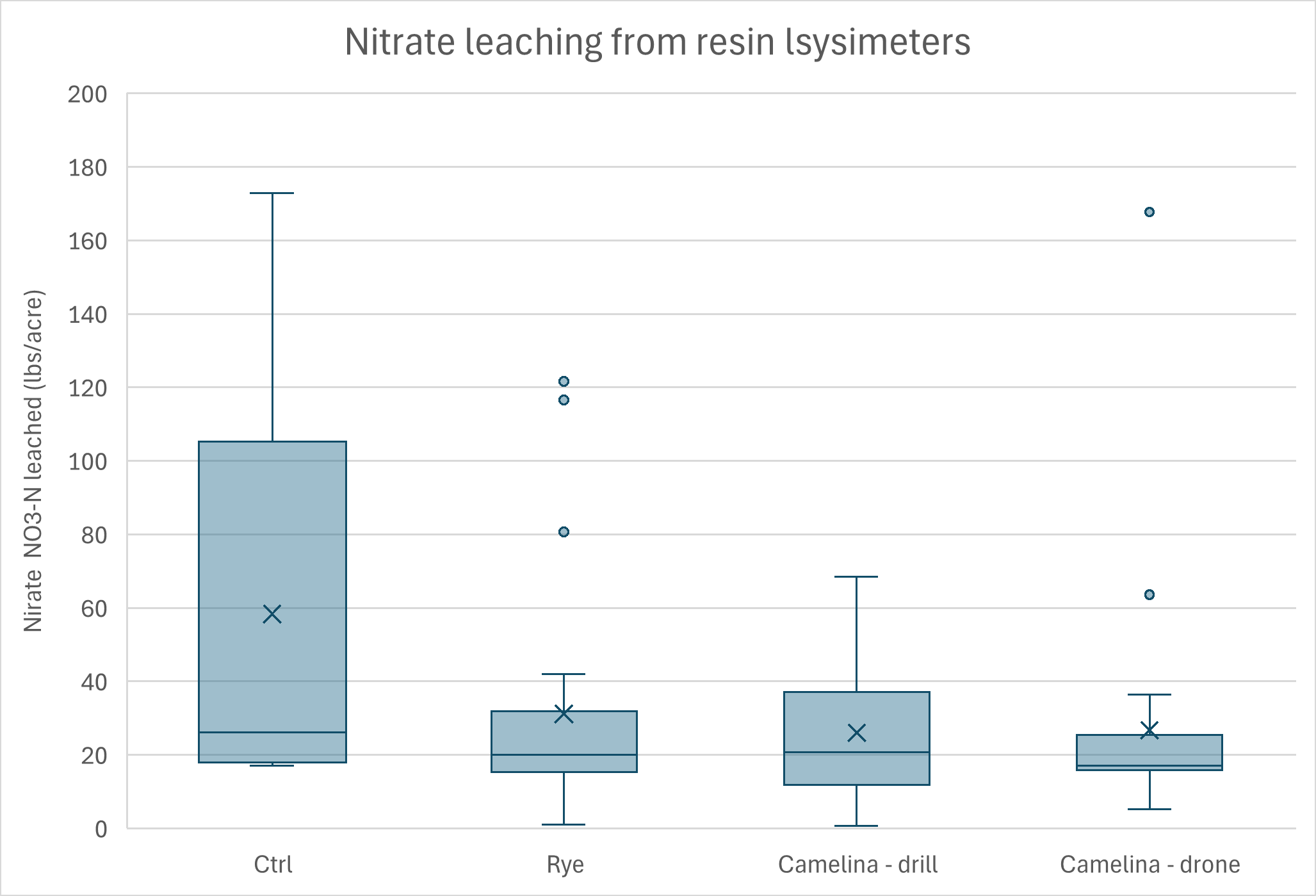
Underneath the roots of the cover crop, the lysimeter data reveals a promising trend: a cover crop is better than no cover crop. Figure 2 shows the lysimeter data compiled from the two farms. A cover crop, no matter the species, helped to cut nitrate leaching as measured by the resin lysimeters in half in comparison to the no cover crop control. Several high nitrate numbers in both the drone and rye treatments point to the variability within the resin lysimeter approach as referenced in Hall et al., 2023.
Yield data
Yields collected from the two farms with significant camelina stands did not show statistical differences in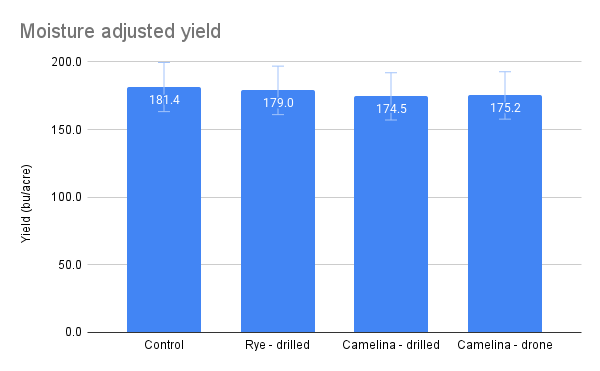 yield between the four treatments (Figure 3). Early season cover crop termination on the two farms led to little biomass accumulation in the non-drone treatments as seen in Figure 1. Research from UW Madison has shown that if a rye cover crop is terminated prior to reaching 1,000 lbs of dry matter/acre, nitrogen will not be tied up by the cover crop and corn yield will be unaffected (Ruark, West, and Siemering, 2019). Rye biomass did not exceed that 1,000 lbs DM/acre at either farm in 2025. In prior work when wheat was planted as a cover crop instead of rye and grew more than 1,000 lbs DM/acre, corn yield was significantly affected. That year camelina and control plot yields were identical. Furthermore, the herbicide termination of the wheat took more than a week to take effect.
Educational & Outreach Activities
Participation summary:
Farmer interest in winter camelina continues to grow throughout Wisconsin. In April of 2025, two field tours in collaboration with producer-led watershed groups in Juneau and western Dane County showcased two of the successful sites while camelina was actively growing. After obtaining first-year lysimeter data, we hosted a workshop about the crop and discussed our initial results in July 2025. For popular agricultural media, an article was written describing the project and initial results. This article gained attention from several Midwest states. In March 2026, we are hosting a ‘Camelina Conversation’ workshop for area farmers and agronomists to learn more about the crop and our research. This presentation will feature two years of lysimeter data. Additionally, a representative from Cargill, the main entity commercializing the crop as Sustainable Aviation Fuel, will talk about cash cropping camelina and the prospects for south central Wisconsin. As more valuable insights are gained from this project and farmer enthusiasm grows, more outreach will be conducted through conferences and publications.
Learning Outcomes
Increased awareness and interest in camelina as an alternative cover crop
Increased awareness on how cover crops affect nitrate leaching
Project Outcomes
Cover crops are instrumental in conservation agriculture. While the concept of cover crops is not new, fine tuning recommendations, especially so that cover crops are seen as additive to the operations rather than reducing the bottom line is key to keeping farmers engaged and excited about this important conservation practice. Because of the yield drag that some farmers can see in their corn crops following cereal rye, especially in dry years like 2023, camelina is being explored as an alternative cover crop that potentially has the benefits we see in cover crops while mitigating costs to yield.
This project has a large focus on reducing nitrate leaching to groundwater. This issue is not only crucial for farmers to manage their environment and reduce economic losses, but it impacts the nearby community. Nitrates in drinking water are a major concern for community members and much blame for this issue goes to farmers. By implementing camelina as a cover crop, farmers are able to reduce nitrate entering groundwater and potential drinking sources as well as retain nitrogen in their soil to reduce costly inorganic N inputs. Farmers are becoming more aware of how their practices impact the environment and people around them. Through this project, farmers are able to educate other farmers and community members about the positive practices they are implementing to reduce nitrate leaching and improve soil health.
Finally, camelina flowers very early in early May when little else is flowering. Wisconsin research has shown this provides pollinators with an important, early season resource, especially if farmers plant green and delay termination. This research’s findings that earlier planted camelina flowered earlier also provides more rationale for drone seeding the cover crop to maximize potential pollinator benefits.