Progress report for ONE24-435
Project Information
This project centers on investigating the use of Black Soldier Fly larvae (BSFL) frass as an eco-friendly and inexpensive substitute for traditional growing media, like peat moss, in urban farm production systems.
The initiative collaborates with Boston Microgreens and Apogee Farms, both recognized for their interest in innovative agricultural solutions in Boston and D.C., respectively. This partnership aims to address the environmental and economic issues associated with conventional growing media, which are costly and have a significant ecological footprint.
The core of the project is a series of experimental trials conducted at the partner farms and Circular Agricultural Solutions’ facility. These trials will evaluate the efficacy of BSFL frass as a standalone and mixed growing medium for microgreens and vegetable starts. Key performance indicators include germination rates, yields, and overall plant health.
This approach not only promises a reduction in environmental impact through the recycling of organic waste into valuable agricultural input but also aims to lower the production costs for urban farmers. The project intends to offer insights into the management practices required for the successful integration of BSFL frass in urban agricultural systems.
Our primary goal is to translate the developing research on BSFL into a manageable, and adoptable practice for farmers across diverse production systems. We plan to achieve this by focusing on the following two areas:
Objective 1: Assess the use of BSFL frass as a substitute for growing media in microgreen production
Specifically, we will look at how BSFL frass can be supplemented into growing media in microgreen production using two economically important microgreens, sunflower and broccoli. We will then assess how frass alone compares to frass mixed with media, and how both of these compare to growing media alone. We will use the metrics of germination rate and yield per tray as indicators of plant performance across these different media.
Update 2/13: Due to difficulties with germination in 2025, we are looking to assess what % frass mixed into growing media creates a EC below 2.0 mS/cm - then grow microgreens with this mixture.
Objective 2: assess the use of BSFL frass as a substitute for growing media for vegetable starts, for outdoor soil-based production
Here, we will repeat the experimental design from objective 1, and trial this with tomato and lettuce vegetable starts that are being used for outdoor production.
Update 2/13: Due to difficulties with germination in 2025, we are looking to assess what % frass mixed into growing media creates a EC below 2.0 mS/cm - then grow vegetable starts with this mixture.
While implementing these questions, we will communicate with farmers to identify obstacles that arise along the way, and use these to inform our future efforts of disseminating and sharing our results.
Growing media is vital for both soilless vegetable cultivation and vegetable starts (seeding to transplants) soil-based cultivation, as it offers an ideal substrate for seeds to germinate and grow. However, the cost and impact of popular growing media poses significant concerns- highlighting an issue: expensive and unsustainable growing media affect the profitability of a farm, as well as the protection of natural resources.
The production and disposal processes of popular growing media like peat, coir, and mineral wool vary significantly in their energy demands and environmental footprints. Peat, in particular, a non-renewable resource, contributes significantly to damaging emissions during extraction (Kern et al. 2017), while its decomposition is a major source of emissions in horticulture (Growing Media Europe 2020). As Gorham (2012) emphasize, the carbon stored in peat bogs is critical, representing a substantial portion of the world's organic soil carbon. The extraction of peat disrupts these ecosystems and releases fossil carbon dioxide (Hirashi et al., 2018)
Microgreens is a production system that relies heavily on peat-based growing media. Currently, microgreen production is a quickly growing agricultural industry. Across the northeast region, microgreens are being farmed by both microgreens-focused farms, and incorporated into more traditional soil-based farms as a way to generate more revenue. An issue with microgreens production is that it requires large amounts of growing media, which is usually thrown away after one growing cycle (typically lasting between 10-20 days). Microgreens farmers cite seeds and growing media as their highest costs. While more sustainable substrates for microgreens production have been investigated (Di Gioia et al., 2017), increased expenses of these “improved” substrates have forced growers to continue to use peat moss and other non-renewable resources, according to conversations with growers. The cost of adopting non-peat grow mixes is the main ongoing issue preventing adoption. For this reason, substrates that are both renewable/low environmental footprint and low-cost need to be further investigated.
In response to the issues with peat, coir, and mineral materials, research into organic, peat-reduced, and peat-free blends has been accelerating (Dannehl et al. 2015; Domeno et al., 2005). However, to our knowledge, the use of frass to replace growing media for microgreen production and vegetable transplant production has not been investigated. To us, this seems to be a natural next step in research on this topic.
A solution that is immediately available to farmers lies in leveraging the excess organic matter generated by farms as a resource rather than a waste. The transformative potential of insects, specifically Black Soldier Fly larvae (BSFL), in quickly managing these organic by-products, offers a pathway to reduce both input costs and the environmental footprint of growing media. Farms are beginning to adopt BSFL because of the income-generating opportunity of the larvae as livestock feed, however, there is also a potential to use a less used product of BSFl- frass- to address the problem of expensive, non-renewable soil growing media.
BSFL thrive on a variety of organic substrates, including both vegetable and animal origins.These larvae can efficiently process different types of waste, from livestock manures to municipal solid organic waste, reducing dry mass volume by 38 to 74% and decreasing nitrogen and phosphorus contents significantly (Nguyen et al., 2015). The rapid and efficient conversion of low-quality organic substrates into high-value insect biomass, rich in protein and fat, is particularly notable (Tran et al., 2015). This conversion process, substantially quicker than traditional composting methods also contributes to reducing pathogenic bacteria and preventing the proliferation of pest species.
BSFL have been widely researched and implemented in various contexts, from technologically advanced operations in Europe and North America to simpler, yet efficient systems in Africa and Indonesia. This global adoption reflects the significant potential of BSFL in contributing to a circular economy by converting agro-industrial by-products into valuable resources. While BSFL production capacity is expected to quickly grow across this decade (Vantage Market Research), the understanding of how frass can be used to benefit all sorts of farmers needs to be researched.
Frass, a by-product of BSFL composting, emerges as a potential substitute for conventional growing media. Its composition is derived from a variety of agricultural and other organic wastes, including crop residues, animal by-products, and even municipal waste. Frass is beneficial as a soil amendment comparable to organic fertilizer, improving cereal crop production, and various vegetable production (Tan et al., 2021). For example, one study combined BSF larval frass and commercial peat moss and found it to be a viable soilless growing medium for baby leaf lettuce, basil, and tomato (Bortolini et al., 2020, Setti et al., 2019).
Frass, derived from food-waste specifically, was shown to have been a good substrate for seed germination (Bohm et al., 2023). While this new study has highlighted the opportunity to germinate seeds with BSFL food waste-based Frass, no study has yet been conducted looking at specifically microgreens, or vegetable transplants started on food waste-based frass.
The core question remains can food waste-based BSFL frass effectively replace traditional growing media in production systems for microgreens and vegetable transplants? Despite the promising attributes of BSFL frass, there is a notable gap in specific information regarding its application in growing microgreens and vegetable starts. This project aims to investigate the efficacy of BSFL frass as a growing medium, determining the optimal usage rates and management needs.
Cooperators
- - Producer
Research
Updates and Preliminary Results:
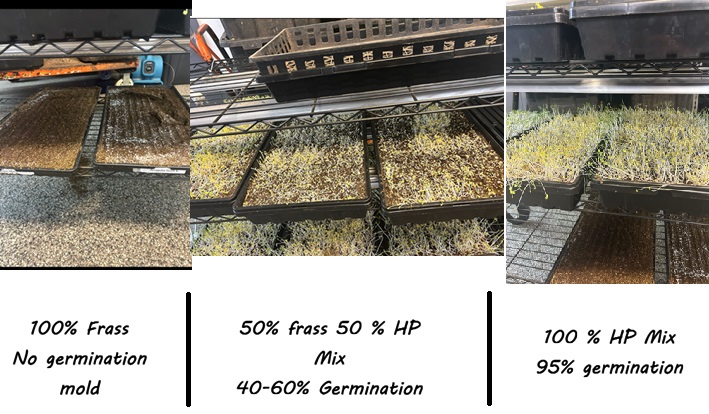
Preliminary substrate microgreen trials were conducted in partnership with Boston Microgreens to evaluate black soldier fly (BSF) frass as a growing medium for broccoli microgreens (True Leaf Market – Waltham 29). All treatments were grown under standard farm production practices. Trays were placed on the same shelving unit, maintained in the same environmental conditions, managed identically, and hand-watered every other day. Planting and harvest dates were consistent across treatments, and the test period lasted nine days.
Three substrate treatments were evaluated:
Treatment 1: 100% Frass (0% HP Mix)
-
0% germination
-
Mold outbreak observed
-
Substrate moist at planting (not fully dried)
Treatment 2: 50% Frass / 50% HP Mix
-
60% germination
-
Some mold development
-
Moderate emergence delay relative to control
Treatment 3: 100% HP Mix (Control)
-
95% germination
-
No notable mold
-
Uniform and rapid emergence
Day 1 germination assessments showed delayed or absent emergence in frass-dominant treatments relative to the peat-based control. Germination rates declined as frass proportion increased, and mold pressure was notably higher in treatments containing frass.
While the farm expressed strong interest in circular nutrient models and was conceptually aligned with incorporating frass into production systems, they reported practical concerns with handling and consistency. Although odor was not severe, the farm suggested that indoor microgreen operations may face challenges integrating frass due to perceived smell, moisture variability, and mold susceptibility. Overall, the farm indicated a preference for conventional peat-based substrates due to predictability and reduced disease pressure.
Vegetable Start Trials Updates and Preliminary Results:
Lettuce and Tomato Substrate Evaluation Using Black Soldier Fly Frass
Overview
A series of germination studies were conducted in 2025 to evaluate black soldier fly (BSF) frass as a primary substrate for vegetable seedling establishment under controlled urban growing conditions. Crops evaluated included lettuce and tomato. The objective was to assess germination performance, substrate behavior, and early seedling development in comparison to conventional peat-based media.
Lettuce Germination Trials
Trial Period 1
April 11 – April 30
Lettuce exhibited no germination in 100% frass treatments.
Trial Period 2
May 21 – June 2
Two lettuce trials were conducted.
Each treatment consisted of eight trays containing 72 cells per tray.
100% Frass (8 trays)
Germination results per tray:
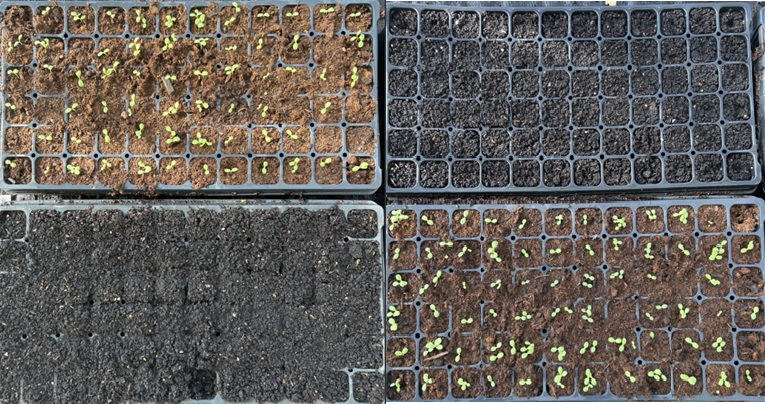
Germination ranged from 0–4% across trays.
100% Peat Moss (8 trays)
Germination results per tray:
Germination ranged from 90–100%, with consistently uniform emergence.
Observations: Physical Substrate Behavior
Several important physical characteristics were observed in the frass treatments:
1. Surface Crusting
A hardened crust formed on the surface of many frass trays. This crust:
-
Sealed the surface similarly to clay
-
Was not absorbent
-
Restricted water penetration
-
Trapped germinating seedlings beneath the hardened layer
In some cases, seedlings began germinating but were unable to penetrate the surface crust, resulting in failure to emerge.
Notably, beneath the hardened surface, the frass remained saturated. This created a dual-layer effect:
-
Hardened, impermeable surface
-
Oversaturated lower layer
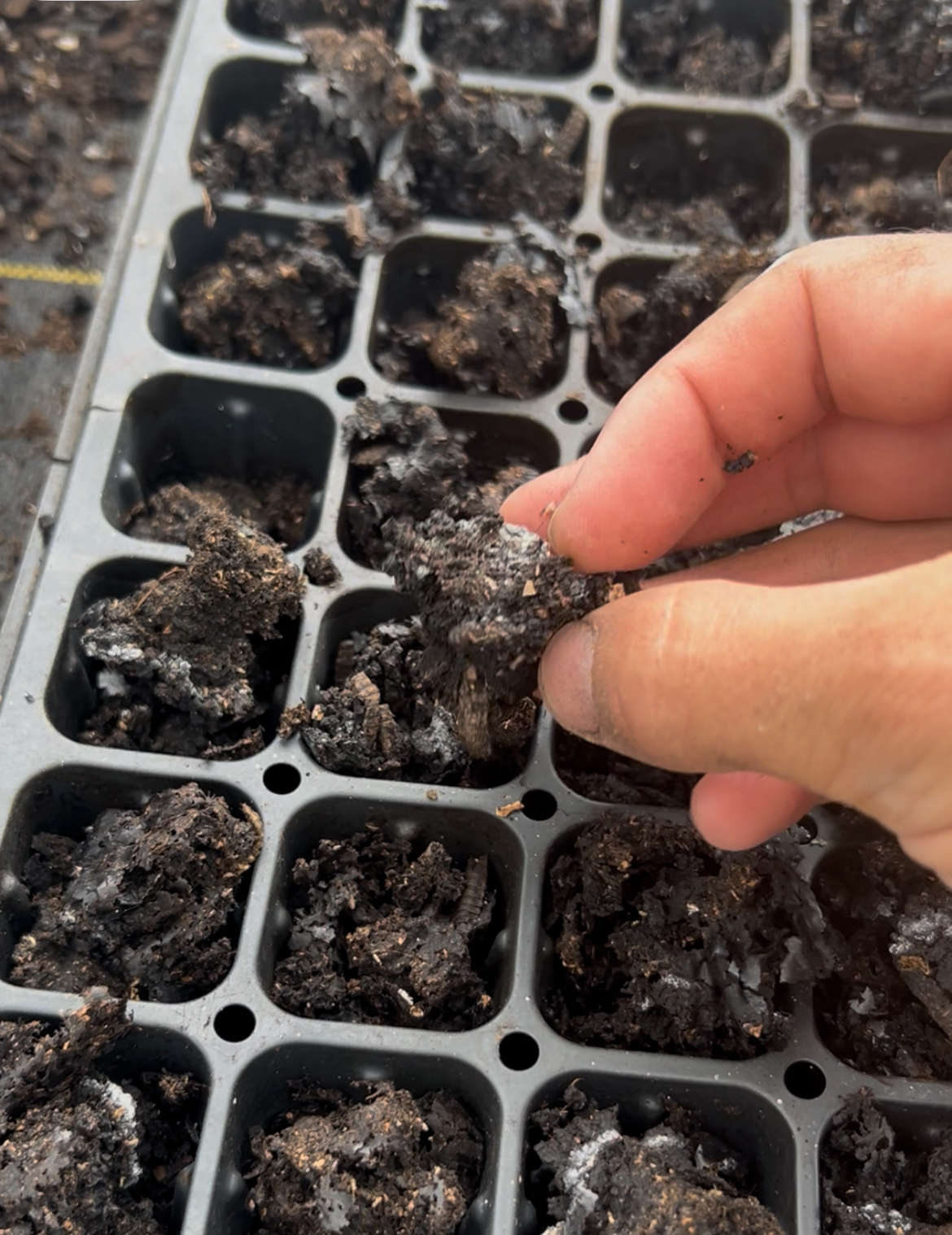
This combination likely contributed to poor oxygen diffusion and inhibited seedling emergence.
2. Biological Reactivation
Some batches of “finished” frass still contained viable larvae or biological activity. Upon watering:
-
Biological movement resumed
-
Substrate structure destabilized
-
Trays became sludge-like rather than crusted
This inconsistency in frass stability suggests variability in processing or maturity level prior to use.
Tomato Germination Trial- Initiated July 15
Tomato demonstrated higher germination rates than lettuce but still showed strong treatment differences.
100% peat showed good germination and establishment.
-
Week 1: 72/72
-
Week 2: 72/72
-
Week 4: 72/72
Consistent 100% germination and establishment.
In comparison, 100% frass showed slow germination, and low germination:
-
Week 1: 0/72
-
Week 2: 21/72
-
Week 4: 19/72
Frass treatments showed:
-
Delayed germination onset
-
Maximum germination of ~29%
-
Slight decline by week 4
-
Seedlings did not reach maturity
Because this trial began late in the season, environmental timing also contributed to lack of maturity; however, nutrient stress was evident.
Our thoughts on the mechanism causing issues
Crusting, biological activity and high EC. Seedlings in frass treatments showed signs consistent with nutrient or salinity stress. Laboratory testing is ongoing, but literature indicates that frass can exhibit elevated EC levels.
Reported EC values of 4.0–6.0 mS/cm in frass (Mulu et al., 2023) are high enough to inhibit germination and early seedling development. Many vegetable crops experience germination suppression above 2.0 mS/cm.
High salinity likely contributed to:
-
Delayed germination
-
Reduced total germination
-
Osmotic stress
-
Seedling collapse
Further chemical analysis of all frass batches used in the study is currently underway.
Across lettuce and tomato trials:
-
100% frass resulted in severe germination inhibition.
-
Frass exhibited physical instability (crusting or sludge formation).
-
Biological inconsistency was observed in some batches.
-
High EC is a probable contributing factor.
These findings suggest that raw frass is not suitable as a sole germination substrate under current processing conditions.
UPDATE 2026: Our methods are slightly changing due to challenges with germination. In 2026, our treatments will be defined by a frass/substrate mixture that is less than 2.0 EC mS/cm). We have engaged in on-going conversations with our partner farms and needed to change partner farms for 2026, from Boston Microgreens to Greenway Farms in MD, and also added University of The District of Columbia as a collaborator to run the trials #3 and #4. In 2025, we started every originally planned trial, but ran into many issues with germination, which prevented us from collecting the originally planned upon data, but has led us to other quetsions.
Our goal is to trial a method that is accessible to a farmer in the context of an urban setting. So, for that reason, the inputs for the BSFL need to be something that’s very accessible. Accordingly, frass will be derived from food waste organic matter. A study by Bohm et al. (2023) showed that food waste (miscellaneous vegetables and plant materials) derived from frass is the best type of frass for seed germination. At the same time, this type of organic matter input is the most accessible type of input for a small-scale urban farm that has a BSFL operation.
Our partner Future Acres, has agreed to produce frass using only food waste organic matter. After we receive the 200 lbs of frass, we will homogenize and sift the frass to make the ideal frass-based, growing media. This media will then be analyzed for chemical composition at University of The District of Columbia EQTL lab. We will send 4 samples to be analyzed. 50 lbs will be sent to Boston Microgreens and Apogee Farms, respectively, for on-farm testing.
While there is research that can be done on the front end about “what are the best inputs to create the best frass for this application” we want to simplify this research. So we are simply looking at if we utilize the most accessible inputs for BSFL to make frass - organic food and agriculture-plant waste- how can that general frass be used in vegetable production. Future Acres will provide the ratios and description of the types of food and agricultural-plant waste used to produce the frass.
Objective 1: assess the use of BSFL frass as a substitute for growing media in microgreen production
Research questions:
- What is the effect of using frass as growing media on microgreen production?
- What changes in management techniques need to be taken to use frass as growing media in microgreens production? (Watering and
- As stated by Thomas at Mevilley Gardens, a SARE grant receiver; a main issue for switching substrates in a microgreens production system, is that there are different management needs. The different water holding capacities, available nutrients ,and texture can all alter the way a farmer should manage the microgreens watering, heat and light schedule. So, part of this trial is addressing what management needs to change for utilizing frass.
- New question: What % frass mixed with media creates a suitable germination environment for microgreens?
Experimental Design:
- Trial #1 (to be conducted at Boston Microgreens and a new farm in MD):
- Test crop: sunflower and broccoli (most popular microgreen varieties)
- 3 treatments
- Frass only (3 trays)
- Frass+Media (1:1 v/v) (3 trays)
- Growing media only (3 trays)
- Put trays on the same shelf, giving the same environment, and management.
- To reduce cross-contamination of these treatments, use hand watering techniques so that the nutrients of one growing media are not leached into the other treatment.
- Start planting and harvest all 18 trays on the same days. When harvesting, record the yield (grams) per tray. Also record the % of the tray that experienced yield loss (maybe due to wilt, or damping off, etc)
- Data collection:
- pH and EC of each treatment growing media
- Germination rate
- Yield per tray
- Conduct this trial 3 times on each farm respectively (see timeline)
- Analyze the effect of treatment on germination rate, yield and pH/EC respectively, using ANOVA
- Trial #2 (to be conducted at Boston Microgreens and Apogee Farm):
- Investigate irrigation management for frass as growing media for 2 microgreen varieties
- Test crop: sunflower and broccoli (most popular microgreen varieties)
- Treatment main plot (irrigation amount):
- Water using the farm's usual watering techniques (control)
- Water less than traditional watering techniques- as defined by farmer
- Water more than traditional watering techniques - as defined by farmer
- Treatment subplot: frass amount
- Frass only
- Frass+media (1:1 v/v)
- Put trays on the same shelf, giving the same heat and humidity and light environment.
- To reduce cross-contamination of these treatments, use hand watering techniques so that the nutrients of one growing media are not leached into the other treatment.
- Start planting and harvest all 18 trays on the same day.
- Data collection:
- Record watering schedule for each treatment
- Germination rate
- Yield per tray
- Conduct this trial 3 times respectively (see timeline)
- Analyze effect of treatment on germination rate and yield, with rep being a random variable, using GLMM
Each farmer will report on the challenges and general impression of utilizing frass. Ideally, we hope that each farm context will be able to make an assessment of the use of frass, and feasibility of the actual application, for other farms that are in a similar context.
Objective 2: assess the use of BSFL frass as a substitute for growing media for vegetable starts, for outdoor soil-based production
- Research question: What is the effect of using frass as growing media on vegetable starts production?
- UPDATE: This research will be conducted at University of The District of Columbia's greenhouse and field facilities.
Experimental Design
Trial #3 (to be conducted at University of The District of Columbia):
- Test crop: Tomato and Lettuce
- 3 treatments
- Frass only (3, 72 cell start trays)
- Frass+Media (1:1 v/v) (3, 72 cell start trays)
- Growing media only (3, 72 cell start trays)
- Grow for 8 weeks in greenhouse
- Data collection:
- Germination rate (how many seeds germinated in each tray)
- Biometric analysis of 10 plants from each start tray
- Record stem weight, leaf weight, Leaf area, height of plant and root length
- Analyze the effect of treatment on germination rate and biometric analysis using ANOVA
Trial #4: on-farm growth (to be conducted at University of the District of Columbia in UPDATE: Summer 2026)
- Test Crop: Tomato and Lettuce
- Using the plants from the previous trial
- Plant 10 plants from each treatment as a plot within a row (3 rows [replications] of 3 treatments; for lettuce and tomato respectively)
- Randomized block design
- Plant 10 plants from each treatment as a plot within a row (3 rows [replications] of 3 treatments; for lettuce and tomato respectively)
- For lettuce:
- After 40 days, harvest
- Collect yield data for all
- Collect biometric analysis for 4 representative samples of each treatment
- stem weight, leaf weight, Leaf area, height of plant and root length
- After 40 days, harvest
- For tomato:
- Collect yield throughout the season for plants from each treatment
- At the end of the season collect biometric analysis for 4 representative samples from each treatment
- stem weight, leaf weight, Leaf area, height of plant and root length
- Analyze the effect of treatment on yield and biometric analysis using GLMM, with rep as random effect variable
- Using the plants from the previous trial
End of 2024 update: There are not currently results from this study, as we are still setting up the project. We were delayed due to less frass supply than originally expected. However, the supplier increased production into the winter 2024, and we will begin the on-farm research projects in the first 2 months of 2025.
Part of the delay was due to the difficulty of producing pure frass from urban organic waste similar to "kitchen scraps". This is partly because of the diversity in materials inherent in "kitchen scraps", and that after the BSF process the waste, there's still left over more carbonous materials that can be difficult to filter out. Our supplier has figured out a modified harvest approach and we received the first batch of Frass derived from urban organic food waste in December. Ultimately the method is just to use a sieve; it's not a complicated method, but slightly different than what was being done before.
That frass will be analyzed for mineral composition at UDC's Environmental Quality Lab and then used at the DC partner farm Apogee Farms in early 2025.
Education & outreach activities and participation summary
Participation summary:
Update end of 2024: We do not have results from studies at this point, and do not expect to have results until mid-2025. Most of the outreach plan will stay the exact same, except the Mid-Atlantic Vegetable Growers Conference presentation will move from 2025 to 2026.
Our goal is to share the findings and experience from this grant with as many urban food system stakeholders as reasonably possible. We plan to do this through a local, regional and virtual outreach approach, to allow dissemination of information as broadly as possible.
- Locally-
- D.C.
-
-
-
- We will host an on-farm demonstration, coordinated through the University of DC. The on farm demonstration will show how Apogee farms uses BSFL frass in production.
- Additionally we will present the findings of each of our applications (across D.C. Boston and at Circular Agriculture Solutions) at a local urban farmer conference that receives over 1500 local farmers/gardeners in the DMV area - Rooting DC.
-
-
- Due to ending the Boston Microgreen Involvment this will no longer occur: Boston
-
-
-
- We will host an on-farm demonstration, coordinated through a local sustainable farming project. The on farm demonstration will show how Boston Microgreens uses BSFL frass in production.
- Additionally we will present at a local gardener and grower conference (The Gardeners Gathering) that receives over 500 attendees in the Boston Metropolitan area and is attended by a diversity of individuals, with on-site spanish translation services provided.
-
-
- Regionally-
-
-
- We will present our findings and experience to the Mid Atlantic Fruit and Vegetable Convention in 2027 (edited and changed to 2027, so that there's enough data to present)
-
- Virtually-
-
- We will create 3-4 videos that detail our studies, experiences and findings.
- Video subjects may be:
- Irrigation management of frass growing media for microgreens
- Frass growing media compared to peat growing media for microgreens
- Frass growing media compared to peat growing media for tomato and lettuce starts
- Update 2/13: Videos have not yet been developed!
- Video subjects may be:
- We will create 3-4 videos that detail our studies, experiences and findings.
We want to stay open to attending other conferences or meetings, or create additional videos, throughout these 2 years if there is demand and opportunities present themselves.
Learning Outcomes
Awaiting project initiation
Project Outcomes
Working collaboration has been set up with UDC. Otherwise, other project outcomes are awaiting initiation of the respective research trials.