Final report for ONE24-445
Project Information
For scaled organic farmers, reducing tillage while maintaining profitability is difficult. It requires balancing yields, inputs and labor, and also managing weeds and compaction in new and unfamiliar ways. Crimped Rye is generally the first (and often only) system that organic farmers use to reduce tillage at scale. While the system can be successful in more northerly latitudes, it was innovated in Southeast Pennsylvania, so farmers further north frequently struggle with inadequate biomass production for weed control, harmonizing planting with anthesis (pollen shed, when rye will reliably die by crimping), cool soil temperatures underneath the rye vs. tilled ground, and nitrogen tie-up. In trials throughout the Northeast with Momentum Ag (the lead on this project), about 20 farmers have begun experimenting with Clover Living Mulch. This system offers management and ecosystem benefits that make it very appealing relative to Crimped Rye, but managing cash crop/clover competition is difficult.
Three organic farmers (one in NY, two in VT) set out to compare Crimped Rye and Clover Living Mulch. They added a third hybrid system -- Crimped Rye with clover. The theory was that the clover would help fill in gaps to suppress weeds (addressing a major concern in the Crimped Rye system), and the crimped rye would suppress the clover during cash crop establishment (addressing a major concern in the Clover Living Mulch system).
Across the board, yields in Crimped Rye -- with and without clover -- were disastrous...essentially zero. The clover did indeed fill in gaps in rye residue as they'd hoped. This is promising for farmers already experiencing success with Crimped Rye, but is of no use to farmers for whom Crimped Rye doesn't work.
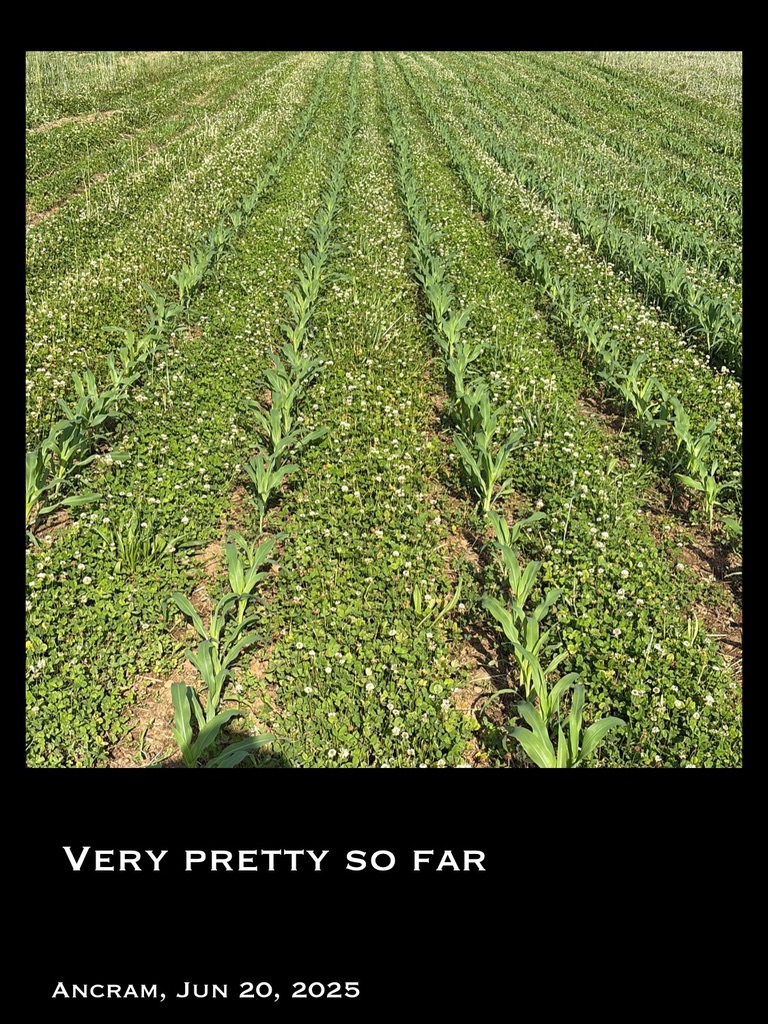
Strip-tilled Clover Living Mulch plots performed well (at two farms; the clover stand at the third farm didn't persist through the previous season), but yield data was compromised by deer pressure at one farm, and by the necessity of using two different planters for the experiment vs. control plots at the other, leading to significantly different stand densities. Observationally, field corn and sweet corn in Clover Living Mulch looked equal to or slightly smaller than tilled controls.
On average, the tilled control plots required 8.67 tractor passes in season from field prep to cultivation. The Crimped Rye plots saw 7.33 passes (a 15% reduction), while the Clover Living Mulch plots had an average of 5.50 passes (a 37% reduction). It would be interesting to compare STIR values in the future, because in addition to fewer passes, the tillage reduction systems also disturbed far less soil and used less diesel. Over larger acreages, these reductions can equal significant savings, from hourly operator labor to diesel to wear and tear. These savings can help offset some yield loss while maintaining profitability.
Crimped Rye may be suitable for a wider variety of organic crops at more southerly latitudes, but in NY/New England, field corn, sweet corn and transplanted winter squash failed to produce. Soy, dry beans and late brassicas may be a better fit.
Strip-tilled Clover Living Mulch proved more promising and more flexible system for growers in our region.
Our objective was to compare three different tillage reduction techniques that can be scaled at organic farms: Crimped Rye, Crimped Rye with undersown Clover, and Clover Living Mulch.
Three farms (two in VT, one in NY) set out to compare and contrast yields, tractor passes, and soil health indicators across these systems.
Reducing tillage can do all sorts of good things – keep topsoil in place, keep nutrients on the farm, and encourage an abundance and diversity of soil organisms. But in practice, tillage reduction often creates management and economic problems for organic farmers. In particular, for organic farmers at scale and/or growing relatively low-value crops, there are very few well-documented options out there. Small-scale tillage reduction techniques generally rely on lots of inputs and/or labor, while larger-scale tillage reduction primarily relies on herbicides.
For scaled organic farmers, there is a real question of how to reduce tillage while keeping profitability at least even. This means balancing yields, inputs and labor, and also managing weeds and compaction in new and unfamiliar ways.
Many medium to large scale organic farmers are frustrated or even angry about all the tillage reduction/no-till/min till conversation these days. Most of these farmers chose to farm organically because they feel strongly that it is 'the right thing to do.' Their commitment to organic hasn't wavered, but the tillage organic systems require is now viewed negatively by the larger community, and in some cases, by the farmers themselves.
Generating and disseminating useful data is the primary goal of our proposal, but it also aims to create and support existing communities of scaled organic farmers as they reclaim their commitment “to honor the holistic connection among land, water, air, and all living beings.”
The three farmer-partners on this proposal have all done a significant amount of experimentation on their own, but none of them would claim to have all the answers. What really connects these three farmers is curiosity and a willingness to try new things. It is so important to pay farmers for this work; it’s easy to lose money on labor and yield when you’re trying something new, and the knowledge they produced is useful not just for their farms but for the whole community. Momentum Ag shares SARE’s dedication to the idea that farmers should be paid for growing knowledge.
Crimped Rye is generally the first (and often only) system that organic farmers use to reduce tillage at scale. While the system can be successful in more northerly latitudes, it was innovated in Southeast Pennsylvania, so farmers further north frequently struggle with inadequate biomass production for weed control, harmonizing planting with anthesis (pollen shed, when rye will reliably die by crimping), cool soil temperatures underneath the rye vs. tilled ground, and nitrogen tie-up. Crimped Rye only reduces tillage by a few passes, because it often requires tillage for establishment, and more tillage post-harvest to establish the following cover crop. Relative to other scalable organic tillage reduction, however, it is the best studied, the most widely known, and roller crimpers can be easily purchased or rented.
Clover Living Mulch offers management and ecosystem benefits that make it very appealing relative to Crimped Rye. The clover can be established by interseeding into a prior cash crop, which means it covers the soil for longer, specifically in the post-harvest window, and it eliminates the tillage event(s) that generally accompany post-harvest rye establishment on organic farms. Clover is also much easier to work with from an equipment standpoint – it does not bind up on machinery. Unlike rye, which must be crimped in a very narrow timing window, clover can be planted into at any point during the growing season. Finally, because clover is perennial, it can fully eliminate tillage for a number of years (3-5, depending on the strength of the stand).
However, Clover Living Mulch is a very new system. Few farms use it on a commercial scale, and research often finds a yield drag due to clover competition that is not always offset by labor/passes savings. Momentum Ag has begun working on Best Management Practices for Clover Living Mulch that will be published in late 2026 (you can contact us for a working version) to de-risk the system.
The third system – Crimped Rye & Clover – came out of a successful, one-off attempt at Evening Song Farm in Vermont. Evening Song intensively manages small blocks of a diversity of vegetables. In 2024, they crimped rye and vetch and tarped it. When they removed the tarp in late June, they immediately oversowed Dutch White Clover and transplanted Brussels on the same day. The clover came through the rye beautifully and provided season-long weed suppression for the Brussels. From left to right: Tarp removed, clover broadcast at 1#/1000ft2, Brussels transplanted on 6/23/2023; Clover emerging just three days later; Clover filling in on 7/22/2023; Fully filled in by 7/31/2023.

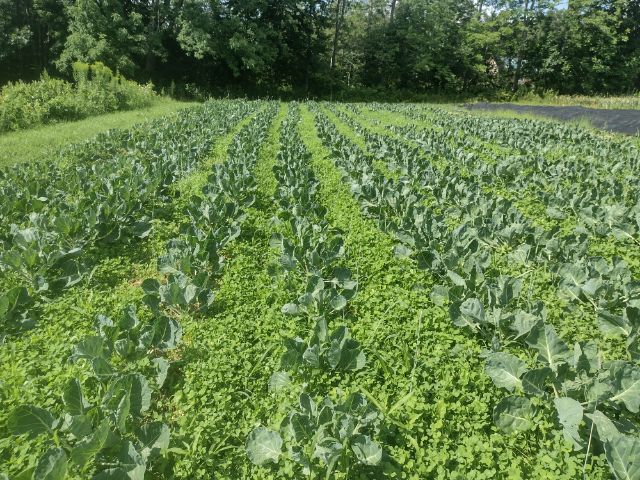
The three farmers in this project wondered whether this method could be scaled to address the two of the main problems that the other systems have. 1) Getting enough rye biomass to suppress weeds all season is variable from year to year, and we hoped the clover would fill in gaps and help with that. 2) The clover would be young and/or suppressed by rye during cash crop establishment, so it wouldn’t compete with the cash crop.
This proposal sought to enable our farmer-partners to “steward resources to ensure sustainability, resilience, economic viability, and a high quality of life,” by compensating them for their knowledge production. On a larger scale, we hoped to help other farmers make informed, environmentally positive management changes without taking on undue risk.
Cooperators
Research
Participating Farms:
Hudson Valley Hops and Grains is located in Ancram, NY. Stuart Farr grows organic, food-grade small grains and row crops on over 400 mostly leased acres.
Hurricane Flats is located in South Royalton, VT. Ash Loehr grows organic vegetables, dry beans, popcorn and hay on 20 owned acres.
Snow Farm is located in and around Fairlee, VT. Mike Snow grows organic small grains, row crops, and vegetables on 15 leased acres.
Fields and crops in the research plots:
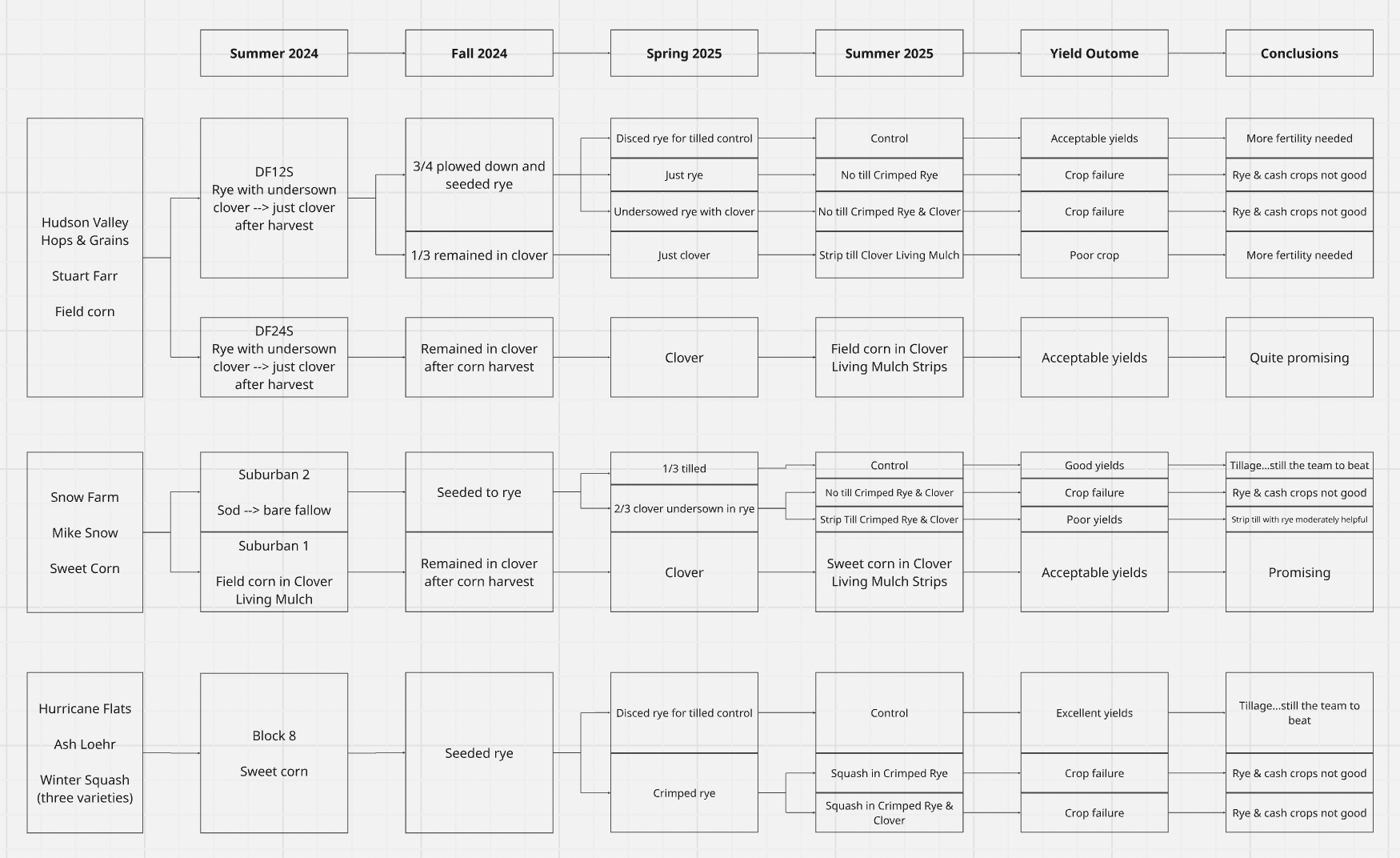
Stuart: The trial plot (in field DF12S) was just under 2 acres total. In 2024, Stuart grew rye for seed. He undersowed clover in spring of 2024, so after rye harvest, the field was entirely in clover. For the trial, Stuart grew grain corn. On a directly adjacent field (DF24S), he grew 20 acres of field corn in clover living mulch strips as well.
Ash: Crops are produced in half-acre blocks. Block 8 grew sweet corn in 2025 and was seeded down to rye after harvest. The clover in Ash’s 2024 trial did not persist throughout the season, so Ash didn’t have a Clover Living Mulch plot for this trial – just Crimped Rye and Crimped Rye & Clover.
Mike: Used two adjacent blocks, each about 1/5th of an acre. The first block (Suburban 1) was in grain corn and Clover Living Mulch in 2024. It was used for the sweet corn in Clover Living Mulch again in 2025. The second block (Suburban 2) was in sod in 2024. It was plowed up, bare fallowed, and seeded down to rye in the fall. In 2025, Suburban 2 had the control and the Crimped Rye & Clover treatments.
Establishing Clover for Clover Living Mulch (2023 / 2024):
All participants used Dutch White clover, a low-growing perennial that withstands field traffic.
Stuart established clover in both DF12S and DF24S by frost-seeding clover into rye in spring of 2024. After rye harvest, the clover was left to overwinter and was ready to go for 2025. In the trial plots for control, Crimped Rye, and Crimped Rye & Clover, Stuart disced in the clover in fall of 2024 to establish rye (see below).
Ash established clover through interseeding into popcorn in 2023, which is her usual practice for establishing an early cover crop in this late-harvested cash crop. In 2024, she grew winter squash in the clover, which had overwintered well. For a variety of reasons, known and unknown to us, the squash fared poorly and the clover failed to persist into 2025, so there was no Clover Living Mulch treatment.
Mike Snow also established clover by interseeding into popcorn in 2024 and it overwintered nicely into 2025.
Establishing Rye (fall of 2024):
All three farmers sowed rye into tilled ground between mid-September (Ash and Mike, VT) and mid-October (Stuart, NY, and Mike, VT). A week or two earlier is considered optimal for maximum biomass production, but is very hard to achieve in the real world, because most crops are still in the ground. They all used a grain drill to seed rye at ~150 pounds per acre. Mike’s seed had poor germination and he had to reseed in early October.
The fall of 2024 was extremely dry, so rye emergence and growth was slow. This seemed like a perfect setup for the Crimped Rye & Clover to shine because rye biomass in 2025 was sure to be lacking due to the poor fall conditions.
Establishing Clover (spring of 2025):
Mike’s rye was thin in spring due to poor germination and late reseeding, as well as the dry fall. He was concerned about weed suppression without enough rye biomass, so he used a chest seeder to broadcast Dutch White clover into all of the rye in mid-April. He seeded heavy (25-30 pounds per acre), and didn’t incorporate.
Stuart also hand-seeded in late April, at a rate of 10 pounds per acre.
Both Mike and Stuart have a lot of experience with broadcasting clover in early spring into small grains for harvest. Stuart usually uses a Herd spreader. The Herd is essentially a very small cone spreader meant for small seeds, mounted on a three point hitch (or even on an ATV) with an aperture that can be adjusted with much more precision than a cone spreader. He likes the Herd well enough but is moving to an air seeder which offers significantly greater precision, can be used for a wider variety of seed sizes, and can be used to apply fertilizer as well. At 400+ acres, Stuart needs to reduce the pounds of clover per acre as much as possible. Mike and Ash can afford to go heavier on their relatively smaller acreages.
Ash decided to wait to seed clover until after crimping (like Evening Song / Ryan had). She had a rough Clover Living Mulch trial in 2024 and wanted to reduce clover/squash competition as much as possible, so she seeded clover on the day of transplanting.
The road to on-farm trials is paved with good intentions:
It’s important to acknowledge that, despite farmers’ best efforts to establish clover and rye in the right plots at the right time, weather and life can get in the way. We came into 2025 with no Clover Living Mulch plot at Ash’s, and no Crimped Rye plot at Mike’s. Stuart’s plot was chopped in half by the landlord. We think it’s important to state up-front where factors outside our control confounded or at least cast doubt on our findings. This is almost unavoidable in agricultural research (yes, even in peer-reviewed journals), but they are often quietly acknowledged rather than highlighted. Though most of our conclusions come with significant caveats, we learned a lot that we think will be interesting to farmers.
Making strips (late spring/early summer 2025):
Ash didn’t make strips – she just planted no-till into the Crimped Rye and Crimped Rye & Clover (more details below).
In 2024, Stuart had poor luck terminating Dutch White clover with his Remlinger strip tiller, so in 2025, he took tines off of a 10’ rototiller so that it made four strips, about 10” wide, 30” on center. He rototilled and then followed with the strip tiller to further loosen and mellow on May 20th, and planted shortly after.
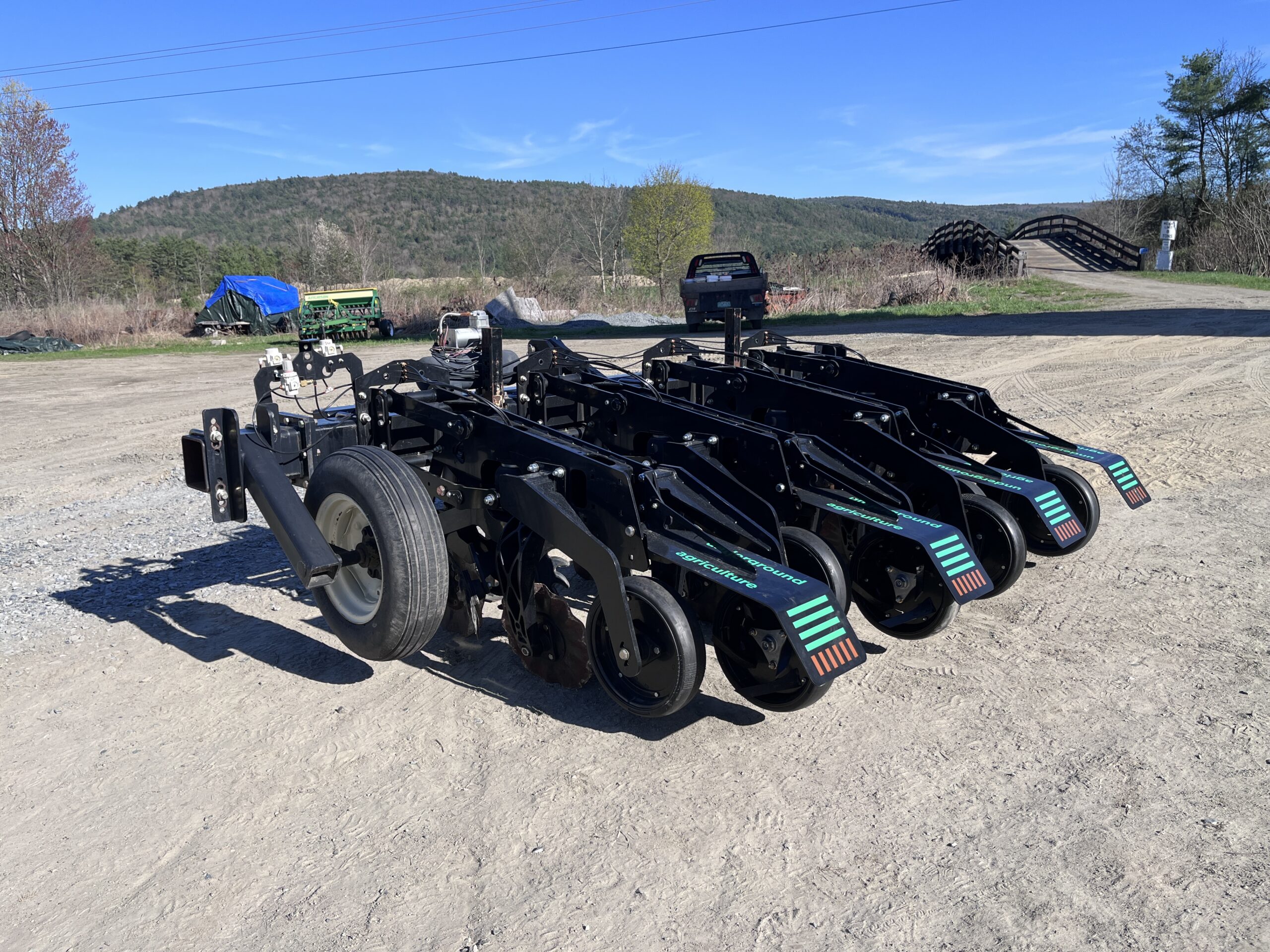
Mike used a brand-new 4-row Dawn strip-tiller to make the strips. The Dawn arrived later than expected, so there wasn’t as much time as we would have liked to get the strips uniform and weed free before planting. He hit the strips twice over about a week before seeding.
Crimping (late spring / early summer 2025):
Stuart and Mike were able to crimp their rye with no issues. But Ash’s farm is called Hurricane Flats for a reason – the wind rips through there. A corner of the field lodged on May 2oth, so, at Lincoln’s suggestion, Ash crimped the whole field though the rye had not yet reached anthesis. This technique is supposed to “teach” the rye which way to lie down if it lodges, so it theoretically lays down uniformly. In fact, the rye only partially stood back up and was kind of a mess. It took an additional three crimpings (all in late May) to finally lay down. Even then it was not a smooth directional roll. On the other hand, letting all the rye lodge would’ve created a mess, too, so maybe we were just in for it. Getting rye to crimp down in one direction is important to keep rye from binding up on equipment.
Pre-Planting Recap (late spring / early summer 2025):
Ash had three treatments – tilled control, no-till Crimped Rye, and no-till Crimped Rye & Clover just before transplanting.
Mike had four treatments – tilled control, no-till in Crimped Rye & Clover, strip-till in Crimped Rye & Clover, and strip-till in Clover Living Mulch.
Stuart had four treatments – tilled control, no-till Crimped Rye, no-till Crimped Rye & Clover, and strip-till Clover Living Mulch.
Are you confused yet? Don’t worry about it too much – the results were pretty straightforward.
Planting (late spring / early summer 2025):
Ash transplanted three varieties of winter squash in each treatment on June 11th and 12th. She used a Shirk ripper/coulter with a fertilizer attachment to slice through the rye, rip a narrow (2”) slot, and drop fertilizer. It worked well despite the criss-crossed rye stems. She followed with a waterwheel in that slot for transplanting. Ash has a very light, sandy soil, and the ripped slot was very, very loose. I could push my arm in up to the elbow with little effort. We worried about this, but transplanting seemed to go smoothly. The starts themselves were quite weak.
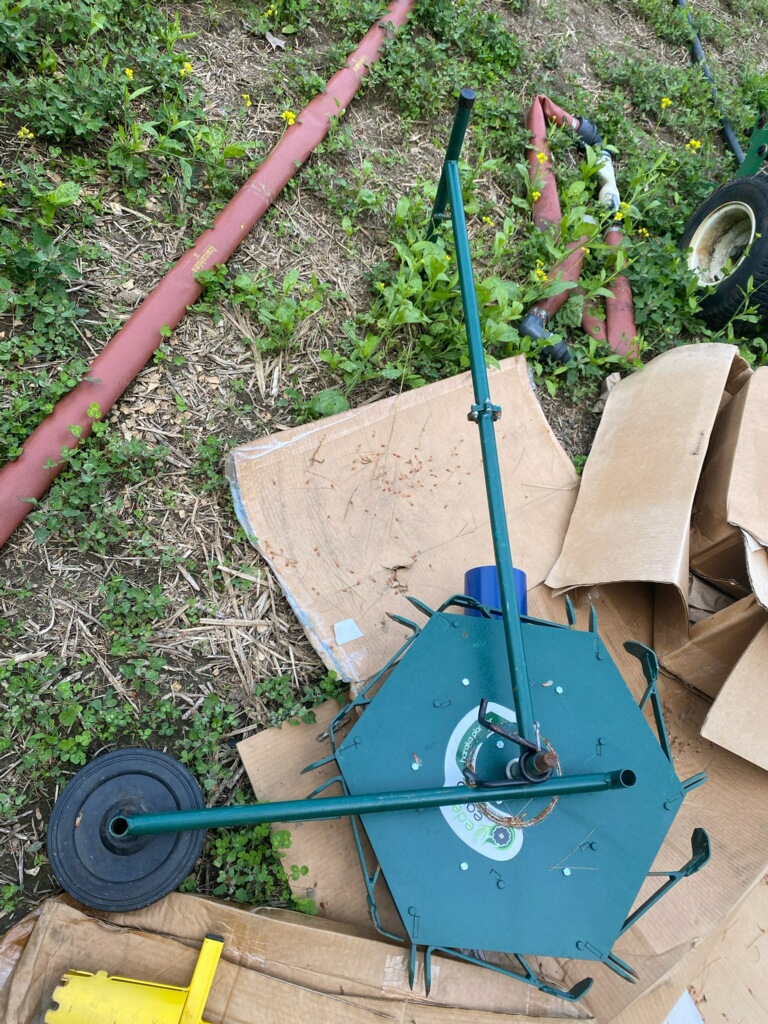
Mike planted sweet corn in the experimental plots with a Haraka seeder. The Haraka is a heavy-duty push seeder designed for no-till planting. It’s pushed by hand, jabs holes, and releases seed. In the control, Mike used his regular 2-row, 3pt hitch corn planter. The planter put down about twice as many seeds per foot as the Haraka, so the stand was much denser in the control, leading to questionable yield comparisons.
Stuart planted his no-till and strip-till plots with a 4-row no-till corn planter.
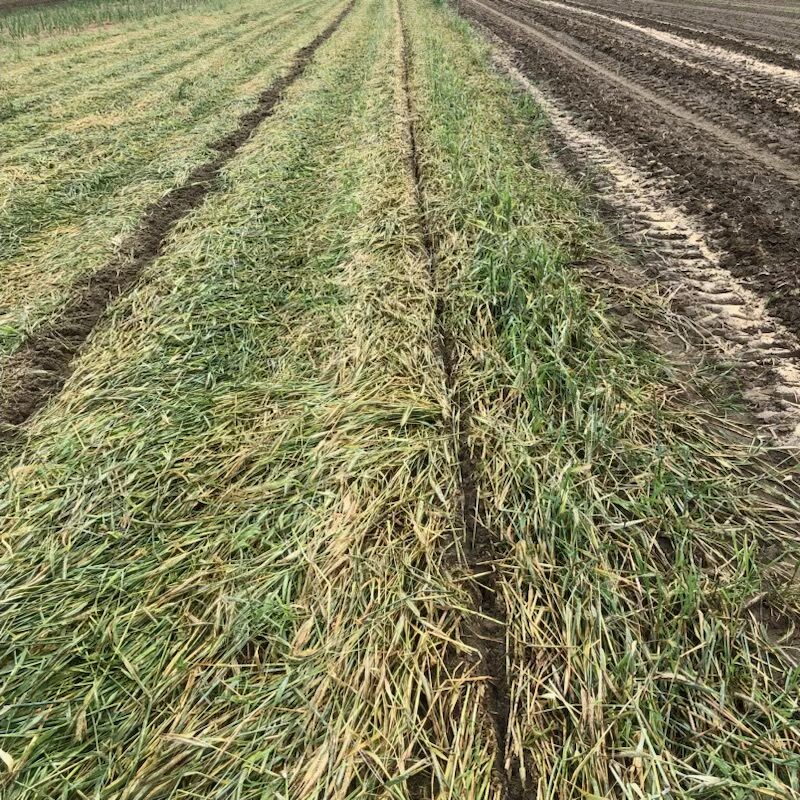
Crimped rye created management issues. 1) Establishing rye during the ideal time window (early September) was difficult because there were still cash crops in the ground. 2) Rye emergence and growth was poor because of a drought that extended into the fall (historically unusual, but increasingly common). 3) For Ash, lodging and multiple crimpings created three additional passes and timing uncertainty. 4) Timing cash crop planting with anthesis added scheduling uncertainty at an already stressful time of year. 5) For Ash and Mike, the equipment they had available for no-till planting/transplanting into the rye was suboptimal, leading to transplant loss for Ash and poor sweet corn stands for Mike. 6) For Mike, making strips in crimped rye led to messy strips that were difficult to cultivate post-emergence.
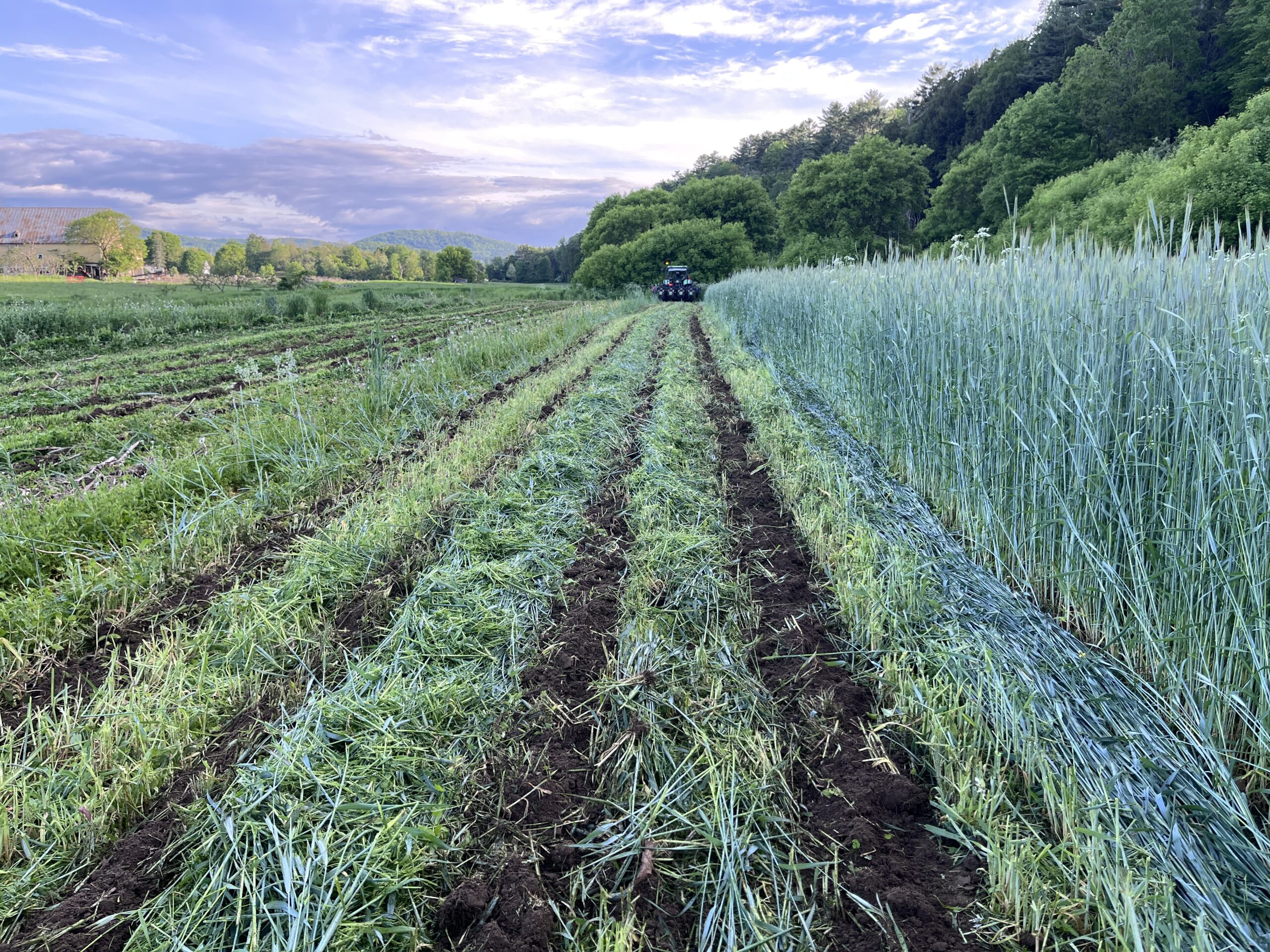
From left to right: the 4-row Dawn strip-tiller; after two passes through the rye/clover with the strip tiller (it looks OK, but it's actually full of rye stems and root balls); the Baraka hand-pushed no-till seeder. Not ideal for this job, but Mike doesn't have a no-till planter, so it was the best option.
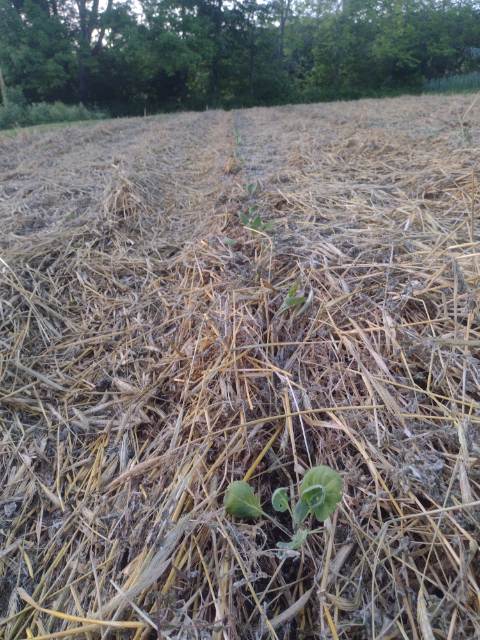
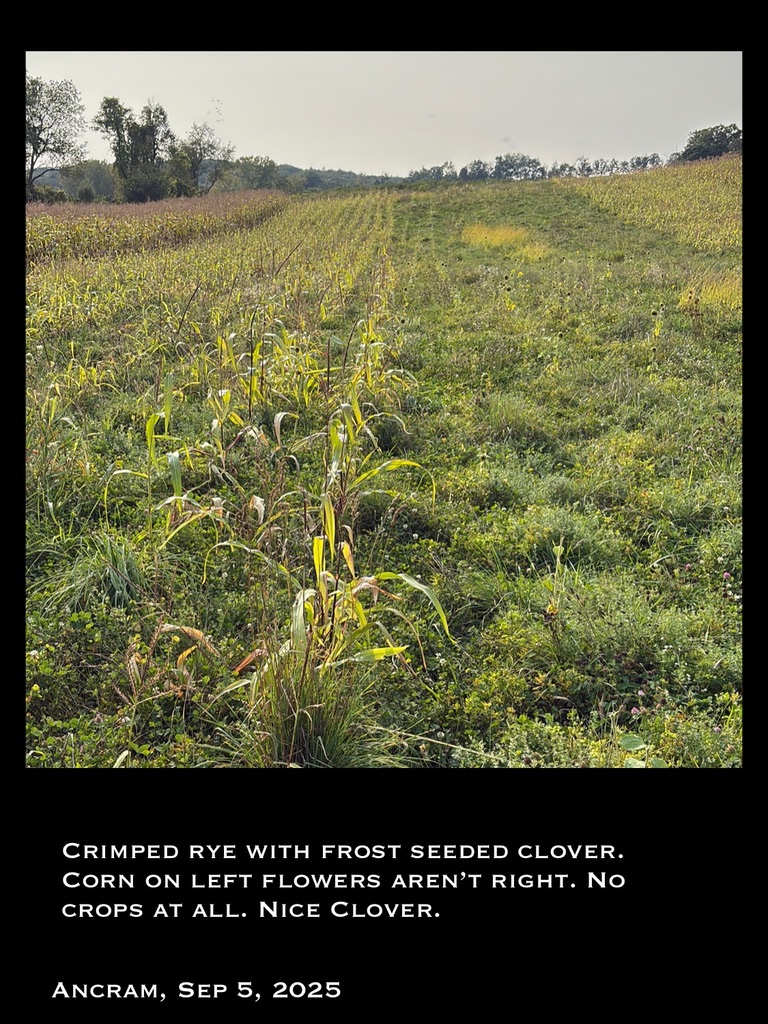
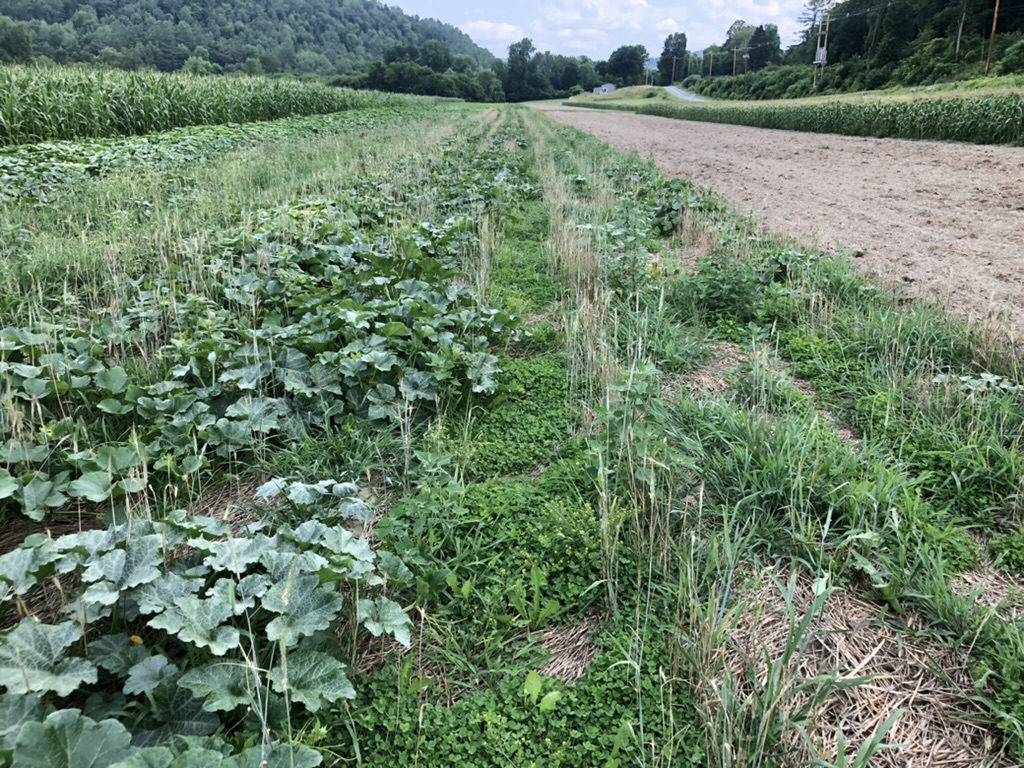
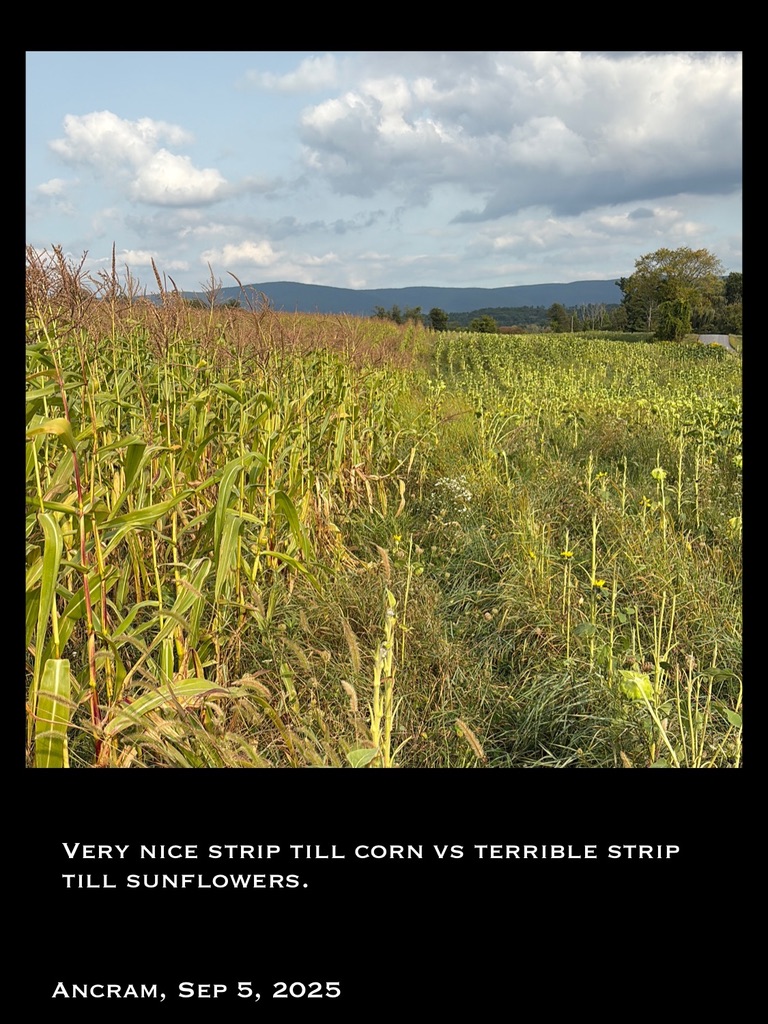
No-till planting into crimped rye destroyed yields. Field corn (Stuart), sweet corn (Mike), and winter squash (Ash) growth in Crimped Rye and Crimped Rye and Clover was uniformly awful. The specific reasons for this vary between farms, but the pattern is clear. We think that a cold, wet spring like we had in 2025 exacerbated some of the documented challenges with crimped rye – cold soils and slow nutrient release, nitrogen tie-up, and insufficient air exchange in heavier soils. In the end, none of the three farmers harvested a crop from the no-till crimped rye plots. Mike’s strip-till plot in crimped rye performed better, but making and maintaining the strips with all the rye stems proved frustrating. Here's a photo of Stuart's Crimped Rye plot towards the end of the season. Not good. He also planted oilseed sunflowers -- on the right side -- which didn't emerge at all.
Ash experienced >50% transplant loss. The percentage did vary with the initial health of the transplants, but even for the best-performing variety, loss was significant and plant growth was slow. We suspect that the deep ripper shank on Ash’s Shirk created an air pocket under the transplants. Below, left to right: slots in crimped rye with the Shirk coulter-ripper on the day of transplanting (6/12/2025); Transplants set with water wheel (same day); tilled control squash on 8/4/2025; Transplant loss and poor growth in Crimped Rye - with and without clover - on 7/24/2025.
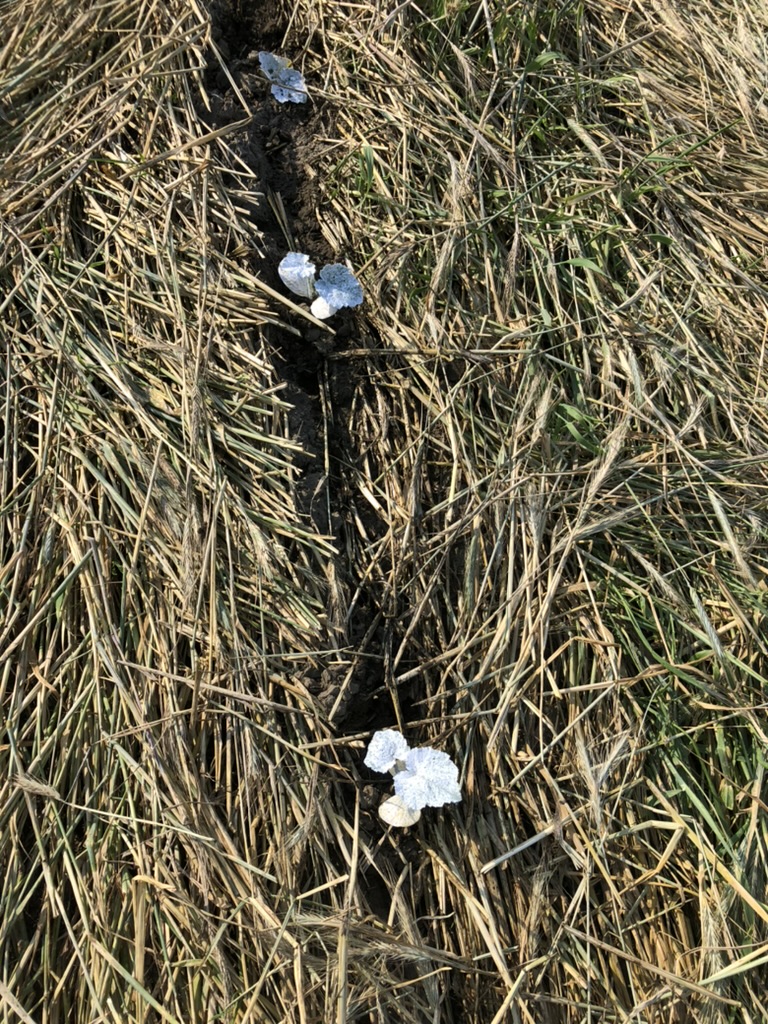

Like Stuart, Mike had essentially no sweet corn germination in the no-till crimped rye. He suspects his Haraka seeder failed to get good seed-to-soil contact because of higher residue ground cover. But Stuart used a no-till corn planter and – though germination was better – the corn failed to produce.
We realized that the Crimped Rye & Clover experiment at Evening Song Farm had a few key differences that may have made it successful. 1) The experiment involved Brussels, which are far more tolerant of cool soils than the crops we trialed. 2) They went in later (June 23rd) than any of our trials and the rye was tarped prior to planting, both of which likely led to warmer soil temperatures. 3) It was a rye/vetch mix, which probably helped reduce nitrogen tie-up.
Frost-seeded clover into crimped rye improved ground cover, but who cares? For all three farmers, the Crimped Rye with Clover plot – though it yielded nothing – did create a nice clover ground cover with fewer weeds than crimped rye alone. Below, note the clover in the center strip.
→ For farmers already having success with Crimped Rye, incorporating clover will likely lead to greater weed suppression and ground cover. But for farmers who have been unsuccessful with Crimped Rye so far, our results indicate that incorporating clover will not help improve yields. In our trials, emergence and vigor were the primary issue. Weed suppression was therefore a second-order problem.
This is not to say that crimped rye can’t work for farmers in New England, but it highlights the difficulties of working with crimped rye in colder climates. It’s fair to say that, at least for these three farmers, this experience further dampened their enthusiasm for crimped rye. Areas for further research include 1) choosing cash crops with later planting dates, 2) choosing cash crops that are tolerant of cool soils, 3) including a nitrogenous cover crop to pair with the rye, and 4) exploring alternatives to rye that produce less biomass.
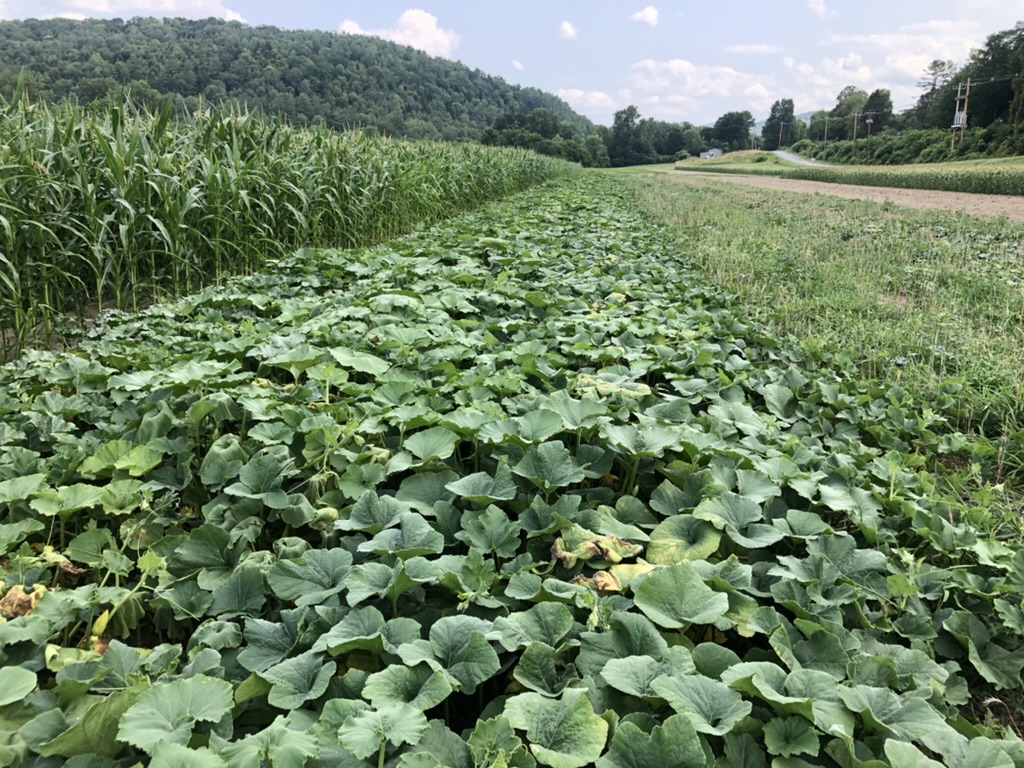
Clover Living Mulch significantly outperformed Crimped Rye. Ash did not have a Clover Living Mulch treatment, so our results are based on Stuart and Mike’s plots. Mike’s sweet corn yield data was inconsistent. Multiple harvest / succession crops like sweet corn are difficult to track throughout an entire season. Overall yield was lower compared to the control. Observationally, the plants were somewhat smaller, paler, and ears generally shorter. Quality in those plots was adequate but not as good as in the control plots. Mike felt that making strips earlier and fertilizing them more heavily could lead to comparable yields. The field corn in Stuart’s Clover Living Mulch strips started off strong, but stalled out in late July and barely produced. The tilled control didn’t look good, but it did make a crop. Unfortunately, by season’s end, the deer pressure in both plots was so significant that there was no yield comparison. Interestingly, in a neighboring field, Stuart planted 20 acres of the same variety of field corn in Clover Living Mulch strips. That field (DF24S) would likely have outyielded the control plot. The only difference between the two fields is that 3,000 pounds per acre of chicken manure was spread on DF24S in 2024, whereas none was spread in the experimental field. We think that the incorporation of clover in the tilled control was sufficient additional nitrogen to produce a crop, while the chicken manure was sufficient in DF24S.
Both Stuart and Mike felt that strips in Clover Living Mulch were promising and plan to continue experimenting with the system in the future.
Below: Mike's sweet corn in Clover Living Mulch strips about a month after planting. Thin stand due to Baraka seeder, but nice plants. 
Below, left: Stuart's field corn in Clover Living Mulch strips about a month after planting. Below, right: Near harvest. Field corn on the left side of the photo looking good. Sunflowers on the right, looking not good.
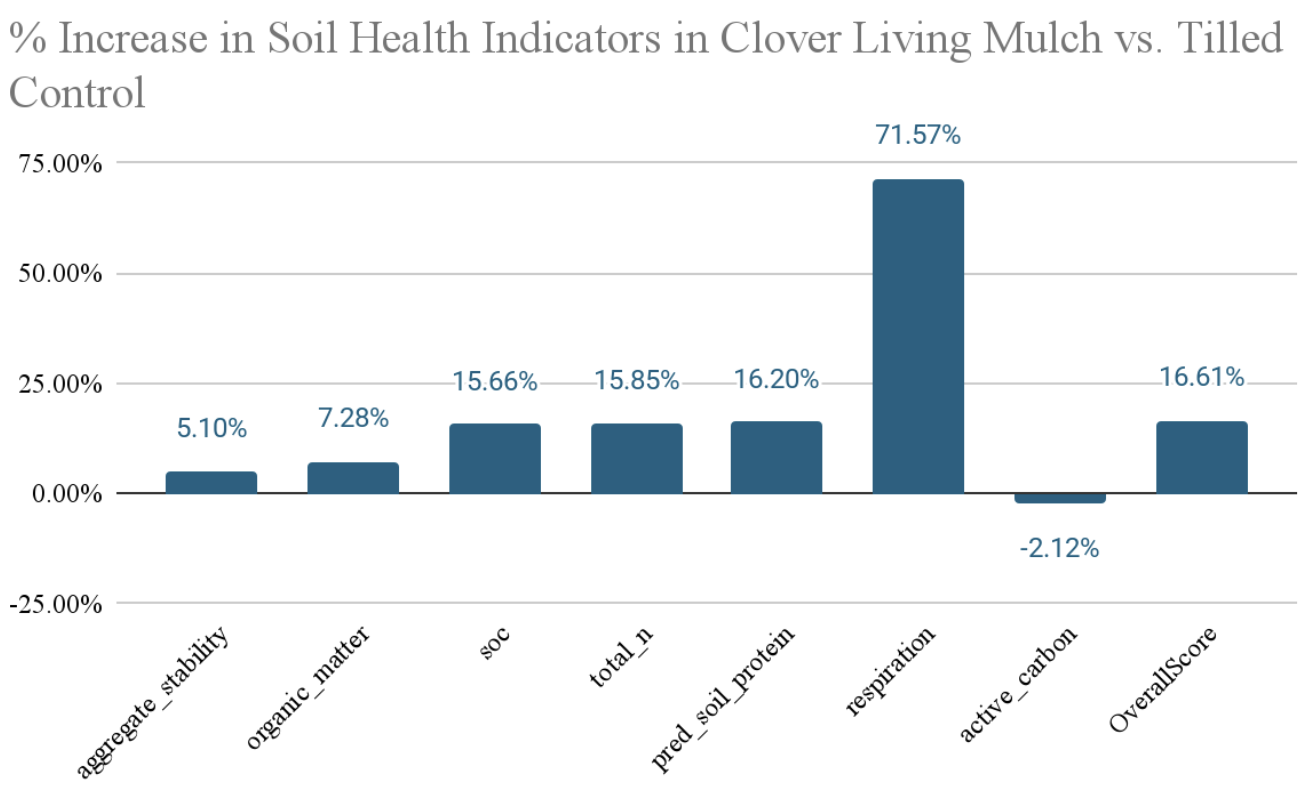
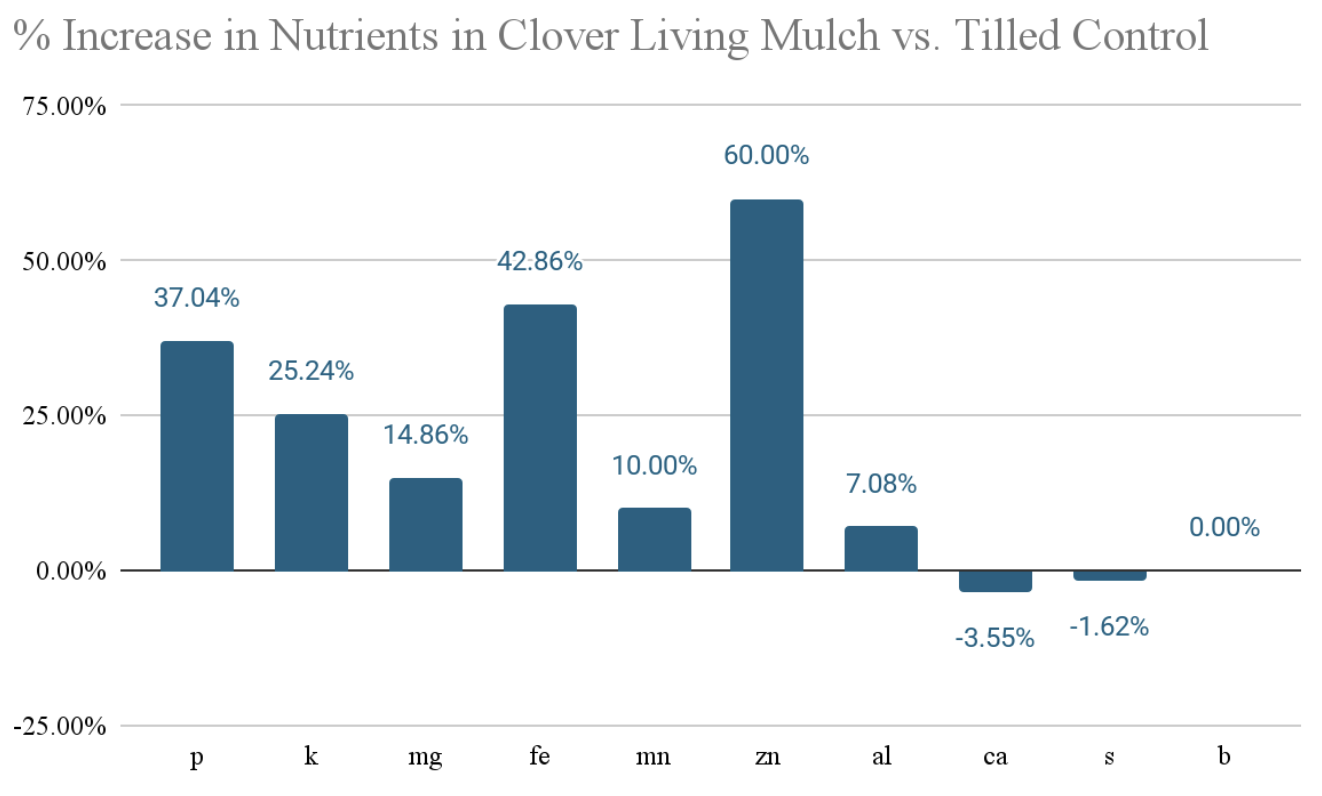
Soil health. At Ash’s we didn’t get soil samples because she tilled in her experimental plots mid-season; there was clearly going to be little to no yield and there were weeds about to make seed. At Mike’s we were comparing two fields with very different field histories – one previously in sod, and the other field corn. So the following results are only from Stuart’s plots. We used the Cornell Assessment of Soil Health. Note that the tests were pulled from the plots at the end of the season, so we are comparing the difference between plots, not how they changed from a baseline. These percent increases are impressive but fairly typical of what we see in Clover Living Mulch versus tilled controls – having perennial living roots in the soil is really good for the soil! (We don’t know why active carbon is slightly negative; in our experience it’s usually correlated with respiration.) The question now is whether we can make this system practical and profitable.
Education & outreach activities and participation summary
Participation summary:
At Momentum's 2025 Winter Meeting, Mike Snow and Stuart Farr presented their plans for these SARE trials (Ashley could not attend). There were 20 farmers in attendance and four TAPs. There was significant interest, and three of Momentum's farmers (in VT, MA, and CT) ran smaller, parallel trials in the 2025 season. Their work and results were not highlighted in this report, but they broadly reinforced our findings.
All three farmers shared their results in detail at Momentum's 2026 Winter Meeting on January 13-14 (in collaboration with American Farmland Trust). There were 40 farmers and 10 TAPs in attendance. Stuart's shared some details of the modified rototiller that he used for making strips for this trial, and, based on farmer interest and follow-up conversations, we anticipate that a number of farmers will use his design in the 2026 season.
In his role as the Director of Connecticut River Watershed Farmers Alliance (CRWFA), Mike Snow presented his and aggregated findings a number of times. In conjunction with the White River Conservation District, Mike demonstrated the strip tillers he used to establish strips in his trial plots on September 19th, 2025. Those strip tillers are now available for rent through CRWFA. There were 17 attendees.
Hampshire College Farm ran a supporting trial. Momentum Ag and the Community Involved in Sustaining Agriculture co-sponsored a field tour on July 31st, 2025. Lincoln shared the results of these SARE trials with attendees and compared/contrasted Hampshire's experience with SARE participants' experiences (the lessons were quite similar). There were 15 attendees.
Mike Snow shared his plan with the CRWFA board and membership on February 10th, 2025, and updated that group post-season in November. There were approximately 20 attendees. Mike shared his results at CRWFA's annual meeting on January 21st, 2026, which had over 100 attendees. Mike also shared his trial results (multiple trials, including the SARE trials) at NOFA-VT's No-Till & Cover Crop Conference on February 13, 2026 (50 attendees), and at the Vermont Vegetable and Berry Growers Association on March 25th, 2026. He's been a real asset in getting the word out about these trials!
Ash was a presenter at VVGBA's annual meeting on Jan 20th, 2026, where she shared her experiences with tillage reduction and cover cropping, including the results of her SARE trial. She estimates there were over 200 attendees.
Lincoln has included these farmers' experiences and findings in a number of in-person and online formats. In particular, these trial results were crucial in moving towards a working document titled "Best Management Practices in Clover Living Mulch." The success of frost-seeded clover into winter rye versus the difficulty of managing that rye residue leads to interesting conclusions and paths for future trials. Lincoln has discussed the results in well over twenty one-on-one planning sessions with farmers in and out of Momentum's network. Lincoln presented "Best Management Practices in Clover Living Mulch" in a webinar sponsored by URI Extension on February 19th, 2026 (32 attendees), at NOFA-MA's winter conference on February 28th, 2026 (~75 attendees), and at a Momentum webinar on March 12th, 2026 (16 attendees).
Lincoln published an article in ACRES magazine that included the results of these trials, but did not specifically highlight these results -- the article is an aggregated overview of CLM. ACRES October 2025 - Fishman article
The "Best Management Practices in Clover Living Mulch" presentation will be recorded and made available on YouTube. It is not yet ready for publication, as it combines the results of these SARE trials with dozens of other of Momentum's CLM trials.
Learning Outcomes
For all three farmers, Crimped Rye with and without clover was disappointing, but knowing that is worthwhile.
We also learned that strips in rye may be an effective way to overcome the yield drag, but that managing the rye residue in the strips is tricky. See the next sections for ideas we have about how to do that.
The farmers learned a lot about equipment – both dos and don’ts. Stuart was happy with his simple rototiller modification, and will continue to use it to make strips in clover. Ash learned about the danger of ripping too deep in a no-till setting. In the future, she would rip less deep and/or rip a few days ahead of planting to let the soil settle. For Mike, the Dawn strip tiller worked fairly well, but it was difficult to track on the same strip twice, the strip was fairly narrow, and it was somewhat messy. He’d like to start making strips the fall before or earlier in the season, when the rye is still small. Mike also had luck later in the season (in another experiment) using a homemade strip tiller that can be adjusted to make the strip wider or narrower and is easier to track on the strip.
Project Outcomes
Mike and Stuart plan to continue experimenting with strip-tilled Clover Living Mulch. The yields were promising enough that they feel a series of timing, equipment and fertility tweaks will allow for comparable yields.
Ash has had discouraging Crimped Rye and Clover Living Mulch trials for two years running. The technique she’s most excited about trying is: undersowing clover in popcorn in year 1 (she already does this), no-till drilling rye into the clover after corn harvest, and then harvesting off the rye for straw mulch in year 2. The clover would overwinter into year 3, and then be terminated (and provide a nitrogen credit) for the following bare soil cash crop. This would eliminate tillage for nearly two full years.
Other farmers were encouraged by the Clover Living Mulch strip results and will trial them in 2026. There was significant interest in Stuart and Mike’s innovative strip-till equipment modifications.
Again, the road to on-farm trials is paved with good intentions. There are so many moving parts that need to align to pull off a good study involving cover crops on working farms. That doesn't mean they're not worthwhile. On the contrary, the issues that come up are often the real unanticipated issues that are most important -- equipment, timing, and logistics. Planting rye in the optimal window was impossible, we had a fall drought, shifting market demand over the winter forced us to shift around fields and cash crops, loss of leased land forced us to forgo replicates, equipment didn't arrive on time, equipment didn't function as planned, early (honest) management mistakes led to crop losses, deer devoured crops. But we're asking how these systems hold up in the real world, so identifying Worst Management Practices is as important as identifying Best Management Practices. In other words, failures are equally as important as successes. For example, Ash's deep ripping just before transplanting intuitively seemed like the right idea, but it ended up creating air pockets under the transplants that led to catastrophic losses. Stuart's accidental nitrogen comparison plots showed us where to look in future trials to reduce yield drag.
We set out to capture yield and tractor pass data, and though we mostly failed to do that, we were still able to answer our basic questions: 1) Crimped Rye systems are unpredictable at best in New England. 2) Adding clover to the rye will increase ground cover and help with weed suppression, but it won't do anything to mitigate the other problems with cash crop production in Crimped Rye. 3) Strips in Clover Living Mulch are a more promising way to maintain yields and reduce tillage compared with crimped rye, but they are not yet as reliable as tilled systems.
At Momentum Ag’s 2026 Winter Meeting, these three farmers shared their experiences with the 40+ attendees. Some of the attendees have tried Crimped Rye and have had similar struggles with using rye for tillage reduction. A few interesting conversations arose around new trials for possible solutions based on the findings of our SARE trials:
- Mowing the rye while it’s vegetative to reduce its final height at anthesis. This would mean dealing with less stemmy biomass when making strips, but we weren’t able to find good information about whether this would delay anthesis. If so, it would compound the anthesis / planting window problem. So these first trials would simply mow rye at different times and measure the effect on biomass and anthesis.
- Using a short-statured winter barley instead of rye to reduce stemmy biomass. Heather Darby has published on winter barley varieties and measured their winter hardiness, propensity to lodge, and height at anthesis. Farmers were interested in making strips in the barley / clover early in the season and then mowing or crimping the barley.
- Using Yellow Sweet clover and / or Balansa clover with rye or barley to help with nitrogen tie-up.
- Dry beans and late brassicas in Crimped Rye seem to have more promise in our climate; trials with those crops would be very interesting.
Other Momentum farmers have been experimenting with Clover Living Mulch, and the three collaborating farmers in this SARE grant were able to add valuable information as we develop Best Management Practices together.
- Start with a pure stand of low-growing clover (Dutch White or similar).
- Make and maintain great strips.
- Start prepping strips weeks ahead of planting. Plan on multiple passes.
- Wider strips (>12") are easier to work with.
- Rip and stalebed the strip.
- Don't make strips in a rye/clover combo -- too much messy residue.
- Let the strip mellow before planting.
- Have a plan for keeping the strip clean post-planting.
- Get your crop off to a quick start.
- Band and incorporate macronutrients at your normal rate. Don't broadcast. Don't assume a nitrogen credit for the minimal clover terminated in the strip.
- Do broadcast calcium, sulfur and micronutrients.
- Let fertility in the strip mellow before planting.
- Mow immediately before planting.
- Use healthy, vigorous seeds and transplants.
- If you have irrigation, irrigate early.
- Crop species and varieties interact differently with clover; trial two species and two varieties when possible.