Final report for OW23-376
Project Information
Interest in integrating cover crops and grazing into conventional almond farming practices is growing. However, almonds are harvested by shaking the nuts onto the ground, sweeping them to row middles and mechanically collecting them. Since about 70% of almonds are not pasteurized, the presence of grazing animals and manure on the orchard floor raises concerns about food safety; the industry standard to maintain food safety is to avoid grazing in almond orchards.
Documented benefits of cover crops in orchards include more effective nutrient cycling, reduced fertilizer use, and increased water infiltration. Grazing further enhances these benefits by reducing herbicide use, synthetic fertilizers, and fuel for tractors. However, the actual food safety risks of sheep grazing in almond orchards are unknown. We assessed the presence of foodborne pathogens in orchard soils where cover crops are grazed by sheep.
For broader adoption of sheep grazing, in addition to data on food safety risks, producers need to know the economic feasibility of using sheep to manage vegetation in orchards. Prior to this study, there was no cost analysis of grazing in California almond orchards. There is a perception that grazing will cost more than conventional methods. It is also possible that grazing may cost less, or that higher returns could offset increased costs. We conducted a cost analysis to help producers understand the tradeoffs and make the best decision for their operations. We compared the costs and returns of conventional almond production to the costs and returns in a livestock-integrated almond orchard system.
- Test for the prevalence and die-off of fecal pathogens in the soil of almond orchards grazed by sheep to understand the food safety risk of ground-harvested almonds in a grazed system.
- Complete a cost analysis comparing the costs and returns of conventional almond production to the costs and returns from a livestock and crop integrated almond production system.
Cooperators
- (Researcher)
- (Researcher)
- - Technical Advisor - Producer (Researcher)
- (Researcher)
- (Researcher)
- - Producer (Researcher)
- (Researcher)
Research
Research objectives
- Test for the prevalence and die-off of fecal pathogens in the soil of almond orchards grazed by sheep to understand the food safety risk of ground-harvested almonds in a grazed system.
- Complete a cost analysis comparing the costs and returns of conventional almond production to the costs and returns from a livestock and crop integrated almond production system.
Project sites
We sampled soil from two California almond orchards, one in Kern County and one in Merced County. The soil on the Kern farm is a clay loam, Calflax and Panoche series, and the main soils on the Merced farm are sandy loam soils of the Montpelier and Pents series. During the study both farms utilized cover crops and grazing as orchard floor management practices.
Research design, Data collection, and Analysis Methods
Treatments
All almond orchard acreage we include in our study was planted with cover crops. Within these orchard systems we established a grazed and ungrazed treatment. The ungrazed treatment was about one-quarter the size of the grazed treatment. Ungrazed treatment areas were mowed.
Randomization of sample locations within each orchard
Pathogen persistence and population size in soil is affected by several environmental factors including weather; soil temperature, moisture, and texture; organic matter; etc. (Sharma et al., 2019, Topp et al., 2003, and Underthun et al, 2018). In an almond orchard there are two micro-climate zones where these factors differ significantly. The wetting zone under the trees is a moist-temperate zone where soil remains moist due to irrigation, and temperature fluctuations may be more minimal due to shading from the canopy. Outside the wetting zone is a dry-arid zone where the soil will remain drier through the growing season and temperature fluctuations may be more severe due to higher sun exposure. These zones also represent two primary locations for potential contamination during harvest. The wetting zone is where almonds will first contact the soil when shaken from the trees, and may remain as the crop dries. The almonds are then blown and swept into the dry-arid zone in between the trees (row middle) where they will be picked up from the ground and mixed with the soil in this area.
The Produce Safety Rule of the Food Safety Modernization Act (FSMA) addresses concerns about the feasibility of compliance for farms that rely on grazing animals, but does not require establishing waiting periods between grazing and harvest. However, farmers are encouraged to voluntarily consider applying intervals appropriate for the farm’s commodities and practices. Organic farmers follow the National Organic Program standards for raw animal manure, applying a 120 day interval between incorporating raw manure into the soil and harvest. Moreover, third-party food safety auditors have directed attention toward these integrated crop-livestock farms due to the possible contamination risk of nuts. As a result, the standard practice in almond orchards is to remove all grazing animals at least 120 days before harvest.
We characterized the longitudinal profile of the occurrence of bacterial pathogens and indicator species in orchard soils from cessation of sheep grazing until almond harvest. Seven pairs of sample locations were selected in the grazed treatment and three pairs of sample locations were selected in the ungrazed treatment. For each paired sample, one of the paired sample locations was within the wetting zone of irrigation; the second was outside the wetting zone. A random number generator in Excel identified the tree row to be sampled and the tree to be sampled. Tree rows on the external edge of an orchard were excluded from the randomization to reduce edge effects. Samples were collected at 0, 7, 14, 30, 60, 90, and 120 days post-grazing in both treatments. In the grazed treatment seven trees were selected at each sampling interval (different trees at every sampling) (7 trees = 14 paired samples; 14 x 7 sampling dates = 98 samples/year/orchard). In the ungrazed treatment three trees were selected at each sampling interval (3 trees = 6 paired samples; 6 x 7 sampling dates = 42 samples/year/orchard). Post-grazing samples totaled to 560 samples over two years. Forty pre-grazing samples were collected in the same manner, 20 in Year 1 and 20 in Year 2 (10 paired samples in each orchard per year). Two paired samples in the ungrazed treatment (2 trees = 4 paired samples) and 3 paired samples (3 trees = 6 paired samples) in the grazed treatment.
Soil sampling
Trees were divided into quadrants based on cardinal directions - northwest, northeast, southeast, and southwest - and soil sub-samples were taken under each tree from each of the four quadrants. Soil sub-samples from under each tree were placed in resealable plastic bags and mixed. Samples from the row middles were collected from either the south or west side of the tree. Actual sampling depended on which direction the rows ran. For example, if the almond trees were in rows that ran north to south, the row middles fell on the west and east sides of the trees. In that case, soil sub-samples were collected from the west side of the tree. Similar to the soil samples from under the trees, three sub-samples were mixed together. Using the example above in which tree rows ran north to south, three soil sub-samples were collected from north to south, at least one meter apart.
At each sample location within the orchard, a sterile sampling scoop (Spectrum, New Jersey, USA) was used to collect three or four soil subsamples of about 50 grams each from the upper 2 inches of soil, soil samples were placed into resealable plastic sample bags and shipped overnight on ice to the University of California, Davis.
Bacterial analyses
UC Davis provided analyses on pathogens of interest for food safety as well as indicator bacteria that sheep fecal matter may host.
Detection of Pathogens (Atwill Lab)
For each sample location and sampling date, 25 grams of mixed soil were placed into a 710 ml Whirl-Pak(R) Homogenizer Blender Filter Bag (MilliporeSigma, Darmstadt, Germany) and incubated in 225 ml tryptic soy broth (TSB; Difco, San Jose, CA) on a shaking incubator (50 rpm) at 25° C for 2 hr followed by 42° C for 8 hrs. Then, 0.5 ml of the TSB enrichment were transferred into 4.5 ml of TSB and modified Enterohemorrhagic E. coli broth (mEHEC). These secondary TSB and mEHEC (BioControl Systems, Inc., Bellevue, WA) enrichments were screened for E. coli O157, stx 1/2 genes, and Salmonella using quantitative-PCR (qPCR) (Atwill et al., 2015; Baker et al., 2019; Suo et al., 2010). All suspect positives from the qPCR screen were plated onto their respective selective agar and suspect colonies qPCR-confirmed for E. coli O157 and Salmonella as previously described (Atwill et al., 2015; Gorski et al., 2011). Suspect shigatoxin producing E. coli (STEC) colonies were confirmed using multiplex conventional PCR to identify O26, O45, O103, O111, O121, O145 and O157 serogroups of E. coli (Paddock et al., 2012).
Generic E. coli Most Probable Number (MPN) (Pires Lab)
A subset of soil samples were cultured for indicators of contamination and generic E. coli quantification. To quantify E. coli in soil, we used a standard tube method with serial dilutions up to 10-6 in quadruplicate followed by streaking onto CHROMagar ECC to quantify E. coli as described previously (Patterson et al., 2018). At least one presumptive positive isolate per sample was purified and confirmed using a standard PCR method (Chen and Griffiths, 1998). MPN series cell densities were calculated based on dilution to extinction using an MPN Calculator (Curiale, 2004). Fecal coliforms were assayed using the USEPA 1680 protocol (Reynnells et al., 2014).
Whole Genome Sequencing
A subset of isolates (soil and fecal) representative of orchard type, treatment, time post-grazing and year were selected for whole genome sequencing analysis (WGS;~50 isolates). We will conduct WGS for these isolates to identify potential genomic elements, (i.e., genus/species, serotype, virulence genes and antimicrobial resistance genes). DNA extraction and purification will be conducted using previously described methods (Carroll et al., 2017). DNA will be quantified using a Nanodrop One (ThermoFisher). Library preparation and WGS will be conducted at the Weimer Lab using Illumina sequencing methods as commonly used (Bandoy et al, 2020; Miller et al.,2021). These results are pending as the WGS analysis is still being conducted.
Almond yield assessment
Yield per acre for the different treatments was assessed in August after trees were shaken. For each replicate at the Kern farm, almonds were collected from the ground following standard on-ground commercial harvesting techniques. Subsamples of a minimum of five pounds of harvested nuts from each replicate were collected to run a turnout analysis to separate almond kernels from other materials such as hulls, shells, dried leaves, wood sticks, soil particles, etc. This allowed us to determine the percentage of almond kernels in the gross weights and extrapolate the values to yield per acre based on the harvested area. Yield from each orchard was compared to historical average almond yields per orchard. At the Merced farm, yield assessment was conducted by a private-party.
Quantifying economic impacts
We used partial budget analysis methods to evaluate the changes in economic costs and benefits from integrating livestock into almond orchards in comparison to using conventional methods. We gathered information for cost and benefit estimates through conversations with participating growers and fellow Co-PIs and collaborators on this proposal. As a baseline for the conventional methods, we used the most recent Almond Cost and Returns Studies, updated in 2024. Potential increased costs associated with integrating livestock include: contract grazing fees and repairs to irrigation equipment. Potential benefits include: decreased herbicide use and decreased labor for mowing and/or navel orangeworm sanitation. Quantifying these benefits and costs helps growers evaluate their current practices in comparison to integrating livestock.
Manure pellet counts
Just prior to harvest, after the orchard floor was cleaned, we surveyed for manure pellets under 50 trees in each orchard. We used the same Excel program as mentioned above to randomly identify the trees sampled. Under each tree sampled a one meter square quadrat was placed three times: 1) under the tree, right next to the trunk; 2) under the tree canopy, near the dripline, and; 3) in the row middle. Each time the quadrat was placed a visual survey for manure pellets was conducted and manure pellets were counted.
Partial Budget Analysis
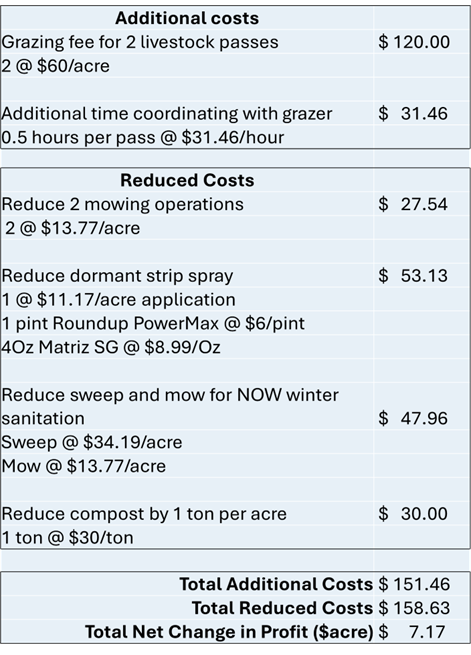
Increased costs include paying the sheep producer $60/acre for two grazing passes in an orchard, plus labor spent coordinating timing of grazing for a total of $151/acre increased cost. Reduced costs include less mowing, less herbicide use, and less compost application for a total of $158/acre less. Net change is a potential $7 increase in profit per acre. It should be noted that mowing the orchards is not always necessary, particularly in drought years.
E. Coli O157:H7 and STEC (Shiga Toxin producing E. Coli - potential to cause disease) soil prevalance - both years
|
Treatment |
O157 %(+/n) |
STEC %(+/n) |
|
|
Grazed |
Dry |
0 (0/208) |
0.5% (1/208) |
|
Wet |
1.4% (3/208) |
1.0% (2/208) |
|
|
Ungrazed |
Dry |
0 (0/92) |
1.1% (1/92) |
|
Wet |
0 (0/92) |
0 (0/92) |
|
|
Total |
0.5% (3/600) |
0.7% (4/600) |
|
Sheep Fecal Samples Year 1 and 2
- Year 1
- 20 samples collected on both farms
- Farm A (Kern)– 6 out of 20 positive for E. Coli O157:H7
- Farm B (Merced) – 9 out of 20 positive for STEC (Shiga Toxin E. Coli – potential to cause disease)
- Year 2
- 20 samples collected on Farm A (Kern) and 15 samples collected on Farm B (Merced)
- Farm A (Kern) - 1/20 samples positive for E. Coli O157:H7; 1/20 samples positive for STEC
- Farm B (Merced) - 1/15 samples positive for E. Coli O157:H7; 3/15 positive for STEC
Pre-Harvest Manure Surveys
- Year 1 (50 trees sampled - 150, 1 m quadrats)
- Farm A (Kern)– 4 whole and 2 partial; wildlife scat noted
- Farm B (Merced) – data not available
- Year 2 (50 trees sampled - 150, 1 m quadrats)
- Farm A (Kern) - 1 whole
- Farm B (Merced) - 3 whole; 2 partial
Generic E. Coli
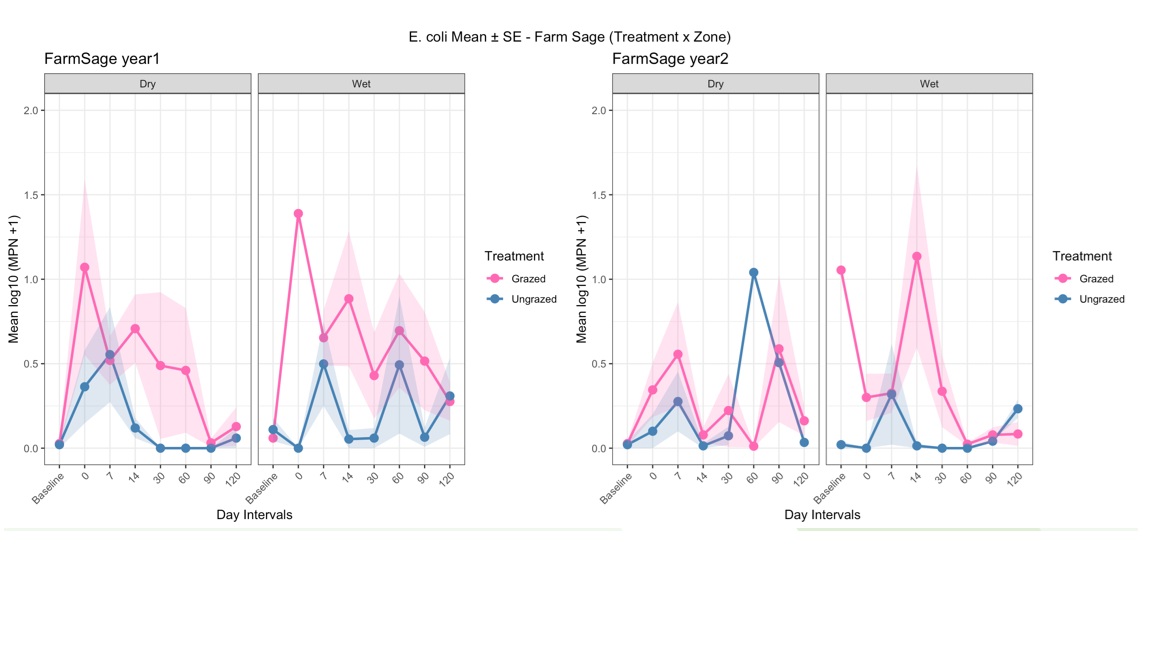
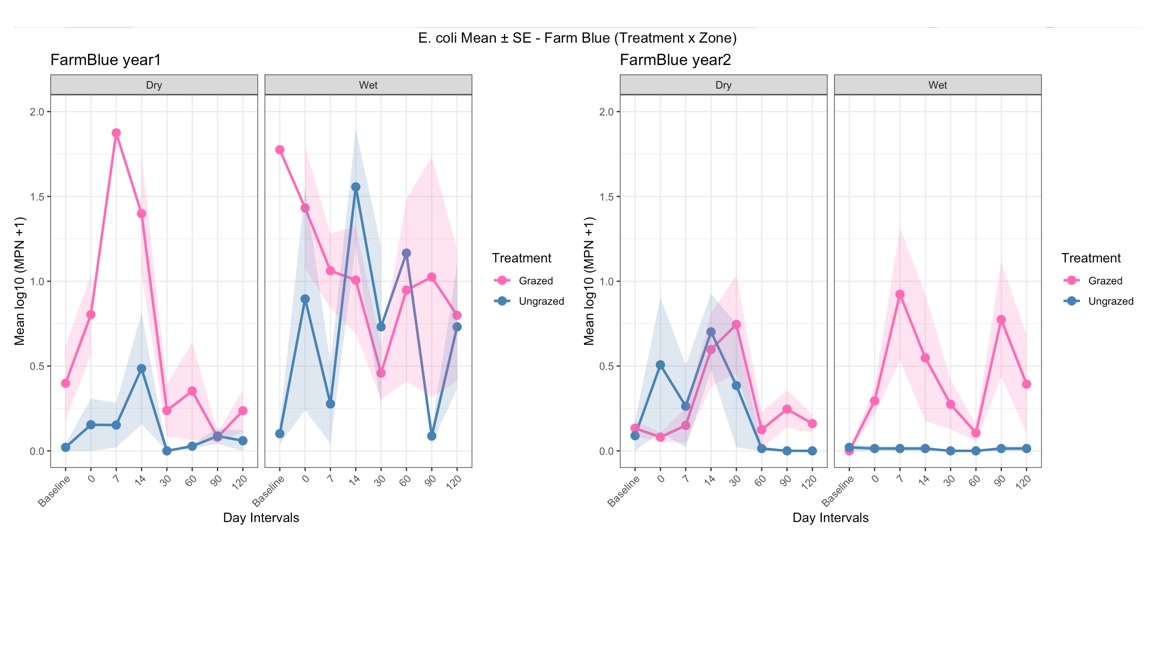
We also tested for Generic E. Coli, meaning any kind of E.Coli, not just the strains that may cause disease. Findings are presented in the figures below. Farm A is called Farm Sage in these figures and Farm B is called Farm Blue.
Summary of Results
Soil analysis for E. Coli O157:H7 and STEC had a less than 1% positive rate (7/600). Generic E.Coli was higher, but comparable to the findings of other studies. Further, the generic E. Coli counts demonstrated a die-off pattern as the summer progressed and harvest approached. Analysis of sheep fecal samples revealed positives for both E. Coli O157:H7 and STEC (21/75), however, soil analysis demonstrated that these pathogens were not found at the time of harvest at our sampling locations. Pre-harvest manure surveys found few remnants of manure on the orchard floor (12/100). In some cases the manure was difficult to identify because the hot, dry conditions had changed its appearance. Pathogen desiccation is known to occur in hot, dry conditions.
Research outcomes
Soil-borne Fecal Pathogen Testing
We collected two years of data post-grazing in almond orchards. These data support that the current rule to remove grazing animals 120 days prior to harvest maintains high food safety standards.
Partial Budget Analysis - Benefits and Trade-offs of Integrating Sheep Grazing in Almond Orchards
Our partial budget analysis demonstrated that farmers may be able to expect a savings of about $7/acre when integrating sheep grazing into their orchard management practices. Further, the partial budget analysis provides a starting point for farmers interested in the practice to consider where they might find cost savings, increased costs, and increased returns.
Recommendations for Future Research
This project began to quantify the safety of grazing sheep in almond orchards. As previously discussed, grazing sheep in almond orchards increases the health of the orchard soil and also produces two food crops on the same ground, magnifying the sustainability of the practice. However, this project had a relatively small sample size. Future projects should increase the number of orchards sampled, expand to cover more types of crops, and incorporate soil health testing such as soil carbon and microbiota diversity.
Education and Outreach
Participation summary:
- We held a field day in the fall of 2023 to share information about sheep grazing in orchards as an option for cover crop and weed management. At that meeting we presented an overview of the objectives and methods for this project. The meeting was well-attended by producers and pest control advisors (about 15 total). (Workshop/field day)
- We also held an introductory meeting for our grower cooperators at the Burroughs Family Farm in the fall of 2023. This meeting was well-attended and included question and answer and discussion time for our grower cooperators (about 10 total). (workshop/field day)
- We presented a poster in December 2024 at the annual Almond Board Conference in Sacramento showcasing this project and our findings to date. More than 3,600 people attended the three-day event. ABC2024.Poster.Finzel (educational tool)
- In the fall of 2024 we held an update meeting for our grower cooperators at the UC Cooperative Extension office in Merced County. We shared with our grower cooperators the results from Year 1 sampling, discussed the project to date and answered questions (about 10 total). (workshop/field day)
- PI Finzel was contacted regarding sheep grazing in a pistachio orchard as a result of her work on this project. This included an hour long phone consultation and a site visit to the orchard. (consultation)
- We held a field day in the spring of 2025 to share information about this project and the use of cover crops in orchards. One of our farmer cooperators attended the field day and shared about his experience grazing sheep in his orchards. (about 15 total attendees)
- We participated in an outreach video for WSARE.
- We are putting the finishing touches on an outreach video of our own. I look forward to sharing this with WSARE when it is complete!
- PI Finzel was contacted by The Shepherd magazine for an interview. The article was recently published (no paper or electronic copy available yet) and was the cover article!
- We presented a poster in December 2025 at the annual Almond Board Conference in Sacramento showcasing this project and our preliminary findings. The Almond Board Conference is attended by growers from across California.
- We are preparing two journal articles for submission. One article will focus on the complex science of testing for fecal pathogens in the soil. The second article will have a more practical perspective and focus on the application of what we learned from this study.
Surveys were not conducted after the workshops/field days, however, anecdotal feedback and interest after the field days was strong and attendees asked insightful questions that showed significant interest in using sheep as a management tool in orchards. One-on-one interactions with growers indicates continued concerns about on the ground implementation of sheep grazing in almond orchards due the increased difficulty of orchard management logistics.
Education and Outreach Outcomes
With the two years of data collection complete, we were excited to begin data analysis so we could share our findings. We organized a meeting (mentioned above) for our grower cooperators to share updates and ask questions. We presented a poster at the annual Almond Board Conference in December 2024 and December 2025 in Sacramento. PI Finzel was recently approached by a viticulture Advisor with UCANR to speak at an upcoming meeting to grape growers about this project. Interest in livestock/crop integration using sheep is growing and now we have some data to help quantify potential risks. A researcher at UC Davis is conducting a similar study to this one, but has expanded the scope to include walnut and pistachio orchards.
The partial budget analysis is complete and we have shared a summary of those results at our two field days and at the annual Almond Board Conference twice. We plan to publish the results of the partial budget analysis as part of the food safety findings from this study, so we have not prepared any educational materials to share this data at this time.