Progress report for SPDP24-025
Project Information
More than any other type, small-scale farms are particularly vulnerable to not having a plan to mitigate various risks and have less access to resources to respond and recover. Therefore, their well-being is undoubtedly influenced by the extent to which they can bring their risks under control and make the right decisions in challenging environments. Risks in the agricultural sector involve things that are hard to predict, such as weather, prices, government policies, accidents, and illness, that can impact a person’s farm. Some risks are everyday business risks, while other risks are brought on by changing climate effects. There is an urgent need to build practical tools that involve mitigating risks on small farms. The pilot project proposed in this application seeks to strengthen the capacity of 1890 Agricultural Extension staff to deliver practical disaster educational programs and train farmers and their families using various participatory training methods.
The primary objective is to help small and limited-resource farmers and their families learn how to prepare for, respond to, and mitigate the impacts of disasters through disaster risk management planning. Focusing on this group is critical because they are often the least prepared, lack resources, and/or need to receive the timely assistance necessary to promote resilience. This project will be piloted in four states, namely Texas, Tennessee, Arkansas, and North Carolina, in partnership with university and Extension faculty and staff at Prairie View A&M University (PVAMU) Tennessee State University (TSU), University of Arkansas at Pine-Bluff (UAPB) and North Carolina A&T State University (NC A&T).
The goals are as follows:
- To identify the agricultural risks faced by small farms and ranchers, with special emphasis on those who considered to be socially disadvantaged, limited resource (SDLR). Concerns about risk vary across types of producers. Although the sources of risk in agriculture production have been well cited, less is known about what risks SDLR farmers are concerned about, what factors determine how those inherent risks are perceived, and how they choose among alternatives to reduce the effects of the diverse types of risk.
- To train agents to deliver an instructional program on risk management for small-scale farmers, supporting them in making decisions in uncertain environments. The program will follow a train-the-trainer approach where agents will be trained in an instructional program on risk management and provided with tools to deliver this program to their respective farmers.
- Supervise specific assignments that farmers can complete to determine their proficiency in the content shared during the training. After each workshop session, homework assignments will be provided to the farmer participant. Extension agents/educators will make regular personal contact with the participants, answer questions, and ensure that participants try to complete their homework assignments.
- Determine appropriate government programs and other supports that help farmers mitigate risks in their business.
Education
The approaches and methods are outlined by each objective below:
Objective 1: To identify the agricultural risks faced by small and socially disadvantaged farmers and ranchers. Completed by PVAMU, NC A&T, TSU, and UAPB
Concerns about risk vary across types of producers. Although the sources of risk in agriculture production have been well cited, less is known about what risks small and socially disadvantaged farmers are concerned about, what factors determine how those inherent risks are perceived, and how they choose among alternatives to reduce the effects of the diverse types of risk. The approach for the first objective is to build on the preliminary survey data captured in 2019 that assessed producers' preparedness for disasters in two of the targeted states (TX and TN). Approximately 80% of the survey participants indicated they currently had no disaster plan for their home and 70% indicated they have never had such a plan. Equally compelling was the response to whether they had a disaster plan for their farms. Approximately 86% cited having no farm disaster plan, and 55% said they never had one. Institutional partners are collecting survey and focus group data on assessing the culture and disaster views of the farmers in their respective states via a funded SARE R&E project led by Dr. Noel Estwick with other 1890 partner institutions. That information will help inform the agricultural risks that agricultural producers face.
Objective 2: To train agents to deliver an instructional program on risk management for small farmers and ranchers, supporting them in making decisions in uncertain environments. Completed by PVAMU, NC A&T, TSU, and UAPB
This program delivery plan will consist of two major parts. The first part involves conducting training for Extension agents/educators. This workshop will include Extension agents/educators from partner states, following a train-the-trainer approach. We will train up to 20 educators/agents to use an instructional program on risk management that has been designed and provide them with tools to deliver this program to their respective farmers. The training will cover approximately two days (about 14 hours) in a centralized location in Tennessee where the project team and Extension agents/educators can meet in person.
The training program's content will focus on five areas of risk: production, marketing, financial, legal (liabilities and estate planning), and human resource (labor) management. Other critical components of the train-the-trainer program or Extension agents/educators include:
- Reviewing risk management principles, practices, and tools to familiarize producers with how they can be effectively applied in a holistic approach to their farm situations.
- Assisting producers in conducting a practical risk assessment of their farm business.
- Informing producers of alternative risk management strategies, including crop and livestock insurance, and delineating financial and marketing opportunities for alternative case scenarios.
- Assisting producers with forming and adopting their own individualized risk response strategy.
- Reviewing the financial implications and legal considerations of their chosen strategy.
The second part of the program is training small and socially disadvantaged farmers and ranchers. The training will be the same for each group in TX, NC, AR, and TN to provide extension agents/educators with the skills to train farmers/ranchers in their respective states. Two day-long (6 hours, 12 hours total) workshops will be conducted in each state approximately 60 days apart. It is expected that 25 farmers/ranchers and up to 5 agents/educators will attend two workshops in each state. A total of 8 workshops and up to100 farmers/ranchers and 20 educators/agents for the project will be the target among the overall project. The day-long workshops will be instructional with "hands-on" participatory exercises. Participants will work through several case examples and apply the principles learned to their operations.
Objective 3: Supervise specific assignments that farmers/ranchers can complete to determine their proficiency in the content shared during the training. Completed by PVAMU, NC A&T, TSU, and UAPB.
After each workshop session, homework assignments will be provided to farmer participants. In addition, agents/educators will make regular personal contact with the participants, answer questions, and ensure that participants try to complete their homework assignments. This technical support provided by the Extension agent/educator to the farmer/rancher will include an individualized study and impact assessment components.
Individualized Study. The educational activities in the workshops will also build on specific homework (individual study) assignments to be conducted by the farmer/rancher (participant) following each workshop. These assignments will be in the form of exercises where the participants develop their more-detailed risk management strategies following the steps taught and using the tools reviewed during the two workshops. The two homework/individualized study assignments that will be assigned will take approximately 25 hours each (50 hours total) to complete. The educators will be responsible for following up individually with the producers to ensure that homework assignments are completed after each workshop.
Impact documentation and assessment. This third component consists of recording and documenting what each participant implemented as a direct result of this training. Each participant will be interviewed 30 days before the project end to account for their activities. Each participant will have developed a personalized risk management action plan for each special emphasis topic (production, marketing, financial, human, legal) during the second workshop. Local educators will maintain regular contact with the participants and record all contacts noting the length and method of the contact, topics discussed, and outcome of that contact.
Objective 4: Determine appropriate government programs and other supports that help farmers/ranchers mitigate risks in their business. Completed by PVAMU, NC A&T, TSU, and UAPB.
The institutional partners would like an environment for farmers and agents to interact with professionals (e.g., loan officers, crop insurance agents, estate planning advisors, etc.) and develop specific strategies to measure and manage risk. In addition, through educating farmers about governmental and private sector programs, they are more like to benefit and apply for such programs to mitigate risks in their business.
As a tangible outcome of the education program, producers will be intricately involved in designing and implementing their risk management plan tailored to their farm operation.
Education & Outreach Initiatives
Train agents to deliver an instructional program on risk management for small farmers.
An important goal of this project in the first year was to equip Extension educators and agricultural professionals with the skills and tools needed to conduct risk management programming with farmers. The first component of this goal, completed last year, was the organization of a face-to-face, train-the-trainer workshop for Extension educators. Educators from partner states—North Carolina, Tennessee, Arkansas, and Texas—were invited to participate in this training.
A risk management consultant worked closely with the project team to review and edit the training materials. The workshop was intentionally designed using a train-the-trainer approach to gauge how well attendees could effectively model and deliver the content to farmers in their respective states. The event (see flyer uploaded in “Media”) was promoted through multiple institutional Extension channels.
Approximately 16 Extension educators and agricultural professionals, in addition to the project team, attended the two-day workshop held April 30–May 1 at the Agricenter Showplace Arena in Cordova, Tennessee (in a centralized location). Participants received an instructional program on risk management that provided practical tools and resources to support delivery of this programming to farmers. Training content focused on five core risk management principles, conducting farm-level vulnerability assessments, and the fundamentals of farm business planning. The workshop consisted of approximately 14 hours of instruction and training format help to facilitate interaction and collaboration among participants and the project team.
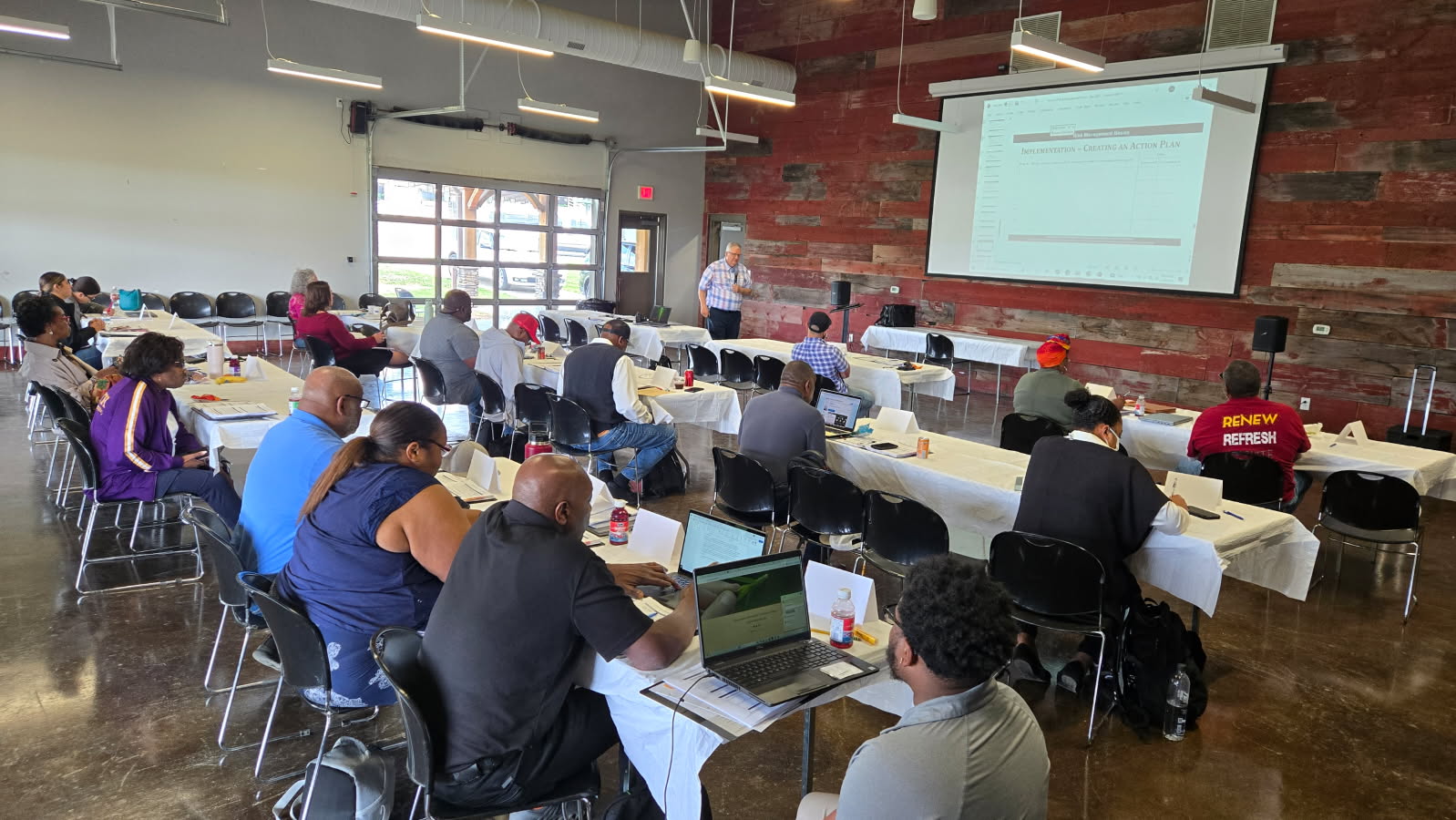
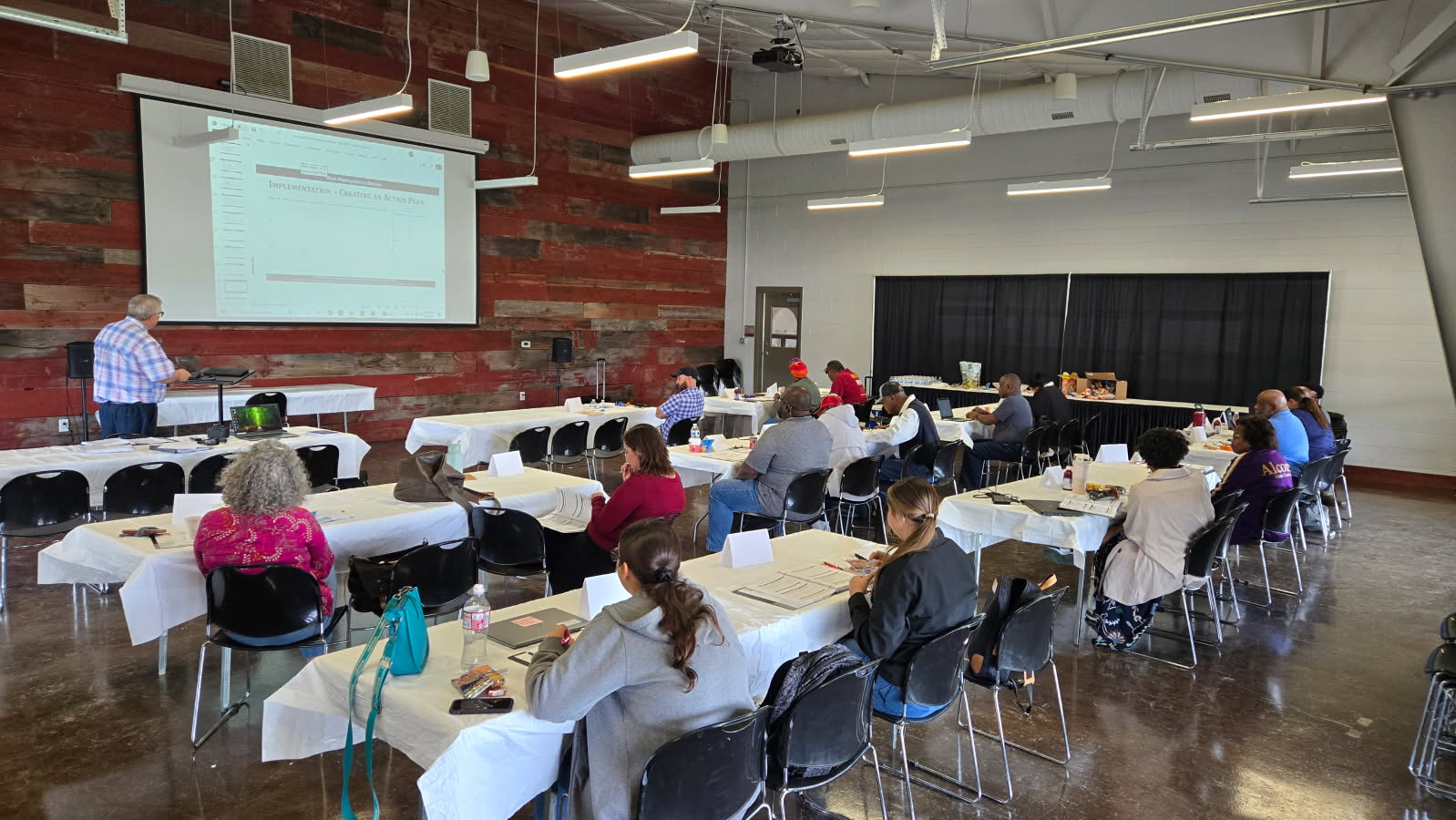

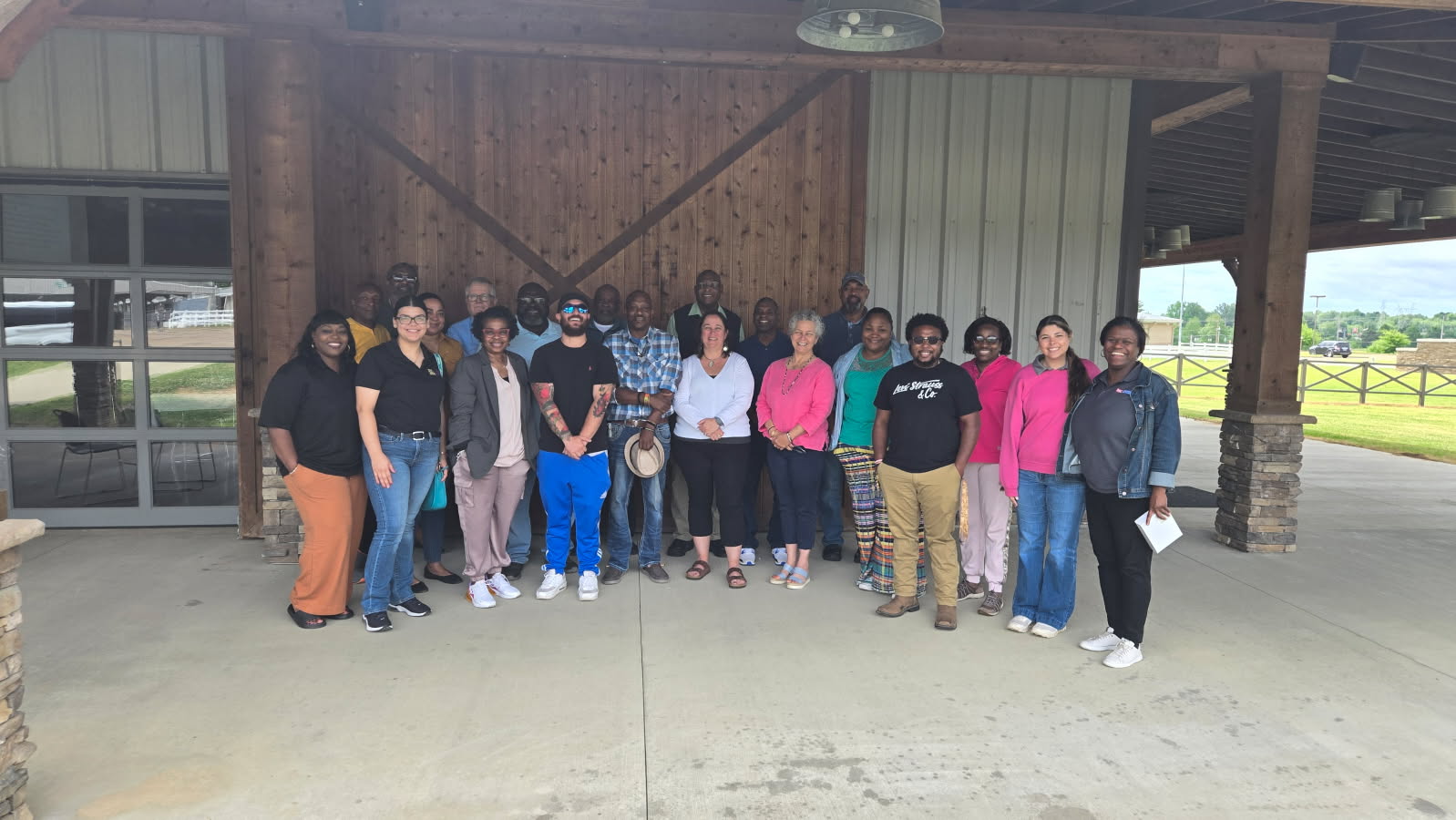
The training event was highlighted in the Extension Disaster Education Network (EDEN) newsletter in May- 1890-EDEN Advisory Group aims to help small farmers face disasters – Extension Disaster Education Network
Learning Outcome: Increased Risk Management Preparation Skills of Extension Educators Through Effective Training
Action Outcome: Enhanced capacity of Extension educators to independently deliver disaster risk management workshops to farmers using the project-developed training materials.
Delivering the training content in a hands-on, participatory format allowed Extension educators to engage with exercises that mirrored real-life farm and disaster risk scenarios. Participants worked through multiple case examples, exploring how to apply risk management principles to situations commonly encountered when working with farmers.
Deliver the disaster risk management program to farmers.
The second component of the project involved delivering this risk management training directly to farmers in North Carolina, Tennessee, Arkansas, and Texas. The training curriculum was consistent across all locations and designed to reinforce the skills Extension educators gained through the train-the-trainer model, enabling them to effectively deliver programming within their own communities.
Trainings were offered as two-day workshops and combined lecture-based instruction with hands-on, participatory learning activities. To date, the project team has reached more than 60 farmers, and additional workshops are still being conducted in areas served by the project team. During the workshops, participants worked through multiple case examples and began applying the risk management principles learned to their own farming operations.
Workshop content included:
-
A review of the five primary categories of agricultural risk: production, marketing, financial, legal, and human risk.
-
Use of a case farm to demonstrate risk identification and how to categorize risks.
-
An overview of crop insurance and financial, marketing, and estate planning tools used to control and manage risk.
-
Demonstrations of how recordkeeping, budgeting, and other financial statements can be used to track the current status of the farm.
-
Application of a case farm framework to help participants assess the risk situation of their own operations.
Farmer participants from Zapata County (TX) 
Farmer Participants in Durham County (NC) 
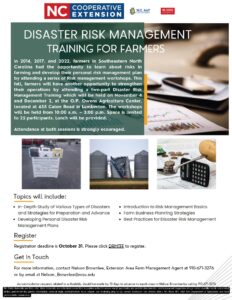
Sample Flyers Used to Advertise Training to Farmer Participants Robeson Co. (NC) and Guadalupe Co (TX)

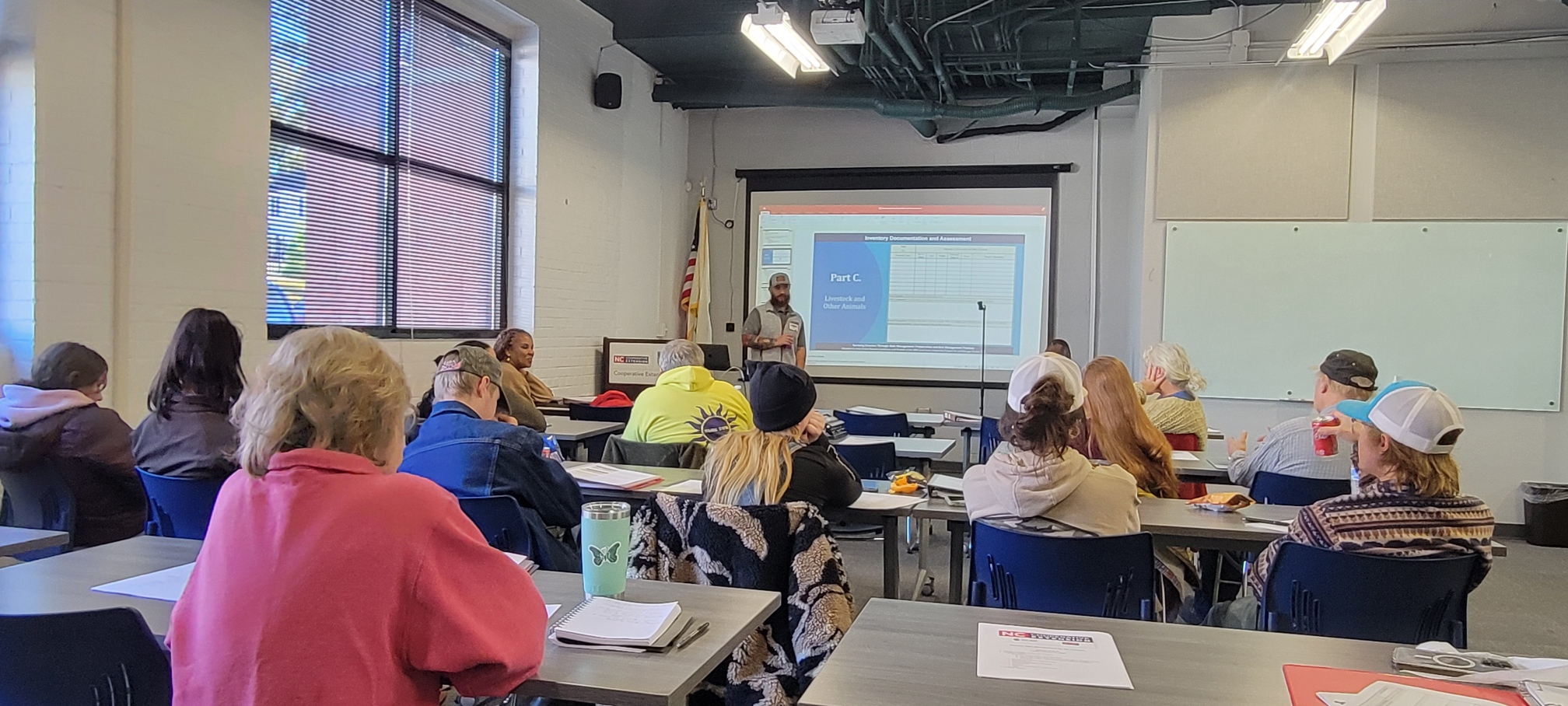


Learning Outcome: Increased Risk Management Preparation Skills of Farmers Through Effective Training
Action Outcome: Enhanced capacity of farmers to apply disaster risk management principles using the project-developed training materials.
Additional impact observed from the initiative - so far, educators demonstrated increased comfort and confidence with the material, along with a stronger understanding of how to present the content in a comprehensive and practical manner.
Additionally, the initiative supports the development and strengthening of working relationships between farmers and Extension educators, extending beyond disaster risk management to other key Extension service and program areas.