Progress report for STN24-001
Project Information
The University of Tennessee and Tennessee State University look to continue the sustainable agriculture training the SARE program offers to Extension agents, specialists and other agriculture professionals. In meeting training needs we gather input from regional agriculture program leaders, Extension agents, program partners, producers and others, along with state co-coordinators. The program assistant will promote awareness of the SARE program, along with a secondary focus on the SARE grant programs, encouraging utilization and promotion of this program while tracking grant recipients within the state. The state co-coordinators working with the program assistant will seek to provide opportunities for more in-depth training related to sustainable agriculture. This will help to develop training with a more direct program focus. All training opportunities provided will be in-line with the overall mission of SARE.
We will work with agriculture professionals that find other training opportunities to participate in as long as these trainings relate to the mission of SARE. These will be treated on a case-by-case basis and the determination of these trainings in meeting the mission of SARE will be determined by the state co-coordinators and the program assistant. All trainees will be required to report on their training opportunities so program impact can be determined and reported. Impacts will be provided in the annual SARE report and the Extension reporting areas. Department information sheets will be developed on major program impacts/research.
We wish to re-vamp our advisory committee to include new members and others willing to assist with program planning and promotion.
- SARE Promotion of Agriculture Planning Days, Professional
Development Association Meetings, and other events to promote the
TN SARE Program – Opportunities to promote, educate and offer
ideas about the SARE program in TN are valuable to continue to
expand the program. These planning days and events will be used
to accomplish these goals. Reports on previous sustainable
agriculture programs conducted, giving Extension Agents the
opportunity to speak about their sustainable agriculture
opportunities, and our SARE display at these meetings and events
will be helpful in promotion of SARE. Included in this
budget is travel expense for the Program Assistant to attend
these events. - Sustainable Agriculture Trainings for Agriculture
Professional will provide an opportunity for up to six
professionals to attend sustainable agriculture trainings - these
trainings will feature the Pick TN Conference and a 2-day farm
tour of sustainable agriculture farms in Tennessee. Farms
to visit will represent a cross-section of various sustainable
agriculture enterprises. This tour may be done on a
regional basis over the next three years, or just various places
across the state. These visits will provide agriculture
professionals the opportunity to see and learn from these
different farm ventures. - These educational opportunities for agriculture professionals
will focus on trainings designed by the SARE program assistant,
such as the Sustainable Agriculture Training held annually the
day before Pick TN. The second day of this training is held
at the Pick TN Conference and allows agents to spend one day at
the conference learning about different subjects relating to
sustainable agriculture. Various speakers include Extension
personnel, industry representatives and producers. Other
professional opportunities will be considered for trainees to
attend such as the SOWN Conference (the new SSWAG to begin in
2025), the Southeast Regional Fruit and Vegetable Conference, as
well as other closely related trainings and activities. - In each of these areas we will work with Tennessee State
University to reach Extension Agents and Specialists who may have
an interest in these training and professional development
activities.
Advisors
- (Educator)
- (Educator)
- (Educator)
- (Educator)
- (Educator)
- (Educator)
- (Educator)
- (Educator)
- (Educator)
- (Educator)
Education
The primary audience for the professional development educational trainings will be County Extension Agents, Subject Matter Specialists, and other professional agriculture professionals in Tennessee. This group of trainees is well-positioned to transfer information learned about sustainable agriculture practices to farmers and landowners in local communities. The Professional Development Program (PDP) is based upon the traditional method of "Train the Trainer," which has proven to be an effective model with the SARE Program.
Education & Outreach Initiatives
To teach participants the basic needs in starting a community garden including land, operating funds and labor resources.
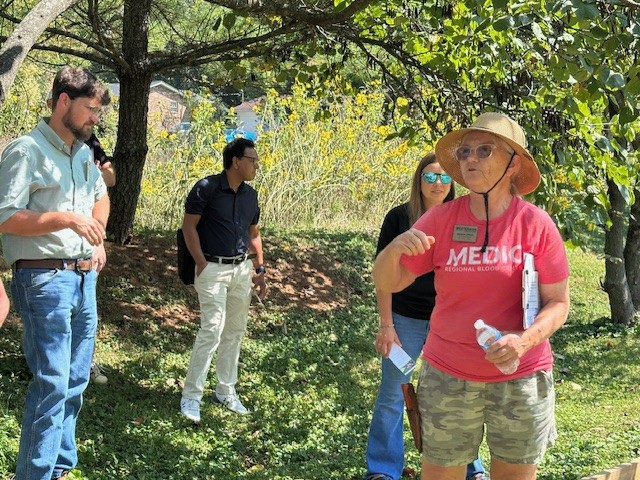
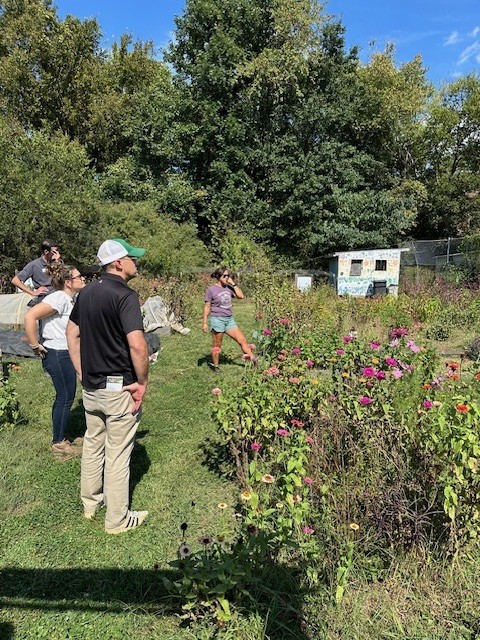
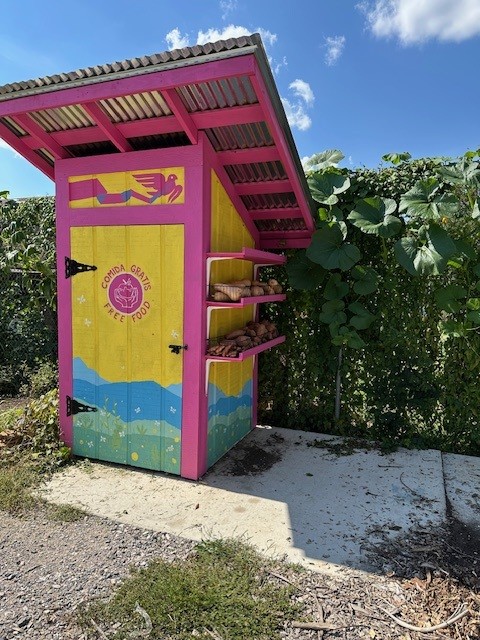
Participate in professional development tours conducted at two local non-profit community gardens. Visits were made to the Concord Community Garden and the Beardsley Community Farm in Knoxville, Tennessee.
A total of 19 participants, made up of nine members of the SARE Advisory Committee, five SARE program coordinators and assistants and four county Extension ANR agents met in Knoxville on September 17, 2025 to participate in tours.
Information learned:
- First Steps – Obtain soil map of the planned space; conduct soil sampling; become familiar with zoning requirements especially if garden/space is located within the city limits.
- The need for community involvement to include youth groups, Extension, Master Gardeners and other volunteers or include apprenticeship programs to make sure the project can be managed properly.
- A realization of the amount of food produced in these settings and the thousands of pounds of fresh produce readily made available for those in need of these items.
- One garden provided space for refugee gardeners giving them the ability to produce food products with which they are more familiar.
The SARE Advisory Committee is an essential part of the state’s successful sustainable agriculture endeavors. The committee’s primary purpose is to provide support and guidance for the model state annual training program by providing insights from the trainee and farmer perspective in order to assist in producing effective trainings targeted to local/state needs.
The SARE Advisory Committee will do the following:
- Serve as an on-going focus group to help identify needs, trends and solutions for Extension outreach in the Sustainable Agriculture program space.
- Serve as an advisory team for the Tennessee SARE State Coordinators and Program Assistants in the identification of program priorities.
- Serve as the primary planning team for an annual or biennial ‘sustainable agriculture educational training tour’ for Extension Agents, Industry Partners and other leaders in a training role.
A total of 14 participants, made up of nine members of the SARE Advisory Committee and five SARE program coordinators and assistants met in Knoxville on September 17, 2025.
As a result of the meeting, the following action steps were developed:
- Encourage/invite SARE advisory committee members to attend the SE Regional Fruit and Vegetable Conference.
- Ask Extension ANR regional program leaders to consider having a “TN SARE” segment on their ANR Program Planning Day for agents to share what they learned in a recent SARE-funded training program.
- Develop sub-committees of the advisory committee to develop specific possible group tours, excursions and field trips to events and trainings.
- SARE Advisory Committee members receive the TN SARE Newsletter.
- Develop and discuss guidelines for an inner-state county ANR agent ‘exchange’ program with Extension ANR regional program leaders.
- Consideration for future meetings of the TN SARE Advisory Committee.
For participants to learn about horticulture, hops, turfgrass and organic agriculture.
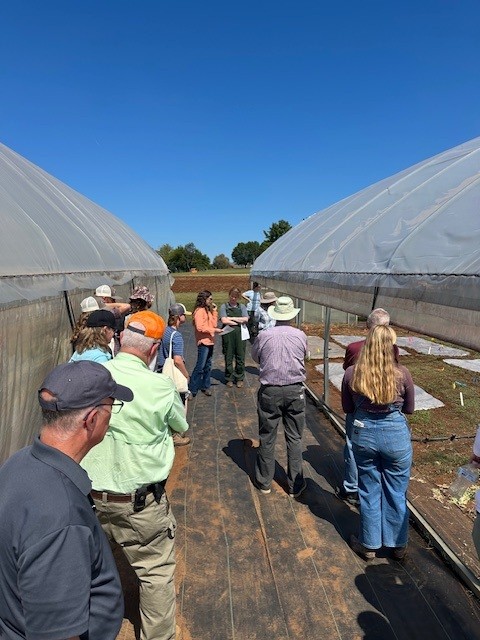
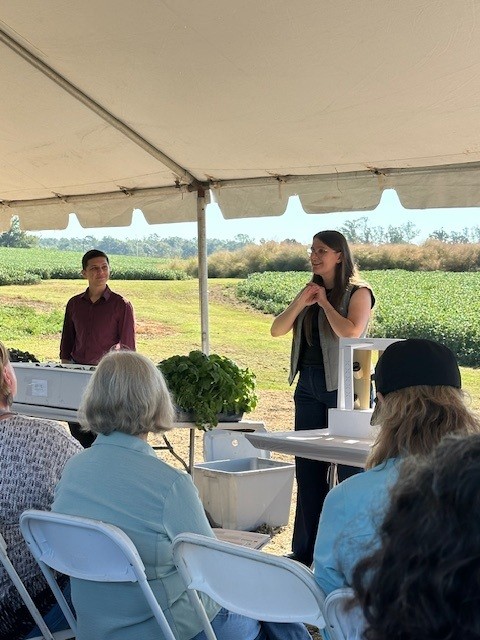
For participants to explore exhibitor booths and equipment displays, attend educational sessions and a special tour of the Plant Sciences Research Farm.
A total of 9 participants, consisting of four SARE Advisory committee members and five other SARE-sponsored trainers attended the UT Hort, Hops and Crops Field Day at the East Tennessee Research and Education Center on September 18, 2025.
Participants learned about the following subject areas:
- Eucalyptus for Terpene Production and Sustainable Aviation Fuel
- Leaves contain terpenes (essential oils) that can be distilled
- Terpenes can be converted into renewable jet fuel – reducing dependence on fossils fuels
- Cover Crop Resources
- Species Selection and Seeding Rates
- Variety Selection
- Nitrogen Calculator
- Economics Tool
- Soil Health and Weed Management in Organic Grain Systems
- Building Fertility and Controlling Weeds
- Solarization in High Tunnels to Control Weeds
Hydroponics – What to Consider in Producing a Crop
To bring farmers and agriculture professionals together to test equipment, see innovations in mechanical weeding for specialty crops and attend a trade show.
Participants will test and learn about mechanical weed control equipment, tool adjustment and new technologies for organic/specialty crops.
A total of 7 Extension agents attended the Kentucky Mechanical Weed Control Field Day in Lexington on September 23, 1925.
Information learned at the field day:
- Weed control information related to weeding tool designs, components, and stale seedbed techniques.
- Live equipment demonstration of a dozen or more 2-wheel and 4-wheel machines with the opportunity to utilize one for hands-on training.
- Guided tour of research plots which included cut flower production and plants used for dyes.
- Well-organized trade show with vendors from across the U.S. displaying hand tools, soil mixes, irrigation equipment, and several different weed control systems.
The field day was highly recommended by the agents that attended and thought it might be worth duplicating at one of our research farms in Tennessee.


Educational & Outreach Activities
Participation summary:
Learning Outcomes
Project Outcomes
The agents who attended the Kentucky Mechanical Weed Control Field Day highly recommended that this may be worth duplicating in Tennessee.
Face of SARE
The SARE program is a great benefit to agents, specialists and agriculture professionals in Tennessee as it provides them a means to increase their knowledge of sustainable agriculture. This is done by allowing a number of travel scholarships to agents/specialists/ag professionals, where they can learn first-hand by attending conferences, workshops and farm tours covering a wide array of learning opportunities. The need is to branch out more to other agriculture professionals other than Extension to promote teaching, training and application of sustainable agriculture practices to producers. The promotion of the SARE program in Tennessee has this year and will continue to be done in the following ways:
- Agent In-Service Trainings
- Annual Regional/State Agents Professional Association Meetings
- Personal and Group Emails
- Individual Visits with Agents/Specialists
- Farm Visits
- State Website
- Promotional Banners and Exhibits at Trade-Shows, Agent In-Services and Planning Meetings
- Efforts are made to exhibit a seamless SARE program that includes Extension Personnel from the University of Tennessee and Tennessee State University and to continue these close working relationships.