Progress report for WLED25-003
Project Information
Dry farming is the practice of growing crops without irrigation during the dry season by relying on soil moisture retained from the wet season. Despite its many benefits, strong farmer interest, and high suitability in coastal Oregon and California, few formalized vegetable dry farming research and educational activities have taken root in the coastal regions of these states, limiting wider producer adoption. This program aims to increase regional adoption of dry farming through education, demonstration and outreach activities, and will connect coastal dry farmers between Oregon and California to facilitate knowledge exchange between the regions.
Phase one of this project will build on the work of the WSARE-funded project ‘Establishing a beginning dry farming curriculum and accelerator program’ to develop a new dry farming accelerator module focused on the coastal context. Content will be informed by and co-created with experienced coastal dry farmers and will incorporate research findings from experiments and interviews with dry farm practitioners in Oregon and California.
Phase two will build on the module from phase one to create a Pacific Coast Dry Farming Accelerator that engages a cohort of beginning dry farmers along the Oregon and California coast and builds a community of practice around dry farming. Pacific Coast Dry Farming Accelerator cohort participants will work through Dry Farming Accelerator content, including the new module, and will meet regularly with regional breakout groups. Cohort participants will get to plan and implement a dry farm tomato trial on their farm, and will visit dry farming demonstration sites hosted by experienced dry farmers, and will receive personalized consulting support from the project leadership team.
Coastal farmers have conveyed a great need to expand dry farming educational efforts to coastal regions. This project will address barriers to adoption of previous SARE dry farming research results and meet farmers’ educational needs as follows:
Objective 1: Implement a cohort-style Pacific Coast Dry Farming Accelerator Program for vegetable growers in Oregon and California to increase dry farming skills, practical science-based knowledge, and community-oriented farmer-to-farmer networking. Considering lack of information access and growing interest, this project will increase coastal growers’ understanding of dry farming practices, improve their technical skills to implement water saving strategies, share SARE-funded research findings on dry farming practices, and create grower-to-grower learning opportunities for lateral knowledge sharing.
Objective 2: Develop and establish a Coastal module to add to the existing Dry Farming Accelerator Program curriculum to increase the accessibility of coast-specific dry farming information for farmers on the California and Oregon Coasts. Since much of the science-based dry farming work in Oregon has been conducted solely in the Willamette Valley, PI Smith and Co-PI Nebert will share and adapt SARE-funded research findings to the coastal Oregon context. Co-PI Socolar’s WSARE-funded doctoral work is the only peer-reviewed research on vegetable dry farming in California, and it has yet to be shared widely beyond the region in which it was conducted. Dr. Socolar has started working with the new North Bay UCCE Specialty Crops Advisor, Co-PI Andrews, to bring outreach and educational opportunities to more coastal California growers, work that cannot continue without funding from this project.
Dry farming is the practice of growing crops without irrigation during the dry season by relying on soil moisture retained from the wet season. Dry farming has been practiced worldwide for millennia, but is now less common due to modernized irrigation practices. West Coast farmers are expressing renewed interest due to dry farming’s many potential benefits including reduced irrigation costs, drought risk mitigation, improved weed control, increased productivity on land without water rights, and marketing potential (Socolar et al., 2024).
A small number of producers in coastal California have successfully dry farmed for decades and share knowledge with farmers seeking advice. Dry farmed tomatoes are famously flavorful here, captivating local consumers who are willing to pay twice the price of irrigated tomatoes. However, few educational activities have taken root locally, limiting wider adoption. Producers showed a strong appetite for more dry farming educational content at the statewide CAFF Small Farms Conference in 2023 where the dry farming workshop had the highest attendance, and during a recent Needs Assessment of North Bay specialty crop growers (Andrews, 2023).
On the Oregon coast, producers see potential for dry farmed tomatoes and other vegetables. While a comprehensive dry farmed tomato variety trial was conducted in Oregon’s inland Willamette Valley (WSARE SW20-917), much less is known about dry farmed tomato variety performance in milder coastal climates. Coastal tomatoes typically experience less drought stress due to cooler summers and thus suffer fewer physiological disorders; however, the cooler climate limits tomato varieties that can be successfully grown there. Similarly, dry farming site suitability research (OW19-348) has focused on the Willamette Valley, so coastal producers are left with a limited understanding of viability. The Dry Farming Collaborative Virtual Winter Convenings, organized by the OSU Dry Farming Program, continue to be well attended by coastal farmers in Oregon.
This project will support coastal farmers to further the adoption of effective dry farming strategies through a cohort-style accelerator educational program tailored to coastal microclimates. This will equip producers with skills and practical knowledge within a supportive learning network. Beginning dry farmers (<2 years of experience) interested in learning more about dry farming will join a learning cohort, gaining two years of dry farming experience by 2027. Experienced dry farmers on the leadership team of this project will have 2 or more years of experience implementing dry farming and will share their expertise through demonstration sites and field days.
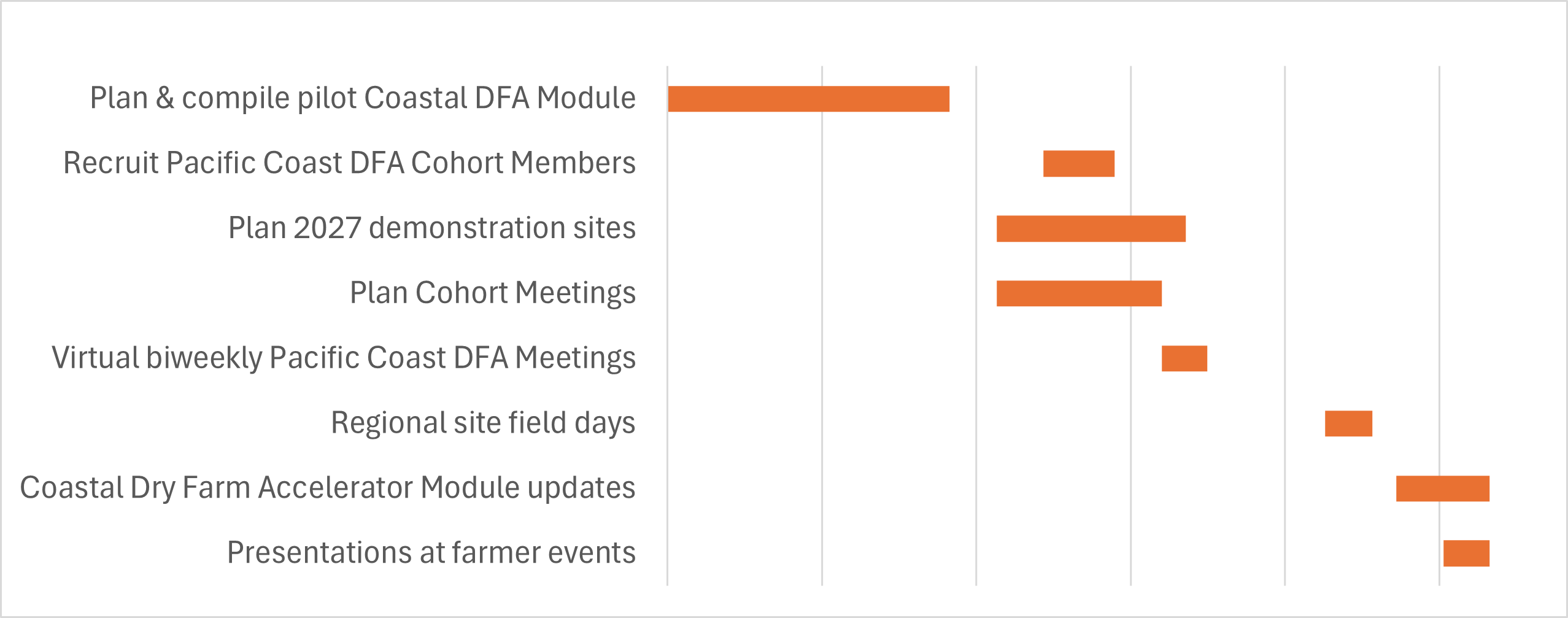
- Spring 2025-Spring 2026- Project Team (composed of experienced dry farmers and extension professionals) will plan and compile pilot Coastal Dry Farm Accelerator Module. This will involve quarterly planning/check-in meetings, as well as compilation of relevant information and video recording with experienced dry farmers.
- Summer 2026-Early Winter 2027- Project Team will plan 2027 demonstration sites and meetings with the Pacific Coast Dry Farm Accelerator cohort.
- Late Summer- Fall 2026- Extension professionals will recruit Pacific Coast Dry Farm Accelerator Cohort Members
- January-March 2027- Pacific Coast Dry Farm Accelerator Cohort will meet virtually biweekly to discuss Dry Farm Accelerator content and plan for 2027 on-farm dry farming experimentation. Following the orientation meeting in January, the cohort will divide into 2 focus groups based on similar growing conditions to discuss Dry Farming Accelerator content. The final March cohort meeting will include a pilot of the new Coastal Dry Farming accelerator module with time for feedback from cohort participants.
- March- October 2027- Experienced Dry Farmers will establish and manage demonstration plots with support from extension professionals as needed. Beginning dry farmers will establish and manage dry farm tomato trial sites with support from Project Team.
- August-October 2027- Project Team will host regional site field days at Experienced Dry Farmer demonstration sites. Field days will be open to all interested farmers and resource providers.
- October 2027- Final Pacific Coast Dry Farm Accelerator cohort meeting. All cohort members will meet together virtually to recap the growing season, discuss lessons learned, and identify next steps for themselves and the program.
- November 2027-March 2028- Project team will update Coastal Dry Farm Accelerator Module based on cohort participant feedback and complete other educational outputs (see below).
Cooperators
- - Producer
- - Producer
- - Producer
- - Producer
- - Producer (Educator and Researcher)
Education & Outreach Initiatives
(2) Develop and establish a Coastal module to add to the existing Dry Farming Accelerator Program curriculum to increase the accessibility of coast-specific dry farming information for farmers on the California and Oregon Coasts.
To date, the extension project team has recorded interviews with each of the (5) experienced dry farmers who are working on this project. Interviews focus on describing what makes dry farming in the coastal context unique, and how experienced coastal dry farmers adapt their dry farming practices to the coastal context. The extension project team reviewed interview recordings and identified common themes to highlight in the coastal dry farming module of the dry farming accelerator program. They then drafted a storyboard for the online coastal dry farming module, which they reviewed in a meeting with the experienced coastal dry farmers. Our next step will be for the extension professionals to synthesize this feedback from experienced dry farmers into an updated storyboard, and then develop the video portion for the online coastal dry farming module.
The Pacific Coast Dry Farming Accelerator Program directly impacts experienced dry farmers on the project team, as well as a cohort of beginning dry farmers that we will recruit in 2026.
The regular meeting of the five experienced dry farmers and four Extension professionals on this project team has resulted in novel, dry-farm knowledge exchange between farmers, and between farmers and technical advisors, across state boundaries. In 2026, we anticipate this community of practice to grow to more coastal farmers, as we recruit a cohort, and develop more outreach for the program.
Additionally, the free, online module will serve to reduce barriers in knowledge for future prospective coastal dry farmers. We expect that this project will bring renewed attention and web traffic to the existing Dry Farming Accelerator program modules, in addition to the new coastal-specific module.
Viewers of the online coastal dry farming accelerator module will be able to:
- Describe 3-5 key characteristics that make dry farming in the coastal context unique
- List 4-6 strategies that experienced coastal dry farmers use to adapt dry farming to the coastal context on their farms
- Select 2-4 management strategies to trial when dry farming on their coastal farms
Cohort members will have the added benefit of opportunities to attend regular, facilitated meetings, as well as field days on the farms of experienced dry farmers.
Educational & Outreach Activities
Participation summary:
We are still in the development phase of the online module, so no outreach activities have yet been conducted. We have started circulating a flyer to begin recruiting a cohort of new and beginning coastal dry farmers that will begin in early 2027.
Project Outcomes
The project team (4 extension professionals + 5 experienced coastal dry farmers) have met multiple times to discuss the project. Team meetings have led to exchange of ideas and experiences amongst farmers and agricultural professionals who otherwise might not have had the opportunity to connect and learn from each other.