Progress report for WLED25-011
Project Information
Occultation, known as "weeding with tarps," is revolutionizing small farm management in Oregon by enabling no-till practices that reduce labor (and tractor costs) while enhancing soil health. Verdant Phoenix Farm has conducted research, supported by WSARE Farmer/ Rancher funding, and the Organic Farming Research Foundation to legitimize the practice and explore the benefits of this method for terminating unwanted plants and maintaining soil tilth.
Verdant Phoenix Farm (Oregon Tilth Certified Organic), which features Anderson Creek, is also participating in conservation programs aimed at managing invasive species along creek banks with both the Jackson Soil and Water Conservation District (JSWCD) and the NRCS EQUIP program. By applying occultation tarps on the farm, in the field, and near the creek, Verdant Phoenix is effectively suppressing weeds and preventing regrowth. This technique is gaining traction as a sustainable, herbicide-free approach to managing invasive weeds on farms and in riparian restoration efforts.
This project will bring together farms and riparian restoration projects that are currently utilizing occultation tarping, and will provide an opportunity to share this technique. The Understory Initiative (TUI) and Vesper Meadow uses tarps to prepare areas for meadow restoration, and in the cultivation of native plants. Through partnerships with TUI, OSU Small Farms, JSWCD, the Family Nurturing Center Farm and local farmers, Verdant Phoenix Farm aims to demonstrate the advantages of occultation tarping, which not only aids in weed control but also supports soil health and moisture conservation.
Our innovative project encourages collaboration between agricultural and ecological restoration professionals, farmers, and landowners in the Rogue Valley through education and demonstrations. Our goal is to showcase the impacts of tarping, demonstrate the technique, and provide informative fact sheets to support the integration of occultation tarping into more sustainable, land management practices on farms, in fields and near streams.
This project aims to promote the adoption of occultation tarping among agricultural and riparian restoration professionals, land managers, and farmers through in-field demonstrations.
The objectives include, to:
Increase the Technical Capacity of Agricultural and Riparian Professionals so they can recommend occultation tarping. We will provide in-field demonstrations, share insights from occultation research, and develop fact sheets to facilitate increased understanding about tarping.
Increase the Skills of OSU and JSWCD Faculty to be able to share about the benefits of tarping, how to prepare the area, tips for success, timing, seasonal, and slope considerations. Cooperating faculty will be able to address the challenges with tarping including uneven ground, the need for stakes and weights, and fluctuating water levels.
Reduce Tarping Expense through JSWCD’s plan to include vinyl tarps in their equipment rental program for reduced cost to interested landowners, and land managers. Income from our demonstrations will go to supporting the purchase of tarps for the rental program.
Raise Awareness and Grow Confidence in Tarping among professionals, farmers, land managers, and restoration practitioners by creating educational fact sheets tailored to grow their confidence in the technique and to facilitate broader adoption. OSU Extension Communications will publish and distribute over 200 fact sheets to increase awareness and understanding of occultation tarping practices.
Demonstrate Impacts on the Ground, Over Time across multiple years: or multi-year projects, demonstrating year 1-3 impacts in the soil and on weed populations. Also track the extent to which participants used new knowledge and skills in subsequent educational activities.
Occultation, often referred to as “weeding with tarps,” is a valuable management tool for biointensive no-till systems and is gaining popularity in small-scale organic vegetable production. This practice involves covering the soil with a thick black vinyl tarp for 4 to 8 weeks. Under the tarp, plants die due to lack of sunlight, and as they decompose, they enrich the soil with the help of an active soil food web. Once the tarp is removed, the clean bed is ready for planting or seeding, resulting in minimal soil disturbance.
There is growing interest from farmers, restoration professionals, and land stewards of all kinds in new strategies to terminate weeds while protecting soil and watershed health. In the Rogue Water Quality Initiative Plan, professionals indicated “concern with herbicides being applied to manage invasive plants in local waterways” resulting in dangerous pesticide levels in the water. The plan also highlights that many farms or land designated EFU are adjacent to riparian areas with “(45%) zoned for agricultural use (AG) and exclusive farm use (EFU), of which is approximately 97% private lands” (Stabach & Siedlecki, 2023). In our rural region, farmers, land managers and riparian restoration professionals have expressed a need to learn to terminate vegetation without harming the environment.
Verdant Phoenix Farm seeks to partner with riparian restoration professionals, technical assistance providers (OSU and JSWCD), and local farms currently utilizing occultation tarping to showcase this technique through educational workshops and demonstrations across the Rogue Valley. The initiative includes a series of in-the field demonstrations aimed at informing both new and existing growers about tarping for site preparation, weed termination, and cultivating soil health.
By uniting agricultural and ecological restoration communities, this project seeks to enhance understanding and implementation of no-till practices, particularly occultation tarping. Building on research from WSARE and Organic Farming Research Foundation (OFRF), Verdant Phoenix Farm is excited to integrate findings from our previously-funded SARE research project, translate those results into practical demonstrations of application for our diverse audience, and bring the results of our research into the field through demonstration for agricultural and riparian professionals and producers.
Our team of collaborators plans to share insights through in-field demonstrations, along with developing fact sheets to encourage greater adoption of tarping as a sustainable agricultural practice. Our goal is to promote occultation tarping on farms, in fields, and, where feasible, near streams throughout our region as a result of this effort.
|
Date |
Milestones |
Participants |
Outcomes |
|
April 2025 |
Convene team |
All members of project provide input to timeline |
Create timeline for events, and meeting schedule |
|
Spring 2025 |
Draft fact sheet -ag and riparian versions |
PI draft, and collaborators contribute |
Polished draft of fact sheets ready to shared with participants at tours |
|
Summer 2025 |
Marketing begins 6 weeks before Host 4 demonstrations (2 farms & 2 riparian) |
Collaborators & tour hosts |
Tours planned, hosted, and learning evaluated |
| Fall 2025 |
Review and refine fact sheets -ag and riparian |
PI draft, and collaborators contribute |
Fact sheet content refined based on input and learnings from tours |
|
Spring- Summer 2026 |
Marketing begins 6 weeks before Host 4 demonstrations (2 farms & 2 riparian) |
Collaborators & Tour hosts |
Tours planned, hosted, and learning evaluated |
| Fall 2026 |
Refine fact sheet -ag and riparian Order Tarps for JSWCD program |
PI refine with input, and collaborators edit JSWCD |
Content refined from input and learnings from tours and cooperators Use program income to purchase tarps for rental program |
|
Spring- Summer 2027 |
Marketing begins 6 weeks before Host 4 demonstrations (2 farms & 2 riparian) |
Collaborators & tour hosts |
Tours planned, hosted, and learning evaluated |
|
Fall 2027 |
Begin OSU publishing process Purchase tarps for JSWCD |
Maud Powell, Small Farms JSWCD |
Complete requirements for OSU publishing Purchase tarps with program income for tarp rental program |
|
March 2028 |
Finalize fact sheets & publish with OSU Ext Communications |
Collaborators approve final version |
Final fact sheets ready for publishing with OSU Extension Communications |
Cooperators
- - Producer (Educator)
- (Educator)
- (Educator)
- - Producer (Educator)
- (Educator)
- (Educator)
- - Producer (Educator)
- (Educator)
- (Educator)
Education & Outreach Initiatives
Increase the Technical Capacity of Agricultural and Riparian Professionals
Increase the Technical Capacity of Agricultural and Riparian Professionals so they can recommend occultation tarping. We will provide in-field demonstrations, share insights from occultation research, and develop fact sheets to facilitate increased understanding about tarping.
This project has been very successful in engaging diverse stakeholders and increasing the technical capacity of Ag and riparian professionals. We successfully partnered with Oregon State University Extension Service, The Family Nurturing Center Farm, The Oregon Farm Corp, American Farmland Trust, Jackson Soil and Water Conservation District as agricultural professionals. We partnered with The Understory Initiative and Vesper Meadow and Jackson Soil and Water riparian restoration professionals to increase their technical capacity through in-field education about occultation. Our educational workshops brought these audiences together to learn from each other, and we successfully shared about occultation as a strategy that could support both groups to manage unwanted plants.
Example of one of the workshops with Vesper Meadow: Gathering the Seeds of Change: native plant habitat restoration — Vesper Meadow Education Program
Increase the Skills of OSU and JSWCD Faculty to be able to share about the benefits of tarping, how to prepare the area, tips for success, timing, seasonal, and slope considerations.
Increase the Skills of OSU and JSWCD Faculty to be able to share about the benefits of tarping, how to prepare the area, tips for success, timing, seasonal, and slope considerations. Cooperating faculty will be able to address the challenges with tarping including uneven ground, the need for stakes and weights, and fluctuating water levels.
Through broad participation of multiple Oregon State University staff (Small Farms, general Ag, and Master Gardeners) and Jackson Soil and Water Conservation District staff (Agricultural and riparian conservationists) in the educational field-tours offered through this project, their skills increased. After seeing the benefits of tarping in real- life applications, TA staff now has a better understanding of the timing, seasonal changes, and area preparation techniques to support occultation tarping. Since the educational tours took them to several participating locations, they were able to observe the strategy and increase their own skills for implementation.
In addition, staff from American Farmland Trust, Oregon Climate and Agriculture Network, and Oregon Farm Corp also participated in educational field tours that showcased occultation tarping. These agricultural professionals also increased their knowledge and skills related to tarping.
Raise Awareness and Grow Confidence in Tarping among professionals, farmers, land managers, and restoration practitioners by offering field tours and by creating educational fact sheets tailored to grow their confidence in the technique and to facilitate broader adoption. Also, our objective includes Reduce Tarping Expense through JSWCD’s plan to include vinyl tarps in their equipment rental program.
Raise Awareness and Grow Confidence in Tarping among professionals, farmers, land managers, and restoration practitioners by creating educational fact sheets tailored to grow their confidence in the technique and to facilitate broader adoption. OSU Extension Communications will publish and distribute over 200 fact sheets to increase awareness and understanding of occultation tarping practices.
Reduce Tarping Expense through JSWCD’s plan to include vinyl tarps in their equipment rental program for reduced cost to interested landowners, and land managers. Income from our demonstrations will go to supporting the purchase of tarps for the rental program.
Through hosting in-field demonstrations, including tarping in educational workshops, and sharing with ag professionals about the technique - we have increased the awareness and confidence in tarping. As familiarity grow with the strategy, we are finding more producers are open to hearing about it and trying it in their operations. Many farmers we approached - that attended workshops - said that they were already trying tarping, or were interested in experimenting with the technique on their operation. The key indicator that we have raised awareness and grown confidence in tarping is through the Jackson Soil and Water Conservation District moving forward to includ vinyl tarps in their equipment rental program. This opportunity reduces the tarping expense for participating producers, and shows the validity of the strategy to a broader audience. This is a huge impact of our WSARE funded research and represents a significant culture shift in the ag community.
Educational & Outreach Activities
Participation summary:
Fall Farm & Restoration Soil Health Tours
Join us this fall for hands-on learning in the field! Topics include tarping, native seed production, pollinator habitat, and regenerative farming. RSVP to any or all of these opportunities by emailing Rhianna Simes. Classes offered include:
 Sept 12 | How to Prep with Tarps in order to Grow Native Seeds
- Selberg Institute, Ashland | 9:00–3:00
- Host: The Understory Initiative
 Sept 24 | Tarping for Small Farms
- SOREC, Central Point | 6:00–7:00 PM
- Host: Family Nurturing Center Farm
 Oct 2 | Making Pollinator “Restaurants” Volunteer Day (prepare location with tarping)
- Vesper Meadow, Ashland | 10:00–2:00
- Snacks & supplies provided!
 Oct 16 | Planting for the Future (prepare location with tarping)
- Vesper Meadow, Ashland | 10:00–2:00
 Oct 30 | Regenerative, No-Till Agriculture
- Verdant Phoenix Farm, Phoenix | 5:30–6:30 PM
Cost: $10 suggested (free at Vesper Meadow events; no one turned away)
 Partners: The Understory Initiative, Family Nurturing Center, Vesper Meadow, Verdant Phoenix Farm
Funding provided by Jackson Soil and Water Conservation District, and Western Sustainable Agriculture Research and Education (WSARE Grant)
The list below outlines the additional workshops and educational events that we supported and included information about tarping for a broad audience.
| Event date | Event name | Event location | Collaborators (if any) | # hours | # attendees |
| 8/25/26 | Soil Health & Water Workshop | Belle Mare Farm, Willamina | Peter Donovan | 6 | 21 |
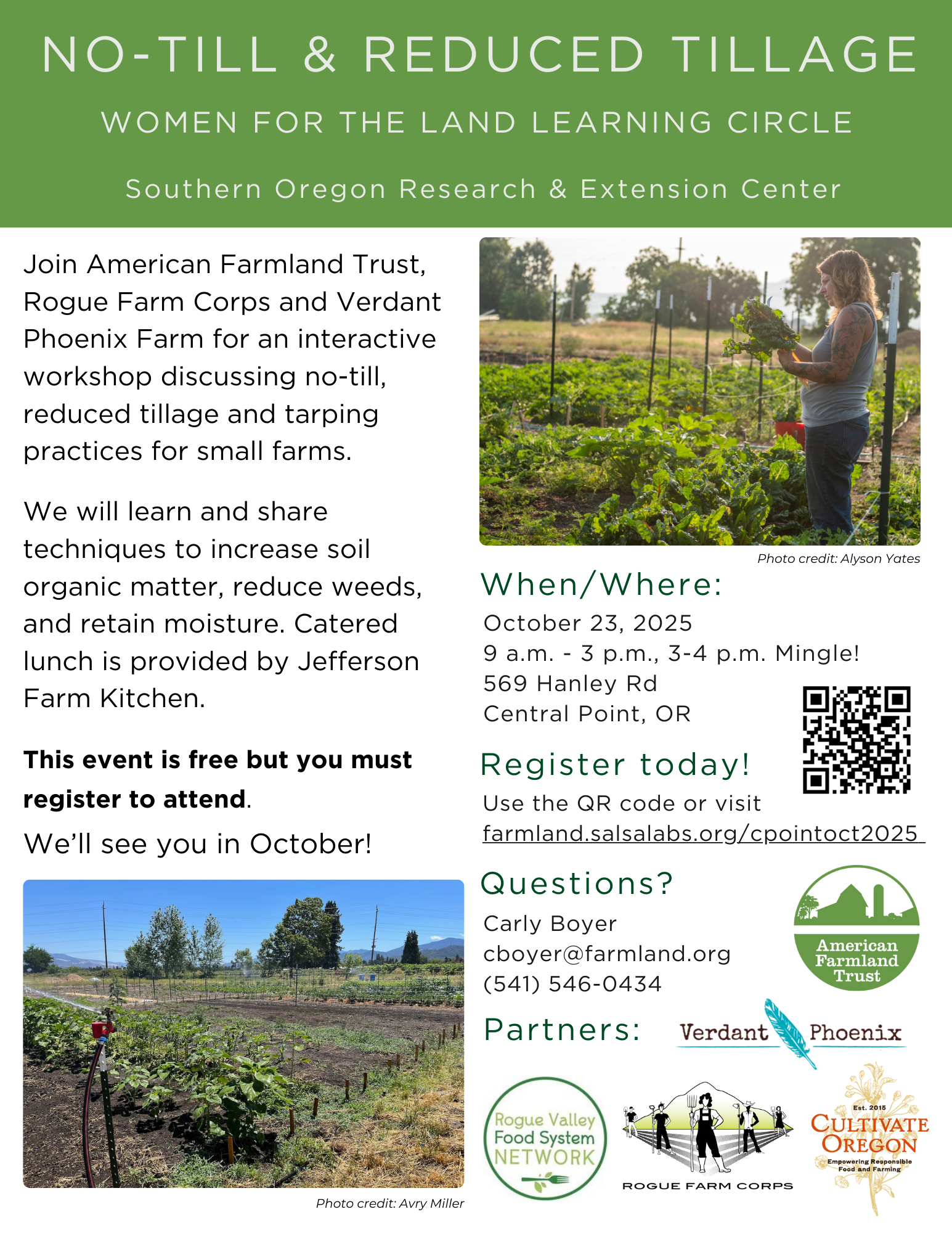
| 10/23 | AFT Peer Learning Circle | SOREC | AFT | 8 | 15 |
| 9/24 | Tarping for Small Farms | Family Nurturning Center Farm | FNC | 3 | 12 |
| 10/2 | Prepare Pollinator Resturants | Vesper Meadow | Vesper | 5 | 15 |
| 10/16 | Planting for the future | Vesper Meadow | Vesper | 5 | 15 |
| 10/30 | Regenerative No till Ag | Verdant Phoenix Farm | SOCAN | 3 | 15 |
| 10/25 | Soil Health 101 | JSWCD | JSWCD | 2 | 10 |
| 11/1 | Managing weeds | JSWCD | JSWCD | 2 | 10 |
| 10/5 | Soil Sampling Basics — Part 1 of the Soil Sleuth Series | Daily Blessings | Nan | 2 | 3 |
| 11/6 | Soil Testing Results Interpretation— Part 2 of the Soil Sleuth Series | Zoom | Nan | 2 | 5 |
| 11/10 | Soil Nutrient and Amendment Options — Part 3 of the Soil Sleuth Series | Zoom | Nan | 2 | 4 |
| 11/18 | AFT Peer Learning Circle | Rusted Gate | AFT | 8 | 20 |
| 9/12 | Tarping for native plants | Selberg | TUI | 6 | 8 |
| 9/18/2025 | Soil Testing for Effective Soil & Crop Management | SOREC | Nan | 2 | 11 |
| 9/30 | OSU Extension Land Stewards Presentation -Irrigation and Pasture Management | Multiple properties | OSU Ex | 4 | 23 |
Learning Outcomes
Project Outcomes
The outcomes of this project have been significant. It has been powerful to bring together professionals in the agricultural and restoration communities to learn about occultation tarping as a strategy to terminate weeds and protect soil health. Our planned educational events were well attended, marketed by diverse community partners, and resulted in participants expressing that they "feel inspired to try tarping" and "for such a simple strategy, it solves many of the pressing problems facing farmers today". In addition, we were able to share about tarping at educational events that were not planned as part of this grant such as the OSU Master Gardener class, the tour with the Oregon Farm Corp, and Peer Learning Circle with American Farmland Trust.
The biggest impact is now our ability to support the Jackson Soil and Water Conservation District's "Tarp Rental program" that helps to make tarps more accessible to a broader audience. This means that each of our workshops that we provide contains a mention and marketing for the "Tarp Rental program" so that the outcomes of our project's outreach activities are exponential and complimentary.
Yes, based upon the previous WSARE Occultation research, and the strong interest in the farm/field tours from WSARE LED funding, we have submitted a producer + professional WSARE grant to pursue more soil health research focused on what is happening under the tarps during occultation tarping, and what nutrient cycling is occurring.