Progress report for WLED25-013
Project Information
The Rangeland Monitoring Group (RMG) brings together ranchers in central and eastern Montana to collaboratively monitor and manage private and public land. RMG has seen firsthand the benefits of sharing on-the-ground knowledge and experience to inform land management practices. RMG also strives to incorporate research and academic knowledge by engaging with other experts in the field. Facilitating authentic conversations among such a diverse and widespread group can be challenging; trust is needed to engage in productive discussions. Additionally, collaborative efforts may be hindered if there is lack of an organized, adaptable platform for sharing evidence and experience. RMG strives to overcome these obstacles through multiple avenues.
With a dedicated facilitator, an established mission (see soilhealth.app/RMG-Montana), and an emphasis on peer-to-peer learning, RMG builds trust among its participants, which leads to more honest, effective conversations surrounding sustainable land management. Through facilitated conversations, peer-to-peer learning sessions, and on-the-ground demonstrations, ranchers expand their technical knowledge and analytical skills. Additionally, other field experts witness the innovation and dedication of ranchers to adaptive management. Each of these components, combined with RMG’s grassroots origins, has made the group particularly successful at building trust among diverse stakeholders.
To provide structure and consistency in the collaborative efforts of RMG, a shared database, soilhealth.app, has been developed. Through this platform, ranchers and collaborators can pool monitoring data on range health, grazing practices, and climatic changes. This approach enables participants to learn from each other’s experiences via tangible, organized data. Ranchers are empowered with tools to track long-term trends and better understand the impacts of their management decisions, transforming individual insights into a more comprehensive, credible regional picture.
Further success and expansion of this project will provide a model for using cooperative monitoring and data-sharing to positively impact the ecological, economic, and societal health of a landscape.
Previous SARE research indicates the value of peer-to-peer learning and sharing in the field of natural resources for developing effective, lasting conservation efforts (EW11-015, LS21-345, SW19-905, and SW22-942). However, issues of accessibility, privacy, and organization can hinder the collection and exchange of information among landowners. This project focuses on helping ranchers in central and eastern Montana overcome these hindrances to collaboration with the following objectives:
Objective #1: Coordinate and facilitate virtual (at least 8 per year) and in-person meetings (at least 1 per year) where ranchers from central and eastern Montana can exchange knowledge and experience with peers in a supportive environment, for the purpose of informing management on their own operations and across the landscape.
Objective #2: Provide education and assistance for at least 8 participating ranches to collect, share, and interpret rangeland monitoring data, which will be used in peer-to-peer conversations among said ranchers to evaluate and adjust land management practices.
Objective #3: Work with project participants to enhance the accessibility and utility of the data-sharing platform, soilhealth.app. Optimize this platform by integrating outside resources, adding rancher-derived observation questions, and/or developing data visualization tools; this will allow participants to collect, share, and interpret more detailed monitoring data to learn, experiment, and collaborate more effectively.
The above objectives are intertwined and will therefore be ongoing for the duration of the project. They will be evaluated at least annually according to the evaluation protocol outlined later in this application.
Since 2016, the Range Monitoring Group (RMG) – a network of central Montana ranchers and other rangeland professionals – has been asking the question, “How can we promote ecological, social, and economic sustainability on individual ranches and across the landscape?” Rangeland monitoring has been the group’s primary focus, with special emphasis on utilizing that data to manage for increased forage production, benefitting livestock, wildlife, soils, and the water cycle. Data sharing and peer-to-peer learning events began in 2022, assisted by a WSARE Farmer-Rancher grant (FW21-372). Since then, the group has realized the need for more coordination and facilitation of on-the-ground learning and has also recognized the need to expand monitoring questions to include social and economic factors (see https://soilhealth.app/RMG-Montana, https://soilhealth.app/RMG-Montana/posts/48, and https://soilhealth.app/RMG-Montana/posts/49). Bestelmeyer, et al. recognized that this type of landscape-scale collaborative research, supported by appropriate technology and funding, leads to more effective conservation efforts (2016). At recent RMG gatherings, participants have communicated the following needs in order for the group to continue its forward progress.
First, ranchers want to prioritize range monitoring methods which are aligned with professional standards in the field of range science. With a coordinator and an experienced field technician, RMG will be able to collaborate with experts in the field, collect meaningful data, and use said data to inform and evaluate land management practices.
Land managers have also acknowledged the need for a data-sharing platform that is accessible and adaptable. The development of soilhealth.app has provided an avenue for compiling collected data and sharing it amongst RMG participants. Ranchers have expressed a desire to enhance this platform by integrating external resources, developing data visualization tools, and incorporating observations that go beyond the typical indicators of rangeland health; this would allow land managers to construct a clear story of how ecological factors and management decisions intersect on the landscape.
Finally, participants in RMG have repeatedly emphasized the value of sharing and examining range monitoring information among individuals and communities; they have also voiced a desire to monitor more than just the landscape, potentially exploring opportunities to examine financial and social capital through a peer-to-peer framework as well. A barrier frequently encountered with this type of collaboration is landowner hesitancy to divulge personal data. To overcome this challenge, RMG requires a consistent coordinator who can facilitate learning events with clear expectations, where landowner-participants can focus on learning and sharing their experiences to build knowledge and enhance sustainability.
Current Timeline
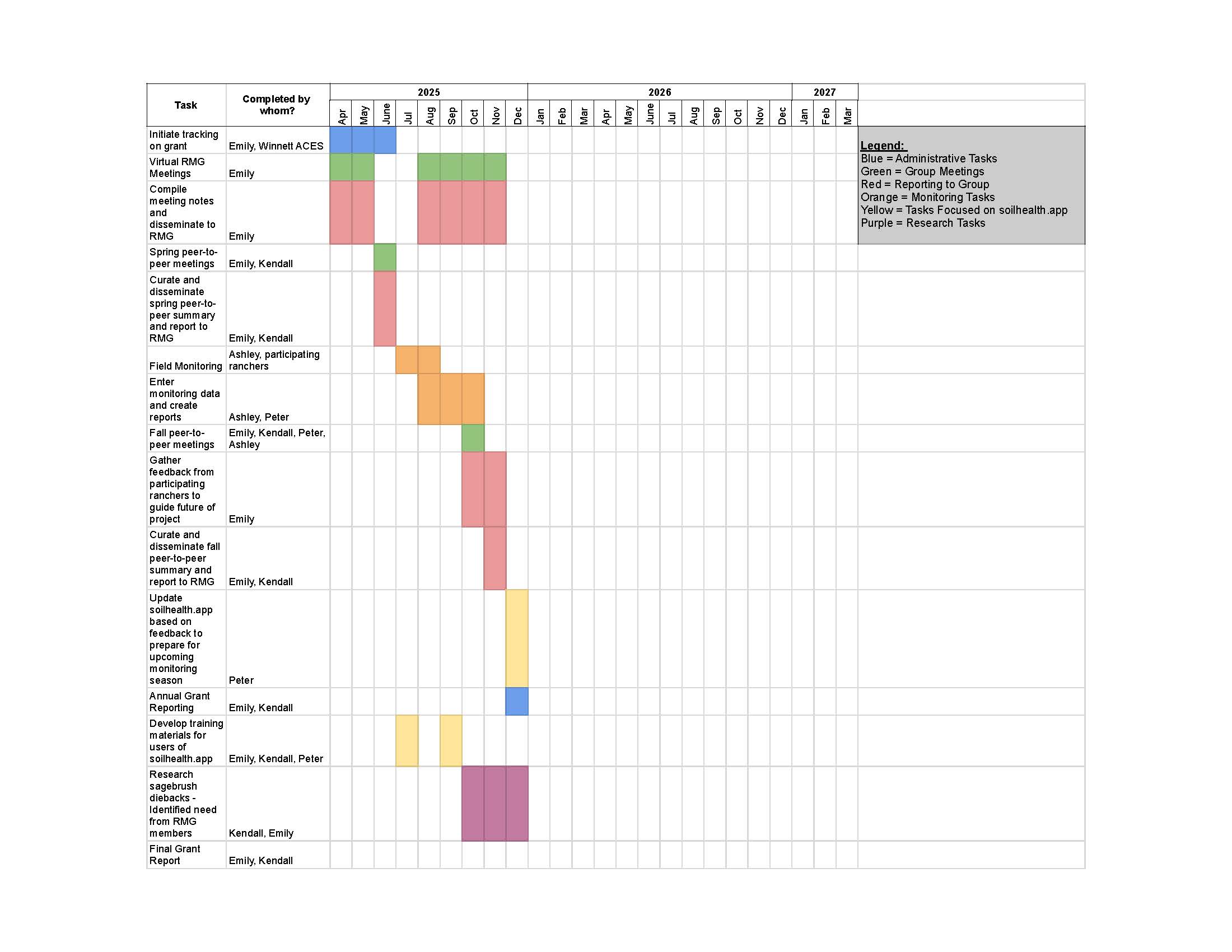
The actual timeline for this project is pictured below. Only activities for April through December of 2025 have been recorded as of right now, but the rest will be filled in as the project continues. Although we did not bill any costs for April-June of 2025 due to uncertainty with federal funds, we did complete our planned meetings during these months.
Through our peer-to-peer meetings this year, RMG has identified a new need to help us collaboratively monitor the rangelands in central Montana, and this need has been added to the timeline. During multiple meetings this year, ranchers and agency personnel relayed observations of big sagebrush (Artemesia tridentata) die-backs in the area. The problem seems to be widespread and significant enough that it is affecting how ranchers manage their landscape, so the group agreed to pursue informal research of the sagebrush die-offs to get a better understanding of the issue. This task is further elaborated on throughout this report, but it is important to note its addition to our timeline here.
Anticipated Timeline
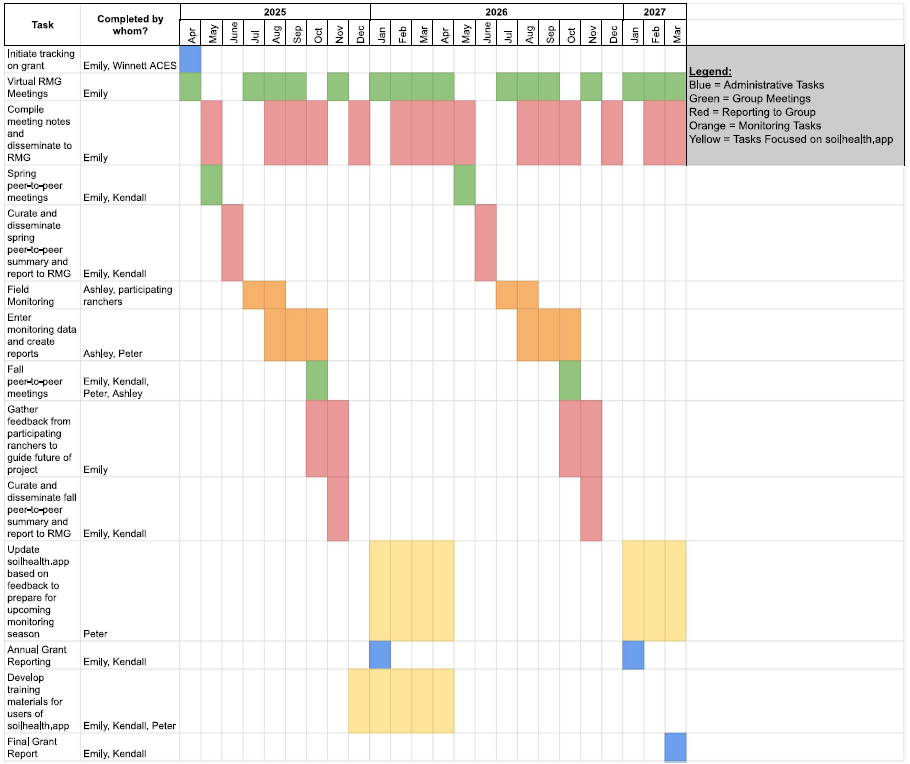
The anticipated timespan for the originally proposed project is April 1, 2025 through March 31, 2027. The attached chart details specific tasks related to the project and their anticipated completion schedules. Many tasks will occur throughout the entire timeline as the need arises: the coordinator will communicate with group members about upcoming events and educational opportunities; the group will explore avenues for expanding and adapting monitoring metrics; and RMG will complete outreach activities to share the group’s efforts and experience.
Cooperators
- - Producer
- (Educator)
- - Producer
- - Producer
- - Producer
- - Producer
Education & Outreach Initiatives
Coordinate and facilitate virtual (at least 8 per year) and in-person meetings (at least 1 per year) where ranchers from central and eastern Montana can exchange knowledge and experience with peers in a supportive environment, for the purpose of informing management on their own operations and across the landscape.
To build the trust and support needed for a collaborative group like RMG to succeed, we enlisted the services of a dedicated coordinator (Emily Standley). This coordinator has organized and facilitated the following peer-to-peer events:
- From April to December 2025, RMG held 5 virtual meetings (our goal is at least 8 virtual meetings per calendar year—we are on track to meet this goal).
- Meeting content depends on the group's needs. During spring, we focused on planning the upcoming monitoring season and discussing opportunities to strengthen our monitoring (such as working with Enriched Ag or collaborating with other NGOs). During summer and fall, we discussed observations from the monitoring season, shared management strategies, and exchanged feedback about potential improvements. During winter, we focus on continued education through guest presenters and group discussions.
- Each virtual meeting has averaged 13 attendees.
- During these meetings, we heard educational presentations about digital monitoring tools (such as Enriched Ag) and data sovereignty/ownership. In January, we will hear from researchers who have studied the impact of informal rangeland monitoring.
- In June and October, RMG held in-person gatherings focused on peer-to-peer learning and feedback.
- We had 18 attendees at our June meeting. Members shared updates about their operations, management goals for the current grazing season, and ideas for upcoming monitoring.
- We had 20 attendees at our October meeting. This gathering focused on feedback and reflection after the 2025 grazing season. We reviewed 2025 monitoring data, learned how to use digitally-collected data from Enriched Ag, watched demonstrations on how to access and compare data on soilhealth.app, and discussed members' goals and needs for the upcoming year. We also spent the afternoon on an RMG member's ranch, where we watched a monitoring demonstration, learned about the landowner's management experiments, and explored soil and vegetative health metrics.
In addition to organizing and facilitating these events, Emily compiled and distributed notes and educational materials from each meeting, communicated with members about upcoming meetings and presentations, and completed administrative tasks necessary to keep the group productive and efficient. Though these tasks are not measurable with concrete numbers, they are crucial to developing a supportive, efficient, and productive group.
Overarching impacts of these activities include:
- Strengthened partnerships among ranchers and other rangeland professionals
- A peer network for ranchers to discuss management ideas and decisions
- Increased collaboration and communication about rangeland conditions, benefiting the ecological, social, and economic sustainability of the landscape
- Increased knowledge of tools and topics relevant to ranchers
- Opportunities for producers and professionals to learn about innovative and adaptive resource management strategies
Impacts tied to specific activities include:
- Through virtual meetings and educational presentations, ranchers learned about the Enriched Ag camera as a monitoring tool. RMG developed a partnership with Enriched Ag that allowed participating ranchers to use the camera for free, providing monitoring data at no cost.
- Ranchers and RMG members gained knowledge about data ownership and sovereignty. These conversations led RMG to work with Winnett ACES to develop a clear data-sharing and data-use policy for the group.
- During in-person meetings, RMG members identified a common concern about sagebrush die-offs in central Montana. Kendall and Emily began researching potential causes and established a plan for informal research to explore the issue. This helps ranchers understand if and how their management affects the die-offs and provides local data to foster productive conversations between agencies and landowners.
- At the October peer-to-peer gathering, 100% of survey respondents said they gained new knowledge from the meeting.
Provide education and assistance for at least 8 participating ranches to collect, share, and interpret rangeland monitoring data, which will be used in peer-to-peer conversations among said ranchers to evaluate and adjust land management practices.
To further RMG's goals of collaborative rangeland monitoring, we contracted with experienced range technician Ashley Gould to complete rangeland monitoring. In 2025, she collected data for 8 RMG ranchers across central Montana.
Ashley uses a consistent protocol developed by RMG to align with professional standards and produce data useful to both landowners and agency personnel.
Ashley works with each rancher to establish the number and location of monitoring sites. She visits with ranchers before monitoring to gather relevant information about the operation. Ranchers visit some or all monitoring sites alongside Ashley to gain hands-on experience collecting the data themselves.
Once data is collected, Ashley compiles the information into a report and uploads it to RMG's data-sharing platform, soilhealth.app. Ashley is available to answer questions about the data and presents an overview of her findings at the fall peer-to-peer gathering.
Ranchers discuss their reports, share observations about landscape trends, and discuss management ideas with each other.
In 2025, because of RMG's partnership with Enriched Ag, Ashley also used the Enriched Ag camera on five ranches to gather supplemental visual data. This data belongs to and is accessible by the ranchers.
Overarching impacts of these activities include:
- Through consulting with Ashley and visiting range monitoring sites, ranchers gain one-on-one education and assistance in rangeland monitoring.
- Because monitoring protocols align with agency expectations, ranchers can use the data for both personal management decisions and to fulfill monitoring requirements for federal, state, or NGO permits and contracts.
- Because monitoring data is collected using a consistent protocol and stored on the same platform, it is more useful for examining and understanding land health trends across the landscape.
Impacts tied to specific activities include:
- On one participating ranch, Enriched Ag estimated forage production based on gathered photos, and those estimates were nearly identical to Ashley's on-the-ground production estimates. This validated RMG's monitoring methods and Ashley's work as a range technician and demonstrated the variety of monitoring tools available to ranchers.
- RMG's partnership with Enriched Ag provided more aggregated data for Enriched Ag to improve their analysis model.
- Funding from this grant allowed Ashley to expand monitoring to 8 ranches, with plans to expand to 10-12 ranches in 2026. (In 2024, during the pilot year, Ashley monitored only 5 ranches.)
- Funding from this grant allowed RMG to provide a discount to participating ranchers for the cost of monitoring. This lowered a common barrier to third-party monitoring and has drawn more interest to RMG.
- Because some ranchers interested in monitoring with RMG are also part of other monitoring programs, we are exploring partnerships where our monitoring efforts might overlap. We are currently working with World Wildlife Fund (WWF) to determine if some ranchers in their RSVP (Ranch Systems and Viability Planning) monitoring program may be a good fit for monitoring with Ashley. This monitoring has not started yet, but we have created a plan with WWF to collaborate in 2026.
Work with project participants to enhance the accessibility and utility of the data-sharing platform, soilhealth.app. Optimize this platform by integrating outside resources, adding rancher-derived observation questions, and/or developing data visualization tools; this will allow participants to collect, share, and interpret more detailed monitoring data to learn, experiment, and collaborate more effectively.
To ensure monitoring data is easily accessible and usable for informing management decisions, RMG contracted with Peter Donovan, the developer of soilhealth.app. RMG had been using soilhealth.app for a few years to track progress and record monitoring information, but under this grant, we are adapting the platform to better meet ranchers' needs.
In 2025, monitoring data from 8 participating RMG ranches was uploaded to soilhealth.app. This data is viewable by other RMG ranchers but not by the general public. Other RMG ranchers who are not receiving monitoring services from Ashley have also uploaded some of their own data, though this data is not as extensive as Ashley's monitoring.
soilhealth.app can record observations for every monitoring metric Ashley uses (photos, infiltration, basal cover, bare ground, vegetative production, etc.) and provides space to record other observations useful for management decisions, such as significant weather events, charts, and soil health metrics. Ranchers can also view data from multiple years side by side.
During the fall peer-to-peer meeting, Peter gave a live presentation on soilhealth.app. Because several new ranchers joined in 2025, he demonstrated how to log in, access data, compare data from multiple years, enter new data, and download information for hard-copy use. Peter also led a discussion about what information is most helpful to ranchers, what the data reveals about the landscape, and how to further improve soilhealth.app's capabilities.
For those who could not attend the fall meeting, Peter created a YouTube video providing a basic overview of how to upload and access monitoring data on soilhealth.app. This video has been shared with RMG members and is posted on the RMG homepage of soilhealth.app.
Peter has also been integrating more data-visualization tools into soilhealth.app to better illustrate what's happening on the landscape. He is currently examining evapotranspiration data for participating ranches (evaluating water cycle health) and incorporating it into their soilhealth.app data using graphs and charts.
-
Overarching impacts of these activities include:
- Ranchers can access their monitoring data in digital format (which can be easily converted to hardcopy), allowing them to use that data to inform management decisions.
- Ranchers can easily compare data from multiple years, providing better insight into landscape trends and how management may affect rangeland health.
- Using soilhealth.app as a consistent data platform allows the group to easily examine data together and have more productive peer-to-peer conversations about landscape observations.
- Adapting soilhealth.app based on feedback from RMG allows us to respond to ranchers' needs for data collection, leading to greater efficacy in applying that data.
Impacts tied to specific activities include:
- Discussion during Peter's presentation at the fall peer-to-peer meeting indicated strong interest in integrating more visual tools into soilhealth.app, which led Peter to incorporate evapotranspiration charts into ranchers' monitoring data.
- The expansion of RMG's monitoring program means there are ranchers new to the group who need more assistance navigating soilhealth.app, as indicated during the fall peer-to-peer meeting. Because of this, Peter will give another presentation on soilhealth.app during a virtual meeting.
Educational & Outreach Activities
Participation summary:
Peer-to-Peer Activities, Webinars/Presentations, Workshops/Field Days, & On-Farm Demonstrations
The Range Monitoring Group meets monthly, except December and one summer month. During the grant period (April 2025 onward), we have held five virtual meetings (April, May, August, October, November) and two in-person meetings (June, October).
Virtual meetings are focused on planning for monitoring season, exploring monitoring tools, discussing opportunities to partner with other monitoring endeavors, sharing landscape observations, and discussing relevant policy changes. These meetings facilitate peer-to-peer learning among ranchers and range professionals. Based on group discussions, we have invited educational presenters on digital monitoring tools (Enriched Ag) and data sovereignty/ownership. In late January, we will host researchers to present on informal rangeland monitoring impacts. Future presentation topics include the Rangeland Analysis Platform, data evaluation on soilhealth.app, and calculating Animal Unit Days (AUDs) for grazing management.
In-person meetings focus on sharing experiences in order to inform management strategies. The June meeting, held in conjunction with the Montana Range Tour, featured ranchers discussing their operations, goals, and planned management strategies. The October meeting followed up on the grazing season, with ranchers discussing landscape observations and management results. In October, we also reviewed 2025 monitoring data, learned how to access and dig into the data, and discussed members' goals and needs for the upcoming year. Two presentations were given: one by Enriched Ag on accessing collected monitoring data, and one by Peter Donovan on uploading monitoring data and observations to soilhealth.app. We also visited a member's ranch to observe monitoring demonstrations and management strategies.
Consultations
At least 10 individual ranchers have received consultations since the grant began. Eight ranchers met with Ashley Gould multiple times (contracted range technician) to discuss monitoring goals, select sites, complete monitoring, and review collected data.
Two other RMG ranchers (who monitor independently) consulted with Peter Donovan about incorporating data from sources like RAP or openET into soilhealth.app.
Because of the network RMG has built, many ranchers also consult with each other on an informal basis to discuss observations and management strategies outside of RMG's structured meetings.
Educational Tools
Peter Donovan created an introductory YouTube video on uploading and accessing monitoring data on soilhealth.app for new RMG members who joined in 2025. The video has been shared with RMG members and posted on the RMG homepage of soilhealth.app.
Peter plans to develop additional how-to resources for soilhealth.app and other rangeland monitoring tools based on ranchers' needs in the coming year.
Newsletters
Emily Standley compiles and distributes meeting notes and educational materials, records virtual presentations for group access, and communicates about upcoming meetings and presentations. These materials are shared with our RMG listserv of over 100 recipients. Notes from post-monitoring in-person meetings are posted on soilhealth.app.
Learning Outcomes
Project Outcomes
Although the Range Monitoring Group existed before this grant was awarded, RMG has been able to grow, gain momentum, and explore new opportunities because of the WSARE funds received.
First, having a dedicated coordinator for the group (Emily Standley) has provided RMG with a space to organize more productive, consistent meetings, which has built trust and strengthened partnerships among ranchers and other rangeland professionals. New ranchers and ag professionals have joined the group this year, creating a larger peer network for discussing management ideas and decisions. The coordinator has also recruited presenters, which has helped increase knowledge of tools and topics relevant to ranchers. By gathering feedback from participants, the coordinator has helped RMG clarify its goals and plans for future projects and education.
Second, with support from the WSARE grant, RMG has expanded its monitoring program in multiple ways. The number of participants monitoring with RMG's dedicated range technician (Ashley Gould) increased from 5 ranchers in 2024 to 8 ranchers in 2025, and the group has already heard from others who are interested in monitoring during the coming grazing season. Ranchers who utilize this service gain one-on-one education and assistance in rangeland monitoring; monitoring data which aligns with agency expectations and can be used for both personal management decisions and to fulfill monitoring requirements for federal, state, or NGO contracts; and an accessible data platform where ranchers can view and compare all of their ranch's monitoring records. Rancher-participants who complete their own monitoring or work with another monitoring service have also seen benefits from RMG's growth and may also use the soilhealth.app platform, which is consistently being adapted to rancher suggestions and needs. With additional funding, Peter Donovan has worked with individual ranchers and the group as a whole to explore and utilize existing tools that provide additional information about landscape health. This momentum has also led ranchers in the group to dig into their own monitoring data and share trends and observations with the rest of the group.
The above outcomes (and those described in sections below) support the overarching objectives of improving ecological, economic, and social sustainability on rangeland landscapes. Ranchers have a space to gather and discuss their current challenges and new ideas, and ag professionals hear firsthand observations about what is happening on the landscape. Trust is built among group members, which benefits working relationships beyond the boundaries of RMG. Producers can learn and share about successes and failures with their peers, which means that management decisions do not happen in a vacuum, but instead build on each other, creating better outcomes for ecological and economic health. Social sustainability is enhanced through the relationships of not only producers, but also agencies and NGOs across the region. Thanks to its dedicated members and assistance from this WSARE grant, the Range Monitoring Group continues to pursue its goal of collaboratively monitoring and managing rangelands in central and eastern Montana.
During and after our in-person meeting in October of 2025, we received many comments from participants which illustrate the impact of RMG's work:
From a rancher and former NRCS employee: "These are the kinds of discussions I always hoped would happen with this group."
From a participant with a long career as a university professor and working with producer communities in other countries: "I will use pieces of this project in my work training Mongolian herders, interacting with general citizens in my community, and advising university students in Ag & Natural Resources."
- "Yes, I appreciate the network of producers."
- "Yes. New ideas/maintains my enthusiasm."
- "Yes. Shared intelligence and experience."
- "Yes. Makes me think of things I wouldn't have otherwise."
- "Increases effectiveness as a teacher and promotes regenerative agriculture."