Progress report for WLED25-028
Project Information
Agroforestry is poised to emerge as a significant regional solution to Oregon’s priorities for climate, food security, and ecological restoration on working farms and forestlands. In spite of its potential, the awareness by farmers and service providers of applicable regional agroforestry systems remains limited by the lack of working regional examples. Through this project, Center for Rural Livelihoods (CRL) will establish an agroforestry demonstration site; showcasing regionally relevant approaches to the integration of livestock and perennial crops into agricultural systems. The CRL demonstration site will highlight real-world examples implemented with proven techniques to equip farmers with knowledge and resources necessary to adopt sustainable practices that improve production levels, increase revenue, reduce labor, and benefit the environment. Agricultural service providers and restoration practitioners will become familiar with agroforestry practices that meet both regional conservation and production goals.
The project will utilize CRL's established demonstration and event hosting site to highlight species and systems relevant to Oregon. By modeling both mature and newly established systems in a wide variety of contexts from intensive orchards to oak woodlands and conifer groves, learners will experience a suite of examples that apply to most Western Oregon site contexts. A series of educational workshops will occur utilizing the demonstration site, and farm field days will take place. A series of educational pamphlets will also be produced. The project outcomes will include:
- Establish a demonstration garden designed to showcase both individual species and their functions in various agroforestry systems;
- Host in-person educational gatherings at CRL and at local farms to showcase agroforestry systems;
- Develop 5 agroforestry pamphlets relevant to Oregon’s agricultural and conservation needs.
After the project's completion, CRL will continue to host quarterly open houses where individuals can observe real-world examples of agroforestry methods and techniques in action, ensuring ongoing access to practical demonstrations.
Project objectives will lower barriers to regional adoption by expanding long term demonstration and education capacity. Three overarching project objectives are listed below. Related activities are listed below each objective.
- Increase the knowledge of producers and resource professionals by showcasing regionally appropriate agroforestry systems.
- Host two in-person field days to visit agroforestry farms; train a minimum of 40 farmers and resource professionals in 2026 and 2027.
- Host two agroforestry practicums, over the course of 4 weekends per year, to train practitioners; train a minimum of 20 individuals in 2026 and 2027
- Host 12 open houses to tour agroforestry systems on Center for Rural Livelihoods campus; train a minimum of 100 individuals between 2025 and 2027
- Host 3 full day agroforestry workshops (one per year) on the CRL campus; train a minimum of 20 individuals between 2025 and 2027.
- Increase the availability of regionally specific agroforestry resources for use by farmers and resource professionals.
- Develop five agroforestry system brochures; Achieve 200 downloads of brochures by 2027.
- Establish a permanent agroforestry demonstration site at The Center for Rural Livelihoods.
- Install systems in the demonstration gardens by 2026
- Utilize donations from Nelson Irrigation to install permanent irrigation infrastructure across the gardens by 2026
- Collaborate with Lucas Nebert to install dry farm forage alley crops between tree rows in the garden plots by 2026
- Incorporate the establishment and management of these systems as part of the agroforestry practicum program by 2026
- Utilize the demonstration gardens as a permanent demonstration site by 2026.
The USDA “Agroforestry Strategic Framework 2019-2024” directs all agencies to provide public access to, conduct research for, and integrate agroforestry support into their work (USDA, 2019). This mandate comes at a time when agroforestry adoption by farmers in the region is increasing dramatically. Adoption of agroforestry practices in Oregon increased from 87 farms in 2012 to 1,467 farms in 2017. (USDA, 2017).
In Oregon, there is rich support for practices that support strategy habitats and meet conservation goals. Despite this, Oregon has an explicit lack of professional advisers and state agency staff sufficiently equipped to plan and apply agroforestry systems. (Hardesty and Lyon, 1995) (Bishaw et al. 2017). A regional survey established that the main barrier for farmers and agricultural service providers is lack of technical information on how to implement agroforestry practices. (Lawrence and Hardesty, 1992). These results mirror more recent surveys on agroforestry adoption across the country where producers report a lack of information and technical assistance as the main barriers to their success with practices (Smith et al. 2021).
The proposed project addresses a critical lack of knowledge and region-specific data on agroforestry systems and their design and management in Oregon. This hinders service provider capacity to support farmers and limits farmer adoption of sustainable agroforestry practices. This project will increase access to site-specific and replicable examples of proven agroforestry systems and techniques. This approach will help to channel the enthusiasm among farmers for agroforestry into the adoption of viable economic systems, thereby extending the success of agroforestry’s rollout in the state. Our initiative provides information about systems with both predictable and replicable outcomes. This approach significantly reduces the perceived risk of transitioning to more ecologically friendly farming methods (Gold et al., 2009). Beyond farmers, CRL aims to enhance understanding among all food growers about appropriate plant species and their multifaceted values as food, medicine, and wildlife habitat.
Without this project, Oregon will continue to lack a demonstration site and hub for the deployment of agroforestry in the region. Lack of workable examples will perpetuate low farmer adoption and service provider support for viable economic and ecological systems in the state and ultimately, the continued degradation of agricultural land and further expansion of farms into natural habitats to meet the food demands of growing populations.
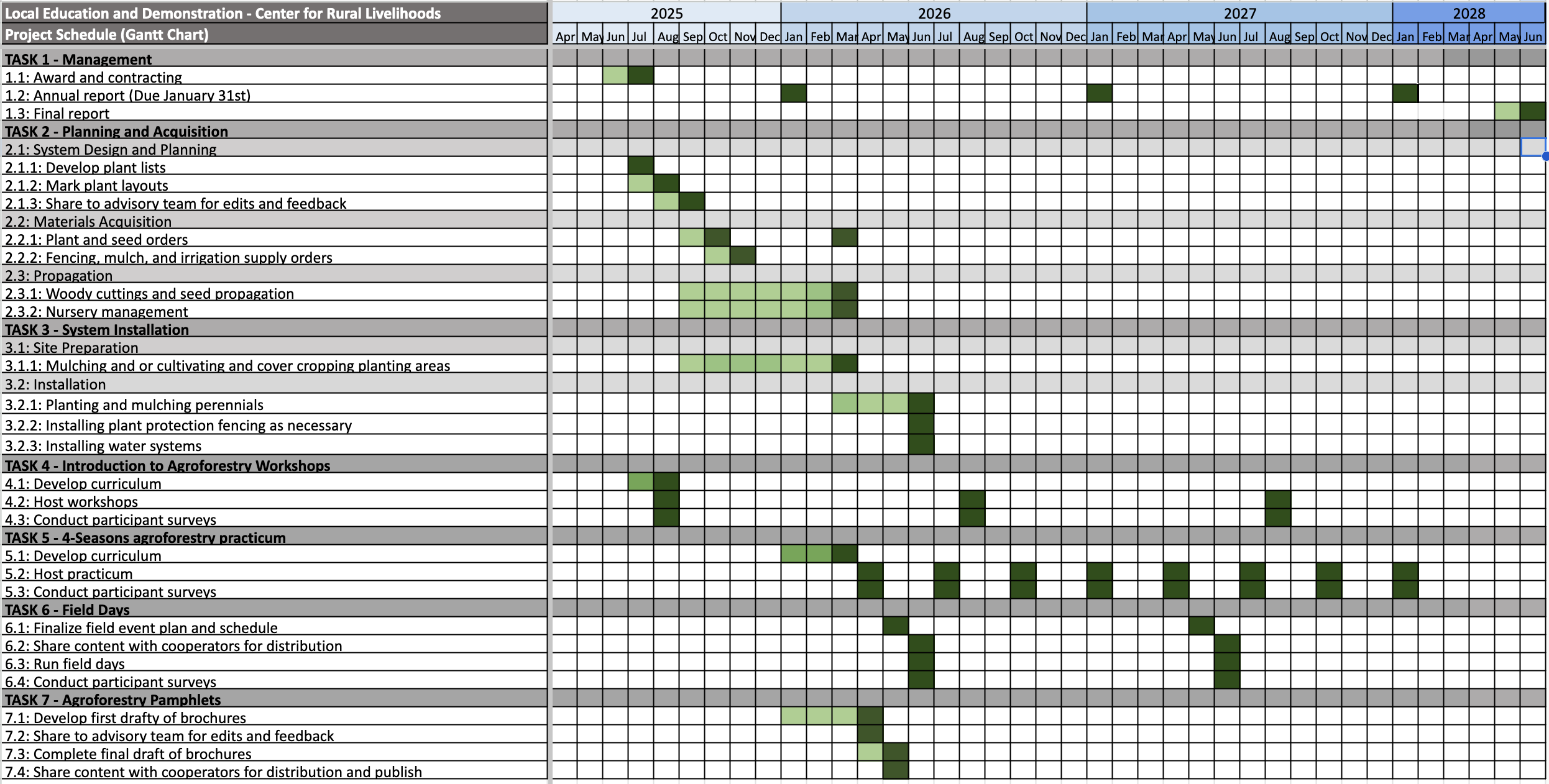
Milestone 1: Complete Demonstration Garden Plan by September 1, 2025
-
- Outcomes:
- Final design and species list for demonstration site
- Obtain professional review by collaborators
- Outcomes:
-
- Completed by:
- Abel Kloster, Josh Fattal, Drew Thomas, Michael Godfrey
- Completed by:
Milestone 2: Complete initial introductory agroforestry workshop at CRL August 1st 2025
-
- Outcomes:
- Develop Curriculum
- Run workshop
- Collect evaluation
- Outcomes:
-
- Completed by:
- Abel Kloster, Drew Thomas
- Completed by:
Milestone 3: Complete and circulate all agroforestry pamphlets by June 1, 2026
-
- Outcomes:
- Complete first draft of pamphlets
- Obtain professional review by collaborators
- Publish final draft of pamphlets
- Outcomes:
-
- Completed by: Abel Kloster, Drew Thomas, Michael Godfrey
Milestone 4: Installation of Agroforestry Demonstration Site by July 1, 2026
-
- Outcomes:
- Installation of all plantings
- Installation of plant protection and irrigation systems
- Installation of informational signage
- Outcomes:
-
- Completed by:
- Abel Kloster, Josh Fattal, Drew Thomas
- Completed by:
Milestone 5: Complete first round of farm field days and all CRL workshops by February 1, 2027
-
- Outcomes:
- Develop curriculum
- Run first round of educational workshops
- Analyze evaluations and feedback and make adjustments as necessary
- Outcomes:
-
- Completed by:
- Abel Kloster, Drew Thomas, Penny Feltner, Tao Orion, Jarvis Jensen, Tina Jensen, Andhi Reyna
- Completed by:
Milestone 6: Complete final round of farm field days and all CRL workshops by February 1, 2028
-
- Outcomes:
- Run Educational workshops
- Collect participant evaluations
- Outcomes:
-
- Completed by:
- Abel Kloster, Drew Thomas, Penny Feltner, Tao Orion, Jarvis Jensen, Tina Jensen, Andhi Reyna
- Completed by:
Milestone 7: Final report and evaluation: June 1, 2025 - June 1, 2028
-
- Outcomes:
- Collate all survey data
- Produce final grant report
- Outcomes:
-
- Completed by:
- Abel Kloster
- Completed by:
Cooperators
- - Producer (Educator)
- - Producer (Educator)
- - Producer (Educator)
- - Producer (Educator)
- (Researcher)
Education & Outreach Initiatives
Lead hands-on workshops throughout the year, providing a consistent and free resource for farmers, service providers, and the rest of the public to learn regional strategies related to agroforestry.
This workshop series will occur on weekends throughout the year at CRL and partner farms. Workshop themes include specific practices and strategies under the 5 overarching agroforestry systems in the Northwest (silvopasture, tree intercropping, riparian buffers, forest farming, and forest gardening). The series was kicked off in 2025 with a silvopasture workshop, followed by a bigleaf maple syrup field day, and most recently a living willow fence installation workshop. Upcoming spring workshops include pruning and orchard management, and forest gardening.
Establish agroforestry demonstrations on the CRL campus that showcase practices and species applicable to the Pacific Northwest for both research and public demonstration purposes.
A concept plan has been approved and a final draft design is in development for the main demonstration garden area. Leaves have been
Educational & Outreach Activities
Participation summary:
3 site visits to farms to provide consultation on silvopasture integrations to their grazing enterprises - in cooperation with Coast Fork Willamette Watershed Council and Upper Willamette Soil and Water Conservation District
2 workshops - "Bigleaf Maple Syrup Installation and Harvest" and "Living Willow Fence Planting" have taken place since grant began. Curriculum and scheduling for 2026 programming is in development. Workshops will include "Introduction to Agroforestry", "winter pruning and fruit tree management", "Forest gardening", "Hedgerow design and installation", "Forest farming maple syrup, mushrooms, and forest medicinals", "conservation grazing and silvopasture", "biochar production".