Final report for WPDP24-021
Project Information
We have developed high-quality, low-cost soil moisture probes and IoT irrigation control systems that can significantly improve irrigation efficiency when used to automate watering. In this proposal, we couple this technology with an Upskilling micro-credentialed hands-on training kit with self-paced online learning. This training and technology is especially relevant for urban and peri-urban food production along Colorado’s Front Range. The Food Access Research Atlas shows that Denver, Loveland, and Fort Collins, CO, have significant low-income community populations with minimal access to fresh food. Unfortunately, this same urban area is prone to water restrictions and increasing water costs – making urban food production challenging in this arid zone. This project partners with urban food producers to create demonstration experiments to help our urban clientele see first-hand the impacts of precision irrigation tools and practices on crop and vegetable yields while reducing water use and costs. Stakeholder partners will follow a training program on Soil Internet-of-Things (IoT) technology using a hands-on kit that also teaches crucial irrigation principles. The program will follow cognitive science research, utilizing “Fit-Bit for Learning” and “Coaching Circle” models, which have proven successful in longer-term learning that better leads to behavior changes. This program pilot will empower Urban Ag Leaders to offer subsequent sensor-based irrigation training in their education/outreach programs. In addition, the micro-credential earning opportunity will also provide skills documentation for any participant, thereby allowing for potential new career pathways. It is often stated that “Colorado Runs on Water,” which is more true today with drought, water shortages, and climate change looming along the Front Range. With the rapidly growing urban population, we must train tech-savvy urban growers who can produce fresh food while conserving water resources.
The Project Objectives to be achieved by 2025 span three inter-connected sub-groups that we are
targeting.
1) Urban Food Innovators (“Trainers”)
- Through participation in the Urban Food Innovators program, participants will gain...
- Awareness of AI applications in urban food production.
- Longer-term knowledge of precision irrigation principles and their use in urban food production.
- Skills for utilizing soil sensing and IoT technology in urban food production.
- Skills in designing irrigation experiment demonstrations.
- Skills in implementing the U-Behavior principles for improved learning for those they train.
2) Employees/Staff at Urban Food Innovator Locations
- Increased knowledge of precision irrigation principles and their use in urban food production.
- New skills for utilizing soil sensing and IoT technology in urban food production.
- Skills in managing experiment demonstrations.
3) Visitors to Urban Food Innovator Locations
- Increased awareness of precision irrigation principles and use in urban food production.
- Improved knowledge of soil sensing and IoT technology in urban food production.
- Expanded Interest in pursuing agriculture careers.
Project Year 1
(April 2024) Phase 1 – Urban Food Innovator in-person onboarding workshop with 10-20 stakeholder partners to explore their specific irrigation challenges, discuss how to use the Soil Sensing IoT probes and online training badge materials. Establish goals for and plan out Coaching Circles, site specific demonstration experiments, as well as community outreach activities. Connect group to the accompanying online badge courses for those wishing to dive deeper and earn a badge for their career. Expected outcomes: 10 –20 participants.
(May – October 2024) Phase 2 - Urban Food Innovators complete online micro-credential badge (optional), set up and run on-site experiment demonstrations including data collection, and implement outreach activities. Weekly-biweekly virtual Coaching Circle check-in sessions available to troubleshoot and to compare what each site is learning. Expected outcomes: 7-15 participants in Coaching Circles and set up experiments (with 200 staff/volunteers), 5 complete badge courses.
(November 2024) Phase 3 - End of growing season Urban Food Innovator and their guests come back together to tour each urban food farm/garden to see experimental results and to hear what was learned. Expected outcomes: 20 participants in tours. 1500 visitors to experiment demonstrations.
(December 2024-January 2025) Evaluation and Reflection - Analyze Urban Food Innovator feedback and experiment plot data to measure impacts and progress towards overall project goals. Make adjustments for Year 2. Expected outcomes: Knowledge gain in 10 Urban Food Innovators, 200 staff/volunteers and awareness gains by 1500 visitors.
(Feb-March 2025) Recruit next co-hort of 10 new Urban Food Innovator joining first co-hort.
Project Year 2
Repeat project cycles/phases and calendar target dates implementing modifications based on lessons learned in 2024. Expected outcomes: Similar or greater than Year 1.
Cooperators
- (Researcher)
- (Educator)
- - Producer
- - Producer
Education
Our team used the Design Thinking Process to research, evaluate, and better understand the needs of our urban agriculture collaborators (ie urban farms/gardens). What this means is our urban ag collaborators were co-developers with us in all aspects of the program. We started first with a focus group to learn more about their specific needs, constraints and opportunities. We used the information gathered through this process to improve our hands-on learning kit and training program approaches before piloting them.
Our focus group work was then followed with major redesigning of the IoT/AI learning kit and rethinking how to conduct training in a manner that better aligned with our stakeholder needs. We then pilot tested (2024) the redesigned IoT/AI kit with Loveland Youth Gardeners and Colorado State University’s horticulture Trial Garden program, both of which saw large numbers of public visitors. Input and lessons learned from the focus group and pilot work positioned our team for a larger roll out in the 2025 growing season to six urban ag community partners along the Front Range and we are beginning demonstrations installations now for the 2026 season .
The evaluation aspect of the project was designed to support continuous improvement, assess program effectiveness, document measurable outcomes, and position the initiative for long-term sustainability and broader dissemination. Using an agile, Design Thinking–informed framework, the evaluation incorporated formative and summative methods, including focus groups, structured partner consultations, site observations from project partners and principal investigators, survey enhancements, interviews, and secondary data analysis. Dissemination and outreach efforts expanded the project’s visibility through LinkedIn posts, long-form thought leadership articles, and integration into CSU Soil & Crop Sciences communications platforms. These efforts increased professional engagement, elevated partner visibility, and reinforced CSU’s leadership in agricultural upskilling and human-centered innovation.
Overall, the project’s evaluation demonstrated that the urban agriculture project improved irrigation outcomes, strengthened professional capacity, increased awareness of water stewardship, and established a scalable demonstration model that can support continued expansion of IoT and AI-enabled agricultural workforce development in urban communities.
Education & Outreach Initiatives
Urban Food Innovators (“Trainers”) - Through participation in the Urban Food
Innovators program, participants will gain...
1) Awareness of AI applications in urban food production.
2) Longer-term knowledge of precision irrigation principles and their use in urban
food production.
3) Skills for utilizing soil sensing and IoT technology in urban food production.
4) Skills in designing irrigation experiment demonstrations.
5) Skills in implementing the U-Behavior principles for improved learning for those
they train.
- Focus Group: Five urban ag staff participated in an online focus group held in April 2024. They summarized their organization's key learning objectives for participating in the SARE project and provided input on their needs, limitations, and ideas for experiment demonstrations.
- IoT/AI Kit Redesign: Based on input from focus group participants the IoT/AI hands-on learning kit was significantly changed in Year One (2024) and implemented in Year Two (2025).
- Experiment Demonstration: Using the revised IoT/AI kit and experiment demonstration plan, our team worked with one urban ag partner to set up and run this pilot the end of the summer of Year One. In Year Two (2025) this was expanded to six urban ag partners and will continue with 10 in 2026, after funding has ended.
- U-Behavior/Durable Learning: Working alongside an urban ag partner with a strong youth outreach program, we developed an online training module (built in iSpring) on durable learning concepts applied to irrigation, water conservation, and agricultural technology.
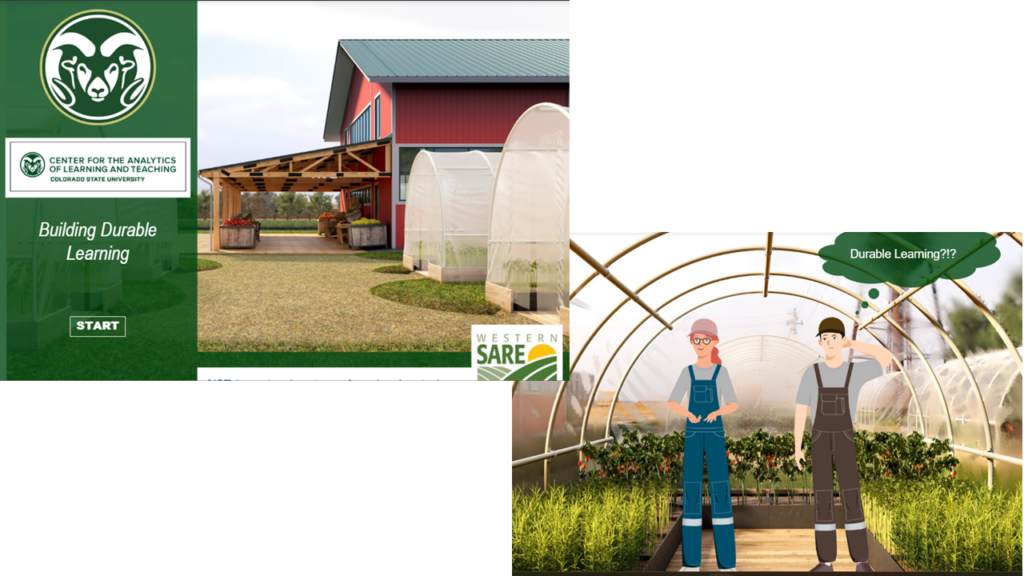
Screen captures of durable learning activity.
The outcomes of the focus group included 1) Urban Ag partners’ (and their teams) baseline skillsets varied and most would benefit from foundational training on using AI tools for improving irrigation efficiencies, 2) Employees and volunteers have very limited time available for training, and 3) Personnel changes occur frequently indicating a need for innovate approaches to training and engagement. This evaluation indicated a need to pivot from the in-person one day training event to more on-demand online micro-learning and one-on-one assistance from our team.
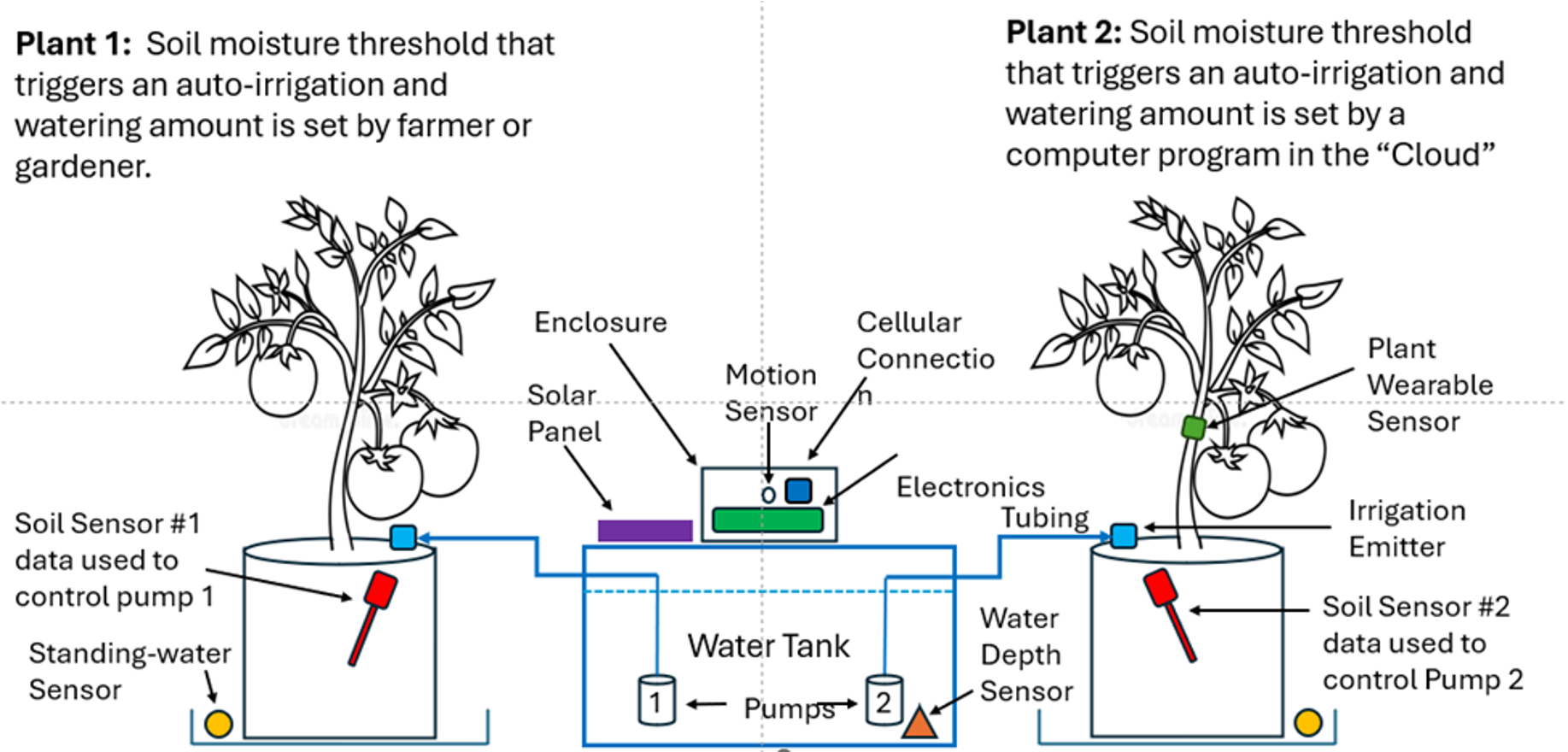
Given this valuable input, we spent much of the summer 2024 redesigning the learning kit. We developed a more stand-alone experiment demonstration set up in which one kit was powering 2 different irrigation pumps for 2 potted plants. One plant was water completely by AI and the other with IoT and user-driven decisions.
Our revised approach increased the impacts of this project by helping participants better access, use and apply the key concepts offered in this funded grant proposal.
- The input obtained was very valuable and we significantly modified our IoT/AI learning kit, as well as our training approaches. The initial 5 Urban Ag Innovator Participants identified key specific goals including learning to:
- Increase water conservation/decrease water use.
- Use natural resources more wisely in an effort to increase conservation and decrease costs.
- Improve soil health.
- Increase food production.
- Learn how to use ag technology to solve 1-4 now and into the future.
- Urban ag partners self-reported time constraints that prevented them from participating in workshops. Our grant team used this insight to utilize one-on-one consultations as our program's training delivery method for the remainder of the project.
- Initial consultations with partners also identified a need to significantly modify our hands-on learning kit. Their input helped us perfect the design of the educational demonstration to better meet participants' needs and improve the user interface. For example, not all of our urban partners had electricity at their sites and very few had reliable Wi-Fi access. Example modifications completed:
- Educational demonstrations were converted from Wi-Fi to cellular internet, so they work in locations where partners need to use them. For example, we learned that they don’t have Wi-Fi in garden areas; however, cellular service can run the demonstrations in these areas.
- A solar powered energy source was added so that partners without electricity on site or garden locations not near an outlet can use the IoT/AI technology.
- An automated people counter was tested to track the number of people who observe the educational demonstration. This tool proved to highly over-estimate participant numbers. We replaced this with a new tool that utilizes radar and will be testing it Summer 2026 (after grant has ended). Others in Extension have learned about this technology from our project and are interested in adopting it for their programs if it proves to be successful.
- One important outcome for the UBehavior/Durable learning piece was a clearer understanding of both the opportunities and challenges of implementing durable-learning approaches in community-based urban agriculture programs. Our piloting partner responded positively to the approach and recognized the value of moving beyond one-time exposure to repeated practice and reflection for deeper learner engagement. At the same time, the project revealed that durable-learning strategies can be difficult to implement in short-duration youth programs and volunteer-driven settings. Many community organizations operate under tight seasonal schedules and informal structures that limit repeated instructional contact. This insight helped the project team shift emphasis toward practical, flexible resources that future program leaders could adopt independently.
Employees/Staff at Urban Food Innovator Locations will gain:
1) Increased knowledge of precision irrigation principles and their use in urban food
production.
2) New skills for utilizing soil sensing and IoT technology in urban food production.
3) Skills in managing experiment demonstrations.
It took longer than expected to incorporate all the necessary revisions to the hands-on IoT/AI learning kit, 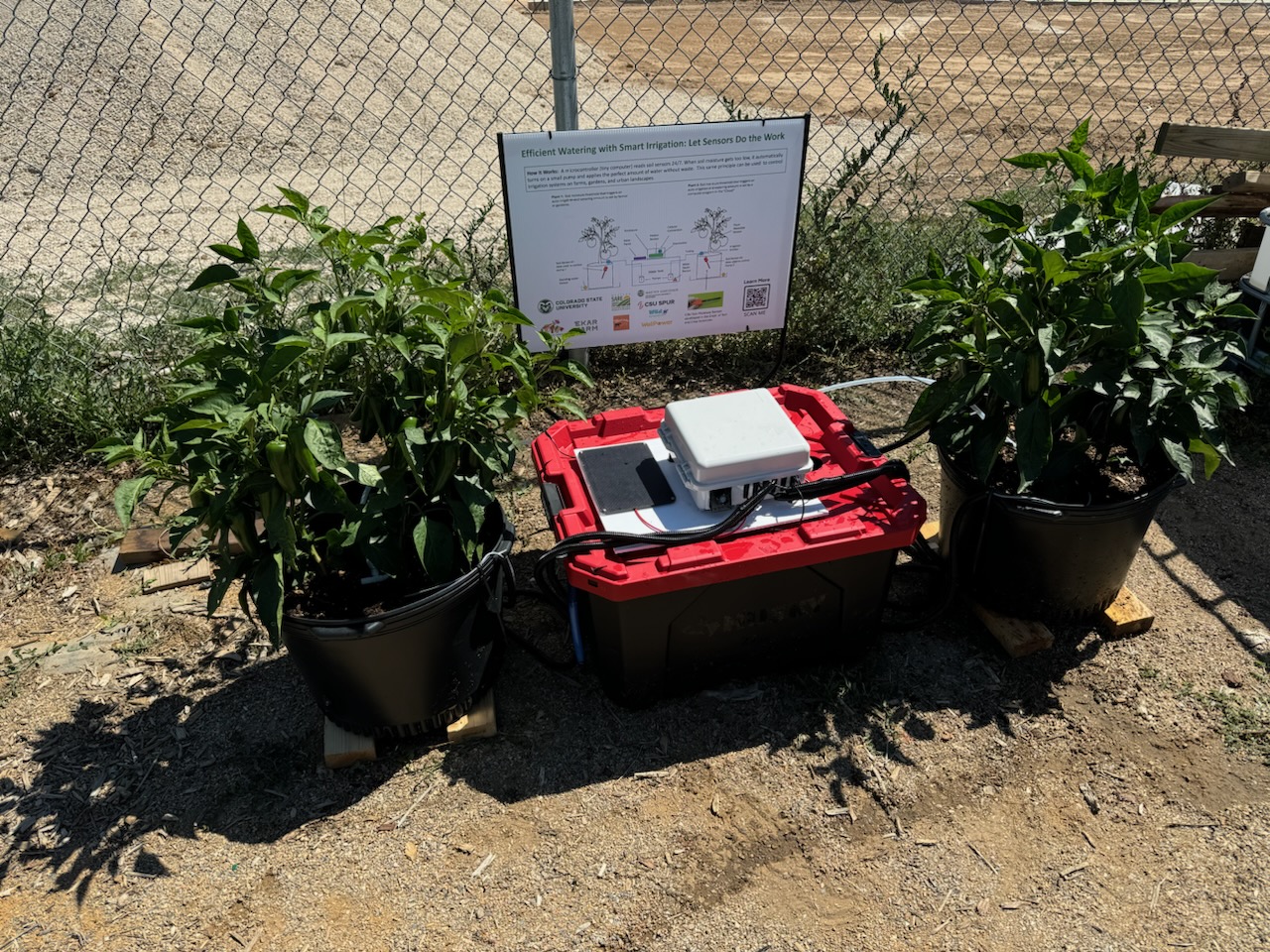 taking us to near the end of the summer 2024 growing season. We piloted this new design and new one-on-one approach to education with one garden manager at a partner Urban Community Garden location (Year One). In 2025 (Year Two), we successfully implemented these with six partners and will be continuing in 2026 (post award).
An external evaluation conversation was conducted with four project partners in 2025 to determine 1) how the kits would be used in each partner location, and 2) best practices associated with evaluation and data collection. A key finding from this discussion was the need to formalize and standardize impact data collection across sites while integrating evaluation into existing program structures. As a result, we added two five-point Likert-scale questions to partners’ existing pre/post evaluations. These questions assessed (1) whether learning to grow plants and monitor soils using sensors and artificial intelligence increased participants’ interest in agriculture and technology careers, and (2) whether participants wanted to learn more about using technology to decrease water consumption, increase yields, and monitor soil health. Concepts from the Western Regional Sustainable Agriculture Research & Education Programs outreach survey were considered when developing the questions and evaluation process. Survey questions were designed to directly measure shifts in career interest, technology engagement, and awareness of sustainable agriculture practices. In addition to the survey enhancements, partners were asked to share and standardize key program metrics to strengthen grant reporting. Suggested data points included the number of demonstration sites, learners, schools, workshops, tours, volunteer and staff hours, yield changes, water usage, and soil health data, pounds of produce donated (and economic value), partner engagement, and observational documentation (including photos). The evaluation process emphasized mixed-method data collection (quantitative metrics combined with qualitative observations) to capture both educational and agricultural outcomes.
- Experiment Demonstrations:
- One garden manager was trained in a one-on-one session and successfully maintained the experiment demonstration for the end of the 2024 growing season.
- The participating organization realized the benefits of an AI enhanced irrigation system and want expanded it to additional garden plots in 2025. The community garden group was surprised to see the increased pepper production compared with what they normally are able to grow.
- The participating organization increased their knowledge of precision irrigation principles in urban food production and learned how to use soil sensing and IoT technologies in food increase production.
- In our testing of using tomato plants and pepper plants in the experiment demonstration, we found the pepper plants worked better. They grow quickly, respond well to irrigation and participants enjoy harvesting them (very visual).
- Also in our testing, we discovered that yellow lids on the water reservoir tubs attracted yellow jacket wasps. They made nests inside, so we switched to red lids to solve the issue.
- In the 2025 summer season (Year Two) experiment demonstrations were successfully implemented at six Community Gardens across the Northern Front Range, all of which also had youth programs and their employees were trained on the technology.
- Throughout the entire project, the evaluation process included a blend of final interviews and secondary data analysis. Final evaluation interviews with four program participants from two urban ag farm settings revealed that the project successfully demonstrated that affordable, sensor-based irrigation can improve plant performance, increase water-use awareness, and reduce perceived barriers to agricultural technology. While youth exposure was high, deeper educational integration requires age-aligned materials and structural alignment with program formats. The greatest impact occurred among adult leaders and staff, who now view ag technology as accessible, practical, and scalable, positioning the program for sustained and expanded influence through strategic refinement.
- The interviews also revealed that 12 youth worked on a Harvest Team one day a week from June to September at one of the participating sites. These students regularly interacted with the experiment demonstration and learned about the important connections between agriculture and technology.
- One garden manager was trained in a one-on-one session and successfully maintained the experiment demonstration for the end of the 2024 growing season.
Visitors to Urban Food Innovator Locations will gain an...
1) Increased awareness of precision irrigation principles and use in urban food
production.
2) Improved knowledge of soil sensing and IoT technology in urban food production.
3) Expanded Interest in pursuing agriculture careers.
Several public outreach activities were conducted.
- 2024 & 2025 Experiment Demonstrations: An experiment demonstration was set up at one community garden location as a pilot test in 2024. Six were set up and maintained at various community garden locations in 2025. Additional sites are being set up now for 2026 (after grant ended).
- 2024 & 2025 CSU Trial Gardens: On the CSU Fort Collins campus is an area where new varieties of flowers and vegetables are being tested. The area is open for the public to walk by at any time. We worked with the leaders of this group to place our IoT/AI Experiment Demonstration at this location.
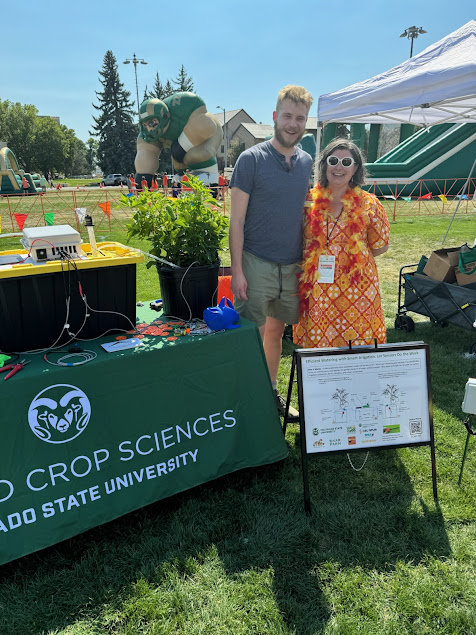
- 2024 & 2025 Ag Day Demonstration: Colorado State University’s Ag D
 ay is an annual, historical event is held during a home football game and is used as an opportunity to highlight agriculture. Our goal was to teach people that it is possible to get more crop per drop.
 -
2025 Festival on the Oval: Public event held on the CSU Fort Collins campus during homecoming weekend used to raise awareness of research and education projects at CSU.
- 2025 Regenerative Ag Summit: Our community partner shared information on our WSARE project with participants at this conference sponsored by the Wright-Ingraham Institute, Conejos County Conservation District, and Colorado State University Extension ; Working the Llano Sin Agua: A Regenerative Ag Summit and Range School for Southern Colorado and Northern New Mexico Producers —a two-day, in-person gathering focused on regenerative agriculture, rangeland health, and drought resilience in the San Luis Valley and the Taos Plateau.
- Experiment Demonstrations: Six community garden partners successfully maintained their demonstrations and indicated approximately 2300 public community members visited their demonstrations over the course of the grant.
- CSU Trial Gardens: One urban garden partner, the CSU Trial Gardens saw approximately 2000 people visited the demonstration throughout the project.
- Ag Day Demonstration: Our team's presentation emphasized ag tech and the "crop per drop" concept. The experiential educational demonstration drew attention and supported a constant flow of people interested in learning more. The demonstration asked questions like, “How many tubs of water does it take to produce plants?” and demonstrated the concepts that ag tech helps produce more food for less water. The approximate 800 participants included statewide ag groups, key ag stakeholders and decisions makers, university administration, Colorado extension, college and high school students and youth. People reported that they enjoyed harvesting peppers from the demonstration plants.
- Festival on the Oval Demonstration: Similar emphasis as the Ag Day Demonstrations, with approximately 400 participants including CSU faculty, students, parents of students and local community members.
- Regenerative Ag Summit: The approximate 40 participants included ranchers, researchers, conservation professionals, public health experts, and community members to share tools, knowledge, and stories for sustaining life and livelihoods in drylands. Our community partner shared information on our WSARE project, including links to online learning resources and descriptions of the demonstrations.
Public Outreach Impacts: Besides gaining a general increased awareness of technology uses in agriculture, including urban agriculture, this project uncovered other impacts among the general public's participation.
- Community Ripple Effects/Exponential Impacts: Visitors frequently connected the technology to potential household water savings, suggesting broader behavioral influence beyond the farm and increased water stewardship awareness.
- Improved Plant Performance: At the community garden experiment demos, visitors were able to see first-hand the clear yield and plant health differences validated the practical effectiveness of AI irrigation in a real-world, low-tech community farm environment.
- Demonstration Power is Significant: At urban ag sites, the kits served as a visible, passive public education tool, where more than 2300 combined youth and community members were exposed to ag-tech concepts through tours, demonstrations, and yield comparisons.
Educational & Outreach Activities
Participation summary:
Learning Outcomes
Project Outcomes
This project demonstrated that affordable soil moisture sensing, IoT technologies, and AI-assisted irrigation can be successfully integrated into community-based urban agriculture settings while supporting water conservation, workforce development, and community education goals. Evaluation findings indicate meaningful impacts across environmental, economic, and social dimensions.
A significant outcome was the successful development and use of low-cost soil sensing IoT technology in real-world community garden environments. At partnering Colorado community gardens, in experiment demonstrations AI-managed irrigation consistently produced healthier tomato plants and greater yields than manually irrigated comparison plants. This highlighted for staff and visitors, the value of real-time sensor data and automated decision-making for improving irrigation performance and resource efficiency.
Through these experiment demonstrations and additional public presentations, the project increased awareness of water use and stewardship among staff, student interns, and visitors (including farmers, ag service providers). Participants reported a greater appreciation for how much water even a small number of plants require and developed stronger interest in water-wise management practices. Urban ag staff also viewed the technology as a practical and reliable tool requiring minimal maintenance, demonstrating that advanced irrigation technologies can be accessible to small-scale producers and community organizations.
Professional development outcomes were also achieved. Two adult educators completed the online micro-credential and reported improved understanding of precision irrigation, IoT technologies, and AI applications in agriculture. The training increased confidence in explaining and demonstrating technology to others and helped normalize the use of sensors and AI as approachable tools rather than intimidating technologies. One participating intern pursued additional agricultural coursework following involvement in the project.
The demonstration-based approach proved highly effective for outreach and engagement. More than 2000 youth and community members were exposed to agricultural technology concepts through tours, demonstrations, and yield comparisons. Partners reported that framing the technology around innovation and AI generated curiosity and engagement, creating opportunities to discuss sustainable agriculture, irrigation management, and agricultural careers. These became valuable additions to existing educational programming and expanded each organization’s capacity to teach technology-enabled food production.
The project also generated important insights regarding educational delivery. Durable-learning strategies were valued by partners but proved challenging to implement in programs characterized by short-duration participation and frequent staff or volunteer turnover. This finding reinforced the need for flexible micro-learning resources and modular training approaches that better fit community-based urban agriculture settings.
Overall, the project strengthened leadership capacity, increased openness toward agricultural technology adoption, promoted water stewardship, and created ripple effects that extended beyond participating sites into the broader community.
Additional Outcomes:
- Kit Redesign: Because of the work completed with our learning kit redesign, we are able to use this same kit for a pitch we made to CHS Foundation for additional funding. We were awarded a grant from them in Jan 2025 and also a USDA-FANE grant, building on this work. We are able to use this same kit and modified on-demand micro-training approach for Colorado high school teachers in agriculture programs.
-
Improved Plant Performance: Clear yield and plant health differences validated the practical effectiveness of AI irrigation in a real-world, low-tech community farm environment.
-
Professional Skill Development: Staff and interns increased their knowledge and confidence with ag technology. One intern pursued further coursework as a direct result of the experience.
-
Normalized Use of Ag Technology: Urban ag sites began viewing sensors and AI as accessible tools rather than advanced or intimidating systems.
-
Expanded Educational Toolkit: The irrigation kit became “another tool in the toolbox” for explaining sustainable, tech-enabled food production to youth and visitors.
-
Broad Youth Exposure: Over 500 youth and community members observed or engaged with the system across both sites, primarily through demonstrations and tours. All of our urban ag partners had strong youth training/outreach programs. A poster was presented at ASA, CSSA, SSSA International Annual Meeting, San Antonio, TX.
-
Shifted Attitudes Toward Technology: Adult leaders reported reduced fear of agricultural technology and greater openness to integrating sensors across additional production areas.
-
Water Stewardship Mindset: Direct observation of minimal yet effective irrigation strengthened commitment to resource-efficient growing practices.
-
Leadership & Translation Capacity: Staff functioned as educational leaders, translating complex technology into accessible language for youth, peers, and visitors.
-
Community Ripple Effects/Exponential Impacts: Visitors frequently connected the technology to potential household water savings, suggesting broader behavioral influence beyond the farm.
-
Emerging Systems Thinking: The project prompted consideration of integrating additional sensing applications (soil, compost, production rows), expanding beyond single-plant demonstrations.
