Final report for YENC24-222
Project Information
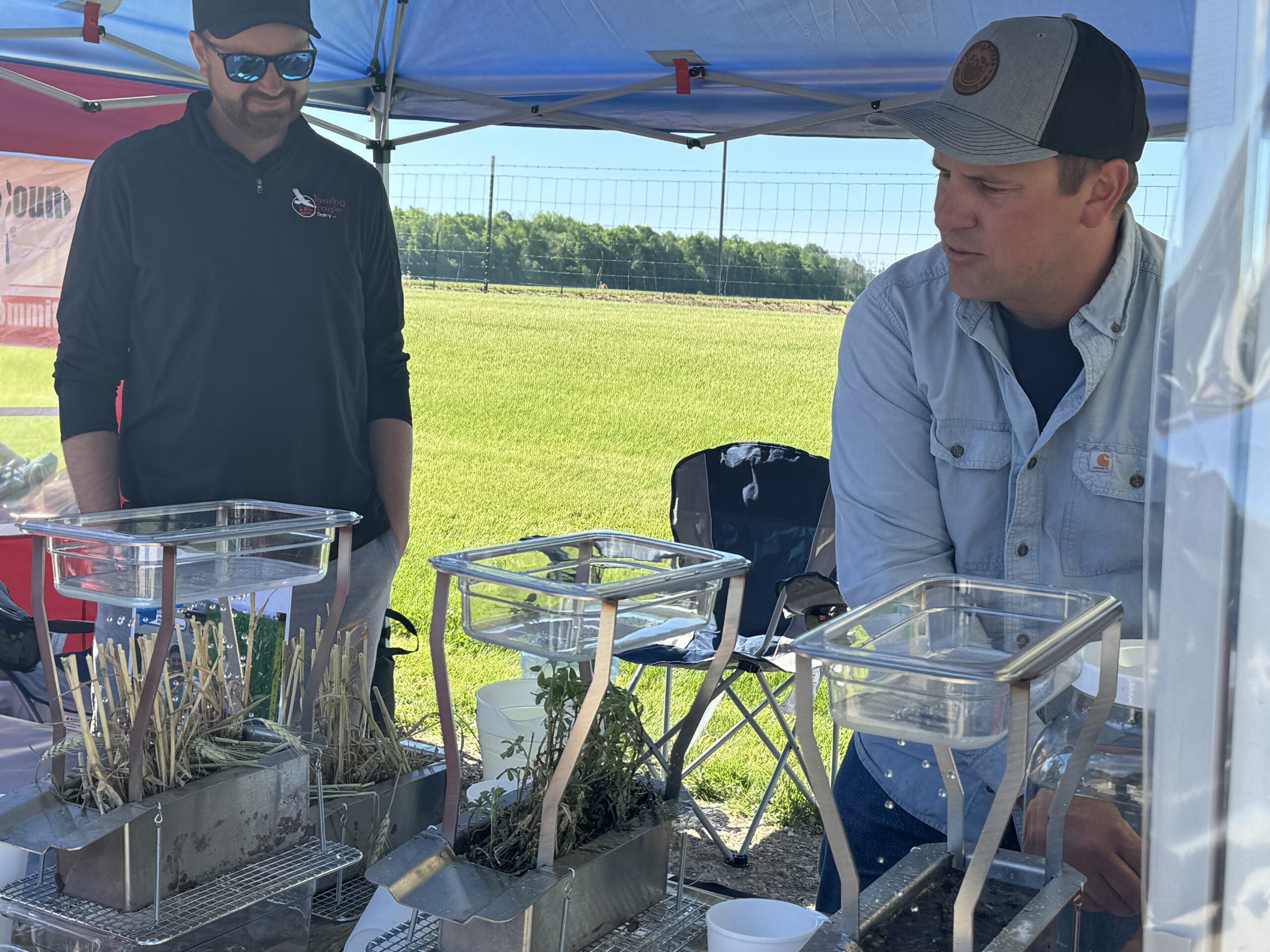
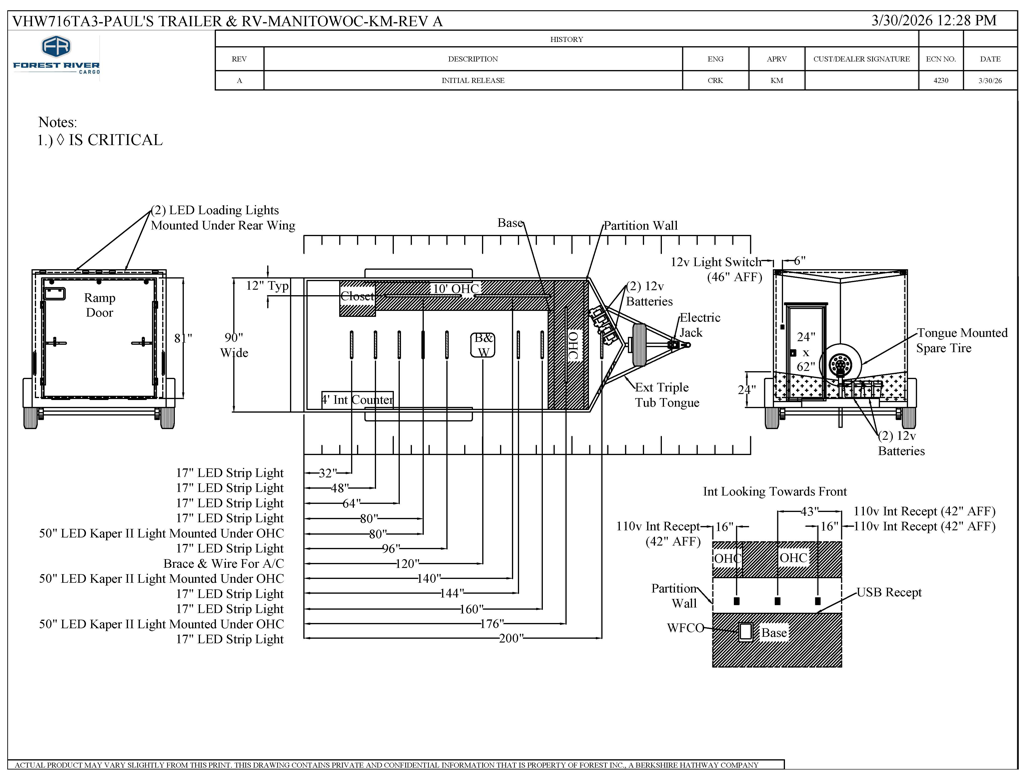
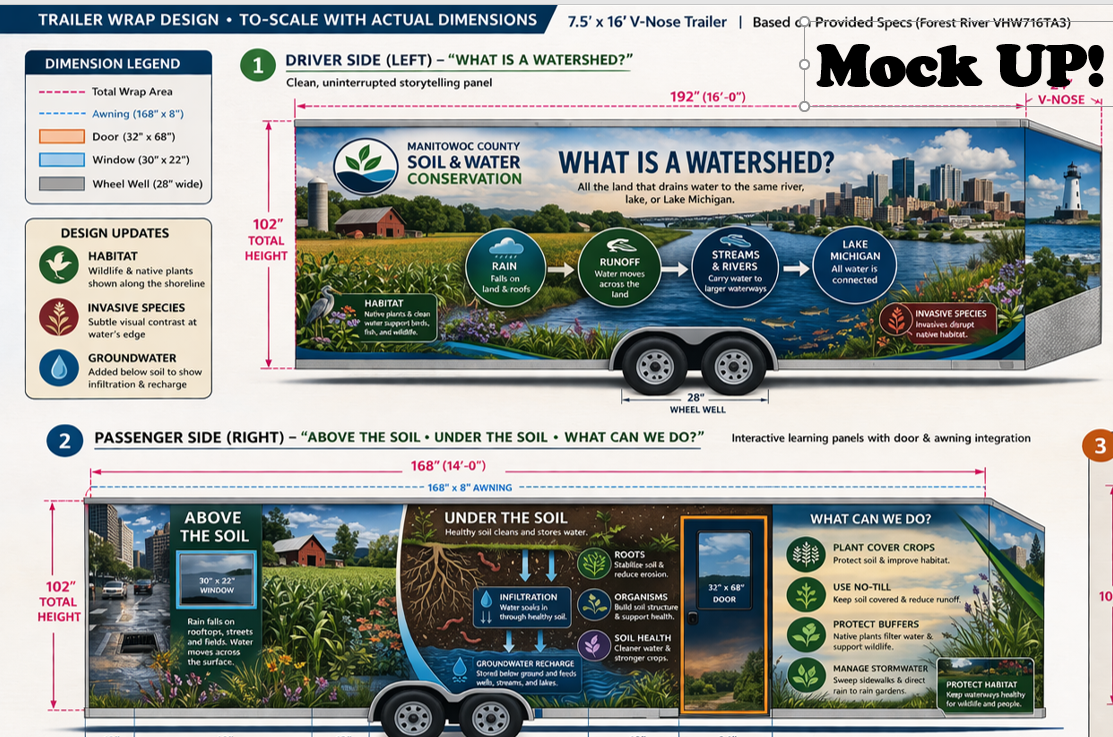
Manitowoc County Soil & Water Conservation Department (SWCD) developed and piloted a mobile sustainable agriculture education program to help youth understand connections among farming, soil health, conservation, and water quality. Youth explored how practices such as cover crops, reduced tillage, perennial vegetation, grassed waterways, nutrient management, and other agricultural best management practices can support productive farms while reducing erosion, nutrient loss, and impacts to local water resources.
The project emphasized hands-on, inquiry-based learning. SWCD purchased and piloted rainfall simulators, soil health assessment tools, slake test equipment, watershed models, and field investigation supplies at schools, community events, and working farms. Youth compared runoff and infiltration under different land-management systems, investigated soil properties, practiced soil sampling, explored the 4Rs of Nutrient Stewardship, observed conservation practices on working farms, and connected land management with downstream water quality. More than 300 youth participated over the life of the project. Through these experiences, students demonstrated increased awareness of agricultural conservation practices and greater understanding that land-management choices affect soil health, erosion, runoff, nutrient movement, and water quality.
Pilot experiences also informed development of a more complete educational program. SWCD developed or refined eight hands-on sustainable agriculture investigations and activities with Hosting Guides that allow teachers, farmers, conservation professionals, and other facilitators to lead the experiences. The Land & Water Connect Us website and an immersive 360°/VR farm experience were also developed to extend learning beyond individual events and make agricultural experiences accessible when farm visits are not practical. The Mobile Learning Trailer experienced manufacturing and build-out delays, but educational programming continued while the trailer was being developed.
The project demonstrated that portable, hands-on agricultural investigations can make complex soil and water concepts visible and understandable while providing a flexible alternative or complement to traditional farm field trips. It also demonstrated the value of offering multiple ways to access agricultural education—on farms, in classrooms, at community events, through digital experiences, and through a mobile learning lab.
Educator adoption is already occurring. Two Rivers High School educators have incorporated Manitowoc County-specific agriculture, geology, conservation, and water-quality information into their curriculum and plan to continue hands-on programming annually. UW–Green Bay Manitowoc Campus educators continue to incorporate agricultural conservation tours and demonstrations into student learning. Local farmers gained experience using rainfall simulators and other hands-on tools to teach youth and community members, and expanded Hosting Guides were developed to support future facilitators. SWCD is also working with Valders School District to incorporate the Mobile Learning Trailer once it is operational. Youth and parent adoption of specific sustainable agriculture practices was not measured as part of this project.
Overall, the SARE-supported project helped turn an initial mobile-learning concept into an ongoing, locally relevant sustainable agriculture education program. Additional grant and community support secured during the project has allowed the initiative to expand beyond its original scope and created a foundation for continued youth, educator, farmer, and community learning.
Goals:
- Establish a mobile learning lab to introduce youth to sustainable ag practices.
- Provide hands-on, engaging learning experiences to promote land stewardship and encourage conservation practice implementation on the farm and at home.
Objectives:
- Purchase and equip the lab.
- Develop at least 4 lesson plans with feedback from local teachers.
- Provide a minimum of 100 middle & high school participants with learning experiences that demonstrate the connection between conservation BMP’s and improved soil health, water quality, and farm productivity during 4 classroom & 1 on-farm workshops.
- Collect data and feedback to evaluate the learning lab.
Cooperators
- (Educator)
- (Educator)
- (Educator)
- (Educator)
- (Educator)
Educational & Outreach Activities
Participation summary:
We continued to develop and expand hands-on sustainable agriculture education through student programming, curriculum development, digital learning resources, and development of the Land & Water Connect Us Mobile Learning Trailer. Since the previous report, the project has moved from primarily piloting equipment and activities toward a more complete, replicable educational program.
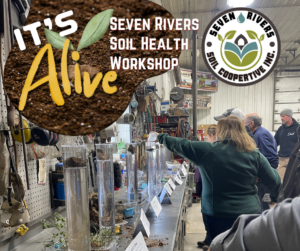
1. Hands-on equipment and farmer partnerships: SWCD continued working with Seven Rivers Soil Cooperative farmers and local educators to use hands-on equipment including tabletop rainfall simulators, slake tests, soil health assessment tools, watershed models, shovels, probes, and other field investigation equipment. Earlier pilots at Breakfast on the Farm, farm tours, and high school classrooms helped identify which activities were most effective and what additional guidance facilitators needed.
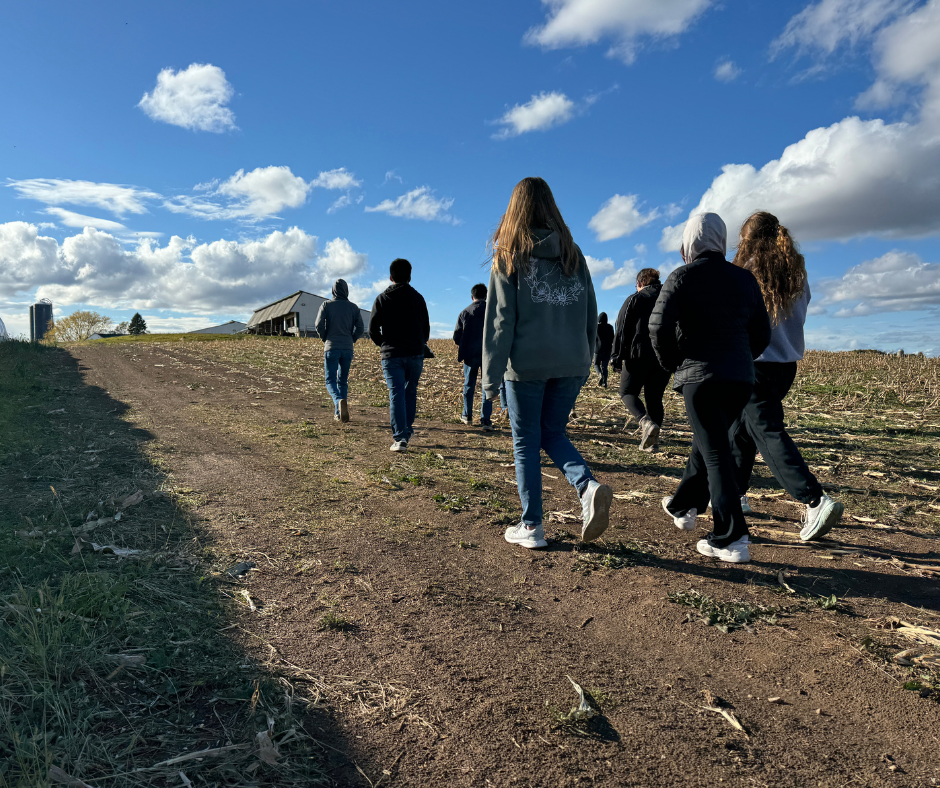
2. Lincoln High School on-farm experience: The on-farm experience previously reported as postponed to spring 2026 was successfully held at Hochkammer Dairy with 24 Lincoln High School students in grades 10–12. It was the sustainable agriculture component of a broader full-day water and careers experience with the morning at UW-Green Bay Manitowoc Campus and the afternoon on the farm. Cory Hochkammer served as the host farmer. Students rotated through hands-on learning experiences that included rainfall simulator demonstrations; practicing soil sampling and discussing nutrient management and the 4Rs; alfalfa sweeps; visiting a grassed waterway and trying conservation-practice siting equipment; touring the dairy barn and learning about the cows and dairy operation; and visiting a harvestable buffer to discuss perennial cover and its significance for water quality.
Approximately 80 students had initially been anticipated, but participation was reduced because not all students returned required permission forms. Coordinating off-campus experiences for middle and high school students continues to be challenging because SWCD relies on school coordinators for student recruitment, scheduling, transportation, and permission requirements. The smaller group, however, provided an opportunity for students to interact closely with conservation staff and the host farmer.
3. School partnerships: SWCD returned to Andrea Glaser's ecology classes at Two Rivers High School for a second year, reaching 44 students. Students used rainfall simulators, performed soil ribbon tests, learned about cropland conservation practices, and participated in a macroinvertebrate index activity using collected water and aquatic organisms brought into the classroom. The activities connected soil and land-management decisions with runoff, aquatic ecosystems, and downstream water quality.
Teacher feedback reinforced the value of the hands-on approach. Glaser reported that students “thoroughly enjoyed the hands-on mini labs” and identified the traveling education trailer as a strong fit for the district. She noted that many students live near or are part of local farming families and saw the mobile model as an opportunity to deepen their connection to agriculture. SWCD and Two Rivers High School plan to continue this partnership annually and incorporate the trailer once it is operational.
SWCD also established an annual sustainable agriculture tour with UW Green Bay - Manitowoc Campus, working with Rebecca Abler and Rick Hein AP Environmental Science Professors. The annual experience guides students throughout the Pine Creek Watershed, visiting conservation practices such as harvestable buffers, cover crop fields, installed grassed waterways and WASCBs with hands-on learning experiences, such as using the rainfall simulator and observing signs of soil health, stationed at several stops. The tour took place three times during the grant period starting in 2024.
4. Curriculum and educator resources: Experiences from the pilots were used to develop and refine a more complete library of sustainable agriculture investigations. Current resources include Operation Soil Armor, When Rain Falls, We're All Downstream, Will It Soak In?, What Holds Soil Together?, Read the Landscape Like a Soil Scientist, and the 4R Farm Challenge, which evolved from the earlier Manitowoc Farm Manager concept. The lessons provide hands-on investigations of cover crops and reduced tillage, rainfall and runoff, watersheds, infiltration, aggregate stability, field indicators of soil health, and nutrient management.
The lessons were developed to be usable by teachers, conservation professionals, farmers, and other facilitators and include learning goals, equipment and setup guidance, opening conversations, inquiry questions, background information, troubleshooting, and reset instructions. Expanded Hosting Guides also address a recommendation to provide additional support for farmers and other facilitators using equipment such as rainfall simulators.
5. Digital and immersive learning: SWCD developed the Land & Water Connect Us website to connect the physical trailer experience with additional learning opportunities and educator resources. The site includes a visitor Field Guide, hands-on activities, deeper learning, local places to explore, actions visitors can take, and resources for educators. A 360°/VR farm experience was also developed to allow participants to explore agricultural systems, including modern dairy barn features such as robotic milking, ventilation, and cow comfort. These digital components expand access beyond a single field trip or trailer visit. Although the VR farm experience is experienced best through a Meta headset, it can be accessed through the Land and Water Connect Us website.
6. Mobile Learning Trailer: The physical trailer is currently being built. Manufacturing and build-out options resulted in several delays, but educational programming and curriculum development continued while the trailer was in development. SWCD is working with Valders School District to plan a school-based launch once the trailer is completed and ready for use.
7. Project growth and future outreach: Since the original SARE application, the project has leveraged additional financial support, including $5,000 through a DNR Surface Water Grant, private foundation support, and several thousand dollars in contributions from conservation and outdoor organizations. This additional investment has allowed the project to grow beyond the scope possible through the original award.
SWCD is also working with Wisconsin Land+Water to present the development of the Mobile Learning Trailer and associated learning experiences at its statewide annual conference in March 2027. The presentation will share the development process, hands-on investigations, lessons learned through piloting, digital components, and strategies other conservation educators can adapt in their own communities.
Despite challenges associated with school schedules, permission requirements, and trailer manufacturing delays, the project has continued to reach students while developing a more flexible model for future delivery. Hands-on investigations can now be used on farms, in classrooms, at community events, through equipment lending, and eventually through the completed Mobile Learning Trailer.
- Other
Learning Outcomes
Awareness of agricultural conservation practices: Students increased their awareness of cropland and structural conservation practices that support agricultural production while protecting soil and water. Through farm visits and hands-on activities, students saw practices including harvestable buffers, grassed waterways, cover crops, reduced tillage, and WASCOBs and discussed why and where farmers use them.
Understanding connections between land management and water quality: Students demonstrated increased understanding that decisions made on agricultural land can affect runoff, erosion, infiltration, nutrient movement, and downstream water quality. Rainfall simulator activities helped students visually compare how water and sediment move under different soil-cover and management conditions.
Soil observation and investigation skills: Students practiced hands-on soil assessment skills including soil sampling, ribbon testing, observing soil structure and cover, and comparing how soils respond to rainfall. These activities moved soil-health concepts from classroom discussion into observable and measurable characteristics.
Awareness of nutrient management: During the Lincoln High School farm experience, students practiced soil sampling and were introduced to the 4Rs of Nutrient Stewardship—Right Source, Right Rate, Right Time, and Right Place—and discussed how soil information, crop needs, field conditions, and water-quality considerations influence nutrient-management decisions.
Understanding agriculture as part of a watershed system: Through macroinvertebrate investigations, water-quality activities, farm visits, and conservation demonstrations, students explored connections between agricultural land management and aquatic ecosystems rather than viewing agriculture and water quality as separate topics.
Awareness of agricultural and natural-resource careers: The Lincoln High School experience connected agricultural conservation with a broader day of water-related learning and career exploration, exposing students to university researchers, conservation professionals, farmers, educators, and community partners working in agriculture and natural resources.
The project has progressed substantially beyond the initial pilot phase. SWCD originally proposed reaching a minimum of 100 youth and has now engaged 310 youth through farm tours, classroom activities, community events, and hands-on sustainable agriculture demonstrations.
Since the previous report, 24 Lincoln High School students in grades 10–12 participated in a full-day water and career-learning experience that concluded with an on-farm sustainable agriculture program at Hochkammer Dairy. An additional 44 Two Rivers High School students participated in hands-on soil, rainfall, conservation, and macroinvertebrate investigations.
A significant lesson from the project has been the challenge of relying primarily on off-campus farm visits for secondary students. Approximately 80 students were anticipated for the Lincoln experience, but only 24 were able to participate, largely because required permission forms were not returned. School schedules, transportation, permission requirements, and SWCD's reliance on school coordinators make larger off-campus experiences difficult to organize.
Rather than reducing the project's reach, this experience reinforced the value of the Mobile Learning Trailer and portable equipment model: bringing agricultural experiences to schools can reduce barriers while still allowing students to investigate authentic conservation concepts. The project has therefore evolved toward multiple delivery options, including farm visits, classroom programming, hands-on equipment, downloadable lessons, digital learning, VR experiences, and the Mobile Learning Trailer.
Teacher feedback has been positive, and partnerships with Two Rivers High School and UW–Green Bay Manitowoc Campus are continuing. The project has exceeded its original youth-reach goal while also establishing resources and partnerships intended to continue beyond the grant period.
Educational activities initially used locally developed demonstrations and field experiences that were later formalized into the Land & Water Connect Us curriculum series. Rainfall simulator demonstrations were used at Breakfast on the Farm events, Two Rivers High School, and farm tours to investigate soil cover, runoff, erosion, and infiltration. Soil sampling, ribbon tests, conservation-practice observations, macroinvertebrate investigations, and farm-based demonstrations were also incorporated according to the setting.
Lessons developed and refined through these experiences now include:
Operation Soil Armor — an active learning game exploring cover crops and reduced tillage.
When Rain Falls — rainfall simulator investigation comparing runoff, infiltration, erosion, and water clarity.
We're All Downstream — watershed-model investigation connecting land use, runoff, conservation practices, and downstream water quality.
Will It Soak In? — field-based soil infiltration investigation.
What Holds Soil Together? — slake-test investigation of soil aggregate stability.
Read the Landscape Like a Soil Scientist — five-station field investigation using observable indicators of soil health.
4R Farm Challenge — evidence-based nutrient-management investigation applying Right Source, Right Rate, Right Time, and Right Place to Manitowoc County agricultural scenarios. This curriculum evolved from the earlier Manitowoc Farm Manager concept.
These resources are being incorporated into the Land & Water Connect Us educator resource library and will support future classroom, field, equipment-loan, and Mobile Learning Trailer programming.
Strengths: The curriculum is hands-on, inquiry-based, locally relevant, and adaptable to different ages and learning environments. Activities use real agricultural examples from Manitowoc County and allow students to observe, test, compare, and discuss concepts rather than only receiving information. The lessons intentionally connect sustainable agriculture with soil health, water quality, and local landscapes. Standardized Hosting Guides provide facilitators with learning goals, setup instructions, discussion questions, background information, troubleshooting, and reset guidance, making the activities more accessible to teachers, farmers, and conservation educators who may not be subject-matter specialists.
Weaknesses/limitations: Several activities depend on field conditions, available equipment, or adequate setup time. For example, rainfall simulator comparisons are most meaningful when appropriate field samples with established plant growth are available. Farm-based activities can also be limited by transportation, school schedules, weather, and permission requirements. Because several of the completed lessons were developed after initial pilot activities, they have not yet all been implemented with students in their final standardized format. Continued use with educators and students will provide opportunities to refine timing, instructions, age-level adaptations, and supporting resources.
Project Outcomes
Organizational support for sustainable agriculture education has increased significantly over the life of the project. What began as an effort to purchase hands-on equipment and develop several learning activities has grown into the Land & Water Connect Us Mobile Learning Lab, supported by a library of locally relevant investigations, hands-on equipment, digital learning resources, a website, and an immersive VR farm experience.
The project has also leveraged additional financial support through a DNR Surface Water Grant, private foundation funding, and contributions from local conservation and outdoor organizations. These investments have allowed SWCD to expand the equipment, technology, curriculum, and Mobile Learning Trailer beyond the scope of the original SARE award.
Organizational support has also expanded through partnerships with schools, farmers, UW–Green Bay Manitowoc Campus, Seven Rivers Soil Cooperative, and other community partners. SWCD is working with Valders School District to launch the completed trailer and with Wisconsin Land+Water to share the project and learning experiences with conservation professionals statewide at its March 2027 annual conference.
The project has moved beyond a short-term grant activity and is being developed as an ongoing SWCD education program, with equipment, curriculum, and digital resources available for continued school and community use.
When Manitowoc County SWCD began this project, the goal was relatively simple: create a mobile learning lab that could give youth more opportunities to experience sustainable agriculture firsthand.
The project grew into something much larger.
Early pilots with rainfall simulators, soil health equipment, farm tours, and classroom activities showed us that students responded strongly to hands-on learning. They could see soil leave a conventionally tilled sample during simulated rainfall, compare it with protected soil, examine conservation practices on working farms, and connect decisions made on the land with the health of local water.
The pilots also taught us something unexpected: getting students to farms can be difficult. School schedules, transportation, permission requirements, and limited time can prevent students from participating. A planned on-farm experience for approximately 80 Lincoln High School students ultimately reached 24 because many students did not return permission forms.
Rather than seeing that as a failure, it helped clarify the need for a more flexible model: when students cannot get to the farm, we can bring agricultural learning to them.
The project evolved into Land & Water Connect Us, combining portable hands-on equipment, locally relevant sustainable agriculture investigations, a Mobile Learning Trailer, digital learning, and an immersive VR farm experience. Teachers can use the resources in classrooms, farmers and conservation professionals can lead demonstrations, and students can still experience working agricultural systems even when an on-farm visit is not possible.
That evolution has attracted additional grant and community investment and new school and community partnerships. Two Rivers High School plans to continue its hands-on programming annually, Valders School District is working with SWCD toward launching the completed trailer, and Wisconsin Land+Water is working with SWCD to share the project's development and lessons learned at its statewide conference in March 2027.
What began as a grant-funded project is becoming an ongoing education program designed to connect more young people with the farms, soil, water, people, and conservation decisions shaping their own community.