Project Overview
Commodities
Practices
Proposal summary:
Establishment approaches for seeding chestnuts vary greatly in labor and material costs. From our review of the literature, there's no published studies on whether methods requiring more labor and materials actually produce better survival and growth.
Details: Domestically grown chestnuts are in high demand for food and wildlife and many farmers are working to establish chestnut trees from seed directly at their farm because (1) nurseries can have limited supply of chestnut trees to buy, (2) nursery trees can be expensive with limited shipping options, and (3) nursery trees can be a source of disease (chestnut blight) and pests (chestnut weevils). For example, in 2025, we sold ~30,000 chestnut seeds from our orchard to farmers that were planning to establish new trees. Most people purchasing chestnuts for seed asked us for advice as to how best to establish their seedlings. In our search for an answer, we found that no published quantitative data are available about what methods are best for establishing chestnut trees from seeds. Different people/companies have different advice and suggestions with no systematic evaluation of techniques available. The problem we described for chestnut trees likely also applies to many nut trees planned for wildlife or human food.
Project objectives from proposal:
Solution:
Scientifically evaluate four establishment methods for seedling chestnut trees requiring varying amounts of labor and materials and communicate a recommendation for which establishment method is most cost effective through field days, presentations, and a final report.
Objectives:
- Determine how survival and growth of chestnut seedlings vary among four establishment methods.
- Quantify the labor and material costs for each chestnut seedling establishment method.
Details: In a nonscientific way, we've successfully established chestnut trees from seed by planting sprouted chestnuts in the orchard (herein termed "direct seeding in orchard") and sprouting the seeds indoors in pots and planting 1-2 ft tall trees out in the orchard (herein termed "outplanting potted seedlings"). Once chestnut seedlings are in the orchard, we also have had success growing them with and without tree tubes. Therefore, we've observed four approaches work: (1 & 2) direct seeding in the orchard with and without tree tubes, (3 & 4) outplanting potted seedlings with and without tree tubes. But we are not sure which method has the highest survival and growth. To be honest, we've had family debates at the farm concerning our differing opinions. Outplanting potted seedlings with tree tubes has been most labor and material intensive, so if survival and growth is like direct seeding without tree tubes, we all agreed it would be wasteful to expend the extra expense.
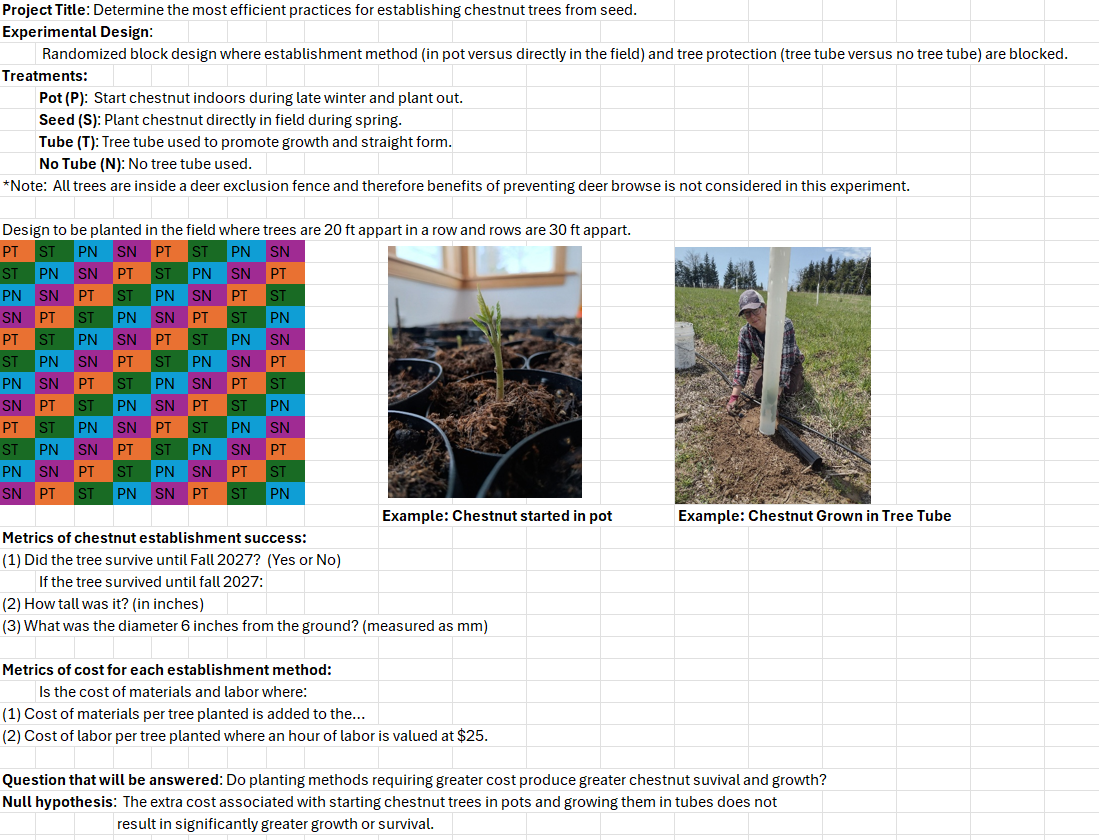
To accomplish our objectives, we will document the cost of and the survival and growth of 160 chestnut seedlings in our orchard given four establishment treatments (1) Direct seeding without a tree tube (n=40), (2) Direct seeding with a tree tube (n=40), (3) Outplanting potted seedlings without a tree tube (n=40), and (4) Outplanting potted seedlings with a tree tube (n=40). Two-hundred chestnut seeds will be procured from our farm from Precoce Migoule cultivar Jap/European hybrid chestnuts and stratified over winter at 38 F in Ziplock bags (method used successfully at our farm). We will start with 40 extra nuts in case some chestnuts do not sprout.
In April 2026, 80 sprouting chestnut seeds will be planted into pots (cell diameter of 2.5 inches and a depth of 14 inches) filled with 50% peat and 50% potting soil. These pots will be held at 60-70 F, provided grow lights 12 hours per day, and watered every 3rd day (methods successfully used at our farm). The remaining 80 seeds will remain in the ziplock bags until middle May. When the risk of hard freeze has passed (mid-May), the potted seedlings (~ 2 ft tall) will be planted out into the orchard. Forty of the potted seedlings will be placed inside 5 ft translucent tree tubes and staked with 10 ft galvanized steel conduit and the other 40 trees will have no tree tube. At the time the potted seedlings are planted, we will also directly seed the remaining 80 sprouting chestnuts. Where seeds are planted in the field, the soil will be loosened and prepared exactly as we did when planting out the potted seedlings. Forty of the planted chestnuts will be covered with a tree tube and the other forty will not.
The four planting treatments will be systematically assigned to eliminate any potential bias due location of planting. All trees will be provided with drip irrigation to supplement moisture and weeds will be controlled using glyphosate. Prior to winter, all the trees will be protected from rodent damage by using Bobbex deer and rodent repellent. All the trees will be planted inside an existing deer exclusion fence. In the spring 2027, all chestnuts will be fertilized following guidance from our previous research (see FNC19-1170).