Project Overview
Commodities
Practices
- Soil Management: composting, nutrient mineralization, soil quality/health
Abstract:
This project evaluated the potential of biochar-integrated composting systems to support sustainable organic waste management, nutrient retention, and soil health improvement through small-scale tumbler composting trials, pot experiments, and a corn field application trial. Three sequential biochar co-composting trials were conducted using food waste and wood chips amended with different biochar types, particle sizes, and application rates. During the thermophilic phase, biochar-amended treatments maintained temperatures approximately 3–7°F higher than the control.
Temporal compost analyses indicated that biochar amendment influenced nitrogen dynamics during composting. In the control treatment, total nitrogen and nitrate concentrations decreased over time, accompanied by an increase in the C ratio. In contrast, biochar-amended treatments showed increases in total nitrogen, nitrate concentrations, and NO₃⁻-N/NH₄⁺-N ratios, suggesting enhanced nitrification and altered nitrogen transformation. Although nitrogen concentrations in the biochar-amended treatments remained lower than in the control, this pattern may partially reflect dilution effects associated with the addition of biochar.
In the greenhouse spinach pot experiment, all compost-containing treatments significantly increased plant biomass compared to the propagation mix-only control. Although biochar-amended compost treatments showed lower initial inorganic nitrogen concentrations than the compost-only treatment, plant growth remained comparable, suggesting that biochar may influence plant performance through mechanisms beyond immediate inorganic nutrient availability.
For the corn field application trial, co-composted materials were produced at a partner farm using both commercially produced biochar and low-tech, farm-produced hardwood biochar. The farm-produced biochar generally showed stronger positive effects on composting performance and nitrogen dynamics than the commercial biochar product.
A biochar corn field trial was established using compost and biochar-amended compost treatments under a randomized complete block design (RCBD). Although statistically significant differences in first-year marketable yield were not observed, amended treatments showed significantly greater root nitrogen concentrations than the untreated control (p = 0.0048), suggesting early belowground nutrient responses that may become more apparent under long-term field application.
Future work will include additional tumbler composting trials, extended temporal analyses of biochar-amended compost, and multi-year field studies to support development of a practical biochar application manual based on long-term field results.
Community biochar workshops and the High Country Kiln Loan Program, conducted in collaboration with the local Agricultural Extension Office, have also helped foster regional interest in biochar and its practical applications.
Project objectives:
The Nexus Project is a collaborative research and outreach effort addressing regional agricultural challenges and aims to enhance the resilience of local farms by evaluating sustainable technology solutions. We propose two activities to achieve our goals with support from the S-SARE On-Farm Research Grant program.
(1) Efficient Greenhouse Heating: evaluation of the upgraded RZH
We propose separating the heat storage from the backup heat source by installing an on-demand water heater. This method will ensure that our system meets the needs of each cooperative farm, such as renewable energy collection efficiency and consistent soil temperature. By doing so, the heat storage temperature decreases after using the heat to warm the soil overnight. It allows cooler fluid to enter the solar collector, increasing efficiency. In the Nexus system, when the temperature of the RZH fluid is around 100 °F, the soil is maintained at an appropriate temperature, about 75 °F for germination soil. The proposed system design increases overall efficiency by maintaining the appropriate temperature of the soil with a small amount of energy because the on-demand water heater heats the fluid only when the temperature of the fluid leaving the heat storage is lower than the set temperature.
With the support of the NC BRI grant, an on-demand water heater was added to the existing RZH of Springhouse Farm in December 2022. Unlike storage tank water heaters that produce and store large amounts of hot water, on-demand water heaters increase energy efficiency by producing only as much hot water as needed when it is needed. During the trial operation conducted for about a month in the spring of 2023, the new system maintained stable growing conditions.
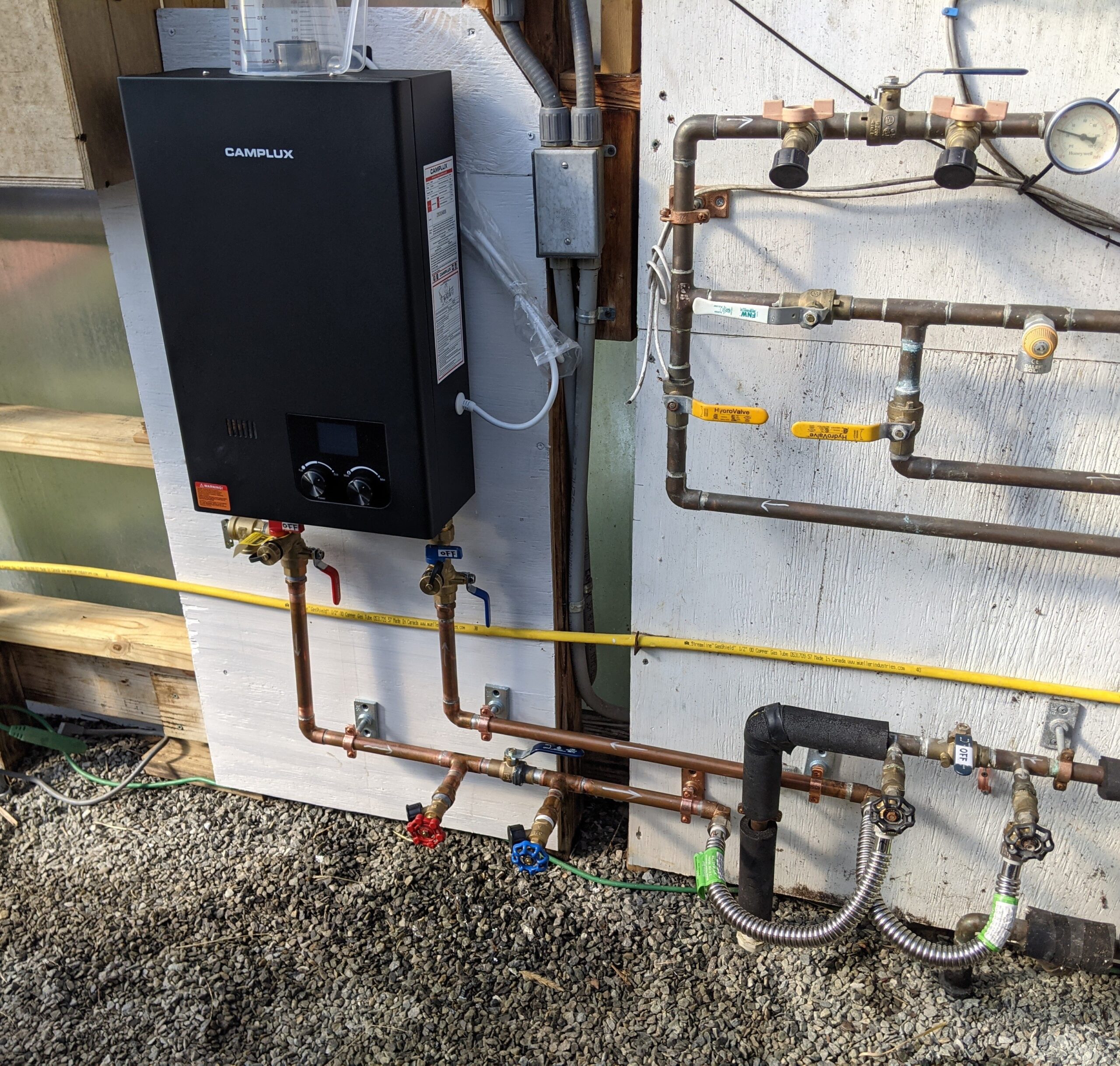
Through this grant cycle of S-SARE On-Farm research, we propose a study to collect and analyze data to evaluate the energy efficiency and growing conditions of the upgraded RZH system. We will collect data for the on-demand water heater RZH without solar energy collection in the first year and with solar energy collection in the second year. By comparing the two data sets, we will be able to know the improved solar energy collection by separating the heat storage and the backup heat source. Additionally, by evaluating RZH which operates solely with an on-demand water heater, it will be possible to propose a design that reduces the initial cost burden on local farms.
(2) Biochar soil application experiments and field trials
Biochar application to soil has been proven as a viable means of increasing soil fertility[13]. Significant porosity and high surface area of biochar provide different habitat properties appropriate for various soil microbes and enhance moisture and nutrient retention resulting in microbial population growth [14]. Inoculated biochar with organic fertilizers such as compost and digestate from anaerobic digestion is an effective method for biochar application to soil.
Over the past few years, the Nexus Project has been actively conducting research on biochar produced from local hardwood with support from NC BRI grant programs. CO2 flux data using a soil gas flux analyzer confirmed an increase in microbial activity in soil mixed with inoculated biochar compared to samples without biochar. A plant growth study performed on a 125 ft. by 4 ft. strip of degraded soil, once used to grow tobacco, at one of our cooperative farms, Against the Grain Farm exhibited the differences in immediate effect by the various inoculated and not-inoculated biochar applications. In terms of dry root and shoot masses and lengths and root-to-shoot ratios, the soil applied with 2mm biochar inoculated with compost tea showed a two-fold improvement compared to the soil without application. We also looked at different ways to produce biochar with hardwood available in the region, grind, and effectively inoculate biochar at a relatively low cost.
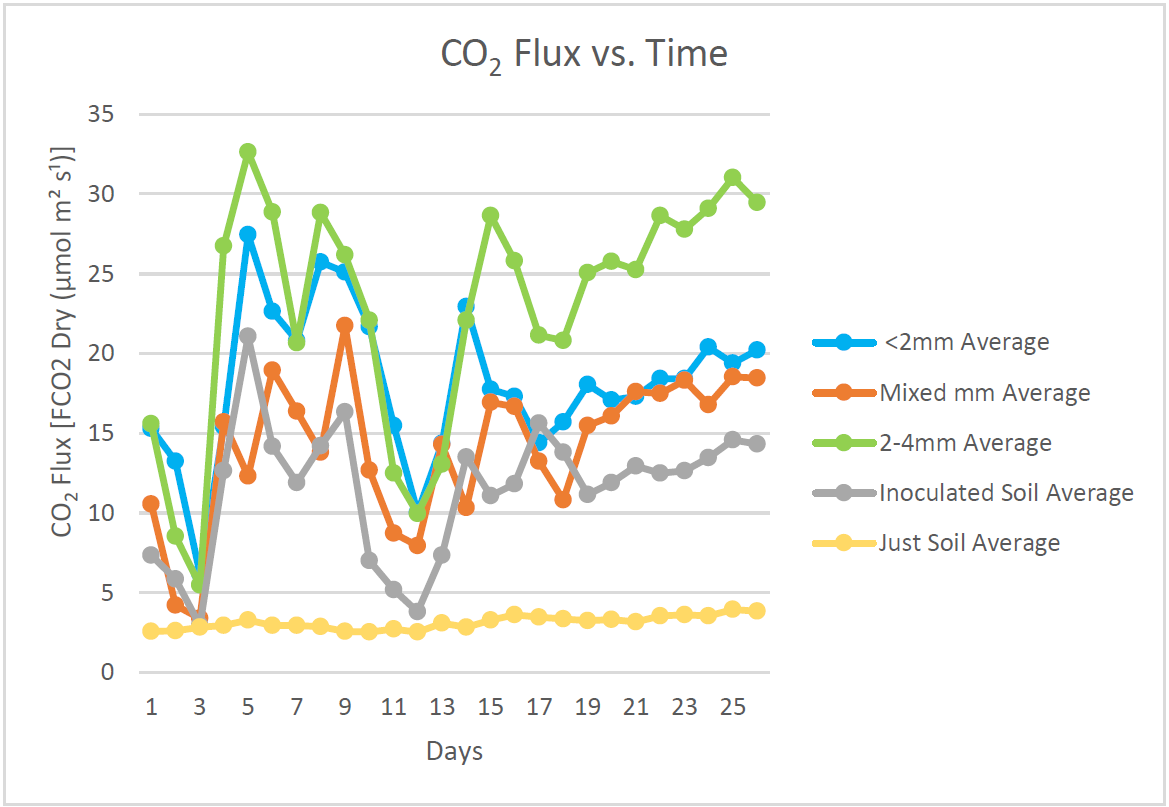
We propose to conduct small-scale experiments and field trials using biochar produced from local oak trees and hybrid poplar, and commercially available biochar. Using the soil from Springhouse Farm, we will conduct experiments in our greenhouse laboratory and field application research and evaluate its effects on crop and soil health. We will produce, crush, and inoculate biochar in the most efficient and reliable ways revealed through our previous studies. Eventually, we aim to provide a comprehensive guideline for soil management practices utilizing biochar. This resource is essential to achieve positive and consistent effects on our cooperative farms and for further dissemination to farms in the Southern Appalachian region.
With support from S-SARE’s On-Farm Research grant, we will be able to continue demonstrating the performance of the heating system and develop a practical guide to biochar application, thus enhancing this closed-loop system. We envision that this research provides more appropriate technologies and farming practices that farmers in Southern Appalachia can adopt for sustainable farming.