Project Overview
Commodities
Practices
Proposal summary:
Striped and spotted cucumber beetles cause stand and yield loss in larval and adult stages through physical damage. In the Midwest these beetles act as vectors of bacterial wilt. This is a challenge for cucurbits, especially in systems that follow NOP guidelines, which have limited insecticide options for cucumber beetle.
Cultural controls (trap crops, insectaries, row covers, screen houses, timing, varietal selection, NOP insecticidal applications) each come with their own set of tradeoffs, efficacies, and adaptabilities to large and small farm operations.
One promising trap crop is amaranth which attracts high numbers of cucumber beetles but requires significantly less land to grow. This has been observed anecdotally within the farming and gardening community but has not been thoroughly researched. Amaranth is a known habitat for beneficial insects including tachinid flies, lacewings, parasitic wasps, ground beetles and lady beetles.
We seek to learn amaranth's potential for crop protection when intercropped with cucumber as a more attractive beetle food source and if the amaranth can effectively serve as a host plant for predatory insects that diminish pest populations over multiple beetle generations. If viable, this intercropping may be adoptable to varied scale farming systems while introducing amaranth as a potential new crop.
Project objectives from proposal:
Solutions: This on-farm research project has demonstration and education components. We will assess if amaranth can be effective as both a trap crop and insectary in cucumber production to defend against striped and spotted cucumber beetle. The designated on-farm research field measures 160'x310.' It has been in Dutch white clover for one year, with a consistent soil type (Glynnwood loam) and management history. Plots will be strip cropped. Both cucumbers and amaranth will be transplanted.
One variety of cucumbers and amaranth will be utilized throughout the trial in the first year. In the second year, pending initial learning outcomes, different varieties may be introduced. Cucumber variety selections will be made under advisement from OSU Entomology, with 'Marketmore' and 'Diva' under current consideration. 'Marketmore' has demonstrated resistance to cucumber beetle and is an industry standard. Diva is susceptible to cucumber beetle yet highly desired by customers for its flavor and texture. Amaranthus cruentus, var. 'Golden Giant' has a 100-day maturity and 8' height and has been successfully utilized for this purpose in Nigeria (Pitan and Esan, 2014). The extended maturity time could allow for late season amaranth head removal prior to seed shedding and after the cucumber crop has concluded.
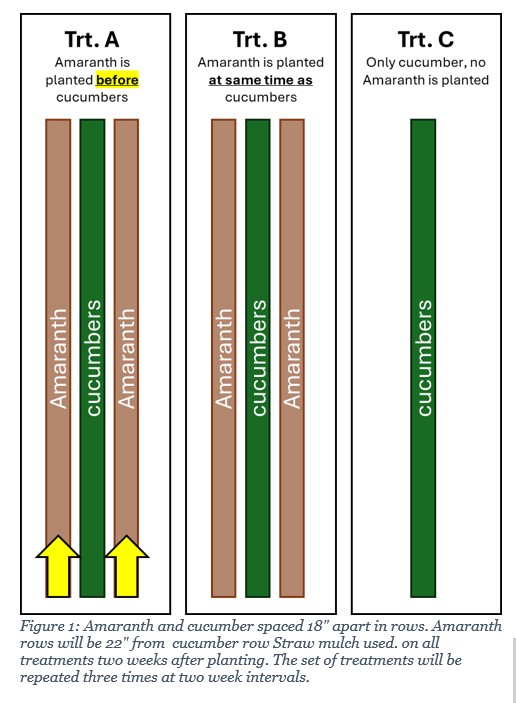
Treatments will be separated as far as possible (>50') to reduce potential for beetle cross over. Each treatment will measure 4'x30' in an East-West orientation and populated with transplants to reduce beetle exposure when plants are most vulnerable. Amaranth and cucumber will be planted at 18" spacing in row. Amaranth rows will be 22" from the cucumber row.
Treatments A and B consist of amaranth-cucumber-amaranth. In treatment A, amaranth is transplanted two weeks before cucumbers. In treatment B, amaranth is transplanted at the same time as cucumbers. Treatment C, the control, is one row of cucumber only. Each treatment will be lightly cultivated after the first weed flush then deep mulched with clean straw, which can potentially slow beetle movement and support wolf spiders (Snyder, 2025). Each treatment would be repeated three times at two week intervals during the growing season beginning the first week of June.
We will measure beetle and beneficial insect populations through weekly field sweeps and traps, fruit yield and percentage of damaged fruit, degree days, soil moisture, soil temperature, near surface humidity and watering frequency.
Objectives: This project will be conducted over two growing seasons and seeks to understand:
- Is amaranth, planted once and grown to term, a sufficient trap crop and beneficial insect host to reduce cucumber beetle infestations and therefore improve cucumber quality and yield?
- Can amaranth provide a cooler microclimate and pest protection benefits to improve cucumber quality and yield while conserving water?
- Is this intercropping system efficient for market growers relative to labor and land utilization?