Project Overview
Commodities
- Animals: poultry, rabbits
- Animal Products: eggs, meat
Practices
- Animal Production: grazing - multispecies, grazing - rotational, rangeland/pasture management
- Education and Training: on-farm/ranch research
- Soil Management: soil quality/health
Proposal summary:
Small diversified livestock
farms like ours often struggle to maintain pasture quality and soil
fertility while keeping costs manageable. Some of our paddocks show
bare spots, weeds, and uneven manure distribution. At the same
time, we purchase most of the feed for our laying hens and meat
rabbits, which increases costs and creates reliance on outside
inputs instead of cycling nutrients efficiently on the farm.
Many farmers in the North
Central region raise poultry or rabbits in small flocks or herds,
but there are limited examples showing how to integrate these
species into managed grazing systems on a small acreage. There is
also limited data showing how much such systems can reduce
purchased feed or improve soil health at this scale. Because this
challenge is common and there is interest in practical regenerative
practices, we believe our project can help provide information that
is useful to other farmers.
Project objectives from proposal:
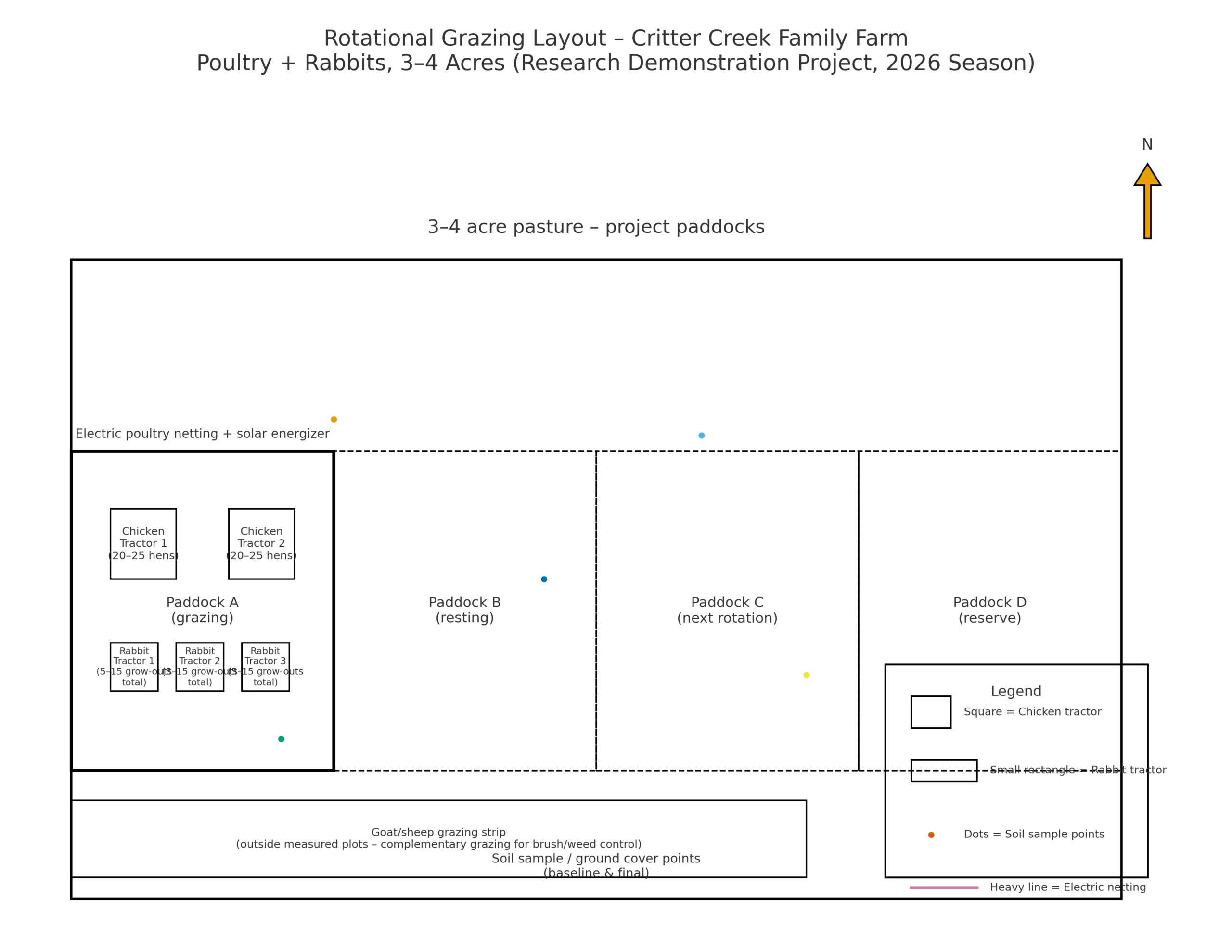 Rotational Grazing Layout for
Pastured Poultry + Rabbits at Critter Creek Family Farm (Project
Diagram - Q3)[/caption]
Solution
Our solution is to integrate
mobile pastured poultry and portable rabbit pens into a rotational
grazing system that improves soil health while maintaining meat and
egg production. We will set up a series of small paddocks on 3-4
acres of pasture and move two chicken tractors with 40-50 laying
hens and three rabbit "tractors" with 5-15 meat rabbit grow-outs
through these paddocks on a regular schedule (about every 1-3 days
depending on forage and weather). This rotation is designed to
distribute manure more evenly, stimulate plant regrowth, reduce
bare areas, and allow us to track changes in soil health and feed
use over time.At the beginning of the
project, we will build or improve our mobile infrastructure. The
chicken tractors will provide secure housing with nest boxes and
roosts, sized to give adequate space for 20-25 hens per tractor.
The rabbit tractors will be lightweight and predator-safe, allowing
rabbits to graze fresh forage while minimizing stress and
protecting them from weather. Three lengths of electric poultry
netting, powered by a solar energizer, will define paddock
boundaries and provide predator protection. This setup will let us
create multiple small paddocks and rest periods so forage can
recover between grazings.We will take baseline photos
and simple soil health observations in each paddock and repeat
those observations during the project and again at the end,
alongside soil tests. We will track purchased feed for poultry and
rabbits and record any fertilizer used on the project paddocks,
aiming to reduce these inputs by improving on-farm nutrient
cycling. We will also track egg counts and rabbit growth/harvest
records to ensure that animal performance stays strong under the
rotational system.Animal welfare and predator
protection are central to the design. All tractors will provide
shade, dry resting areas, secure wire to protect from predators,
and constant access to clean water and appropriate feed. Electric
netting with a solar energizer will provide an added safety
barrier, and animals will be checked daily.Our goats and sheep already
graze parts of the same pasture to help control brush and weeds.
While this project focuses on poultry and rabbits for measurement,
the rotation system we design can later be expanded to include
small ruminants in a planned sequence, increasing nutrient cycling
and soil health benefits across more of the farm.Outreach will include at least
one on-farm field day in the second growing season to show the
system in action and share our records and results. We will also
provide printed updates and a simple "Getting Started" guide for
local farmers through our farmers market network and partner
organizations.
Objectives
• Design and implement an
integrated rotational grazing system using 2 chicken tractors and 3
rabbit tractors on 3-4 acres of pasture.
• Improve soil health and pasture quality in project paddocks,
documented by photos, visual ground cover estimates, and soil
tests.
• Track purchased feed and production (eggs and rabbit weight gain)
to evaluate changes in feed efficiency under the rotational
system.
• Maintain strong animal health and welfare using secure, low-cost
mobile infrastructure and daily monitoring.
• Share results with other farmers through a field day, a farmers
market educational booth, and a 1-page "Getting Started" guide so
others can consider similar systems.