Project Overview
Commodities
Practices
Proposal summary:
Locally produced, pasture-raised eggs continue to be in high demand nationwide. However, producing pastured eggs while keeping labor costs and repetitive use injuries to a minimum continues to be a widespread challenge for farms focused on producing large-volumes of eggs on pasture. Tasks such as egg collection and feeding are time consuming and require repetitive strenuous movements.
To collect eggs, farm workers typically arrive at the coop with the required number of crates and 30-egg flats. One by one, the crates are filled with full egg flats and carried back to a vehicle parked by the coop. During peak production, a farm with 2,400 hens will require workers to make 12 trips to the nest boxes carrying an empty crate and 12 return trips carrying a 26 pound crate in order to collect ~2,200 eggs.
This is inefficient, time consuming, and strenuous, which leads to high labor costs, repetitive use injuries, and worker burn out.
Advancements in egg collection continue to be a common challenge for pasture-based egg producers nationwide because of variable physical terrain, a lack of electrical power, and a scarcity of proven examples, leading to nearly a complete absence of automated collection systems in a pasture setting.
Project objectives from proposal:
Solution: Prairie Folk Farm's innovative solution to multiple egg-collection challenges is to install an automated egg-collection system in their mobile pasture coops and their winter housing. This system will apply concepts and approaches used by large, commercial poultry farms to PFF's scale and resource base. This project will also retrofit an existing nestbox setup with automation.
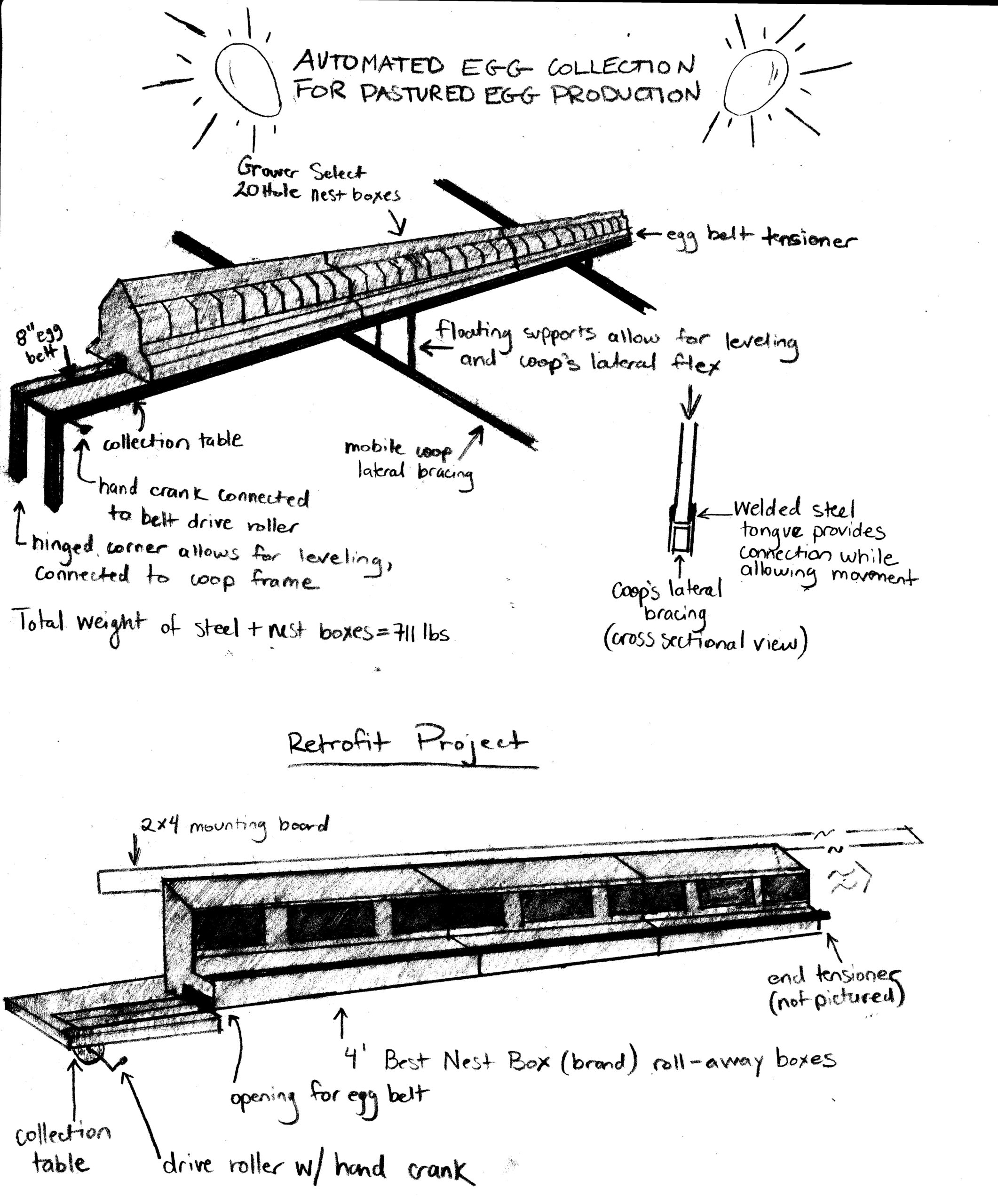
PFF will purchase conventional nest box components used by commercial poultry farms and then mount them on a custom fabricated steel frame inside the poultry housing. These commercial style nest boxes feature a sloping floor that causes the egg to roll into a slot and onto a conveyor belt. The conveyor belt runs through the middle of all of the nest boxes and pulls the eggs to a central collection point, called the collection table. The collection belt will be powered by a simple hand crank and tensioned with an adjustable roller mechanism at the end opposite the collection table.
This setup will allow a single worker to collect all eggs from a single point. Eggs will be packed into crates on the collection table and then loaded onto a truck bed parked adjacent to the collection table. Egg collection will seamlessly occur with just several footsteps per 600 hens. The system does not require electricity to function and the total materials cost is less than the standard roll-away nest boxes most pastured poultry producers are using.
The simple design of the steel frame puts an emphasis on keeping the nest boxes in a straight line and flat plane while allowing the coop to conform to topographical variations in the pasture. The frame will "float" on a support, allowing the coop to move indepently while still supporting the weight of the frame and nest boxes. An additional steel frame will be built for the farm's winter housing setup. This will allow PFF, in a single afternoon, to remove the nest boxes from the mobile (summer) housing and place them in the winter housing.
Because many farms have existing nest box systems, the second part of the project is fitting an automated collection system to an existing nest box setup. This project's partner farm (Three Brothers Farm) will retrofit their nest boxes with a collection belt and the other components necessary for automation. Their mobile and winter coops feature one wall with many boxes in a row. A small opening will be cut into the sides of the collection tray on each nestbox. The nest boxes will be then linked together with a piece of steel that will create rigidity and support the collection belt in between the nest boxes. The collection belt will pull the eggs to a collection table.
Prairie Folk Farm will share the lessons learned from this project by developing a detailed article that will be widely shared with the pastured poultry community through the American Pastured Poultry Producers Association (APPPA) and Grit Magazine, present the project at the annual GrassWorks Grazing Conference, share the project and success stories through social media channels, and host a field day to demonstrate the automation in action.
Regenerative practices include soil health management (via pastured poultry), managed grazing/livestock integration, and organic farming.
OBJECTIVES
- Fabricate and install steel nest box support frame, install nest box components, collection belt, tensioner, hand crank, collection table
- Retrofit existing nest box system with collection belt, tensioner, and hand crank
- Continuously improve function of mobile, winter, and retrofitted egg collection systems
- Evaluate success of project with collected data in four areas: enterprise finances, production (labor) efficiency, quality of life, and outreach efficacy
- Implement outreach campaign to widely share project