Project Overview
Commodities
Practices
- Animal Production: animal protection and health, free-range
Proposal summary:
Currently, the options for mobile turkey shelter are very limited. Products and building plans available are either too small to be scaled to a profitable level while maintaining animal welfare or incredibly difficult to move without heavy machinery, making turkey a hard enterprise to enter as a new producer. As well, many local producers we have discussed turkey with report that they choose not to raise turkeys due to their high disease susceptibility. Investing in mobile turkey roost design development and testing will make rotational turkey grazing practical for more producers by providing a scalable solution to rotating turkeys frequently, a method that is known to reduce disease risks. The market for pasture-raised turkey is rapidly growing as the demand for animal welfare and sustainable, quality meats increases. Creating and making these designs public will allow more small producers to add a profitable turkey enterprise to their farm. Additionally, the demand for heritage-breed turkeys is growing, and heritage breeds thrive in pasture systems and need secure roosts to practice their natural behaviors. Minnesota is the largest turkey producer in the nation, however, has very few sustainable pasture-raised turkey farms. This project will support the broader transition to regenerative turkey production.
Project objectives from proposal:
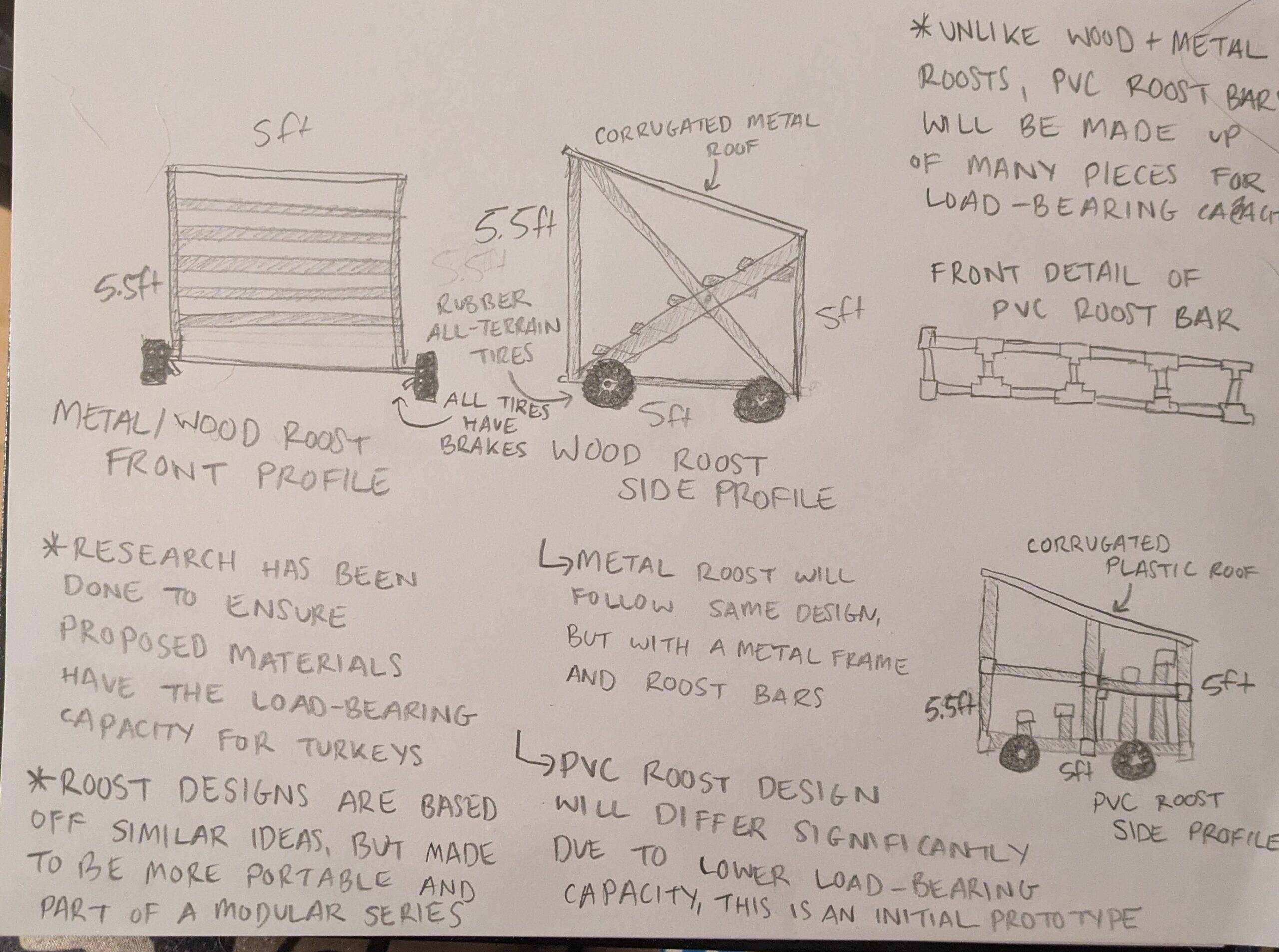
Our innovative solution is to test and iterate designs for 3 mobile turkey roosts to be used in rotational grazing. The designs will be similar, but made out of different materials. These roosts will all focus on the key barriers of scalability, ease of use, and affordability. Roosts will be designed to hold 25 turkeys at once with the goal of creating a design that is modular and can be repeated to achieve the necessary scale. These mobile roosts will replace the use of stationary roosts or shelters, which cause soil degradation and potentially pollute water sources.
All roosts will have tires and handles for ease of movement. They will include steel roofs to protect the turkeys from sun and rain, and have hooks on the roof to add tarps on the sides in case of extreme cold. All roosts will also be equipped with brakes for animal safety.
Wood is chosen as a test material because it is the most commonly used. It is also low cost and most farmers have the tools and skills necessary for wood construction projects. However, wood constructed roosts are often incredibly heavy and require frequent maintenance. They can also potentially host bacteria and be more difficult to clean.
PVC is chosen as a test material because it is exceptionally light and labor-friendly. Building with PVC requires little tools or specialized experience. However, PVC may not be as durable or able to withstand the weight and pecking of turkeys. Turkeys also may not enjoy the slippery smooth feeling of PVC pipes for roosting.
Metal is chosen as a test material because it is light and durable. However, metal is significantly more expensive and difficult to construct with. Metal may also be uncomfortable for turkeys in temperature extremes.
Roosts will be field tested on Lucky Lavender Farm from late-May 2026 to late-November 2026. We will be doing two rounds of 50 turkeys, meaning that the roosts will have been tested by 100 turkeys by the end of the project. Throughout the season, metrics will be collected weekly, and feedback will be collected from other farmers at a field day in early August. In between the rounds of turkeys (late August), the roosts will receive maintenance and updates based on findings from the first half of the field test.
Metrics will be collected weekly using a 1-5 scale to rate the 3 roosts on the following criteria:
- Ease of use by farmer
- Durability
- Environmental impact (plant density will be used as a proxy for biodiversity and soil damage)
- Use by turkeys
- Quality of shelter
At the late-August midpoint and late-November conclusion of the field test, these weekly metrics will be aggregated and each roost will receive a score in each of the 5 categories. Costs of each roost will also be calculated by keeping receipts and detailed records of the time and money spent on each design's construction and maintenance. At the conclusion of the field test, this information will be compiled and integrated into the final design plans for each roost. The plans will include recommendations on what roost will work best in what situations.
Project objectives:
- Construct 3 mobile turkey roosts out of wood, PVC, and metal
- Field test the roosts in an active rotational grazing system with two rounds of 50 turkeys
- Collect weekly data about the roosts and their use
- Host a field day for interested producers to get hands-on experience and provide feedback on roost designs
- Incorporate producer feedback and collected data into final design plans for the roosts
- Make roost design plans freely available online and promote this free resource