Project Overview
Commodities
Practices
Proposal summary:
The proposed solution is to design, build, and test three low-cost vermicomposting systems on my farm:
- A straw-bale insulated bed
- An in-ground trench system, and
- A small hoop-covered worm bed-using the same standardized dimensions (6 ft × 4 ft × 18 in).
By testing these systems side-by-side in real farm conditions, this project will identify which system performs best on Southern farms, and provide other growers with clear, practical guidance for adopting vermicomposting on their own farms regardless of temperature fluctuations.
This project directly addresses a major barrier farmers face: Although vermicompost has been shown to be biologically rich, improves plant health, and reduces fertilizer costs, many growers lack a simple, reliable, and affordable system that they can confidently build and maintain.
Existing SARE projects have explored how vermicast improves soil health or crop performance, yet very few have focused on how to produce vermicompost at scale on a small vegetable farm, nor on which designs work best in hot, humid, and freeze-thaw Southern conditions. This way, farmers don't have to buy red wriggler vermicomposting worms year after year if they want to do vermicomposting.
My proposed solution is realistic and farm-based. All three systems can be built with materials commonly found on diversified vegetable farms-straw, pallets, scrap lumber, tarps, and simple tools-and can be constructed for under $500. Each system will use the same initial worm population, feedstock, and data-collection protocol to allow fair comparison between treatments.
The project will generate measurable outcomes that directly help growers adopt sustainable practices:
-
Temperature stability of each system (daily logs)
-
Worm survival and population trends (monthly counts)
-
Feeding consumption rates
-
Labor time required per week
-
Total annual vermicast yield
-
Ease of harvesting
-
Resilience across seasons (winter survival and summer heat tolerance)
-
Simple stocking-rate guidelines for Southern vegetable operations
The results will lead to a more sustainable farming system by helping producers:
- Increase on-farm nutrient cycling. Instead of purchasing compost or fertilizers, vegetable growers can transform crop residues, weeds, and spoiled produce into high-value vermicast.
- Reduce dependence on off-farm inputs. Vermicompost replaces many purchased amendments, stabilizing annual costs.
- Improve soil health. Vermicast enhances plant-available nutrients, water retention, and various soil microbiology under stress.
- Build resilience. A dependable compost system strengthens a farm's natural resource base and ability to withstand droughts, extreme heat, and heavy rainfall.
- Improve farm profitability and quality of life. Easy-to-manage systems reduce labor and help farmers grow healthier crops with fewer losses. Free plans, field days, and simple sizing worksheets will support growers across the region.
A "S.M.A.R.T" Solution
This solution is specific (three clearly defined systems), measurable (temperature, survival, labor, yield), achievable (all systems built on my farm using common materials), and realistic (requires no electricity, concrete, or special machinery) and timebound. By the end of the project, it is my my hope that Southern vegetable farms will have the information they need to select, size, and operate a vermicomposting system that fits their scale and unique needs.
Project objectives from proposal:
Project Site
[caption id="attachment_1299031" align="alignnone" width="300"]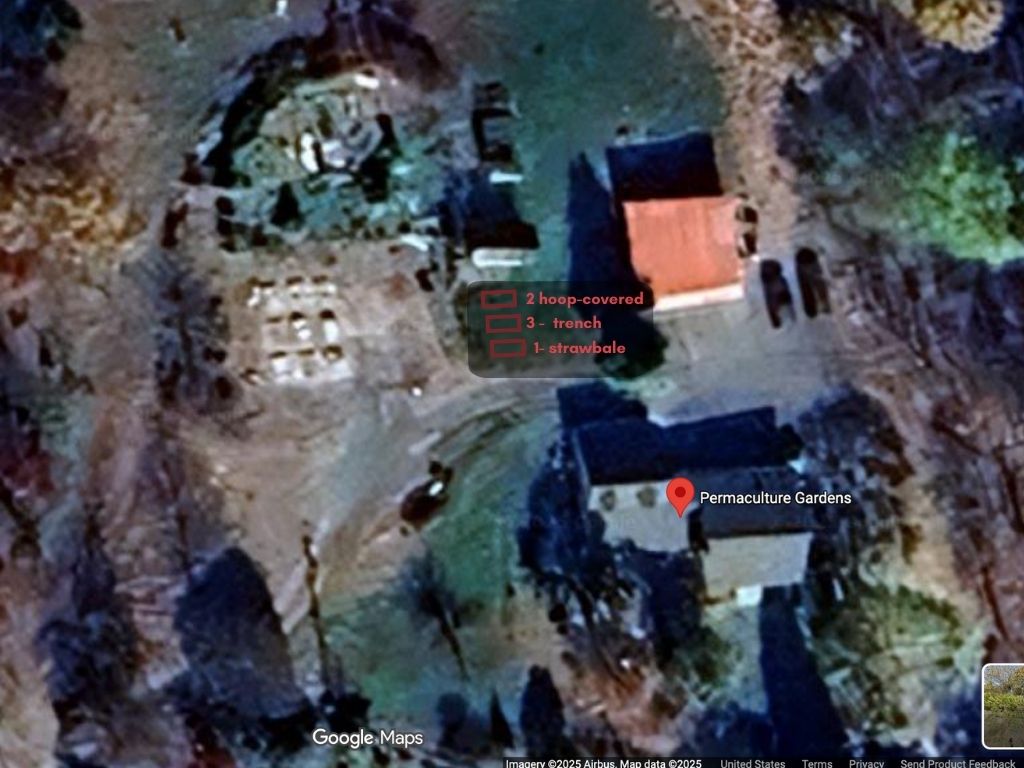 Click on photo to enlarge[/caption]
Research will be conducted on Bethany Farm, a 3-acre permaculture-based vegetable and fruit operation in Loudoun County, Virginia. One acre is actively used for vegetable production, generating a consistent stream of crop residues suitable for vermicomposting. Then three vermicomposting systems will be located in front a demonstration area adjacent to the production garden.
Experimental Design
Three vermicomposting systems will be built, each sized identically (6 ft x 4 ft x 18 in depth) to which red wriggler worms (Eisenia fetida) will be added. These setups were chosen for their simplicity, outdoor location and potential ease of management:
-
Straw-Bale Vermicompost Bed
A rectangular insulated bed framed with straw bales that can later be used as a decomposed straw-bale garden -
Hoop-Insulated Worm Bed
A simple low tunnel (PVC hoops + greenhouse plastic during winter and shade cloth during summer) over a raised worm bed. This structure protects the system from heavy rain and extreme heat/cold without electricity. -
Shaded Trench Vermicompost Bed
A shallow, in-ground trench lined with cardboard and topped with plywood. Soil buffers temperature swings and helps maintain moisture.
All three systems will be run for 12 months. Each system will receive the same amount of bedding, feedstock, moisture, and initial worm population.
-
Bedding: Chinese stiltgrass (makes use of an invasive plant we are trying to manage)
-
Feedstock: vegetable scraps, kitchen waste, on-farm woodchips
A fourth compost-tote worm bin, will act as the control. This bin will be housed in a garden shed to protect it from extreme weather, and used as the backup worm population in the event that worms die in the other outdoor systems.
Materials Used
-
Straw bales
-
Shovels, hand tools
-
Recycled pallets or boards
-
Greenhouse plastic tarp or shade cloth
-
Thermometer probes/data loggers
-
moisture meter
-
buckets and scale for feedstock measurement
- Bucket lids for storing harvested vermicasts (already owned)
-
worms (initial stocking rate 4 lb of red wriggeler worms per system)
-
vegetable residues, weeds, spent crops
See full materials list in the Budget Section.
Data Collection (What Will Be Measured)
1. Temperature Stability
- Daily core temperature readings using three Elitech RC-5+ USB data logger with external stainless-steel probe
How it will be installed:
-
The probe will be buried 6-8 inches in the center of each bed.
-
The logger body will remain outside the bed in a small waterproof box.
-
Logging interval set to 1 hour.
-
Data downloaded monthly and stored in this spreadsheet.
Temperature data will reveal:
-
summer heat tolerance
-
winter freeze protection
-
insulation effectiveness
-
whether worm-safe temperatures (55-90°F) are maintained
Moisture levels will be checked and noted weekly using a handheld compost moisture meter and by hand-squeeze test.
2. Worm Survival & Population Trends
| DATE | Worm Count per Randomized Quart Sample | Presence of Cocoons? | Bedding quality (smell, texture, anaerobic pockets) | Did Worms Survive? | ||||||||||||
| 1 - Straw Bale | 2 - Covered Hoop | 3 - Trench | 4 - Control | 1 - Straw Bale | 2 - Covered Hoop | 3 - Trench | 4 - Control | 1 - Straw Bale | 2 - Covered Hoop | 3 - Trench | 4 - Control | 1 - Straw Bale | 2 - Covered Hoop | 3 - Trench | 4 - Control | |
| April | ||||||||||||||||
| May | ||||||||||||||||
| June | ||||||||||||||||
| July | ||||||||||||||||
| August | ||||||||||||||||
| September | ||||||||||||||||
| October | ||||||||||||||||
| November | ||||||||||||||||
| December | ||||||||||||||||
| January | ||||||||||||||||
| February | ||||||||||||||||
Every eight weeks, I will evaluate worm population by measuring:
-
Presence of cocoons
-
Visible adult worms in a randomized quart sample
-
Bedding quality (smell, texture, anaerobic pockets)
3.Vermicast Yield & Quality
Each system will be harvested twice:
-
End of summer (Month 6)
-
End of winter (Month 12)
For each harvest, I will record:
-
Total finished vermicast volume pounds per cubic feeet
-
Weight of screened vermicast
-
Moisture percentage via moisture meter
-
Visual texture and aggregation rating
-
Time needed to harvest.
4. Weekly Check-Ups for Feedstock Consumption & Moisture Readings
To compare the three systems, I will use the following sheet weekly:
| DATE | Weight of Feed | Observations of Previous Week's Digestion | Moisture Reading | How much time did you spend tending the 3 Setups | NOTES | |||||||||
| 1 - Straw Bale | 2 - Covered Hoop | 3 - Trench | 4 - Control | 1 - Straw Bale | 2 - Covered Hoop | 3 - Trench |
4 - Control |
1 - Straw Bale | 2 - Covered Hoop | 3 - Trench | 4 - Control | |||
5. Seasonal Resilience is Noted in Monthly Check-Ups
-
Winter survival without electricity.
-
Summer heat tolerance.
-
Storm resilience (heavy rain, humidity).
8. Seedling Growth Trial of Tomatoes and Napa Cabbage (to test vermicompost quality)
For each trial, I will record germination rate, height, vigor, and leaf count using identical 1020 trays and vermicast from each treatment. A LeafGro treatment will serve as the external control. I will grow tomatoes in February
| February 2027 | 1 - Straw Bale | 2 - Covered Hoop | 3 - Trench | 4 -CONTROL (LeafGro) |
| Germination rates | ||||
| Height and vigor | ||||
| Leaf count |
and Napa cabbage in August:
| August 2026 | 1 - Straw Bale | 2 - Covered Hoop | 3 - Trench | CONTROL (LeafGro) |
| Germination rates | ||||
| Height and vigor | ||||
| Leaf count |
This provides practical use-case data for vegetable operations.
Analysis Methods
-
Compare average temperatures across systems.
-
Calculate survival percentages and reproduction trends.
-
Compare feedstock consumption rates and labor time.
-
Evaluate vermicast yield by weight and seedling performance.
-
Use simple graphical analysis (line graphs, bar charts).
-
Summarize seedling trial outcomes by treatment.
-
Recommendations will be based on performance × cost × ease of management.
Farmer-Ready Deliverables
-
Detailed construction plans for each system
-
A "Which System Can I Build?" decision guide
-
A "How Big of a Worm Farm do I Need? "calculator"
-
Step-by-step instructions for feeding, moisture control, and harvesting
-
Field day demonstration for local growers, conference presentations and webinars for farmers and growers
It is my hope that this methodology ensures measurable, practical, replicable results that serve real vegetable farmers in the Southern region.