Project Overview
Information Products
Commodities
- Agronomic: canola, oats, peas (field, cowpeas), sorghum (sweet), wheat
Practices
- Crop Production: cover crops, cropping systems, crop rotation, fallow, fertigation, irrigation, no-till, water management
- Education and Training: demonstration, extension, participatory research, workshop
- Natural Resources/Environment: carbon sequestration, soil stabilization
- Soil Management: composting, nutrient mineralization, organic matter, soil analysis, soil quality/health
Proposal abstract:
Agriculture in semi-arid regions, such as the Southwestern United States, faces increasing challenges to agricultural productivity, soil health, and farmers’ livelihoods. This project aims to address these challenges by evaluating the impact of cover crops and compost on soil moisture dynamics and carbon in a winter wheat–sorghum–fallow rotation system. Additionally, the long-term changes in soil carbon due to practices will be evaluated by using the DayCent model and demonstrated to the farmers through COMET-Farm scenario analysis of how these management practices can enhance soil carbon and reduce nitrous oxide.
Our project integrates field experimentation and advanced simulation modeling to comprehensively assess cover cropping and compost as soil health practices. Through field assessments, we will measure soil moisture, temperature, total nitrogen, and soil organic carbon over a two-year period (2025–2026), while the DayCent model will estimate long-term changes in soil carbon for 2027–2080. This dual approach allows for a detailed analysis of the environmental and economic benefits of these practices. The findings from this research are expected to offer practical, science-backed solutions for farmers in semi-arid regions to enhance soil health and conserve water.
Our outreach will include engaging local farmers, agricultural cooperatives, and policymakers through workshops, field demonstrations, and educational materials. Results will be shared via peer-reviewed publications, extension bulletins, and online platforms to ensure broad dissemination. By focusing on sustainable agricultural practices, this project contributes to a future where semi-arid farming systems are resilient, productive, and environmentally sustainable.
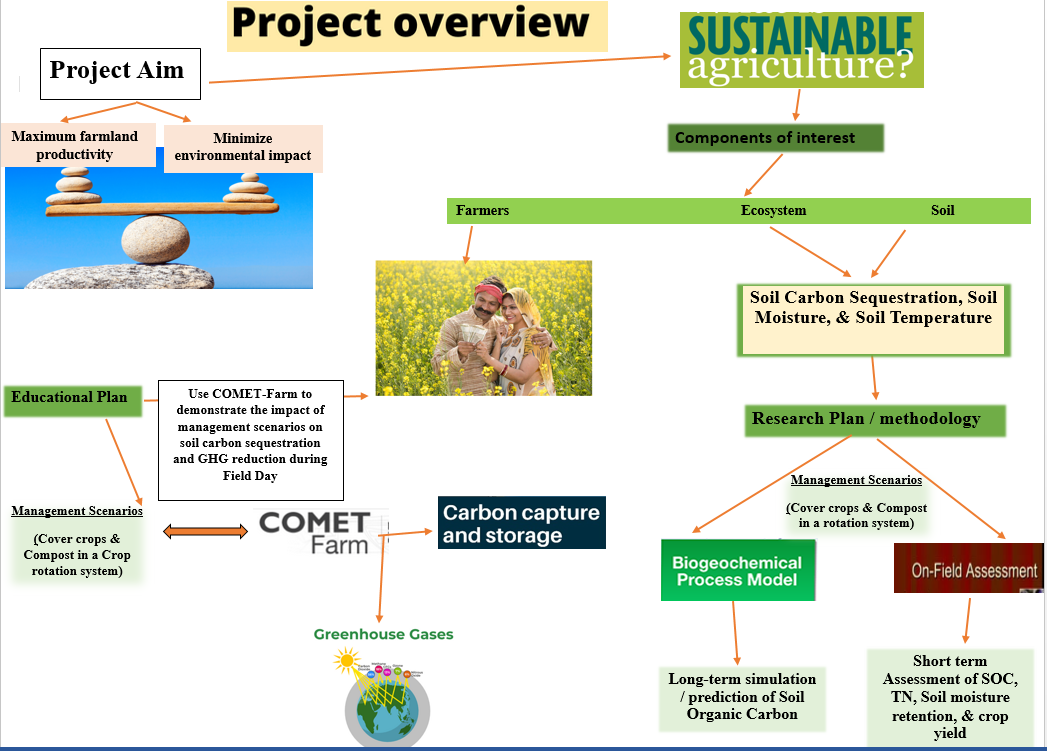
Project objectives from proposal:
Research Plan
- Investigate the effects of cover crops and compost on soil moisture and changes in soil carbon over time in a sorghum-wheat rotation system by measuring SOC, TN, soil moisture, and temperature at different depths for two years.
- Estimate the long-term changes in soil carbon by simulating compost and cover crop practices using the DayCent model (2027 – 2080).
Education/outreach Objectives
- To educate local growers about the application and benefits of soil health practices for sustainable agriculture in the Southern Great Plains.
- To use COMET-Farm to demonstrate the impact of management scenarios on soil carbon and N2O reduction during Field Day
- To disseminate research findings to researchers, educators, potential agricultural investors, students, and policymakers.