Project Overview
Commodities
Practices
Proposal abstract:
Citrus production faces ongoing challenges, including declining soil fertility, increasing weed pressure, and heavy reliance on synthetic fertilizers and herbicides. These conventional practices not only raise production costs but also contribute to problems such as nutrient runoff and reduced soil health. Growers need sustainable, integrated strategies that improve soil fertility, suppress weeds, reduce chemical inputs, and enhance long-term productivity.
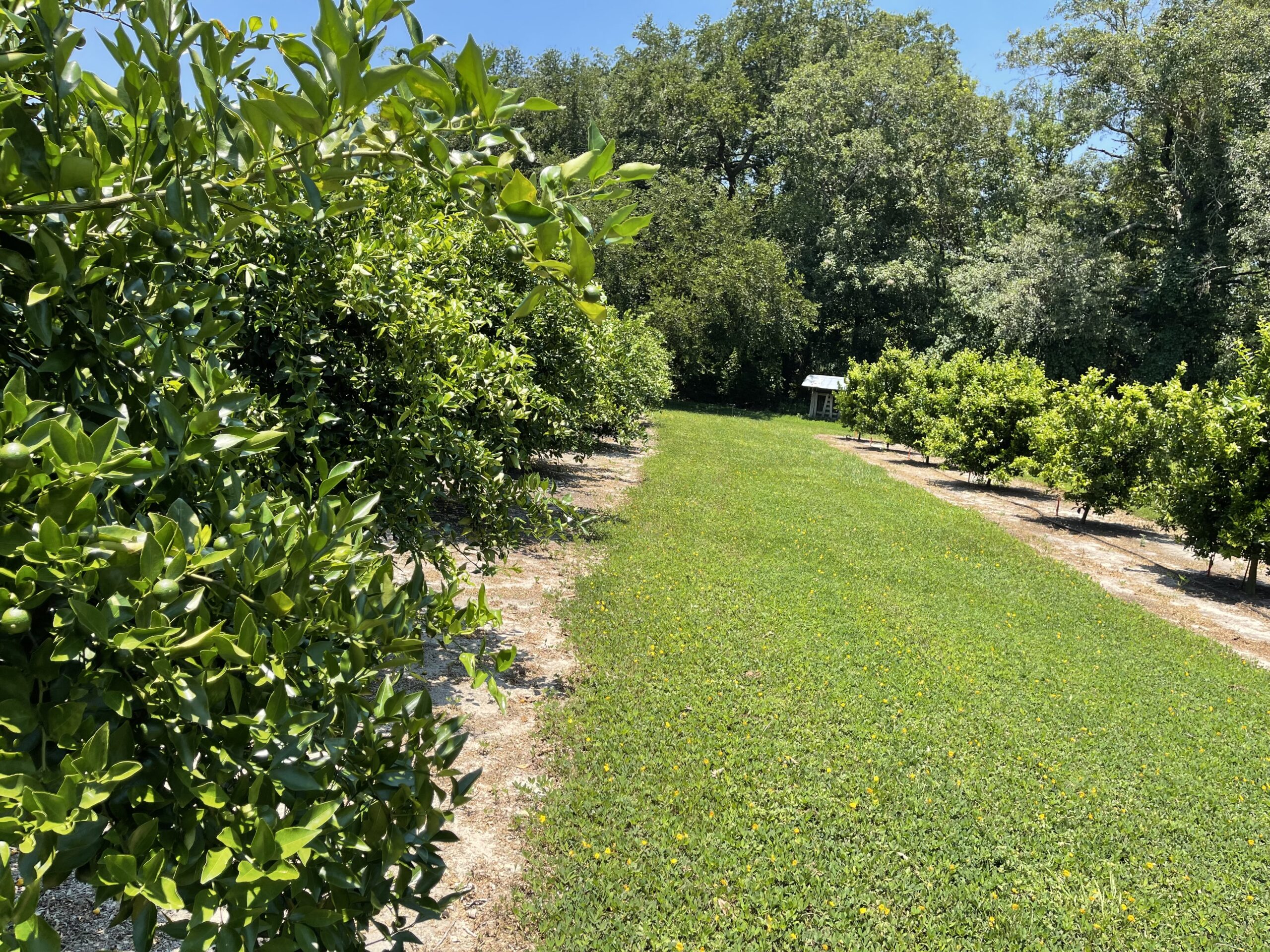
Perennial peanut (Arachis glabrata) is a nitrogen-fixing legume that can serve as a perennial green manure crop in citrus groves. When grown in row middles (see pic), perennial peanut has been observed to contribute up to 100 kg N/ha to trees through mowed clippings. This naturally added nitrogen supports soil fertility, improves tree nutrition, and can enhance fruit quality, while reducing the need for commercial nitrogen fertilizer compared to groves without perennial peanut. Its dense, low-growing canopy provides year-round ground cover, suppresses weeds, reduces soil erosion, and improves microbial activity, making it an ideal choice for sustainable citrus production particularly for the emerging and rapidly expanding cold hardy citrus industry in north Florida, south Georgia and Alabama.
This project will use a systems-based, multi-state approach to evaluate perennial peanut as living nitrogenous mulch and develop practical, research-based recommendations for its incorporation in organic and conventional citrus production systems. In collaboration with growers in Florida and Georgia, research plots will be established across different soils, grove ages, and management systems. Growers will actively participate in plot setup and care, while field days will allow them to observe perennial peanut performance and provide feedback. The project will monitor establishment, growth, ground cover, and nitrogen-fixing nodules, and use this information to develop illustrated guides, fact sheets, and short demonstration videos.
Soil fertility and nutrient dynamics including organic matter, total nitrogen, phosphorus, potassium, micronutrients, pH, and microbial activity will be measured under perennial peanut and control plots. These data will be integrated into visual dashboards and Extension materials to show measurable improvements in soil health and nitrogen availability over time. At the same time, perennial peanut's impact on beneficial insects, weed suppression, tree health, and productivity will be evaluated. Tree health including canopy volume, leaf color through drone-based hyperspectral imaging and productivity metrics such as fruit count, yield, and quality will be monitored to quantify its benefits as living mulch. All results will be translated into actionable, farmer-tested recommendations for integrating perennial peanut into citrus systems. Educational resources including photos, videos, and interactive tools will be disseminated via workshops, webinars, and online platforms. Field days and feedback mechanisms will ensure materials are relevant and practical, while pre- and post-training surveys will capture learning outcomes, participation, and audience demographics.
By providing measurable agronomic and economic benefits including up to 40 kg N/acre contribution, reduced herbicide use, improved soil fertility, and enhanced fruit yield and quality, this project offers a scalable, sustainable approach to citrus production in Florida and Georgia. Cooperating partners include growers, specialists both states, and extension agents, ensuring integration of applied research, practical implementation, and effective outreach that will have lasting impact.
Project objectives from proposal:
Objective 1: Soil health and nutrient cycling - Evaluate perennial peanut as a biologically based groundcover for improving soil health and nutrient cycling in conventional and certified organic citrus production systems by quantifying changes in soil organic matter, total and available nitrogen (kg N/ha), nutrient dynamics (N, P, K), microbial activity, and soil chemical properties. Determine the extent to which biologically fixed nitrogen can partially replace synthetic fertilizer inputs without reducing tree nutritional status.
Expected Outcome:
Improvement in soil organic matter and nutrient availability in
citrus groves managed with perennial peanut, increased biological
nitrogen contributions that reduce dependence on synthetic
fertilizers, and enhanced understanding of soil microbial responses
to living groundcover systems. Collectively, these outcomes are
expected to lead to long-term reductions in synthetic nitrogen
fertilizer use, improved soil fertility and efficiency in citrus
production systems, and more sustainable grove-floor management
practices.
Objective 2: Citrus tree performance and productivity: Assess the impact of perennial peanut groundcover on citrus growth, yield, and fruit quality under commercial conditions by measuring canopy development, leaf nutrient status, chlorophyll content, fruit yield, and fruit quality parameters (size, soluble solids, and marketable yield). Determine whether improved soil conditions translate into stable or enhanced productivity across variable grove environments.
Expected outcome:
Generate clear evidence on whether improvements in soil health under perennial peanut systems translate into stable or enhanced citrus tree productivity. It will provide empirical data on fruit quality responses under reduced synthetic input regimes and improve understanding of the interactions among soil conditions, nutrient cycling, and citrus management practices within a living groundcover system.
Objective 3: Weed suppression and agroecosystem function - Quantify the effectiveness of perennial peanut in suppressing weeds and reducing herbicide dependence by measuring weed biomass, density, species composition, and herbicide use reduction. Evaluate improvements in groundcover stability and overall agroecosystem functioning within citrus alleyway systems.
Expected Outcome:
Reducing weed pressure and herbicide dependence while improving the stability and functionality of citrus alleyway groundcover systems. Collectively, these changes will lead to lower chemical input requirements and reduced environmental contamination risk, decreased production costs associated with weed management, and a clear transition toward more biologically based and sustainable weed suppression strategies in citrus production systems.
Objective 4: Beneficial insects and pollinator responses - Evaluate the impact of perennial peanut groundcover on beneficial insect and pollinator communities by measuring abundance, species richness, habitat use, and seasonal activity patterns. Determine how living groundcover influences ecosystem service provision, including potential contributions to biological pest control and pollination support within citrus production systems.
Expected Outcome:
Enhanced habitat suitability for beneficial insects and pollinators, improving understanding of how groundcover systems influence ecosystem service providers, and identifies seasonal patterns in insect community responses within citrus groves. Collectively, these outcomes are expected to strengthen biological pest control potential, improve ecosystem service delivery such as pollination and natural enemy support, and increase overall ecological stability and system performance in citrus production systems.
Objective 5: Economic performance and grower adoption - Assess the economic viability and adoption potential of perennial peanut integration in citrus systems by conducting partial budget and return-on-investment analyses, including fertilizer and herbicide cost savings relative to establishment and maintenance costs. Evaluate grower participation, knowledge gain, and adoption intent through on-farm trials, field days, and Extension programming to support scalable implementation.
Expected Outcome:
Economic feasibility of perennial peanut for its adoption in citrus production systems, while increasing grower knowledge and awareness of living mulch practices and strengthening stakeholder decision-making capacity through on-farm research and Extension engagement. Collectively, these outcomes are expected to increase adoption of perennial peanut in commercial citrus systems, improve long-term farm profitability while reducing input-related risk exposure, and strengthen Extension-research-grower collaboration to support the advancement of sustainable agriculture.