Project Overview
Commodities
- Miscellaneous: other
Practices
- Crop Production: irrigation
- Education and Training: on-farm/ranch research
- Farm Business Management: feasibility study
Proposal abstract:
Problem and Research Questions
Water scarcity and groundwater restrictions under California's Sustainable Groundwater Management Act (SGMA) threaten the economic viability of agriculture, with up to one million acres projected to be fallowed by 2040. Many producers urgently need low-water, economically viable alternatives to conventional crops. Agave has emerged as a promising solution because it is a drought-tolerant plant with exceptional water-use efficiency, strong biomass yield, and more than 100 marketable by-products. Planted acreage has grown from 50 to more than 600 acres between 2023 and 2025, and the crop is now present in 53% of the counties. Yet growers face three critical challenges: (1) the absence of species-specific irrigation guidelines for California conditions, (2) lack of agronomic data to support dry farming and supplemental irrigation, and (3) no science-based cost-of-production benchmarks. This project asks: What are the water requirements, agronomic performance, and economic viability of agave production under dry-farmed and irrigated systems across California?
Research and Outreach Approach
The project evaluates three agave species per site across five agricultural regions (Sacramento Valley, San Joaquin Valley, Central Coast, South Coast, and San Diego) using plant-scale weighing lysimeters, a direct and most accurate method for measuring actual crop evapotranspiration (ETa). Two irrigation regimes (full irrigation and dry farming) and two soil management systems (cover crop and no cover crop) are tested at each site, generating the first comprehensive dataset for agave in California. Integrating sustainable agriculture principles adds scientific novelty to the approach. Economic analysis following established agricultural enterprise budget methodologies will translate field data into actionable financial tools for farmers.
Significance and Transformative Potential
This project generates first-of-its-kind data at the intersection of dryland agriculture, water policy, and economic resilience. By establishing evidence-based irrigation standards and demonstrating economic viability of dry-farmed agave, the project can catalyze the productive use of land that would otherwise be fallowed, reduce pressure on groundwater resources, and support California's rural communities. Findings are directly transferable to other water-limited regions of the U.S.
Dissemination and Follow-Up for Adoption
Results will be disseminated through five field days in Year 2 and five regional workshops in Year 3, targeting 150 growers and technical assistance providers. Adoption will be tracked using baseline and annual follow-up surveys administered to grower partners, and post-event surveys will document practice implementation. Digital outreach through five bilingual instructional videos and social media will reach a cumulative audience of 1,000 individuals. A professional development course at Madera Community College will train the next generation of agave farmers.
Expected Project Outcomes
- An Agave Growers' Dry-farming and Supplemental Irrigation Manual with species- and region-specific recommendations
- A Soil, Water and Agronomic Practices in Agave Production Manual incorporating soil conservation strategies
- A Cost of Production and Business Planning Guide for California agave farmers
- At least 150 growers trained in dry farming and supplemental irrigation management
- An Agave Growers Course delivered at Madera Community College with online availability
- A peer-reviewed scientific article on agave evapotranspiration and water use efficiency in California
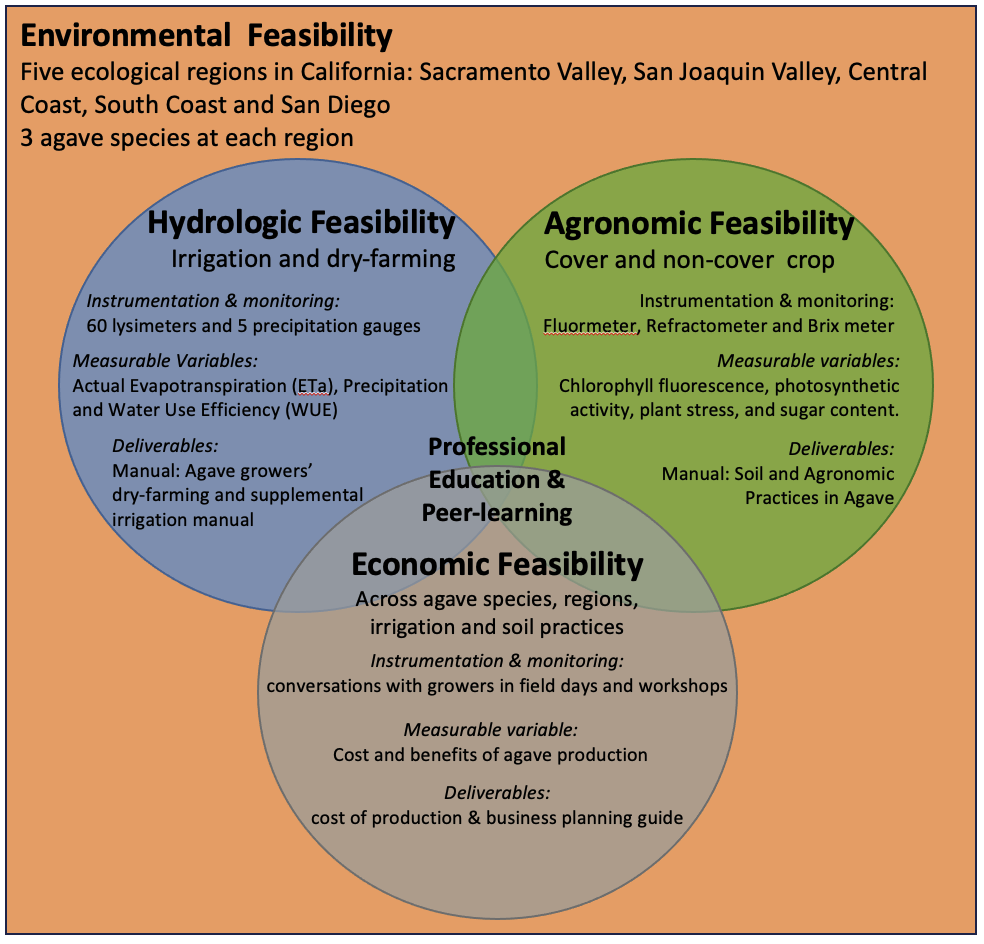 Research Overview and Main Products[/caption]
Project objectives from proposal:
RO1. Quantify agave water requirements across different agricultural regions of California over three years. Weekly actual evapotranspiration (ETa) will be measured for 3 years using 60 plant-lysimeters installed across five representative agricultural regions. Monthly and annual ETa data will be used to estimate crop water requirements and water use efficiency (WUE) under three conditions: (1) agricultural region, (2) irrigation regime, and (3) soil health practice (cover crop versus no cover crop). Annual reports and a manual will be developed to summarize results.
RO2. Evaluate the agronomic performance and productivity of three agave species annually over three years. Physiological development will be assessed across California agricultural regions based on growth patterns, biomass production, soluble solids concentration (°Brix), and offshoot (hijuelos) production under different irrigation regimes and soil management practices.
RO3. Estimate production costs and revenues for California agave farmers by year 3. Operational costs, overhead and cash overhead expenses, and farm-generated revenues will be analyzed to develop initial investment budgets and estimate financial indicators including Net Present Value (NPV), Internal Rate of Return (IRR), benefit-cost ratio, and cash flow across production systems.
RO4. Promote the adoption of sustainable agave production systems through professional education and peer learning activities in years 2 and 3. Co-develop with growers one agave growers' irrigation manual, one soil practices in agave production manual, one cost of production and business planning guide, and five educational videos. In year 2, organize one field day in each region to receive grower input on these materials. In year 3, organize one workshop in each region to introduce the irrigation manual and the cost of production guide, and include activities for peer training and learning. All materials will be bilingual (English and Spanish) and targeted at farmers and agricultural stakeholders statewide.