Final report for ENC23-222
Project Information
Midwest farmer advisors are proficient in supporting farmers in commodity grain production, yet there is a lack of accessible information to help farmers interested in producing food-grade grains, crops grown for human consumption, especially using sustainable and certified organic growing practices. Interest in producing food-grade grains is increasing because of the potential for high economic value, ability to add rotational diversity and ecosystem services, and marketing opportunities that allow grain farmers to feed their local communities (in short: food-grade grains help move agriculture towards economic, environmental, and social wellbeing goals).
The goal of this project was to provide Midwest farmer advisors with the knowledge, tools, and experience necessary to assist farmers in producing and marketing food-grade grains, while also enhancing their peer support system through in person and virtual meetings. We held four roundtable discussions across the region to hear firsthand from farmer advisors on the needs and gaps in materials. Using that information, we created an online training consisting of three modules, hosted on the Artisan Grain Collaborative website. We hosted two live webinars featuring food-grade grain farmers from across the Midwest and held one in person training. The online training was designed to accommodate the full spectrum of farmers that advisors interact with, including those who are new to farming or interested in incorporating food-grade grains into existing commodity grain, diversified vegetable, or integrated livestock operations. By providing advisors across the North Central Region with the knowledge and tools necessary to assist farmers in producing food-grade grains, we hope this project benefits farmers while contributing to the development of a sustainable food system and providing resources that will be applicable across the North Central Region.
There were five expected outputs from this project that were developed in collaboration with farmer advisors and our project partners. These outputs were designed to meet the educational and training needs of farmer advisors across the NCR and promote the adoption of food-grade grain as a landscape diversification strategy.
- Roundtable Discussions: To document the needs and gaps in food-grade grain knowledge and programming, we conducted four roundtable discussions with farmer advisors. Two of these discussions were in person (one in Michigan, one in Wisconsin), and two were held via Zoom.
- Needs Report: The outcomes of the roundtable discussions were documented in a written report that outlines the educational and training needs of farmer advisors.
- In-Person Training and Site Visit: To address the educational and training needs identified in the report, we provided an in person training and site visit for farmer advisors at Rooster Milling in SW Wisconsin.
- Curriculum: We developed an online training for farmer advisors about food-grade grains. This curriculum has the potential to reach hundreds of farmer advisors across the NCR.
- Webinar: We will hosted two live webinars featuring farmers and their experiences for farmer advisors across the NCR on food-grade grains. We also created one video recording of an overview of the training modules to help explain their content and usefulness.
These outputs were created to increase the awareness of food-grade grain agriculture among farmer advisors across the NCR, enhance their confidence and willingness to talk to farmers about food-grade grains, and improve their knowledge of agronomy, storage, and handling, and marketing basics related to food-grade grains.
Cooperators
- - Technical Advisor
- - Technical Advisor
- - Technical Advisor
Education
We used multiple modes for education in this project. First, we held four listening sessions (2 in person, 2 via zoom) to learn about the needs of food-grade grains professional development from farmer advisors. These sessions in and of themselves were highly educational for all who participated! Next, we hosted an in person field day at Rooster Milling in Wisconsin. We have published an online training and shared about it via 2 live webinars and one recorded informational video about the modules in 2025.
Education & Outreach Initiatives
To increase the awareness of food-grade grain agriculture among farmer advisors across the NCR, enhance their confidence and willingness to talk to farmers about food-grade grains, and improve their knowledge of agronomy, storage and handling, and marketing basics related to food-grade grains.
We created three modules: “Crops, Varieties, and Market Classes Overview”, “Agronomic Management”, and “Harvest and Post-Harvest Handling” for food grade grains based on the needs expressed by the focus groups (needs assessment summary can be accessed here - https://miagadvance.org/reports/). Dr. Nicole Tautges, the agroecologist with Michael Fields Agricultural Institute, led the development of the modules and the project team provided content and edits. The modules underwent additional peer review by researchers who are familiar with growing, post-harvest processing, and marketing food-grade grains. The final modules are now released for public consumption on the Artisan Grain Collaborative’s website. We also created one online video that explains the modules and can be used to help recruit participants to participate in the online training (Quick instructions: how to access Food-Grade Grain Training Modules: https://youtu.be/7g4eMgp0WuE).
All three Food-Grade Grains Training Modules launched September 30, 2025. Project partners promoted the modules via live webinars, newsletters, social media, and word of mouth across their membership and networks. The training modules landing page is hosted on the Artisan Grain Collaborative’s website which features a host of resources and was the best option for long-term longevity and use of the modules.
Each online training is a self-paced, click-through module that provides the basics of food-grade grains for farmer advisors. The modules are housed within Qualtrics for a ‘one-stop’ experience of pre-assessment, training, and post-assessment. The training itself is a combination of slides to read, interactive ‘check your comprehension’ questions, and embedded videos. After completing each module, participants receive a PDF of that module’s slidedeck, which can be used as a robust reference when advising farmer clients on incorporating food-grade grains into their businesses and making their grain operations more successful.
The interactive ‘check your comprehension’ questions aim to keep participants engaged throughout the module and are tailored to each module’s content. They are not meant to be a definitive measure of knowledge gained, but rather give the participant a sense of how much of the module they are absorbing and allow them to go back and repeat slides and videos if desired.
The pre- and post-assessment questions aim to measure meaningful changes in knowledge, attitudes, and behavior due to the training. The pre- and post-assessment includes five short-term outcomes related to knowledge, confidence, and awareness of food-grade grains self-reported on a 5-point Likert scale. The final question assesses the participant’s plan to educate and advise on food-grade grains in their upcoming programming. The six outcomes in the evaluation are consistent across all three modules.
Short-term Outcomes included in Pre/Post Assessment of each Module
- Knowledge of food-grade grain varieties
- Knowledge of food-grade grain planting times
- Knowledge of which grains contain gluten
- Comfort level advising farmers on growing food-grade grains
- Awareness of food-grade grains issues
- Plan to educate/advise farmers on food-grade grains
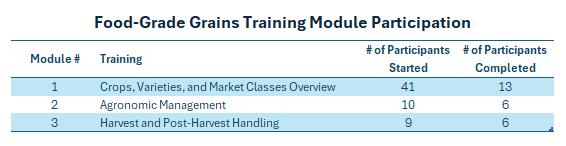
From module launch September 30, 2025 thru February 17, 2026, 41 unique individuals started Module #1, 10 individuals started Module #2, and 9 individuals started training Module #3. Responses with no post evaluation data were considered ‘incomplete’, were removed from the evaluation data set, and are not counted in any of the pre/post findings below. Thirteen unique individuals completed one or more Food-Grade Grains Training modules. For the participation data, we suspect that most people completed most of the modules but did not want to take the time to complete the post survey. For future work we will be thinking about how to (easily) incentivize completing the post survey.
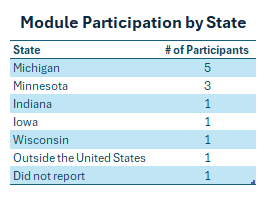
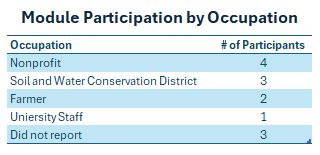
Participants were primarily from the states of Michigan and Minnesota and worked at nonprofits or Soil and Water Conservation Districts.
Based on the content within each module and the selected short-term outcomes, we would expect differences in the impact of those trainings on specific outcomes. For example, Module #1 provides an overview of crops, varieties, and their market applications. Accordingly, we would expect improved knowledge of food-grade grain varieties (outcome #1), knowledge of food-grade grain planting times (outcome #2), and knowledge of which grains contain gluten (outcome #3) in particular. Module #2 covers common pathogen and pest issues as it relates to certain grain types and so we would expect improved awareness of food-grade grains issues (outcome #5) as well as increased knowledge of food-grade grain varieties (outcome #1). Finally, we could see decreases in self-reported knowledge or confidence levels after a training, if the participant feels as though they better grasp the extent to which they do not know the information.
The pre/post assessment data was evaluated using a two-tailed Wilcoxon Signed-Rank Test with an alpha value of 0.05. With these parameters, we have sufficient evidence that Module #1 significantly increased knowledge of food-grade grain varieties, knowledge of food-grade grain planting times, and comfort level of advising farmers on growing food-grade grains. There is not sufficient evidence, but there is a positive relationship of Module #1 on the knowledge of which grains contain gluten. We do not have sufficient evidence of the impact of Modules #2 and #3 on the short-term outcomes, likely due to the small sample size of the participants and the skew of evaluation questions toward Module #1. Nonetheless, there was a small improvement in knowledge of food-grade grain varieties for Modules #2 and #3 and small improvement of awareness of food-grade grains issues for Module #2.
We do not see sufficient evidence of the modules impacting participants’ plans to educate/advise farmers on food-grade grains, potentially due to the participants already planning on doing so. For Module #1, five participants indicated that they planned to educate/advise farmers on food-grade grains (an answer of “yes”) whereas six participants answered that they “maybe” planned on doing so. There was not a significant change from a “maybe” in the pre-assessment to a “yes” in the post-assessment for this question. In the future, the pre/post evaluation could include an open-ended question to explore what would better help participants advise farmers on food-grade grains in the future. Additionally, pre/post questions could be better tailored to each training module to measure their unique impact.
To demonstrate, on farm, the processes of cleaning, storing, and milling food-grade grains. To learn about all aspects of growing and handling food-grade grains from a farmer panel.
The field day acted as an in-person training on September 30th, 2024 for farmer advisors across different organizations. The event has 30 registered attendees traveling from MI, WI, and IL from extension and industry. We toured a regional grain mill and farm in SW Wisconsin (Rooster Milling) and facilitated a discussion about processing food-grade grains. We hosted a farmer panel during the field day to hear a more diverse perspective about all aspects of food-grade grains.
Participants learned all aspects of food-grade grains cleaning, milling, and storing. They learned first hand from the farmer panel what it takes to grow and to market these grains. We did conduct an online post-event evaluation but only had 5 submissions (in the future we will hand out paper copies at the event). 100% of the respondents said the event was well organized; that the presentations were clear and informative; that the value of the information was worth the trip; that they were more connected with a network of farmer-advisors and resources; and that they would attend another event on this topic. 80% said they are likely to make a beneficial change as a result of what they learned. One respondent said: "Keep having a panel of people to share their experiences. This was a highlight for me."
To demonstrate the processes of cleaning, storing, and milling food-grade grains and to discuss marketing. To learn about all aspects of growing and handling food-grade grains from farmer presenters. We also shared about the online training during these sessions.
We held two live webinars in September of 2025. The first one was focused on the agronomy of food grade grains and featured farmer speakers Wesley Reith and Willie Hughes. It was hosted by partner Michael Fields Agricultural Institute. The second one focused on marketing and processing of food-grade grains, and featured farmers Virginia Bolshakova, Ben Reinhart, and Jason Federer. It was hosted by partner Artisan Grain Collaborative.
Participants learned all aspects of food-grade grains cleaning, milling, and storing. They learned first hand from the farmer panel what it takes to grow and to market these grains. They heard first hand about the difficulties in marketing food-grade grains. They also learned about the online curriculum and how to access it.
There were 69 attendees at the first webinar (recording here) and it has had 68 views from the recording as of Feb 18, 2026. Participants were asked to respond to two poll questions or statements:
- “How familiar are you with growing food grade grains?” on a 0-5 scale
- “I plan to educate/advise farmers on food grade grains in my upcoming programming” (Yes/Maybe/No)
By the end of the first webinar, participants showed an increase in familiarity with growing food grain grains (64% ranked the answer between 0-2 before the webinar. After the webinar, 69% ranked answers between 3-5, suggesting an increase in knowledge gained from the webinar. Additionally, by the end of the webinar, in response to question 2, 48% of participants responded “Yes” with 26% responding “maybe”, suggesting a majority of participants are willing to incorporate food grade grain information in future programming.
The second webinar was on September 30th (recording can be accessed here). It was about decision making steps in marketing food-grade grains. There were 37 attendees in this webinar, which was held for members of the Artisan Grain Collaborative community. The recording has been viewed 9 times.
At the end of both of the webinars, we shared the link to the trainings for attendees.
Educational & Outreach Activities
Participation summary:
Learning Outcomes
Project Outcomes
PI Julie Doll and partner Brook Wilke have received a grant from the Michigan Department of Ag to host field days and discussion with farmers on growing food-grade rye for distilling in Michigan. ($4,000)
As described in the sections above, we were able to capture knowledge gain and intent to use this information from the field day evaluation as well as live polling during the first live webinar. For the curriculum, we included pre and post short evaluations and a summary of those is included in the sections above. We will be tracking these as we continue to invite farmer advisors to use the online training modules.
“Lots of farmers that I’ve been working with ask me about a food grade market for their grains. I don’t think there was a resource like this about growing and marketing food grade grains before for people like me who work with these farmers.” ~NCR Extension Educator