Final report for FNC24-1425
Project Information
This project is a collaborative effort among four Nebraska Sandhills ranchers representing a substantial cross-section of integrated rangeland and irrigated forage operations in the region. Collectively, the cooperating ranches manage approximately 22,500 acres of native rangeland and over 2,200 acres of pivot-irrigated cropland and forage ground across multiple counties in the Sandhills.
The irrigated acres include perennial grasslands, alfalfa, cereal rye, oats, millet and summer forage mixes, cool-season forage blends, and in some cases row crops such as corn and soybeans. These irrigated systems complement native range grazing and support diversified beef operations totaling approximately 1,550 cow-calf pairs, along with replacement heifers and yearling cattle exceeding 1,500 head annually. This scale of production provides a meaningful representation of commercial beef systems typical of the Nebraska Sandhills.
Prior to receiving this grant, the cooperating ranchers had implemented several sustainable practices when possible, including rotational grazing systems, integration of annual and perennial forages to extend the grazing season, no till farm operations when possible, and some soil testing to guide nutrient management.
Six on-farm trials were conducted on pivot-irrigated forage fields distributed across the region, allowing evaluation of summer forage options in terms of production, feed quality, nutrient need profile, and total nutrient exported from the field, with hay, as most irrigated summer forage production in the area goes to hay.
Ranchers in North-Central Nebraska face limited options for summer forage. Cool-season pastures decline in yield and quality during mid-summer, resulting in reduced forage availability. Project FNC24-1425 addressed this challenge by evaluating warm-season forage species and multi-species mixes to improve summer forage production, quality, and soil health while providing producers with practical, locally relevant guidance.
Research and Education Approach
On-farm demonstration plots were established across multiple sites to evaluate warm-season grasses, legumes, and multi-species mixes under realistic ranch conditions. Researchers collected data on forage production, quality, nutrients needs, and soil health. Field days with plot tours, winter meetings, and one-on-one consultations enabled producers to observe performance, discuss summer forage strategies, and learn more about nutrient management for summer forages.
Key Findings
Summer forage selection and suitability varied across the Sandhills due to soil type, ranch operations, and intended forage use. Nutrient studies revealed that millet removes less nitrogen but more potassium than sorghum. Most soils exhibited moderate to severe potassium deficiency, which may contribute to millet’s variable establishment. Fertilizer programs were typically weighted toward nitrogen, phosphorus, and sulfur, with minimal potassium input, despite similar K export as N from hay harvest. Micronutrients such as zinc and manganese were limited in specific fields, and soil pH correction through liming to increase nutrient availability was discussed, but it is expensive. Selecting forage species tolerant of low pH soils and adjusting nutrient programs can gradually rebalance soils while improving forage productivity and quality.
Farmer Adoption and Impacts
The project led to significant on-farm changes:
Three irrigated pivot fields implemented nutrient management strategies based on soil tests and nutrient removal from hay, improving efficiency.
One producer expanded cover crops and summer forage plantings to over 600 acres after observing species performance.
Another producer adjusted his summer forage mix based on trial results, improving summer forage production and quality.
The North Central Nebraska Forage Production Group was formed, providing a lasting peer-to-peer network for sharing forage performance data, nutrient management strategies, and soil health practices.
Future Needs
Challenges remain with weed management, particularly for millet, and integrating broadleaf cover crops into multi-species mixes requires further research. Optimizing nutrient management, incorporating grazing where feasible, and addressing micronutrient and pH limitations can further improve summer forage productivity.
Conclusion
This project provided regionally adapted data, practical guidance, and hands-on learning opportunities that improved summer forage management, soil health, and producer confidence. Through demonstration trials and collaborative education, the project strengthened both economic resilience and environmental sustainability for ranchers in North-Central Nebraska and established frameworks for continued peer-to-peer learning and forage improvement.
_Evaluate summer forage options: Compare warm-season grasses, legumes, and multi-species mixes for forage production, quality, and nutrient dynamics under real-world ranch conditions.
_Monitor soil health and nutrient impacts: Track changes in soil fertility, including macro- and micronutrients, and assess how forage selection and management influence soil sustainability.
_Support producer adoption and learning: Share findings through field days, winter meetings, consultations, and peer networks to improve summer forage management and practical decision-making.
_Provide regionally relevant guidance: Document forage performance and management strategies to help ranchers enhance summer forage productivity, quality, and environmental sustainability.
Cooperators
- - Producer
- - Producer
- - Producer
- - Producer
Research
On-farm demonstration plots were established across multiple sites to evaluate warm-season grasses, legumes, and multi-species mixes under realistic ranch conditions.
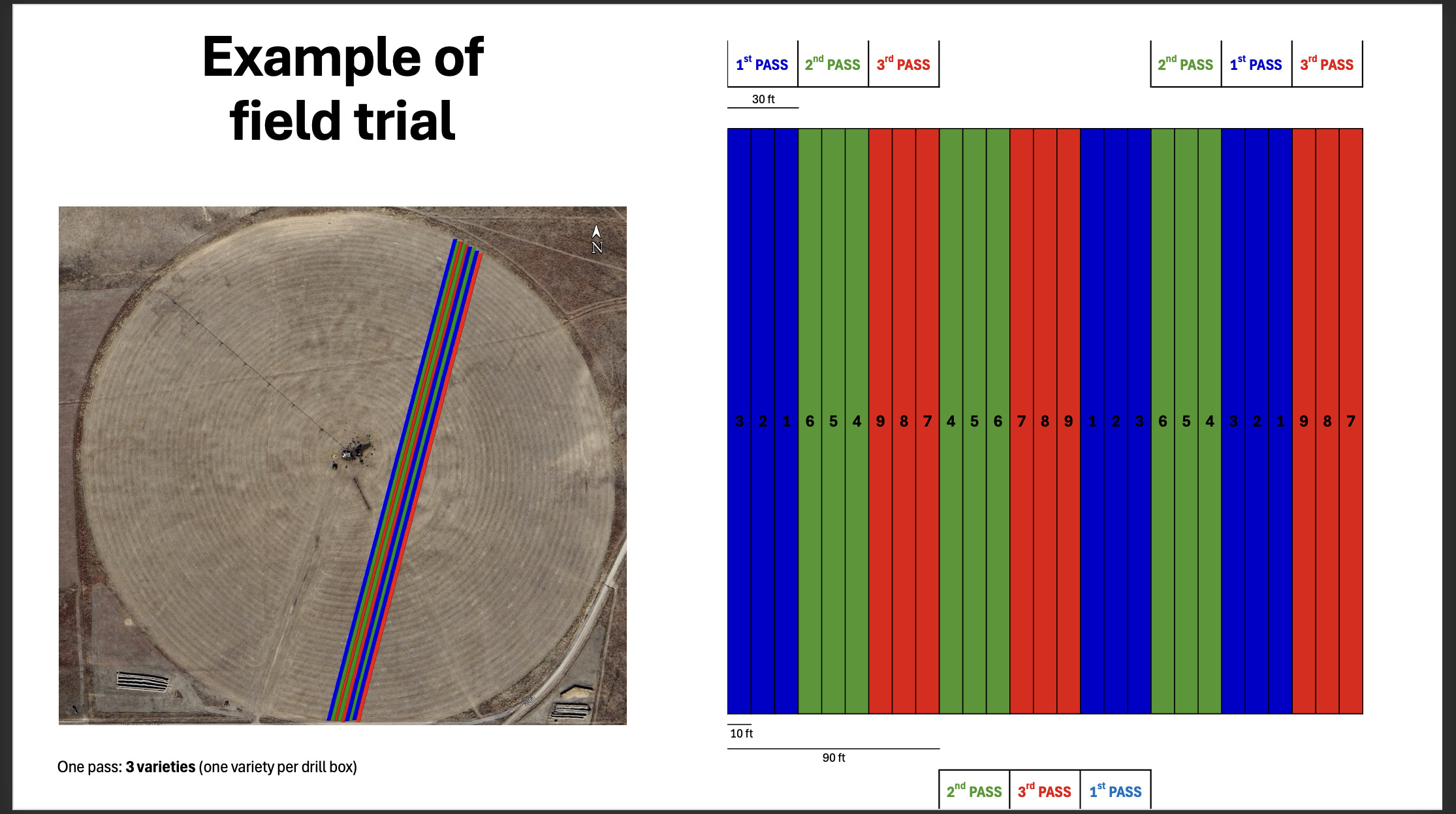
We conducted six (6) summer forage variety/mix trials across five (5) counties (Arthur, Grant, Hooker, Thomas, and Brown) in North Central Nebraska for two years. The four ranchers' team members conducted trials in their pivot-irrigated fields under winter or spring forage/summer forage rotation. Each trial (up to 20 ac total) had up to nine (9) different summer forages and the current rancher's summer forage. Each summer forage plot was a half an acre (0.5 ac) and replicated four times (2 ac total per summer forage) in a completely random or block design depending on the field and recommendation of the Cropping Systems Team from Nebraska Extension. The different forage varieties/mixes facilitated by the regional sales agronomist were selected to offer sustainable agriculture benefits and solutions to rancher team members regarding forage production, feed quality, and soil health improvements.
We seeded the summer forage plots (up to 40 per trial) from late May to early June 2024 and conduct the first (baseline) soil health test in the experimental area. Before the first cut, we collected biomass in each plot and sent samples to a local plant and soil lab for forage production and quality analysis. The same operations were conducted in the summer of 2025 at the exact georeferenced location. It is important that the same plot treatments were repeated in the same area in the second year to track changes in soil health. Other observations on weed pressure, duration of forage crop, etc were recorded.
Throughout, researchers collected data on forage production, quality, nutrients needs, and soil health.
Forages planted:
|
Forage name |
Rate (lb/ac) |
Cost per acre ($/ac) |
|
Master Graze Forage Corn |
20 |
83.0 |
|
Elite II Hybrid Pearl Millet |
40 |
68.8 |
|
Forage Silage Mix |
40 |
59.6 |
|
Multi-Cut Hay or Graze Mix |
40 |
55.6 |
|
Pacesetter SP |
40 |
50.9 |
|
Sug R Bale |
40 |
48.0 |
|
1st Choice BMR |
40 |
47.7 |
|
Honey Graze BMR |
40 |
47.7 |
|
Winter Grazing Mix |
40 |
46.4 |
|
Pacesetter SP & Soybean |
60 |
42.9 |
|
Hay N Graze |
40 |
33.6 |
A detailed breakdown of our project are here:
Summer forage selection and suitability varied across the Sandhills due to soil type, ranch operations, and intended forage use. Nutrient studies revealed that millet removes less nitrogen but more potassium than sorghum. Most soils exhibited moderate to severe potassium deficiency, which may contribute to millet’s variable establishment. Fertilizer programs were typically weighted toward nitrogen, phosphorus, and sulfur, with minimal potassium input, despite similar K export as N from hay harvest. Micronutrients such as zinc and manganese were limited in specific fields, and soil pH correction through liming to increase nutrient availability was discussed, but it is expensive. Selecting forage species tolerant of low-pH soils and adjusting nutrient management can gradually rebalance soils while improving forage productivity and quality.2-year report
The project led to significant on-farm changes:
Three irrigated pivot fields implemented nutrient management strategies based on soil tests and nutrient removal from hay, improving efficiency.
One producer expanded cover crops and summer forage plantings to over 600 acres after observing species performance.
Another producer adjusted his summer forage mix based on trial results, improving summer forage production and quality.
The North Central Nebraska Forage Production Group was formed, providing a lasting peer-to-peer network for sharing forage performance data, nutrient management strategies, and soil health practices.
Educational & Outreach Activities
Participation summary:
Field days with plot tours, winter meetings, and one-on-one consultations enabled producers to observe performance, discuss summer forage strategies, and learn more about nutrient management for summer forages.
During the season, we organized plot tours. Then, we organized the North Central Nebraska Forage Production Meeting on 2024 and 2025 in Mullen, NE, where we discussed nutrient management, weed management, and soil health options and challenges for summer forage production in the area. Additionally, we organized a Forage Production and Quality Clinic at Arthur, NE, in 2025, and 2025. In both events, we had 2-3 presentations that included project results and other related topics of interest. We allowed time for participants to share their experiences and concerns regarding forage production, quality, and soil health. This discussion motivated ranchers and local Ag businesses to adjust forage nutrient and weed management in the 2025 and 2026 seasons and explore options to improve soil health.
Each rancher collaborator received a printed report for the on-farm trial in their fields. These reports were discussed in a project team meeting. Due to the interest in the results obtained and discussions from this project, Dr. Nicolas Cafaro La Menza was invited to deliver a presentation at the "Cover crop grazing conference: Getting the most out of every acre" hosted in North Platte, NE, on Nov 6th of 2024, and at the "Soil Health Conference" organized by Arrow Seed on Feb 13th of 2025, at the 2026 Nebraska Sustainable Agriculture Society Annual Conference, and at the 2026 UNL Soil School. Collectively, these events gathered 197 forage producers. Finally, an editorial note was published on Feb 13th of 2025 in the Progressive Forage section of AgProud.com, and field trials from 2025 were published on the UNL On-Farm Research Network and discussed with farmers and ranchers during their winter meetings.
Learning Outcomes
The main takeaway was the amount of nutrients exported from the system when forage is cut.
It was good to see and walk among the different varieties in the field, to visualize and experience their growth.
Although the average production across varieties was similar, they seemed to have different adaptations to soil conditions and ranchers' operations.
We also learned about some nutrient deficiencies, such as potassium. Although this nutrient is not commonly used in current forage fertilization programs, soils show moderate to severe deficiency in K.
Weed management is also a big issue that interferes with forage production. Different forage varieties compete differently with weeds.
Finally, taking nutrient credits from irrigation water can help to save money on fertilizer expenses.
Project Outcomes
Three irrigated pivot fields implemented nutrient management strategies based on soil tests and nutrient removal from hay, improving efficiency. Basically rebalanced N, P, K, S, and micronutrients. Mostly reducing N and P and increasing K inputs.
One producer expanded cover crops and summer forage plantings to over 600 acres after observing species performance.
Another producer adjusted his summer forage mix based on trial results, improving summer forage production and quality.
The North Central Nebraska Forage Production Group was formed, providing a lasting peer-to-peer network for sharing forage performance data, nutrient management strategies, and soil health practices.
During plot tours, we realized that weeds were growing faster than expected. After discussing this with the extension specialist and local spraying business, we decided to spray the field and control the weeds. If it hadn't been for this project, we would not have controlled the weeds, and the forage production of that field would have been lower than it was.
Seeing the low soil pH results made us also think of long-term planning for recovering one of the fields, and we decided to lime one field. Still, we are planning to adjust some other nutrient management and weed control strategies discussed with this project, such as P fertilizer placement to improve forage production and soil health.
Challenges remain with weed management, particularly for millet, and integrating broadleaf cover crops into multi-species mixes requires further research. Optimizing nutrient management, particularly for K and micronutrients, incorporating grazing where feasible, and addressing micronutrient and pH limitations can further improve summer forage productivity.