Progress report for FNE25-106
Project Information
This project seeks to reduce costs associated with growing ginger to make it more profitable and sustainable for farmers.
Objectives:
- Compare the effect of seed rhizome size to ginger yield.
- Compare ginger yields and labor hours in using fresh grass clippings versus purchased fertilizer and compost in hilling ginger during the growing season. Perform an economic analysis to decide if it is more profitable to use compost or grass when hilling ginger.
- Trial methods to overwinter cured ginger and evaluate shelf life and commercial viability of cured ginger for culinary use.
- Compare ginger yields between overwintered cured ginger and purchased seed rhizomes. Evaluate commercial viability of overwintered cured ginger as seed rhizomes.
Ginger is a widely used spice and herbal medicine and plays a prominent role in Chinese, Indian, and Latin American cuisine (NIH). Despite a short growing season, Northeastern farmers have been growing baby ginger, particularly in unheated hoophouses, for over a decade (Baharet FNE06). While customer demand and market price remain high, significant costs and challenges are associated with growing ginger which can decrease profit margins, at times making this crop unprofitable (Baharet FNE06).
There are significant start-up costs to purchase seed rhizomes annually (Emery 2023, Sawatzky 2024), and seed rhizomes often come from Hawaii with high shipping costs as well as a high carbon footprint. Labor and materials to hill, fertilize, and weed ginger during the growing season further reduce profits (Baharet FNE06). There is a small window to sell baby ginger at market due to its short shelf life. Additionally, some farmers are finding seed rhizomes difficult to source which could halt production altogether or force farmers to purchase seed rhizomes from the grocery store possibly leading to decreased vigor and/or disease outbreak.
There are several farmers with SARE grants on ginger research that have experienced cost challenges first-hand.
“Per pound, ginger yields our highest gross sales. At the same time, ginger is a relatively expensive crop to grow. Seed ginger is expensive and sometimes challenging to source.” (Emery 2023)
“Ginger…typically requires substantial initial investment for seed stock. Ginger has high profit potential as a standalone crop, but these investments may deter farmers from growing ginger.” (Sawatzky 2024)
“The cost of production was higher than the gross income. Ideally, some harvested root would be reserved and stored for mother roots the following year.” (Baharet FEN06)
In addition, at a Collaborative Regional Alliance for Farmer Training (CRAFT) event hosted by NOFA-NH on Maximizing Growing in Small Spaces, I shared that I successfully pilot-tested that baby ginger can be overwintered and resprouted. This was met with both curiosity and enthusiasm. However, to recommend this method commercially, a direct yield comparison and economic analysis of overwintered cured ginger versus purchased seed rhizomes is required.
This proposal aims to address several factors leading to low margins on ginger production: a low seed to harvest ratio, high labor during the growing season, high input costs for annually purchased seed rhizomes, and a short window to sell baby ginger.
Mature ginger takes 8-10 months of cultivation to create the fibrous, brown roots found in the grocery store (Nishina). However, the growing season in the Northeast is only 5-7 months. Northeastern farmers have found they can purchase “seed” ginger rhizomes from warmer climates and pre-sprout them indoors ahead of the growing season to produce baby ginger- a specialty product with thin skin harvested at 4-6 months (Nishina). However, the yield of baby ginger (1:8) is significantly less than that of mature ginger (1:20) (Nishina).
First, we propose to trial methods to increase ginger yields and lower growing costs. A report from Hawaii recommended seed rhizomes sized 4-8 oz noting that late plantings benefited greatly from the larger seed size (Nishina). However, most baby ginger guides targeted to the Northeast recommend starting with 2oz pieces of seed rhizomes. We will trial 2, 4, 6, and 8 oz pieces of seed rhizomes and compare yields to see which size confers the highest seed-to-harvest ratio.
Heavily hilling and fertilizing ginger is also recommended to increase yields (Nishina) but can come with high labor and material costs. We propose to reduce costs by combining hilling and fertilizing into one step using fresh grass clippings -a free, low labor on-farm input. An additional benefit to grass mulch (or cut and carry green manure) is that it also suppresses weeds and maintains moisture. There are cost savings in not adding fertilizer, compost and/or potting soil. And there could be a reduction in hilling and weeding hours leading to higher overall profits. We propose to compare the yields and hours involved in hilling with compost compared to hilling with fresh grass clippings.
As mentioned before, baby ginger (harvested at 4-6 months) has lower yields than mature ginger and a low shelf life of 2-3 weeks. However, delaying harvest could double yield (Sideman). Perhaps pushing ginger harvest to 7 or even 8 months could increase shelf life as the older the plant gets, the more fibrous it becomes. A report recommends mature ginger to be cured on screens for 3 days before storage (Nishina). Adding a 3-day cure to the freshly harvested ginger could also increase shelf life in a way similar to newly dug potatoes. This would encourage farmers to delay harvests knowing they could increase yields and still have a long window to sell cured ginger.
We propose to qualitatively evaluate the shelf life and commercial viability of cured ginger to be sold for culinary use. This could provide growers the option of having a short window to sell baby ginger and then have a longer window to sell cured ginger. More options to sell and a longer window to sell are two more ways ginger can be more profitable to farmers.
Ginger seed rhizomes are expensive, often require shipping costs, and are sometimes unavailable in the marketplace (Emery 2023). The last part of the proposal focuses on ways to overwinter cured ginger to evaluate it as seed rhizomes the following season. Last year, we had proof of concept with 15 plants that it is possible to overwinter cured ginger and grow it out the following season. To ensure that overwintered cured ginger is not just viable but successful in the fields, we propose to compare yields of overwintered cured ginger to purchased seed rhizomes. If successful, farmers in the Northeast would no longer need to purchase seed rhizomes annually greatly reducing the costs associated with growing ginger. This opens a new market opportunity to sell seed ginger to other growers similarly to seed garlic.
If funded, this proposal will make farming ginger more accessible & sustainable by reducing costs, increasing profitability, and potentially closing the loop on several external inputs.
Cooperators
- - Technical Advisor
Research
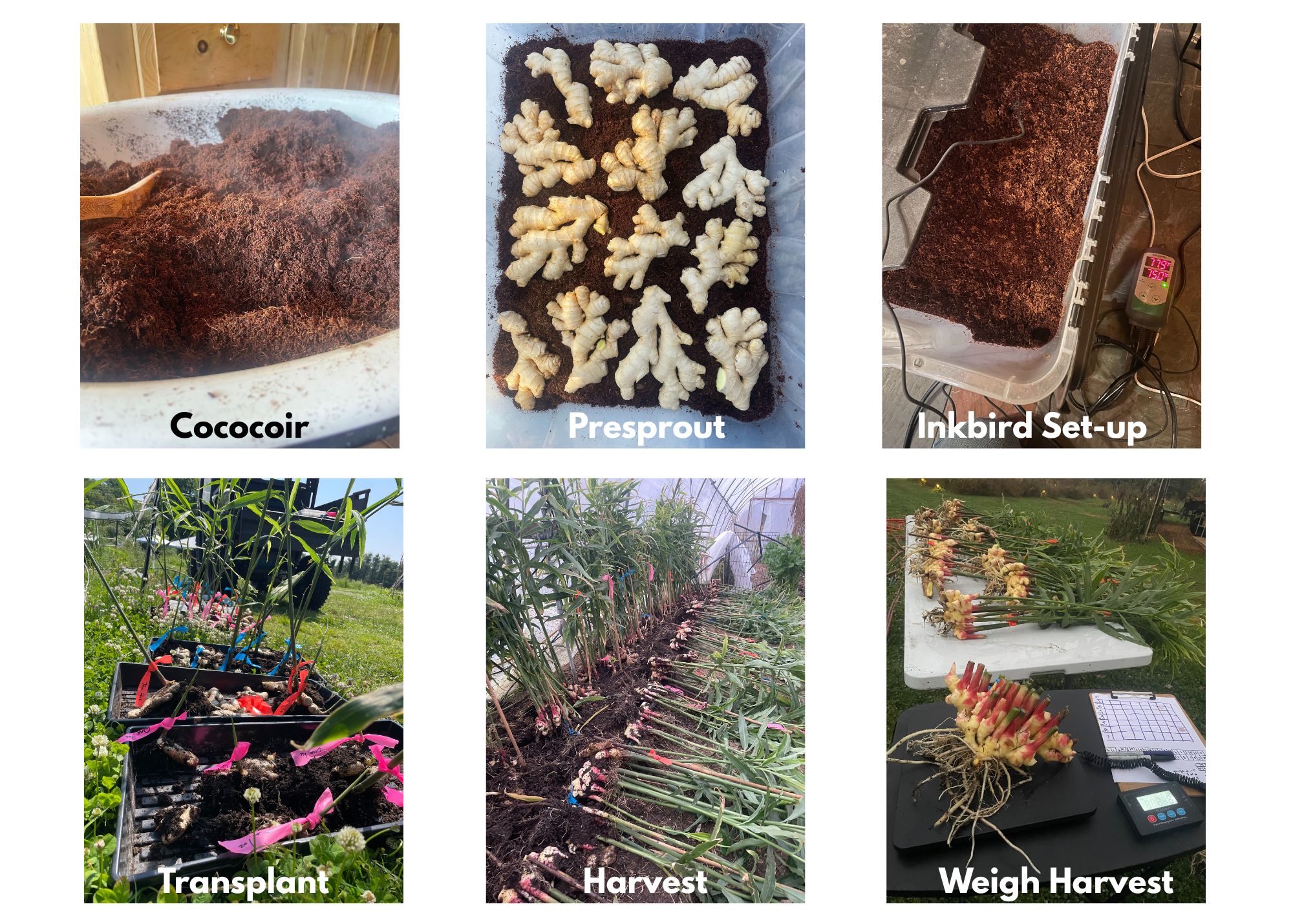
Pre-Sprout Ginger Seed Rhizomes
- 3/3 Ordered ginger rhizomes from Kauai Organics in Hawaii
- 3/12 Cut ginger into pieces aiming for +/- 0.1 oz, laid out at room temperature to cure for 48 hours, 60F
- 3/14 Soaked ginger in tap water overnight to remove any growth inhibitors
- 3/15 Ginger was heat treated with hot water 122F for 10 minutes to surface-sterilize
- 3/15 Prepared pre-sprout media
- pour boiling water onto cococoir to pasteurize and hydrate, let cool to 75F
- place a 1-2" layer of cococoir into large plastic bin, arrange ginger pieces in single layer, not touching, cover in cococoir
- repeat layers as needed with top layer being cococoir
- leave lid adjar, place plastic bin on seed heating mat hooked up to InkBird temperature regulator set to 75-78F
- Check on ginger pieces every week for pre-sprouts and to make sure it isn't drying out or growing mold
- 4/15 Pot up ginger rhizomes that now have pointy pre-sprouts
- Place 2" potting mix into 1020 tray
- Arrange ginger in a single layer, not touching
- Lightly cover with potting mix
- Leave under LED grow light
- Prep beds in hoophouse
- Use soil test to amend soil to pH 6.0
- Adjustment any amendments for optimal amount of macro and micronutrients
- Rake beds flat
- Add 2-3" finished compost along with 2-3" leaf mold
- Top with 6" shredded leaves
- Early June, ginger plants were hardened off
- 6/16 Transplanted ginger in hoophouse according to Objective 1 & 2
Objective 1 : Compare the effect of seed rhizome size to ginger yield
- Purchased ginger rhizomes were cut and weighed into 1, 2, 3, 4, 5, and 6 oz pieces (+/- 0.1 oz) with an N of 8 in each group, 48 plants total. I originally proposed to evaluate seed rhizomes of 2, 4, 6, and 8 oz however, it was difficult to get enough 7 or 8 oz pieces from what was purchased as these were quite large, would have had low N numbers, and would have produced a lot of smaller rhizome waste.
- Ginger seed rhizomes were prepared as listed above
- A plot of 16' x 2' was prepared.
- Research groups were labeled with sharpie & colored flagging tape. Each rhizome received a label as well as a labeled bamboo stake. Labeled stakes were pulled at random.
- Ginger was planted 4" deep, 8" spacing in row and between rows in an unheated, single layer hoophouse.
- Ginger was covered with composted chicken litter, soil, and leaf mulch.
- Ginger was irrigated with drip irrigation every other day on a timer for 1 hour depending on temperature.
- I had intended to hill plants early July, late August, and late September. However, they did not need hilling in early July. So we gave them one hilling in late August.
- I had intended to use dilute fish emulsion as fertilizer with each of the hillings. However, all plants in this research group received 4" fresh grass clippings in late August.
- In October, plants were covered with a layer of greenhouse plastic as the temperature dipped into the 40s and 30s.
- 10/20 All plants were carefully harvested and sorted by original seed rhizome size
- Plants were gently sprayed with water to remove some of the soil
- Greens were trimmed to 2"
- Each plant was weighed with the original seed rhizome (mother root) and recorded
- A few plants had rotted rhizomes and were omitted from the data set
- Any plants with weights less than the original seed rhizome were omitted from the data set
- The data set was used to calculate average plant size with standard deviation and yield ratio.
Objective 2: Comparing ginger yields and labor hours in using fresh grass clippings versus purchased fertilizer and compost in hilling ginger during the growing season.
- The methods from Objective 1 were followed
- All rhizomes in objective 2 were 2 oz seed pieces (+/- 0.1 oz)
- Four 4'x2' research plots with 10 plants each, 40 plants total were prepared. Research plots were labeled Compost 1, Compost 2, Grass 1, and Grass 2
- Hilling occurred in late July, late August, and late September. For each hilling, Compost 1 & 2 plots received dilute fish emulsion and 3" of compost. Grass 1 & 2 plots received 6" of fresh grass clippings.
- Weeding occurred at time of transplant, in early August, and early September
- Labor hours of hilling application and weeding as well as material costs were tracked to compare between Compost & Fertilizer vs Grass Clippings.
- For Compost labor, time was recorded for getting two, 5 gallon buckets and a shovel, walking to the compost pile, filling both buckets, carrying buckets to the hoophouse, covering rhizomes with compost, shaking the ginger leaves to make sure compost is on rhizomes, and repeating for a total of 4, 5 gallon buckets covering 2, 4' x2' plots, and returning the buckets and shovel to the shed. Hilling was apx 3" depth.
- For Fertilizer labor, time was recorded for getting an electric backpack sprayer, a bottle of Neptune's liquid fertilizer fish seaweed blend 2-3-1, filling sprayer with 1 gallon water and 1/8 cup (1 oz) fertilizer, and spraying half gallon onto each 4'x2' plot, then rinsing sprayer and returning it to the shed.
- For grass labor, time was recorded for moving a 44 gallon trashcan filled with green grass clippings (1-3 days old) to the hoophouse and spreading grass onto the rhizomes 6" thick, making sure the grass is not stuck in the leaves, and returning the trash can. Labor time did not include mowing the grass paths as this would have needed to be accomplished independent of this research.
- Weeding labor was recorded for weeding each 4'x2' plot. Plots were weeded at time of transplant with those labor hours not recorded. Plots were weeded between the 3 hilling applications.
- In addition to hilling labor time, the proposed study was to compare yields between Compost & Grass plots. However, a family of rats made tunnels under these plots affecting the plants. Unfortunately, this compromised the study and we were unable to get meaningful data.
Objective 1: Comparing Ginger Plant Size from Various Seed Rhizome Sizes Results
In Objective 1, growth of ginger from rhizomes of various sizes were compared to find the optimal size. All plants were treated similarly and were harvested on the same day. Weights, in oz, were taken of each plant including their mother rhizome. Note that ginger plants do not have true seeds. In this report, seed rhizome is referred to the starting piece of ginger rhizome from which the rest of the plant will grow. At harvest, the seed rhizome is referred to as mother rhizome.
Weights were averaged across seed size groups and standard deviation was calculated. Any plant with a weight of less than the amount of seed size were omitted as these seed rhizomes rotted in the soil for unknown reasons. Of note, there were three plants omitted from the 2oz seed rhizome group. The results were graphed for comparison.
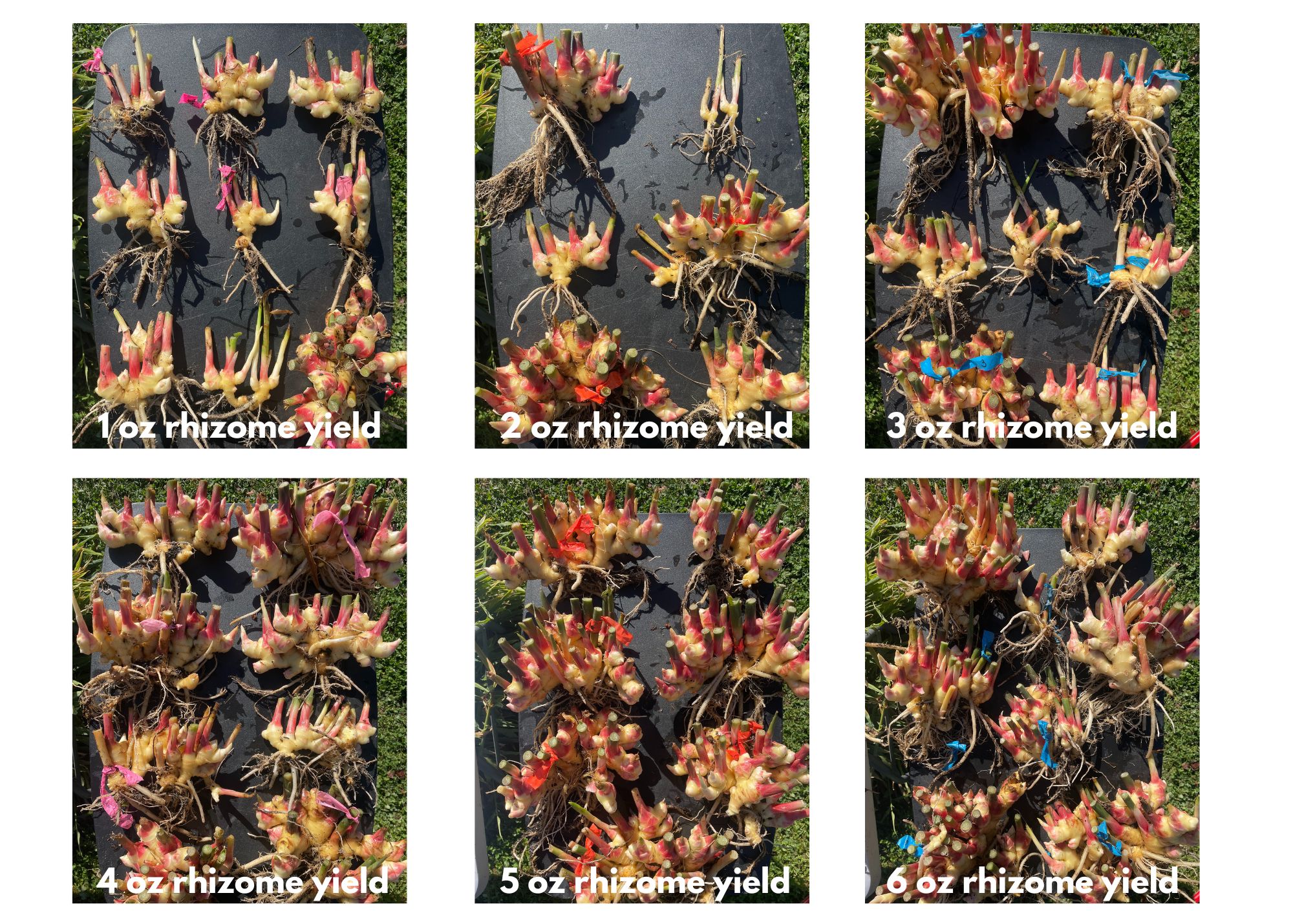
The average yield of each plant increased with the size of the seed rhizome. A smaller seed rhizome produced a plant of smaller size. And a larger seed rhizome produced an average plant weight of larger size. 1 oz seed produced an average of 4.25 oz ginger rhizomes whereas 6 oz yielded an average of 26.86 oz ginger rhizomes.
Yield ratio was calculated by dividing average weight by seed size weight. The 2oz seed rhizome size had the highest yield ratio of 6.2. However, 3oz, 4oz, 5oz, and 6oz had relatively similar yields between 4.48 and 4.97.
All of the plants in each seed size group were photographed together for visual comparison without the mother roots. Based on visual comparison, the larger the seed rhizome, the larger the ginger rhizomes. Of the 1oz seed rhizomes, all of the ginger plants except for one produced a visually small crop. Of the 2oz and 3oz seed rhizomes, the plants look variable in size as some are very small, some are moderate in size, and some are larger in size. In the 4, 5, and 6oz seed rhizomes, the plant yield looks more consistent from plant to plant. The plants from these larger seed rhizomes also look large and marketable with nice hand development.
Objective 1 Discussion
Based on yield ratio alone, it would seem the 2oz seed rhizome pieces would be the grower's best bet as it has the highest yield ratio compared to the other seed ratio sizes. The 2oz seed rhizome size is often recommended in many ginger grow guides in continental north America.
However, taking the average plant weight into consideration, the larger rhizome sizes produce more ginger. Note that with low N numbers and the variability that comes with agricultural field research, the standard deviation across all treatment groups is high. None of these numbers are statistically significant but can point towards trends.
The Nichinan paper from the Hawaii Cooperative Extension Service would agree with these findings as "the yield is not affected by seed size when planting occurs in early spring; however, late plantings benefit greatly from larger seed size." In Hawaii, mature ginger is grown for 10 months. For this research, rhizomes were grown from March-mid October, 7.5 months. In the Northeast, growers need to take as many advantages as possible like pre-sprouting rhizomes indoors and now we have data to show that larger rhizome sizes can increase yields.
When growers purchase ginger, orders are typically by the pound. The size of each piece of ginger within that pound can vary. In a 20lb box of purchased ginger from Hawaii, there were not enough large pieces to grow 8oz or even 7oz pieces. And while in this study, 6 oz produced the highest amount of ginger on average per plant, it may be more practical to aim for 5 oz. In addition, in this study, the 5oz seed rhizomes had the second highest yield ratios of 4.97. The 5 oz seed rhizomes (24.86oz ) also had comparable average plant yields to the 6 oz seed rhizomes (26.86oz). Using a slightly smaller seed rhizome can also reduce cost to the grower. As such, 5 oz will be the size used in Objective 4.
It is also worth noting that again, as purchased ginger will come in varying sizes, growers ending up with sizes of 2, 3, or 4 oz are still worth growing. The plants from the 1 oz seed rhizomes seemed too small to be worth growing.
To put the seed rhizome size into further perspective, a Revenue Analysis was performed between 2oz and 5oz seed rhizomes. With 2oz, a grower can get 8 plants from one pound of seed ginger. With 5oz, a grower can get 3 plants from one pound of seed ginger. Based on the average plant size from this study, 8, 2oz seed rhizomes could yield 6.2lb of ginger. With 3, 5oz seed rhizomes, the yield would be 4.66lb. Again, this would point towards using 2oz as a seed rhizome size. However, assuming $15/lb retail price and 8" spacing per plant, the 2oz plants have a $17/bed foot revenue whereas the 5oz plants have a $35/bed foot revenue.
Comparing 8 plants of 2oz seed rhizomes to 8 plants of 5oz seed rhizomes, it would cost the grower an additional $30 in seed rhizome costs for the larger seed rhizomes. But at $35/bed ft, the 5oz rhizomes would produce 12.43lbs ginger, bringing in $186 revenue sold at $15/lb retail price. A grower could make $93 more in revenue by growing 5oz seed rhizomes vs. 2oz, or $63 more in gross margin (accounting for the increased seed rhizome cost).
Considering that hoophouse space is extremely limited and valuable to all growers, finding ways to increase bed ft gross margin would be of top priority especially when ginger could occupy that space from June-Oct.
Objective 2: Hilling Costs from Compost & Fertilizer Application vs Grass Application Results & Discussion
In an effort to further reduce costs for ginger growers, 2oz seed rhizome plants were hilled three times with either 3" compost and liquid fertilizer or with 6" freshly mowed grass. Hilling with soil and applying purchased fertilizer is a standard commercial practice. Of note, growers in Hawaii will plant ginger in furrows formed with tillers and plants are hilled with soil from the paths. In our no-till operation and with various research plots, it made more sense for us to hill with purchased compost which also adds organic matter to the soil and use a purchased liquid fertilizer 2-3-1 applied with a backpack sprayer.
The advantages of using grass is that if an operation is already mowing grass paths during the season, there is no additional material cost. If the grass is used while still green, it provides a rough NPK of 4-1-2 to plants. And as the grass breaks down, it becomes a layer of brown mulch organic material which can also suppress weeds.
Labor was tracked in minutes during 3 hillings in late July, late August, and late September. Compost 1 & 2 plots received compost and fertilizer applications. Grass 1 & 2 plots received mowed grass clippings. In early August and early September, time to weed each plot was recorded. Labor costs were compared assuming a pay rate of $20/hour. Material costs were also included. Time and material costs were grouped together from the two plots to compare Compost vs Grass applications. The combined costs for Compost plots were across 8 bed feet. And the combined costs for the Grass plots were across 8 bed feet.
Across one growing season, the Compost & Fertilizer plots took an extra 0.78 hours to maintain compared to the Grass plots. There were also less weeds in the Grass plots. Incorporating material costs with labor, Compost & Fertilizer plots cost an extra $33.45 across 8 bed feet compared to Grass plots. This would point towards grass application for hillings as being both cheaper and faster to maintain than the traditional compost & fertilizer applications. However, as rats tunneled under these plants, we were unable to compare yields. If yields were at least comparable from Compost vs Grass plots, the recommendation would be to switch to grass application for hilling ginger if a grower already has unsprayed grass clippings readily at hand.
Of course, all growers farm in a different context. It may make sense for a grower to furrowing ginger plants at transplant and hill with soil or use purchased compost & fertilizer. We had wanted to provide an alternative option to yield at least comparable results and along with reducing costs.
For now, this objective is inconclusive. We plan to use the traditional hilling with compost & fertilizer application for Objective 4.
Departure from Proposed Study:
Ideally ginger is obtained and pre-sprouted in February to extend the growing season as much as possible but not so early that the plants are root bound before transplant. However, the start of the grant period of this grant was early March so we were a month behind where we would have liked to start. In warm climates, mature ginger is grown for 10 months from pre-sprout to harvest. Mature ginger will have the largest yields. In the northeast climate, it may be possible to achieve larger yields by pushing ginger production from February through November.
We had a busy spring and had intended on transplanting the ginger early June but got to it mid June.
Plants in Objective 1 were to receive 3 compost hillings and 3 liquid fertilizer applications during the growing season. However, as it was a difficult season for the rest of the farm, they only received one hilling/fertilizer application of 6" fresh grass clippings. All of the plants in this research group were treated the same so I am still able to compare them to each other.
Unfortunately, yield analysis in Objective 2 was compromised by a family of rats tunneling under the ginger plants in the hoophouse. We are working on eradicating the rats as we head into year two of this study.
Objective 1 sought to identify an ideal seed rhizome size with higher yields that justify the cost of the seed rhizome. Seed rhizomes sized 1, 2, 3, 4, 5, and 6oz were planted and individual plant weights were measured at harvest. Size groups were analyzed for average plant weight, yield ratio, and visual size comparison. 5oz looks like the best seed rhizome size based on average plant yield, yield ratio, visual size comparison, and practicality of consistently obtaining seed rhizomes of this size. A revenue analysis was performed to compare the recommended 2oz seed rhizome with 5oz. For 8 plants in 5 bed feet, plants from 5oz seed rhizomes could yield an additional $93 in revenue compared to 2oz seed rhizomes. This more than accounts for the increased $30 in additional rhizome cost. 5oz seed rhizomes will be used for Objective 4.
Objective 2 sought to identify if grass clippings could be a lower cost alternative to hilling with compost & liquid fertilizer. While the labor and material cost of maintaining ginger plants was lower with using grass clippings, this method cannot be recommended as the yields between the two groups could not be assessed.
Education & outreach activities and participation summary
Participation summary:
We hosted 10 on-site farm dinners in 2025. Before each dinner, Linh Aven leads a farm tour to highlight farm growing practices and to highlight what is happening on the farm. During each of these farm tours, Linh shared that it is possible to grow ginger in the northeast, the farm is growing ginger in a high tunnel, and the farm currently has a SARE grant to improve ginger growing practices. This was included as part of an overview of the farm rather than a talk specifically about ginger growing practices and the research involved in this grant. Folks were invited to look at the ginger plants and ask questions of interest.
One of the most relevant issues to farmers that Linh has noticed anecdotally is if ginger can be overwintered and used a seed rhizome. As such, Linh is planning on hosting a ginger-focused workshop in February 2026 rather than in 2025.
Learning Outcomes
This section will be updated in year two
Project Outcomes
This project is not yet finished. The most meaningful results will occur in year two. At the end of year one of this study, it is very helpful to know that 5 oz of seed ginger is a good size to pre-sprout ginger rhizomes based on average plant weight, visual plant size, and revenue analysis. It is also helpful to know that seed ginger of sizes 3, 4, or 6 oz can also yield meaningful harvests. Larger rhizome sizes may benefit farmers who want to grow ginger in the northeast with a smaller growing window and limited hoophouse space dedicated to growing ginger.
I will fill this section out with the final report.