Final report for FW25-004
Project Information
Olive trees are one of the most agronomically and ecologically sustainable crop trees in the Western U.S.: low pest pressure and low nutrient needs mean low inputs; low to no water needs; excellent year-round carbon sequestration. They are a viable permanent crop on small/family farms, particularly in multi-cropping systems or in conjunction with pasturing.
Olive growers in the Western U.S. produce mainly olive oil. The problem they face is intense pricing competition from very large producers of olive oil from Mediterranean countries. Western U.S. growers are at a significant disadvantage. They need help to make olive growing more economically sustainable.
PI Caceu (olive grower) and TA Traber (Linus Pauling Institute) will research the most sustainable, simple, energy-efficient, cost-effective method to prepare an olive leaf powder that is high in polyphenols (molecules with antioxidant and anti-inflammatory properties). Working with olive leaves offers the advantage of up-cycling a by-product of the pruning of olive trees, and extends the season from a brief fall harvest (of olives for olive oil) to a year-round harvest of olive leaves for olive leaf powder.
The olive leaf powder represents a new business opportunity for olive growers. The powder could be marketed as a standalone food product (replacement for green tea) or as an ingredient to impart polyphenols into food products. Produced in addition to olive oil, the olive leaf powder expands and diversifies olive growers’ product lineup.
The final project report, the article submitted for publication in Antioxidants (or a similar open-source, peer-reviewed journal) and the educational webinar organized by the Linus Pauling Institute with support from AOOPA, the trade organization that represents 80% of olive growers in the U.S., will provide olive growers with information about a novel product they can produce to expand and diversify their product lineup and thereby fortify their economic sustainability.
The project's research objective is multilayered:
(1) Crop processing sustainability. The project seeks to identify a process that is simple, energy efficient (low temperature oven drying) or energy free (air drying), cost effective (little to no inputs), and therefore highly sustainable, to prepare an olive leaf powder.
(2) Nutritional value of the olive leaf powder. With support from TA Traber and thanks to the Linus Pauling Institute's ability to conduct highly accurate assays, the project seeks to identify a process that is not only simple and sustainable but also one that captures the highest levels of polyphenols from olive leaves. Polyphenols (or phenolic compounds) are molecules with strong antioxidant and anti-inflammatory activity that have been linked to health maintenance in humans.
(3) Agronomic sustainability, increased by the up-cycling of a by-product for a farm practice. The project's focus is on olive leaves, not on olives (the fruit) or olive oil. That is because scientific literature shows that olive leaves have similar and sometimes higher polyphenols (depending on olive varietal, time of harvest, etc.) than olives or olive oil. Entire olive branches are pruned each year in order to maintain the 'open vase' shape of the trees that is best for the health of the olive tree (air flow) and best for production of olives (thanks to light penetration inside the olive tree's canopy). The project's research elevates the by-product of yearly pruning into a product that can be marketed.
(4) Agronomic and economic sustainability, increased by season extension. Olive growers in the U.S. primarily produce olive oil. The olives are harvested and milled in the fall, during a very brief season. Working with olive leaf, on the other hand, could happen at any time of the year because olive trees are evergreen and olive leaves are always available to be harvested and processed. This would extend the season to one that is year-round.
(5) Economic sustainability, increased by product diversification. The olive leaf powder is a novel product. It represents a new business opportunity for olive growers. The powder could be marketed as a standalone food product (e.g., as a replacement for green tea that has equal or higher amounts of antioxidants but is naturally caffeine free and has a much lower carbon footprint than a green tea shipped from abroad), or it could be marketed as a functional ingredient to be used in other food and beverage products to impart polyphenols. Produced in addition to olive oil, the olive leaf powder expands and diversifies the product lineup, which can only be beneficial for the economic sustainability of a grower.
The project's educational objective is to submit the project's findings for publication in an open access, peer reviewed journal such as Antioxidants, and to present the project's findings at an educational webinar organized by the Linus Pauling Institute. The Institute’s webinars routinely attract an average of 1,000 participants. The webinar will be further amplified by stakeholders such as Oregon State University and by AOOPA, the leading trade group for olive growers and producers of olive oil in the U.S.
| May 2025 | PI Caceu to begin harvesting olive leaves. PI Caceu to take batches of green leaves to the Linus Pauling Institute (LPI). LPI to obtain baseline values of polyphenols in unprocessed green leaves. | PI Caceu, TA Traber and LPI |
| May - June 2025 | PI Caceu to harvest olive leaves. PI Caceu to prepare samples for preliminary study 1 ('Does washing cause excessive loss of polyphenols?') and preliminary study 2 ('Does bleach before air drying cause excessive loss of polyphenols?'). PI Caceu to take samples to LPI. LPI to obtain values of polyphenols in these preliminary samples. | PI Caceu, TA Traber and LPI |
| June - July 2025 | PI Caceu to harvest olive leaves and prepare samples for main study (to determine the optimal processing needed to produce an olive leaf powder high in polyphenols) by washing, drying, grinding and blending olive leaves with olive oil in different ratios. PI Caceu to take samples to LPI. | PI Caceu |
| July - December 2025 | LPI to assay samples for total polyphenols (Folin-Ciocâlteu method). LPI to identify and quantify key polyphenols by UPLC-mass spectrometry. LPI to prepare report with findings and manuscript for publication in an open-source, peer-reviewed journal such as Antioxidants. | LPI |
| January - April 2026 | PI Caceu and TA Traber to prepare a slide presentation of the project's findings. PI Caceu and TA Traber to organize and hold an educational webinar, with support from stakeholder AOOPA, the leading trade organization that represents 80% of olive growers in the U.S. PI Caceu and TA Traber to gather post-webinar feedback with approved WSARE Survey. PI Caceu to prepare final report for Western SARE. | PI Caceu, TA Traber and LPI |
Cooperators
- - Technical Advisor
Research
PI Caceu (olive grower) and TA Traber (Professor Emeritus at the Linus Pauling Institute at Oregon State University) investigated the most sustainable, straightforward, and most energy-efficient and cost-effective method to prepare an olive leaf powder that is high in polyphenols. Polyphenols are molecules with antioxidant and anti-inflammatory properties. There is a growing body of evidence in scientific literature published in the past 10-15 years that polyphenols (also known as phenolic compounds) play a significant role in human health. In particular, their role in the maintenance of cardiovascular health has been recognized by the European Food Safety Authority (EFSA) when it allowed a limited health claim to be made on olive oil labels. Polyphenols have become better known among U.S. consumers, in recent years, as U.S. consumers have become more aware of the healthful aspects of the Mediterranean diet. What remains vastly less known but has become a topic of increased studies by researchers at universities abroad is the fact that olive leaves have similar or sometimes higher levels of polyphenols than the olive fruit that is used to make olive oil. Our research project was predicated on the fact that it would be highly sustainable--economically speaking--for U.S. olive growers to use olive leaves to produce a simple, shelf-stable, olive leaf powder high in polyphenols (OLP-HiP).
PI Caceu harvested batches of olive leaves that were taken to the Linus Pauling Institute (LPI) unprocessed. This allowed the LPI to obtain baseline values of polyphenols from the fresh olive leaves. Batches of leaves were then washed with and without bleach and were dried in various conditions. After drying, the leaves were ground into a powder. The drying temperatures and drying length of time were designed with simplicity, scalability, low-energy, and therefore low-cost in mind, to determine a process to make OLP-HiP that would be straightforward and easy to adopt by olive growers.
Under TA Traber's supervision, staff at the LPI Analytical Services Core Laboratory (LPI ASCL) measured polyphenols in the various batches of unprocessed and processed olive leaves. The LPI ASCL used the rapid Folin-Ciocâlteu assay to quantify total polyphenols. Upon identifying an optimal washing and drying process, the LPI ASCL measured specific polyphenols using ultra high-pressure liquid chromatography with quantitation by mass spectrometry.
Overall, this research has helped determine a simple, low-cost process to produce OLP-HiP that can be accomplished in a straightforward manner in any commercial kitchen to produce scalable quantities of OLP-HiP.
We outlined five (5) research objectives in our proposal. Below, we address each of the objectives.
- Crop processing sustainability. The project sought to identify a process that is simple, energy efficient (lower temperature, shorter duration oven drying), cost effective (little to no inputs), and therefore highly sustainable, to prepare an olive leaf powder high in polyphenols (OLP-HiP). We tested oven drying (90 °C, or 37 °C) vs air drying (21 °C) to constant moisture. Moisture content of the powders was measured by weighing the samples before and after drying for the indicated times and temperatures. The next step was to evaluate cleaning methods given that the ultimate goal is to use the OLP-HiP as an ingredient in products (foods, beverages, supplements) intended for human consumption. A water rinse (1 minute) was compared to a bleach (200 ppm total chlorine) rinse (1 minute for sanitizing the leaves) followed by a fresh water rinse (1 minute). Both steps (water only vs bleach followed by a water rinse) were followed by patting the samples dry. The optimized drying procedure identified in the first step (oven drying at 90 °C for 90 minutes) was then used to obtain dried leaves that were then ground up in a Waring metal blender. Overall, our research has helped determine a simple, low-cost process to produce OLP-HiP. This process can be accomplished in a straightforward manner in any commercial kitchen by any olive grower.
-
Nutritional value of the olive leaf powder. Our research contributed to broader ongoing research about polyphenols (or phenolic compounds): molecules with strong antioxidant and anti-inflammatory activity that have been linked to health maintenance in humans. One of the challenges has been to determine how to effectively capture high levels of these molecules from plant sources, while ensuring food safety and shelf stability. Our comparison of several washing and drying methods has contributed to these efforts to optimize a procedure that is straightforward, low cost, and efficient to extract polyphenols and have them available in a shelf-stable, easy to use form, such as a dry powder: in our case OLP-HiP.
-
Agronomic sustainability. An important reason why we wanted to undertake this research was the fact that the plant material being used (olive leaves) is a by-product from an olive farm practice: the annual pruning of olive trees. The pruning is necessary for (i) the health of the olive trees (better air flow through the canopy), (ii) the slight increase in fruit yield (better light penetration inside the canopy leads to more olive fruit), and (iii) the ease of harvest (smaller tree size makes harvest easier, requires less use of machinery, therefore lower inputs). The project's focus is on olive leaves, not on olives (the fruit) or olive oil. Scientific literature has shown repeatedly in recent years that olive leaves have similar and sometimes higher levels of polyphenols (depending on olive varietal, time of harvest, etc.) than olives or olive oil. One of our project's objectives was to elevate this by-product of yearly pruning into a product that can be made in a simple, low cost manner, yet is a product of high value because it stores important molecules. Overall, our research has helped determine a simple, low-cost process to produce OLP-HiP. This process can be accomplished in a straightforward manner in any commercial kitchen by any olive grower using olive leaves up-cycled from the annual pruning of olive trees.
-
Agronomic and economic sustainability, increased by season extension. Olive growers in the U.S. primarily produce olive oil. The olives are harvested and milled in the fall, during a very brief season (typically October-November). Working with olive leaf, on the other hand, could happen at any time of the year because olive trees are evergreen and olive leaves are always available to be harvested and processed. This would extend the season for olive growers to one that is year-round. Overall, our research has shown that making a simple product (OLP-HiP) can indeed be accomplished in a straightforward manner in any commercial kitchen by any olive grower, which means that this process could be easily adopted by many (if not all) olive growers in the U.S. to extend their harvest season from less than 2 months to year-round.
-
Economic sustainability, increased by product diversification. OLP-HiP is a novel product. It represents a new business opportunity for olive growers in the U.S. OLP-HiP could be marketed as a standalone food product (e.g., as a replacement for green tea that has equal or higher amounts of antioxidants but is naturally caffeine-free and has a much lower carbon footprint than a green tea shipped from abroad), or it could be marketed as a functional ingredient to be used in other food and beverage products or supplements to impart polyphenols. Produced in addition to olive oil, OLP-HiP expands and diversifies an olive grower's product lineup, which can only be beneficial for the economic sustainability of a grower. Overall, our research has shown that making a simple product (OLP-HiP) can indeed be accomplished in a straightforward manner in any commercial kitchen by any olive grower, which means that this process could be easily adopted by many (if not all) olive growers in the U.S.
Research outcomes
Overall, our research has shown that making a simple product--a dried olive leaf powder high in polyphenols (OLP-HiP)--can indeed be accomplished in a straightforward, low cost manner in any commercial kitchen by any olive grower, which means that this process could be easily adopted by many (if not all) olive growers in the U.S. No special equipment is necessary. Washing of the olive leaves with food grade bleach water is a well-known process. Drying temperatures and drying times were shown by our research to be low enough that energy use would be low, for a low cost, making this process affordable. Furthermore, olive leaves are an abundant material found year-round. Olive leaves contain high levels of polyphenols. Our research determined an optimized drying process--the sweep spot in terms of drying temperatures and length of drying at which moisture is effectively eliminated from the olive leaf yet polyphenols are not destroyed. This simple process can be undertaken in any commercial kitchen by any olive grower to produce OLP-HiP. We highly recommend that U.S. olive growers consider using this process in order to produce OLP-HiP and therefore expand their product lineup and increase their economic sustainability.
Education and Outreach
Participation summary:
The project's findings were submitted for publication in Agricultural Environment and Sustainability, an open-source, peer-reviewed journal. See attached manuscript: https://projects.sare.org/media/pdf/A/G/R/AGRES-S-26-00191.pdf We just received the feedback from four reviewers and PI Caceu and TA Traber are in the process of reviewing the reviewers' comments. We might submit our manuscript to another scientific publication.
Our projects' research results were presented at the Linus Pauling Day on February 27, 2026 as a poster presentation. See attached poster: https://projects.sare.org/media/img/O/l/i/Olive-leaf-OSU-LPI-LaCreole-scaled.jpg The Linus Pauling Day is held each year at the Linus Pauling Institute at Oregon State University as an open house event that draws hundreds of academics, alumni, students, supporters and various other stakeholders.
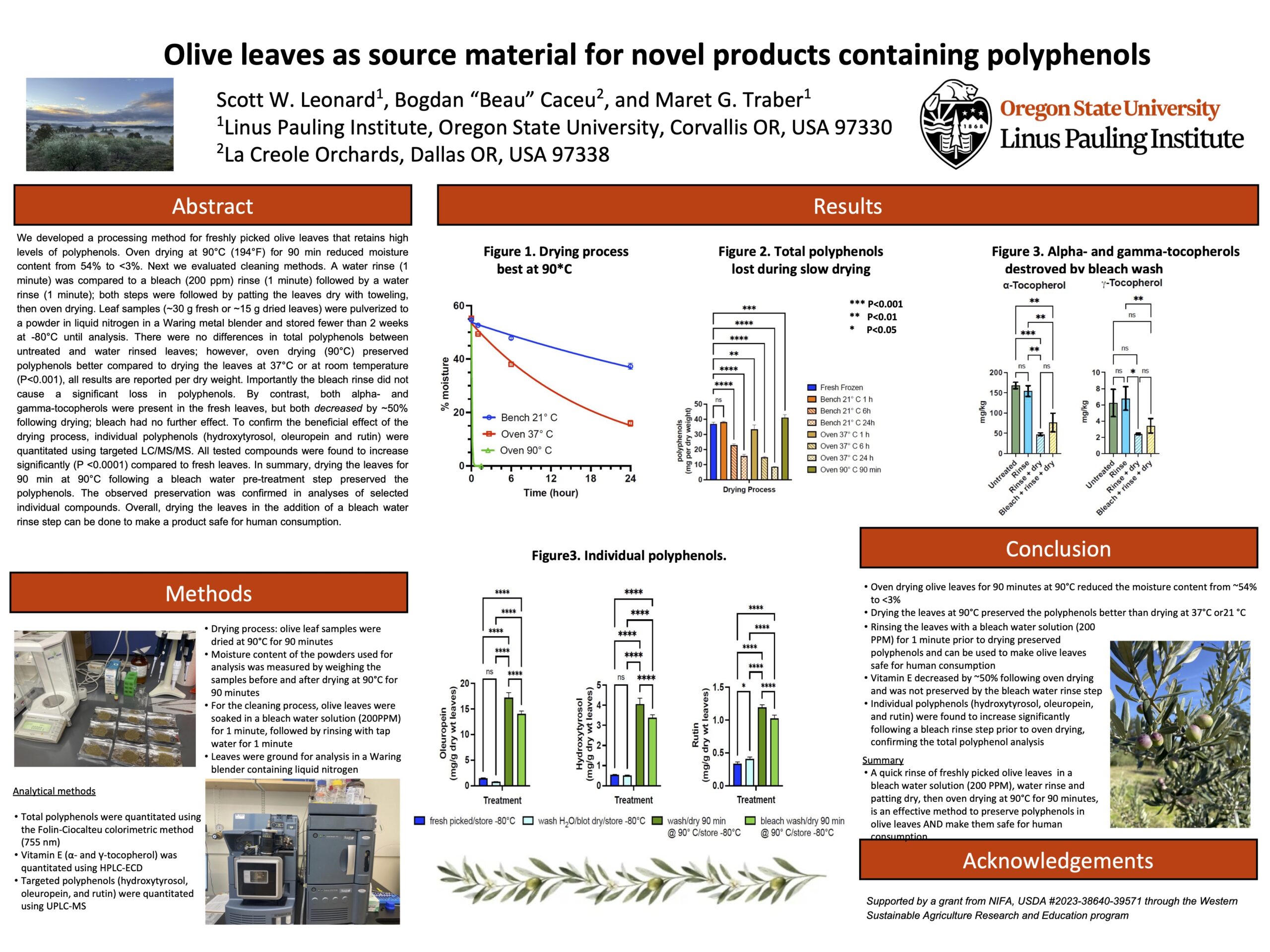
PI Caceu has also liaised with the olive growing community in order to spread the word about the project's results. First and foremost, PI Caceu has liaised with Kimberly Houlding, the President of the American Olive Oil Producers Association (AOOPA), the trade organization that represents 80% of U.S. olive growers. The project's results, in the form of a summary and the project's poster will be shared with the AOOPA constituency.
PI Caceu has also liaised with Heather Stoven of the Oregon State University Extension Service in order to include the project's poster at the upcoming Oregon Olive School day (June 5th, 2026) to be held at the North Willamette Research and Extension Center (NWREC), one of Oregon State University's research farms, which includes a one acre experimental olive orchard.
PI Caceu has also held private consultations with several leading olive growers in Oregon to provide them with a summary of the project's results.
PI Caceu has also disseminated the project's poster via social media (via the @oregonevoo channel on Instagram, a channel with over 1,300 followers, many of whom are olive growers).
PI Caceu has also reached out to specialized news media (Olive Oil Times, Capital Press) and general business news media contacts, to spread the word about the project's results and the idea upon which the project was predicated: that using a by-product of a farm practice (the annual pruning of olive trees) that is naturally rich in polyphenols in order to create a simple value-added product (OLP-HiP) that can be used in many food, beverage, or supplement products (and therefore has a large potential addressable market), is a smart and simple way to increase the economic sustainability of olive growing in the U.S.
- The project's results were detailed in a manuscript that was submitted for publication in Agricultural Environment and Sustainability, an open-source, peer-reviewed journal. We might submit this manuscript to other scientific journals.
- The project's results were summarized in a one-page poster that was presented at the Linus Pauling Day, an open house event that draws hundreds of academics, alumni, students, supporters and various other stakeholders.
- The project's poster has been disseminated to the olive growing community via AOOPA (the trade organization that represents 80% of olive growers in the U.S.) and via the Oregon State University Extension Service at its Oregon Olive School day.
- The project's poster has also been disseminated via social media (via the @oregonevoo channel on Instagram).
- The project's results have been disseminated in private communications and consultations with olive growers, and are being disseminated to the news media for an even broader outreach.
Education and Outreach Outcomes
Overall, the project has confirmed that it is indeed possible to use a simple process (washing with food grade bleach water, drying a lower temperatures for shorter lengths of time) to create an olive leaf powder high in polyphenols (OLP-HiP). This process is simple enough that it can be undertaken in any commercial kitchen by any olive grower. While this was a project focused on very technical research parameters, with research conducted by scientists at an academic institution (Linus Pauling Institute), which resulted in very technical results detailed in a very technical manuscript and a very technical poster, the next step that we recommend (and we are already undertaking by liaising with more general public or general business news media) is for a general public version of the results. More importantly, what we highly recommend is for stakeholders such as AOOPA (the trade organization that represents 80% of olive growers in the U.S.) and for the various state organizations (e.g., Olive Growers Council of California, or Oregon Olive Growers Association) and for the various state extension services to spread the word about the idea that predicated this research project: that it is possible to use a simple process to produce a simple product (OLP-HiP) that has high value because it is a shelf-stable store of polyphenols and that it has a large potential addressable market in that it can be used as an ingredient in many foods, beverages, or supplements. Beyond the technical research results in themselves, what this project has validated is that U.S. olive growers can extend their harvest season, add a new product to their product line, and therefore increase their economic sustainability. That is a message that deserves further education and outreach.
New product development: olive leaf powder high in polyphenols (OLP-HiP)