Final report for GNC24-397
Project Information
Project Title: Smart Grazing: A Web-based Solution for Pasture Management
The purpose of this project was to develop a web-based decision support tool that leverages automated image processing to accurately assess canopy cover and predict pasture forage mass. This project also aimed to facilitate knowledge outreach and adoption through a grazing school for producers and in-service training for extension educators. The proposed outreach programs serve as an educational platform, imparting novel insights into pasture management practices, elucidating its importance, and showcasing how a web-based solution can assist in this aspect.
From the forage samples collected in the field, forage canopy images were used for calculating canopy coverage in the backend of the web-based tool. A forage-specific regression curve was then developed between the canopy coverage and field-collected forage mass data. Subsequently, the developed regression equation was incorporated into the backend to streamline forage mass estimation for newly taken forage coverage images.
The project was initially designed to develop tools for both cereal rye and smooth bromegrass. However, during model development it became evident that canopy cover was not a reliable predictor of forage mass in smooth bromegrass. As a result, the finalized tool, Snap2Graze (available at http://go.unl.edu/snap2graze), was developed specifically for cereal rye pastures. Snap2Graze streamlines biomass assessment, enabling producers to make informed stocking decisions promptly.
A critical phase of the project involved soliciting producer feedback to ensure practical functionality and usability. Feedback was collected through a structured focus group and multiple outreach events, where producers participated in hands-on demonstrations and provided recommendations for improving the user interface and overall functionality.
In summary, by integrating field-collected images with automated processing and regression-based forage mass prediction, Snap2Graze provides a user-friendly method for estimating cereal rye forage mass. This supports more efficient grazing management decisions and contributes to improved productivity and sustainability of pasture-based livestock systems.
This project aimed to improve pasture management by providing education on core management principles and providing a robust and convenient tool to overcome the difficulty of assessing the amount of forage available for grazing. The goal was to empower cattle producers to improve pasture management and use the pasture more effectively. We developed a web-based tool, Snap2Graze (http://go.unl.edu/snap2graze), that allows cattle producers to easily estimate the amount of cereal rye forage in a field and assess appropriate carrying capacity. Learning outcomes included increased understanding of core pasture management concepts and knowledge on how to estimate forage mass, appropriate stocking rate and carrying capacity using the tool. Expected action outcomes included cattle producers making more informed and timely pasture management decisions thereby preventing both under and over grazing. Additionally, Nebraska Extension educators were trained to use and teach the software to producers, expanding the project's reach and providing a more significant impact on the agricultural community. We conducted surveys after educational training events to assess the participants’ perception of their knowledge gained.
Cooperators
Research
For this project, smooth bromegrass (Bromus inermis) and cereal rye (Secale cereale) were selected due to their agronomic relevance and widespread adoption in the North Central region of the United States, particularly across northern Iowa, Minnesota, Wisconsin, and eastern Nebraska. These species represent contrasting forage systems - perennial cool-season pasture (smooth bromegrass) and annual cool-season cover crop (cereal rye), allowing the methodology to be evaluated across different canopy structures and management contexts commonly encountered by producers in the north central region.
Forage mass data for both species were collected using a randomized destructive sampling approach, in which forage was clipped at ground level. For smooth bromegrass, samples were collected from three to eight locations per pasture, depending on pasture size and the expected spatial variability in forage mass. The smooth brome pastures ranged from 6 to 30 acres requiring a greater number of sampling points to adequately capture within-pasture heterogeneity. Within these sampling locations, a 2.7 ft² sampling frame was used to represent variable sward structure typical of perennial pastures. At the end of data collection, a total of 276 samples were collected.
For cereal rye, forage sampling was conducted at four random locations per pasture using a 6 ft² sampling frame. Given the cereal rye pastures' smaller sizes (approximately 2 acres each), fewer sampling locations were used. A total of 400 samples was collected for cereal rye pastures.
Imagery data were collected using a smartphone at a fixed height of 3 ft above the forage sampling area, immediately prior to clipping the forage to the ground. This height was selected to standardize the field of view across sampling events, minimize variation due to camera angle or distance, and ensure consistent canopy representation across both forage systems. Image acquisition immediately before clipping ensures that canopy conditions and the area captured in the imagery directly correspond to the harvested forage mass.
The collected images were used to estimate canopy cover through advanced image-processing techniques developed by Liang et al. (2018), resulting in estimate of forage coverage relative to the ground. Newly collected imagery is combined with an existing database of approximately 200 previously acquired images. Canopy cover estimates derived from image analysis were then correlated with forage mass data, which were dried in a forced-air oven to obtain dry matter yield to develop the relationship between the forage canopy cover and the forage mass.
Regression analyses were performed using SAS to quantify and model the relationship between canopy cover outputs and measured dry forage mass (dry matter basis). In smooth bromegrass, regression analysis between canopy cover and dry forage mass revealed a weak association with low predictive capability. Due to the poor model performance, additional analyses for smooth bromegrass were not conducted. For cereal rye, the complete dataset (n = 400) was randomly divided into a training dataset (80%, n = 320) and a validation dataset (20%, n = 80) to allow for independent equation development and evaluation. Using the training dataset, a second-order polynomial regression was fitted between canopy cover estimates generated from the image and the corresponding measured forage mass. This analysis was conducted using the PROC GLM procedure in SAS, and the resulting regression coefficients were used to generate forage mass prediction equations. The derived equations were subsequently applied to the canopy cover values in the validation dataset to calculate predicted forage mass (lb DM/ac). To evaluate model performance, the predicted forage mass values were then regressed against the measured forage mass values from the validation dataset using the PROC REG procedure in SAS. This linear regression analysis was used to assess the predictive accuracy and agreement between observed and predicted forage mass values.
When the full smooth bromegrass dataset was analyzed, the relationship between canopy cover derived from smartphone imagery and measured dry forage mass was weak (Figure 1). Combining all smooth bromegrass observations (n = 276) resulted in a low correlation coefficient (R² ~ 0.20), indicating poor correlation between the canopy coverage and forage mass. Given the primary objective of this project to reliably estimate forage mass using smartphone images in a rapid and user-friendly manner, this lack of correlation was considered insufficient and did not meet the intended purpose of the methodology.
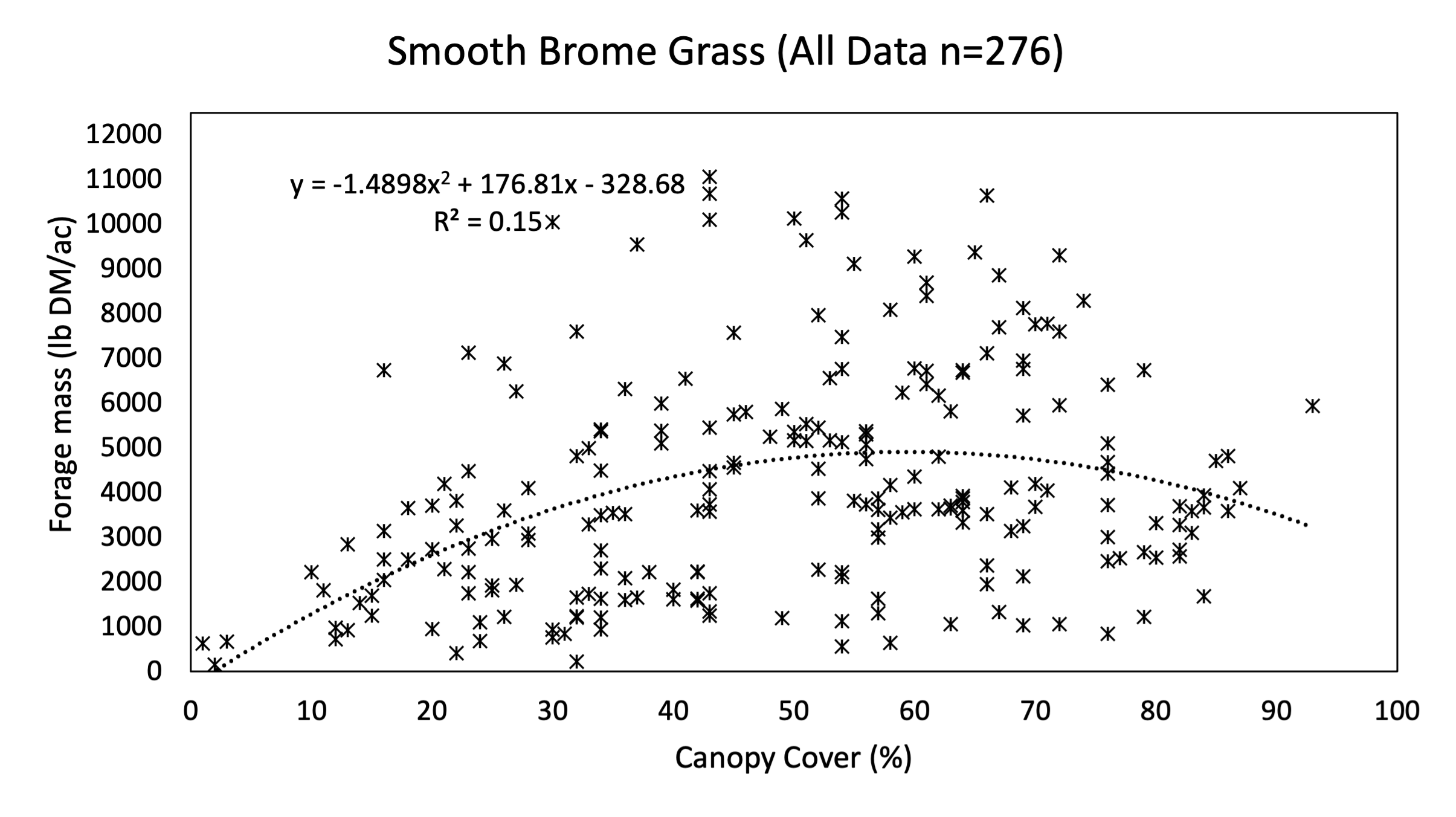
One potential explanation for the low performance observed in smooth bromegrass is related to its growth habit and canopy structure. As a perennial, well-established forage species, smooth bromegrass typically exhibits a dense sward with minimal exposed soil surface. Consequently, even under conditions of low forage mass (e.g., early regrowth or post-grazing), canopy cover remained high. This limited variability in canopy cover across a wide range of forage mass values likely reduced the ability of the image-based model to distinguish differences in canopy covers in relation to ground and the forage mass, resulting in poor correlation between the two variables.
In contrast, the image-based canopy cover approach performed substantially better for cereal rye, an annual forage crop established in rows and characterized by greater exposure of soil between plants. This structural characteristic allowed the imagery to capture meaningful variation in canopy cover relative to the soil background, improving the sensitivity of the model to changes in forage mass.
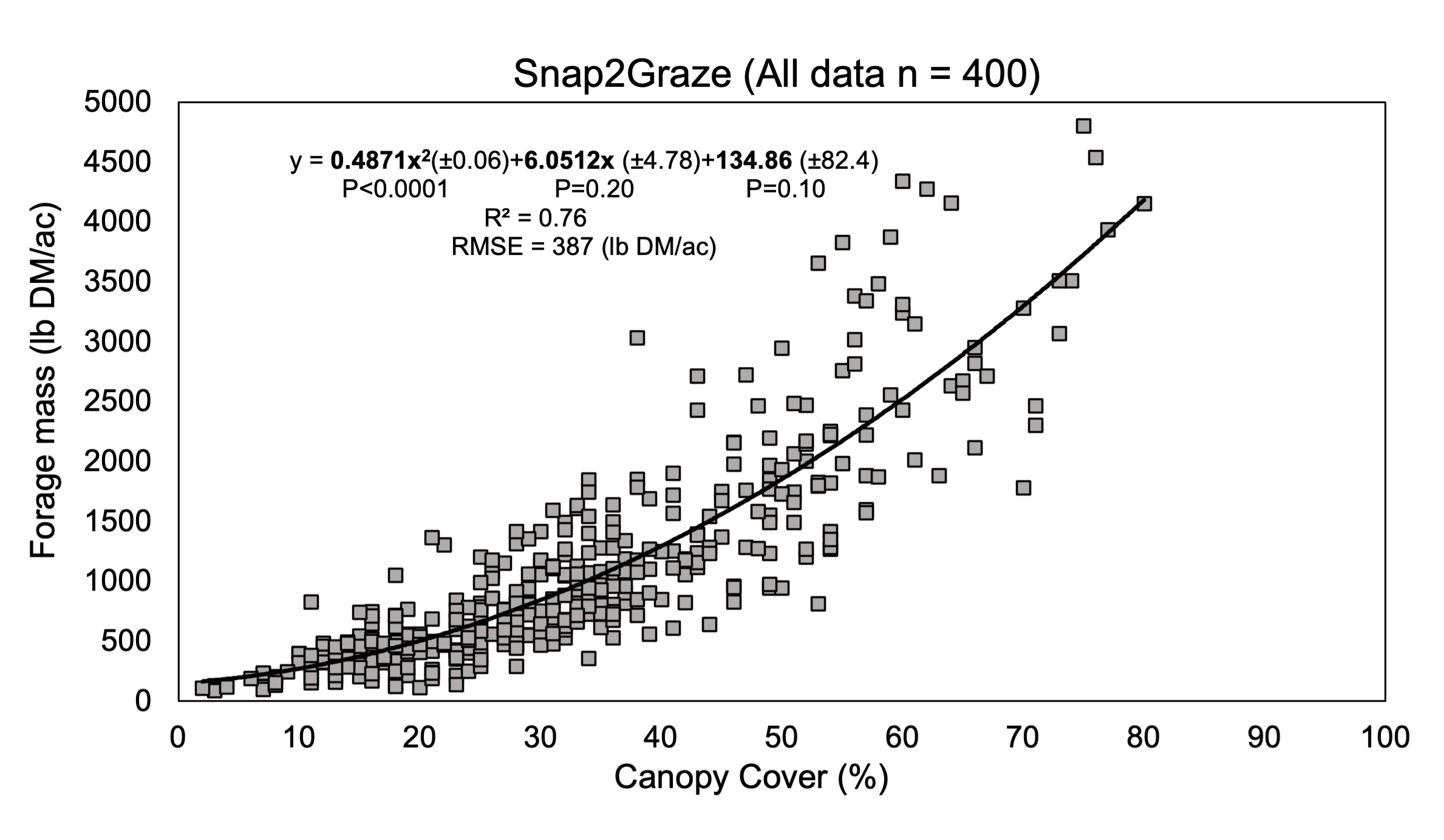
For cereal rye, the quadratic regression model developed using the combined dataset (n = 400) yielded a coefficient of determination (R²) of 0.76, with a root mean square error (RMSE) of 387 lb DM/ac. Using the training dataset, the quadratic equation maintained an R² value of 0.76, indicating a strong relationship between the canopy cover and the measured forage mass. When applied this equation to the validation dataset, the linear regression between measured forage mass and predicted forage mass resulted in an R² value of 0.78 and an RMSE of 362 lb DM/ac, demonstrating strong predictive performance and good agreement between observed and predicted values.
Conventional forage mass estimation methods based on plant height measurements are widely adopted due to their simplicity and ease of use. However, published literature generally reports moderate performance for height-based approaches, with correlations between plant height and forage mass averaging approximately 50% of explained variability. While practical, these methods often fail to fully capture differences in canopy density and spatial heterogeneity within a field. In contrast, the image-based canopy cover approach developed in this project explained up to 78% of the variability in cereal rye forage mass, outperforming commonly reported height-based methods. Importantly, this improvement was achieved using a rapid, non-destructive, and low-cost data acquisition process based solely on smartphone imagery, without the need for specialized equipment or extensive field measurements.
Based on the strong performance observed for cereal rye, we further integrate the image-processing algorithm housed in the team's research website’s backend into Snap2Graze (http://go.unl.edu/snap2graze) that enables smartphone-derived canopy cover estimates with forage mass prediction equations generated in this study. Through this web-based tool, users can obtain not only forage mass estimates, but also a suite of decision-support outputs, including carrying capacity, grazing days, required pasture area, and additional management metrics.
All outputs generated by the software are grounded in empirical relationships derived from field data collected and validated within this project. This integration of agronomic measurements with animal-based decision metrics highlights the potential of the approach to support practical forage and grazing management decisions, particularly for annual forage systems such as cereal rye.
Educational & Outreach Activities
Participation summary:
This project's education and outreach component was designed to translate research outcomes into practical, producer focused decision making tool and management strategies. Educational activities emphasized hands-on learning, and the application of science-based principles to real-world grazing systems. A key outcome of this project was the development Snap2Graze, a practical, research-based digital tool designed to assist producers in rapidly estimating forage availability and supporting timely, data-driven grazing decisions. To expand the reach of the Snap2Graze, we received feedback for the tool (beta-testing) and made changes based on this feedback. We also educated cattle producers on grazing management practices for cereal rye at multiple events.
A Grazing School was conducted on June 27th, 2025, to share the first version of the software for 7 producers and several extension educators. During the event, a questionnaire was conducted to assess the perceived value of the cereal rye management topic and the Snap2Graze tool, as well as its actionability for producers and extension educators seeking to advance grazing management. Producers provided valuable feedback and practical insights on how and where the software could be improved to enhance usability, applicability, and overall user experience. Among respondents, 83.4% indicated that Snap2Graze was valuable or very valuable, and 85.7% rated that cereal rye management topic and tool as actionable or very actionable. These responses suggest strong potential for behavior change, indicating that participants not only recognized the relevance of the tool but also felt equipped to apply it in real-world grazing management decisions.
In addition to the Grazing School, a Focus Group was conducted in which participants engaged directly with field demonstrations, hands-on training on how to use the tool, and guided discussions centered on improving pasture utilization, animal performance, and long-term pasture usage. Participants also provided feedback regarding the software's usability and suggested improvements to make it more user-friendly. We also asked what other functions/features producers would like to see added to the software. As a result, features such as clickable buttons, drop-down lists were added to facilitate the analysis process for producers and simplify the stocking rate calculations. The possibility of adding other small grains to the calculations was introduced, and the team is currently exploring the data previously collected.
Outreach efforts were further expanded through regional and national professional meetings, including the May Beef Group (Nebraska Extension event for educators, 20 participants), Midwest FEEDS Practicum (7 participants), ASAS Western and Southern Section Meetings (20), Nebraska Cover Crop Conference (37 participants), Nebraska Cattlemen’s Meeting (20 participants), North Dakota Cattlemen’s Meeting (70 participants), Nebraska Winter Stocker and Yearling Tour (30 participants), Three-State Beef Conference (108 participants), ISU Extension Forage Management Webinar (40 participants), the Midwest Cover Crops Council (20 participants) and Nebraska NRCS in-service training (30 participants) to integrate project concepts into broader cover crop and grazing education efforts. These events allowed for dissemination of project outcomes to diverse audiences ranging from producers and extension personnel to researchers and industry professionals, fostering dialogue and encouraging adoption of improved grazing and forage management practices as well as our tool.
In addition to in-person events, project findings are being communicated through multiple written and digital platforms. A peer-reviewed article was published to the Crop, Forage & Turfgrass Management journal, ensuring long-term accessibility of results within the scientific and extension communities. Extension-focused summaries and applied recommendations are also being shared through BeefWatch Newsletters and the Nebraska Beef Report, broadening reach to producers across the region. In addition, the Snap2Graze tool and the research effort was translated into articles in popular magazines, including Angus Beef Bulletin, Midwest Messenger/AgUpdate, and NCAT/ATTRA.
Collectively, these education and outreach activities ensure that project outcomes extend beyond research outputs, directly supporting producer learning, encouraging adoption of sustainable grazing practices, and strengthening the connection between research, extension, and on-farm application.
Project Outcomes
This project advanced agricultural sustainability by integrating applied pasture management education, producer engagement, and helping in decision making, technology into a single, producer centered software. Through pasture management field days, hands-on training on the software for forage sampling, and facilitated discussions, the project increased producers’ technical capacity to assess pasture conditions and make informed, data-driven grazing decisions. Rather than prescribing fixed management strategies, the project emphasized critical thinking, interpretation of field observations, and adaptive decision making grounded in forage and grazing principles.
From an economic standpoint, the project contributed to improved forage utilization efficiency and more timely management decisions. Via the web-tool, producers can be trained to accurately assess forage availability, reducing uncertainty in stocking rate and grazing timing decisions. The development and implementation of the Snap2Graze application provided a practical and scalable tool that enables rapid cereal rye pasture assessment and supports real-time management decisions. By improving alignment between forage supply and animal demand, the project has the potential to reduce supplemental feed costs, prevent overgrazing-related productivity losses, and enhance overall profitability of grazing-based systems.
In terms of environmental sustainability, the project reinforced the importance of pasture conservation, through pasture management. Educational activities focused on grazing school, plant growth dynamics, and grazing impacts on pasture persistence. These practices promote improved ground cover, reduced pasture degradation, and greater resilience of grazing lands to climatic variability.
The project also generated meaningful social outcomes by strengthening producer networks and fostering collaborative learning environments. Field days and focus group discussions encouraged producer to producer interaction, knowledge exchange, and collective problem-solving. These interactions created opportunities for brainstorming future projects and reinforced the role of shared experience in advancing sustainable grazing systems. Importantly, the project positioned producers not only as end users of technology, but as active contributors to the development and refinement of management tools such as Snap2Graze.
Overall, this project demonstrated that sustainable grazing systems are built through the integration of education, technology, and human connection. By combining technical training with accessible decision-support tools and intentional producer engagement, the project contributed to lasting improvements in economic viability, environmental stewardship, and social resilience within pasture-based livestock systems.
Throughout the course of this project, both the project team and the advisor gained a deeper and more understanding of pasture management as it is practiced in real-world production systems. Direct engagement with producers provided critical insight into the day-to-day realities they face, including time constraints, labor availability, economic pressure, and the need for management tools that are not only accurate, but also practical and efficient. This exposure reinforced that sustainability must be evaluated not only through biological or environmental metrics, but also through feasibility and adoption at the farm level.
The project highlighted important differences between concepts emphasized in academic settings and the complexity of on-farm decision-making. While university-based research often operates under controlled conditions and longer planning horizons, producers must make rapid decisions with incomplete or insufficient data and under variable environmental and market conditions. This contrast increased awareness of the need to translate scientific knowledge into tools and recommendations that align with producer workflows and management realities.
Engagement with producers representing diverse perspectives, goals, and operational scales broadened the project team’s understanding of how sustainability is perceived and prioritized across agricultural systems. Conversations revealed varying interests related to productivity, risk management. These interactions improved the team’s ability to listen, adapt communication strategies, and frame sustainability in ways that resonate with different producer motivations.
As a result, both the project lead and advisor strengthened their skills in applied outreach, participatory learning, and networking. The project increased awareness that effective sustainable agriculture research and extension must be iterative, collaborative, and grounded in producer experience.
Information Products
- Snap2Graze: User Guide
- Science Behind Snap2Graze
- Snap2Graze - Promotion Card
- Snap2Graze - UNL Beef Social Media Graphic
- Snap2Graze
- Assessing forage mass using smartphone imagery for cereal rye under grazing conditions in Nebraska
- Quantifying Cereal Rye Pastures Biomass with Image Analysis
- ASAS Abstract: Forage mass estimation of Cereal Rye in grazing systems using plant coverage analysis via smartphone images
- Snap2Graze: grazing cereal rye really can be that simple
- Web-based Decision Support Aids in Grazing Cereal Rye
- BeefWatch Podcast: Web-based Decision Support Aids in Grazing Cereal Rye
- Integrating Innovative Sensing and Ground Measurements for Forage Mass Estimation in Rye Pasture
- Turn What You See Into Objective Grazing Decisions Snap2Graze: Turning cereal rye pasture photos into grazing decisions.