Final report for OS23-165
Project Information
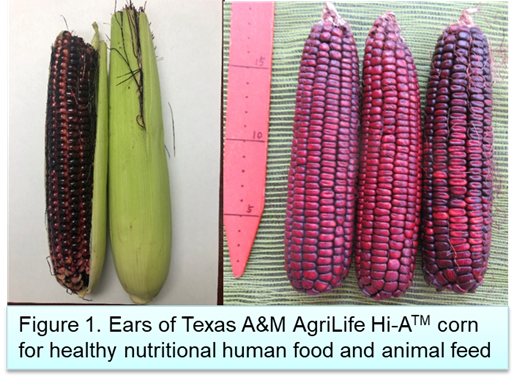 The Texas A&M AgriLife corn breeding program in Lubbock focuses on developing superior corn inbred lines and hybrids with improved drought and heat tolerance, aflatoxin and fumonisin resistance, nutritional values, and yield potential. One type of our new pipelines is the Hi-A™ corn that have black or dark red kernels and contain high anthocyanin and high-antioxidants and these hybrids are well adapted to the Texas environments (Fig. 1). In addition, their cobs have 100 times more anthocyanins than conventional corn. Therefore, our Hi-A™ corn hybrids can produce healthy human food (such as black or red corn ears, large kernels, and colored flours) and of course animal feed. These high-value specialty corn will become a new source of food and feed and a new tool to generate income.
The objective of this project is to conduct on-farm research and demonstrate the value of growing specialty Hi-A corn as a new source of high-value heathy food for humans and a nutritional feed for animals. Development of a commercial corn hybrid may take 10 years and involve two major steps: (a) develop superior inbred lines with desirable traits, (b) make a number of experimental hybrids by cross two inbred lines, (c) test the experimental hybrids in multiple environments for a few years and advance the best one for commercial production. Each step may take up to 5 years. With the funding from The Texas Corn Producers Board and the High Plains Underground Water Conservation District, we have reached the final stage of development with a new generation superior Hi-A™ corn hybrids that have acceptable quality for fresh produce market, human health benefits and good yields. Now that these High A hybrids are developed, this SARE grant will fund a system for integrating and establishing this technology on many small farms and ranches.
This project will lead to the adoption of unique high-value Hi-A corn hybrids along with the best management practices for producing highly nutritional human food and animal feed. This new genetic technology can allow producers to generate income in small areas and help concentrate limited irrigation resources, conserve water resources, and reduce production risks.
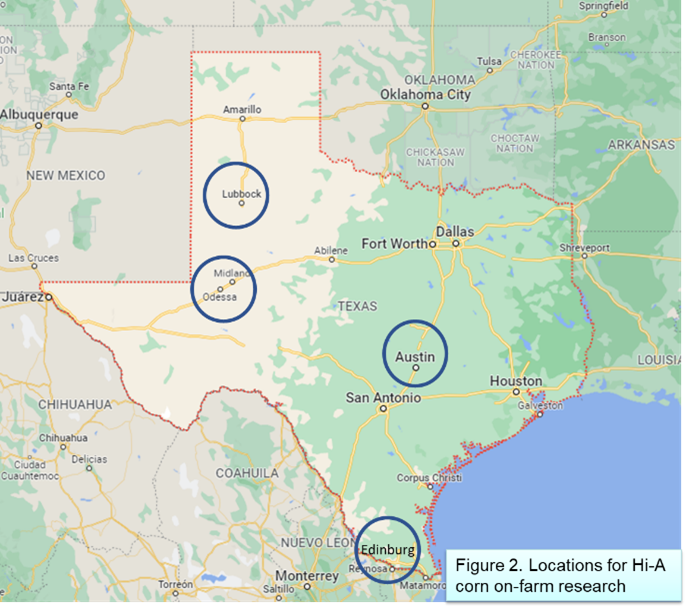 Field experiments: We will grow and evaluate the performance of two Hi-A™ corn hybrids TAMZ102 and TAMZ104 under two plant populations on farmer’s fields in four locations from north to south Texas (Lubbock, Odessa, Austin, and Edinburgh) as shown in Figure 2. These four locations represent major metropolitans and agriculture regions in Texas, have very diverse environments, and have a strong market for fresh corn. The Permian Basin has the greatest concentration of sheep and goat production. If our Hi-A corn-small ruminant systems works, then small ruminants could possibly be brought into those other areas and/or operations expanded.
The experiment will use a split-plot design with three replications. The main plot is the plant populations, medium at 20,000 plants per acre and high at 25,000 plants per acre in order to determine which is the best hybrid-plant population combination for a specific farm. The sub-plot is hybrids. Each plot will be two-row, 20-ft long and 30-in row spacing. Detailed records will be recorded on all farming inputs (such as fertilizers, hours for field operation, irrigation), rainfall, number of plants per plot, pollen shedding and silking dates, plant and ear heights. All ears from 10-competitive plants will be harvested 30 days after silking, weighed, and rated for corn ear worm feeding damage, ear length, and overall quality. Fresh ears with husks will be cooked in a microwave for 5-min and tasted by the farm cooperators and their customers. The remaining ears will be sold as premium products by farmers. The total ears and unit price will be recorded to calculate the gross income and compare the profits of growing Hi-A corn with other vegetables.
Texas is the number one producer and exporter of goats and sheep in the United States. Our project will evaluate integrating Hi-A corn and sheep production that could lead to a tremendous economic benefit for producers. Hi-A corn ears are harvested 30 days after pollination (one month earlier than for grain), leaving plants that are still green. This plant material is usually “wasted” and may even create problems for producers to shred the stalks. This residue may represent about 16,000 lb/ac fresh biomass or 5,600 lb. of dry matter that could be available as feed for small ruminants (e.g. sheep). A 70-lb lamb can consume approximately 2.5 lb. of feed per day on a dry matter basis. Thus, one acre of corn residue is sufficient to feed 100 lambs for 22 days.
The seeds of the Hi-A hybrids for farmers to grow are currently not available commercially. The PI and his staff will increase the seeds of the parent lines for the hybrids and produce the hybrid seeds through hand pollination and by using isolation seed production field. We are working closely with seed companies to commercialize the germplasm developed by our corn breeding program. B-H Genetics, a family-owned regional seed company in Texas, is very interested in licensing the parent lines of the Hi-A hybrids TAMZ102 and TAMZ104 from Teas A&M University and market the hybrids in the U.S.
The project collaborators, Mr. Steve Paz and Ms. Kate Whitney from Texas A&M AgriLife Extension, will use the Hi-A corn fields at Austin and Odessa for their 4-H Youth and healthy-living extension programs. The research fields and products (fresh Hi-A corn ears) can provide educational opportunities to urban 4-H Youth, Master Gardeners and the general public who can come and learn how to plant and grow corn. Several meetings will be utilized to demonstrate the growth and production. Youth members will be educated in selection maturity of corn to market at the farmer’s market. Members will learn basic agronomy and livestock nutrition utilizing the corn stalk for feed.
Cooperators
- - Producer
- - Producer
- - Producer
- - Producer
Research
Figure 1 Hi-A-Test Sites On-farm research is a core component of this project, alongside extension education and technology transfer. Trials with Hi-A™ corn hybrids TAMZ102 and TAMZ104 were conducted under two plant populations at four Texas locations: Lubbock, Odessa, Austin, and Edinburgh—key metropolitan and agricultural regions with diverse environments and strong fresh corn markets (Figure 1). The Permian Basin is notable for sheep and goat production.
The experiment used a split-plot design with three replications: main plots tested medium and high plant populations, and sub-plots tested hybrids. Each two-row plot measured 20 feet long with 30-inch spacing. All farming inputs, rainfall, plant counts, pollen and silking dates, plant and ear heights were recorded. Data included plant counts per 10-ft plot, pollen/silking dates, plant/ear height, root and stalk lodging, ear weight, and ear number; four stalks per plot were also weighed post-harvest. Fresh ears were evaluated for quality by microwave tasting with farm cooperators and customers.
Additionally, significant quantities of Hi-A hybrid seeds were produced, and large-plot strip tests (minimum 0.5–1.0 acre per hybrid) were performed in other farmers' fields.
Field experiments indicated that Hi-A corn hybrids exhibited wide adaptability throughout Texas, including regions such as the Texas High Plains, central Texas, and Rio Grande Valley (Figure 1). The hybrids demonstrated robust growth and successful pollination. Due to labor shortages during peak crop seasons, plant populations were maintained at original planting densities without thinning.
Variation in plant populations at both locations was attributed to differing soil conditions. At Edinburg, average population densities were 18,005 and 30,206 plants per acre for TAMZ102 and TAMZ104, respectively; at Granger, these figures were 32,525 and 30,202 plants per acre. TAMZ102 consistently produced taller plants and higher ear placement compared to TAMZ104, measuring 231 cm versus 219 cm in height, and 71 cm versus 68.4 cm in ear placement across both sites. Both hybrids tended to develop two ears per plant under reduced stand densities. Average ear counts reached 330,782 per acre for both hybrids, with fresh ear weights of 5,148 kg/ac for TAMZ102 and 5,544 kg/ac for TAMZ104. Fresh stalk biomass totaled 6,697.4 kg/ac for TAMZ102 and 7,947.4 kg/ac for TAMZ104 (Table 1).
Consistent with expectations, both plant growth and yield were greater at the Granger site than at Edinburg (Table 1). Specifically, Granger produced approximately 30,782 ears per acre, alongside higher fresh ear weight (6,600 vs. 4,092 kg/ac) and stalk biomass (8,501 vs. 6,143 kg/ac) when compared to Edinburg (Table 2).
Educational & Outreach Activities
Participation summary:
We organized plot tours for producers, seed companies, and policymakers. Major field days in Austin (2023) and Lubbock (2025) demonstrated Hi-A corn’s health benefits and its promise for sustainable production and water conservation with less land and irrigation from the Ogallala Aquifer. Our research was presented to USDA and HHS leaders, and we provided workshops and webinars for advisors and consultants.
Co-PI Whitney presented this project and its technology at various field days and workshops as part of his statewide organic agriculture extension program.
Learning Outcomes
Nutritional and healthy food, high-value crop, water conservation, new Hi-A corn hybrids.
Project Outcomes
The Hi-A corn hybrids, noted for their elevated antioxidant content, are capable of producing high-value food and feed products that support both human and animal health. TAMZ102 is suitable for fresh ear consumption as well as for grain used in tortilla production. While there is considerable interest among farmers in cultivating these corn varieties, seed availability remains limited. A number of animal scientists are initiating collaborative research projects to evaluate the effects of Hi-A corn in cattle and sheep feeding studies. Additionally, two seed companies are currently seeking licenses from the Texas A&M University System to commercialize these Hi-A corn hybrids.
Referred publication:
Trevor D. Johnson, Donna Mitchell-McCallister, and Wenwei Xu. 2023. Consumer Preference Regarding a New Corn Variety: A Willingness to Pay Study. Journal of Food Distribution Research. Volume 55, Issue 2, pp. 46–64
Technical publication:
Wenwei Xu, Morgan Molsbee, Thomas Marek, Dana Porter, Bob Whitney, Kate Hajda, Steve Paz. 2023. TAMZ102 - A Specialty Hi-A Corn with High Anthocyanins and High Antioxidants for Producing High-value and Nutritious Fresh Produce, Grain and Silage. Texas A&M AgriLife Research and Extension-Lubbock Center Technical Report No. 23-2.
Other new articles:
More support is needed to help small-scale farmers adopt this technology, especially for fresh ear crops. While consumer demand for fresh ears is strong, many small organic growers lack mechanical ear pickers. One solution could be assisting a farmer to buy an ear picker (around $85,000) for custom harvesting within a Hi-A corn production cooperative.