Final report for YENC24-225
Project Information
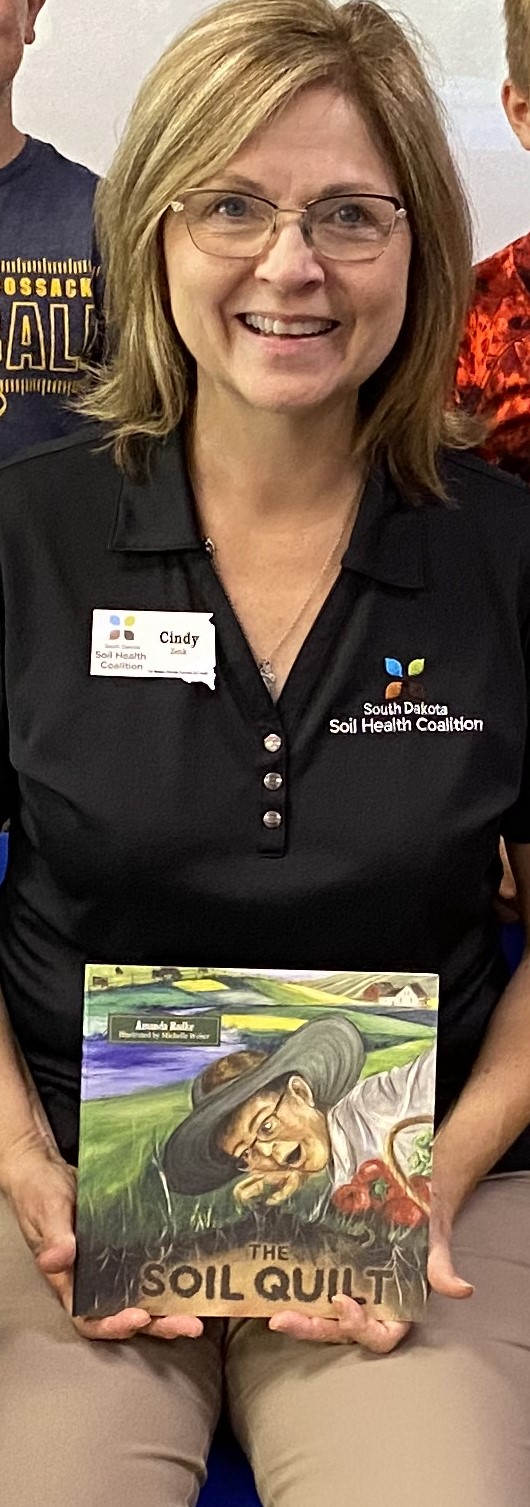
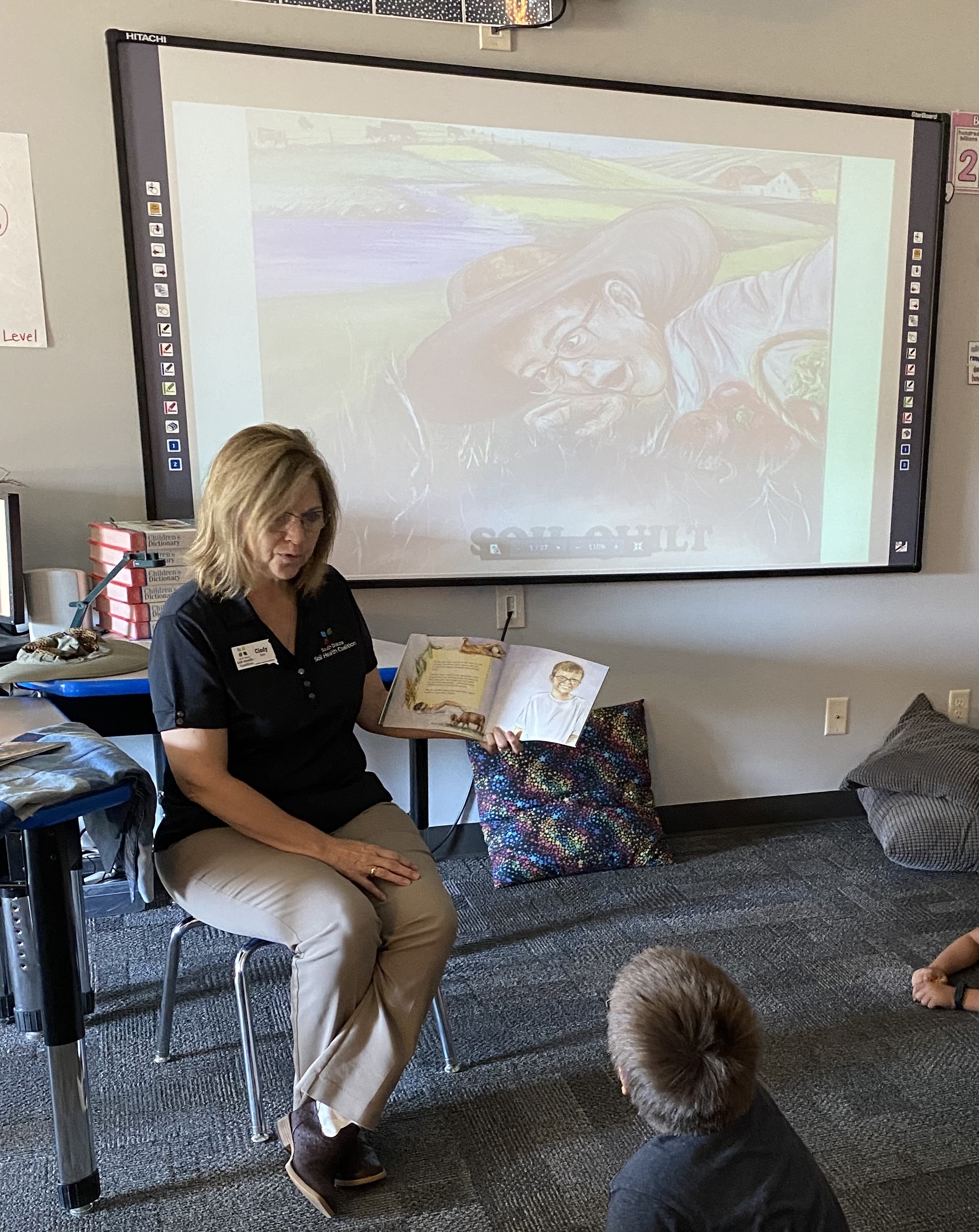
The SDSHC has coordinated the creation of a storybook titled “The Soil Quilt”, developed to introduce children to soil health practices and ways to increase sustainability. There is a documented need for accurate agricultural educational materials like this and this project will greatly amplify its impact. Books have been distributed to elementary libraries for students across the state with continuing education and training provided to teachers interested in utilizing them in their classrooms. Additionally in person read along events were hosted by farmers/ranchers accompanied by conservation professionals, allowing students to learn about various career opportunities. Details about our project are available at:
By distributing the storybook to elementary schools in South Dakota and informing educators and parents, SDSHC will accomplish the following objectives:
- Increase the number of elementary age youth who are exposed to and familiar with soil health and sustainable agricultural practices.
- Increase the knowledge of educators that can then incorporate these concepts into future class curriculum, enduring beyond the project.
- Increase exposure to industry related careers through interactions with farmers/ranchers and conservation professionals.
- Increase the conservation mindset of youth who will be future leaders and contributors in South Dakota communities.
Educational & Outreach Activities
Participation summary:
South Dakota Soil Health Coalition originally emailed six hundred and sixty eight third, fourth and fifth grade teachers describing the Soil Quilt Read Along project. We received twenty responses interested in the book readings. Currently fifteen classroom reading are completed reaching four hundred twenty nine students far out reaching our goal of readings.
Communication with the teachers is essential as well as flexibility due to unforeseen circumstances such as an unscheduled fire alarm practice and sick teacher which changed dates or times. Prior to the reading all teachers received the pre-survey for the students and a PowerPoint with the pages of the book to ensure all students participation. Another email for school protocols for visitors, including doors to enter and any special classroom needs a week before the reading. Appreciation goes along way with educators so always remember sending thank you to the classrooms and teachers. The day after the book reading a post reading survey link emailed and if needed a follow up email to ensure completion.
Learning Outcomes
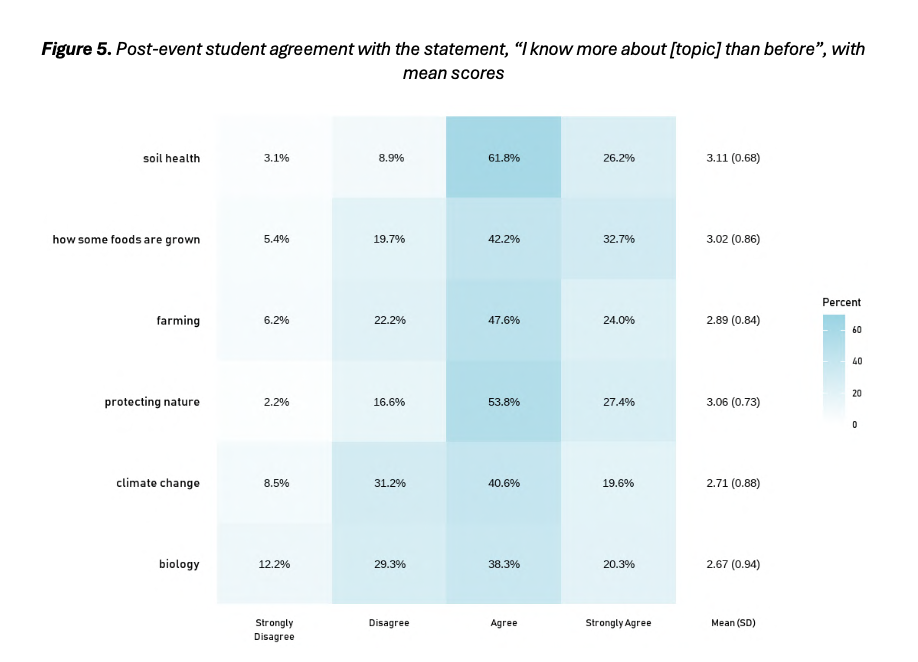
In the post-event survey, we also asked students to rank how they percieved their own improvements in knowledge. For all topics, over 60% of students either agreed or strongly agreed with the statement:
“I know more about [topic] than before.”
Details about our evaluation are below.
Overall, the reading events had a substantial positive impact on student confidence, an effect much larger than that on interest levels and demonstrated knowledge. For all tests performed, there were large, statistically significant effect size estimates, indicating a real, non-random change in perceived knowledge pre- to post- event.
The Dust Bowl, Soil Cover, and Soil Health topics had the greatest increase in perceived knowledge levels following the read-along event, while Agronomy, Infiltration, and Sustainability remained relatively low-scoring. This suggests that it might be beneficial to supplement with additional classroom activities targeted on the latter subject areas.
South Dakota Soil Health Coalition created a website to share the knowledge and results from this project. Utilizing the link above you are able to see the outcomes with the students, teachers and schools. Our goal is to revisit and continue to impact the youth in a variety of ways with sustainable agriculture.
Details about evaluation:
Three different surveys were administered online via SurveyMonkey including a Student PRE-survey, Student POST-survey, and Teacher survey. Printable versions were also developed and made available, but none of the participating teachers opted for these versions. The student surveys assessed three outcomes: perceived knowledge (PK) levels, interest levels (IL), and demonstrated knowledge (DK). PK and IL questions had a 4-point Likert scale from “Not at all…” (= score of 1), “Somewhat…” (= score of 2), “Knowledgeable/Interested” (= score of 3), and “Very…” (= score of 4) for various agricultural and environmental topics introduced in the storybook. DK was assessed with a 10-point “quiz” that included a mix of multiple choice and true/false questions based on content from the book. The maximum total PK score (answering “Very…” for all topics) was 52 points and the maximum total IL score was 24 points. The student pre- and post- surveys were identical except one additional perceived knowledge improvement question in the post-event survey. The goal of the teacher survey was to understand the needs and confidence of teachers regarding educating on topics within the book, gauge interest and availability for workshops, and understand how they perceive student interest and knowledge levels.
To introduce children to soil health practices and concepts related to sustainability, the South Dakota Soil Health Coalition (SDSHC) coordinated the creation of a storybook titled “The Soil Quilt”, written by Amanda Radke and illustrated by Michelle Weber. Centered around the storybook, the SDSHC collaborated with 3rd-, 4th-, and 5th-grade educators across South Dakota to support classroom activities and conducted in-person read-along events hosted by farmers, ranchers, and conservation professionals. The primary goal of the project was to increase student understanding of the role healthy soil plays in providing our food, shaping our landscape, and sustaining our communities. Nearly 700 educators across the state were contacted, approximately 20 expressed interest and were recruited for the project. 13 events were held at 11 different schools, impacting over 350 total students.
The Soil Quilt book was read and discussed with each classroom. Included in the book is a hands-on demonstration which could be used as well. Classrooms varied by the number of students, setting and ability to do both the reading and the demonstration, but shared the resource with the teachers.
Future work will include coordinating educational workshops for teachers centered around utilizing The Soil Quilt book for additional classroom activities, lesson plans, and learning activities, not only for reading and science-related outcomes, but also for subjects such as math, history, and social studies. Additionally, we will work to create pre-made lesson plans, interactive activities, and digital resources on subject matter from the book for instructors to utilize in their classrooms. We also would like to investigate ways we can increase interest in soil health, agricultural, and sustainability-related topics among students. Already, the book read alongs are inspiring additional classroom learning:
Class activities
• 30% did additional classroom lessons about The Soil Quilt book
• 15% did the Edible Infiltration activity
• 21% did classroom lessons about farming, sustainability, and/or soil health
It is important to acknowledge that there is no significant correlation between the total number of classroom activities (the reading event in addition to other lessons, activities, projects etc.) and any of the post-survey quiz scores, total correct, or change in total score correct.
This study provides important insight and advances our goal to help increase youth understanding of the role healthy soil plays in providing our food, shaping our landscape, and sustaining our communities, especially through narrative, story-based tools like The Soil Quilt. In this study, we evaluated student perceived knowledge, interest, and demonstrated knowledge levels related to soil health and agricultural topics found in The Soil Quilt storybook, as well as assessed teacher perceptions and needs. Primarily, we found that after holding reading events centered around the book, student confidence in their knowledge about the agricultural, soil health, and sustainability-related topics substantially improved, and their ability to demonstrate knowledge through a quiz on content in the book improved moderately.
The most predictive factor of post-event demonstrated knowledge quiz scores was total post-event student confidence in the topics, although students who demonstrated having prior knowledge of the topics covered in the book were more likely to succeed in demonstrating higher knowledge about the topics after reading the book as well, suggesting the storybook can be helpful for reinforcing concepts.
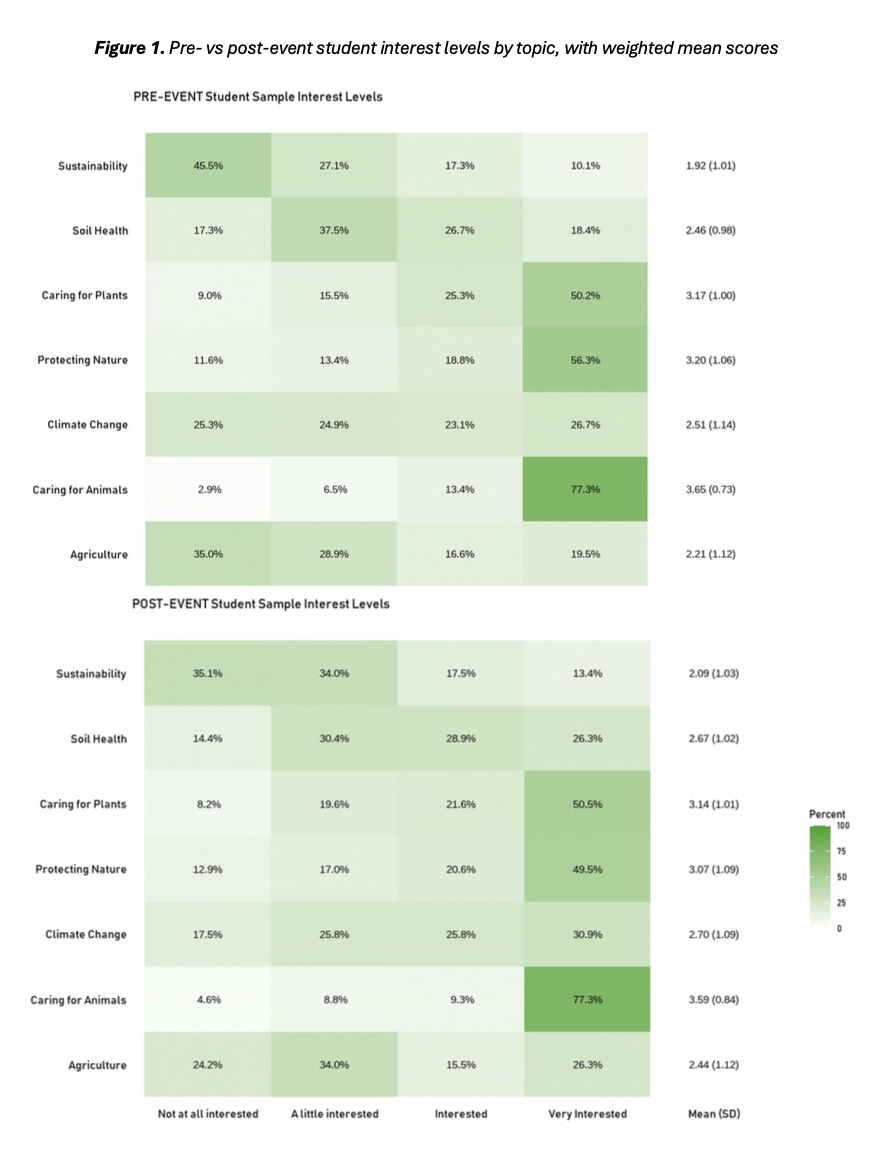
Both pre and post, Sustainability and Agriculture have the least amount of interest, while Caring for Animals and Plants and Protecting Nature have the most amount of interest. Overall, the reading event appears to have little to no real effect on student interest levels. This prompts future investigation into several questions: How can we improve interest levels in soil health and agricultural topics? Should we intervene earlier with sustainable agriculture content? Can we build on students' interest in Caring for Animals and Plants and Protecting Nature?
This table shows the percentage of all students post-event who answered with the given level of agreement based on the statement, “I know more about [topic] than before.” For all topics, the large majority of students either agree or strongly agree. The statement “I know more about soil health than before” had the highest average level of agreement out of the topics asked about:
Based on the results of the study, we recommend increasing education efforts on sustainability, soil health, organic matter, microorganisms, infiltration, conservation districts, carbon, agronomy, and erosion. For improving teaching confidence, sustainability, protecting nature (conservation), and climate change are subject areas that could be focused on. We also must highlight the importance of ensuring students feel confident in their understanding of these topics and increase efforts to expose them to the concepts early on in their education to foster a sense of familiarity that can be reinforced through classroom lessons and activities.
Project Outcomes
Based on the results of the teacher and student perceptions of knowledge levels, it may be beneficial to increase education efforts on tilling, wetlands, sustainability, soil health, organic matter, microorganisms, infiltration, conservation districts, carbon, agronomy, and erosion. For improving teaching confidence, sustainability, protecting nature (conservation), and climate change are subject areas that could be focused on. Lastly, student knowledge outcomes do not appear to depend on teacher perceptions, and instead likely are largely influenced by self-perceptions, the reading event itself, and other environmental factors not considered in this study.